

For years, the business world treated intelligence as a single number. Hire the smartest person in the room, promote the sharpest analyst, put the highest-scoring candidate in charge, and the results would follow. That formula worked for a while, but it never told the whole story.
Walk into any company that is struggling with high turnover, low morale, or leadership that people don’t trust, and you will rarely find a shortage of technical talent. You will find a shortage of self-awareness, empathy, and the ability to manage people through pressure. That gap has a name, and it has quietly become one of the most valuable assets a business can build: emotional intelligence in business.
As artificial intelligence takes over more technical and repetitive tasks, the human skills that AI cannot replicate are becoming more valuable, not less. Machines can process data faster than any person alive, but they cannot read a room, defuse a tense negotiation, or make an anxious employee feel heard. That is still, and will remain, a human job. This is why emotional intelligence in business has moved from a “soft skill” footnote to a core leadership requirement, and why entrepreneurs who ignore it are leaving real performance on the table.
This is not a case for abandoning strategy, systems, or technical skill. Those still matter enormously. It is a case for treating emotional intelligence as a core business leadership skill that sits alongside them, not beneath them, especially for entrepreneurs who are responsible for hiring, managing, and retaining people through growth, setbacks, and everything in between.
This article breaks down what emotional intelligence actually is, why it functions as a genuine competitive advantage, how it compares to IQ, what low EQ looks like in a business setting, and the practical habits that help entrepreneurs build this skill over time.
What Is Emotional Intelligence?
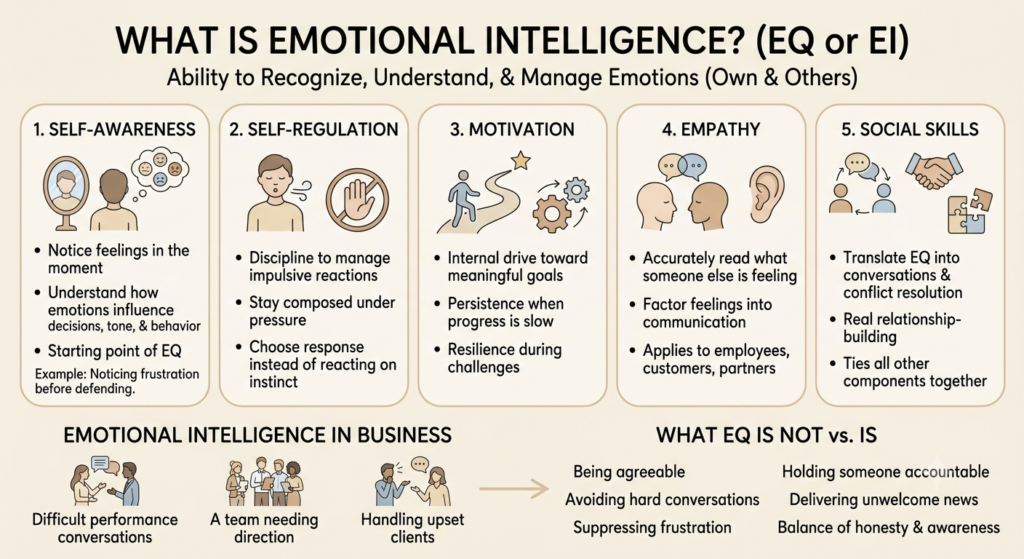
Emotional intelligence, often shortened to EQ or EI, is the ability to recognize, understand, and manage your own emotions while also recognizing and responding appropriately to the emotions of the people around you. It was popularized by psychologist Daniel Goleman, whose framework broke the concept down into five components that still shape leadership training programs today.
Self-awareness is the starting point. It is the ability to notice what you are feeling in the moment and understand how those emotions influence your decisions, your tone, and your behavior toward others. A self-aware founder notices the flash of frustration in a tense investor call before it turns into a defensive response.
Self-regulation is what happens after that awareness. It is the discipline to manage impulsive reactions, stay composed under pressure, and choose a response instead of reacting on instinct.
Motivation, in Goleman’s framework, is not enthusiasm or positivity. It is an internal drive toward meaningful goals that persists even when progress is slow, funding is tight, or a launch does not go as planned.
Empathy is the ability to accurately read what someone else is feeling and to factor that into how you communicate with them. This applies to employees, customers, partners, and investors alike.
Social skills tie the other four together. This is where self-awareness, regulation, motivation, and empathy get translated into real conversations, real conflict resolution, and real relationship-building.
Every one of these five components shows up constantly in business, whether it is a difficult performance conversation, a client who is upset about a missed deadline, or a team that needs direction during a rocky quarter. None of them require a particular personality type. They are learnable skills, which is exactly why they matter so much for entrepreneurs willing to work on them.
It also helps to understand what emotional intelligence is not. It is not about being agreeable, avoiding hard conversations, or suppressing frustration behind a calm exterior. A leader can be emotionally intelligent and still hold someone accountable, deliver unwelcome news, or make an unpopular call. The difference is in how that message gets delivered and how much thought goes into its emotional impact beforehand. This balance of honesty and awareness is quickly becoming one of the most sought-after business leadership skills in hiring and promotion decisions.
The Real Value of Emotional Intelligence in Business
Technical skill and industry knowledge will always matter. But they are increasingly the entry point, not the differentiator. What separates a founder who scales a resilient company from one who burns out their team is usually not intellectual horsepower. It is how they handle people, pressure, and uncertainty.
Recent research backs this up in a way that is hard to dismiss. In a survey of entrepreneurs, roughly 95 percent said that emotional intelligence in leadership matters more than IQ, and 59 percent of employers now say they will not hire a candidate who shows high IQ but low EQ. Leadership studies consistently link stronger EQ to lower turnover, higher engagement, and better financial performance, which is exactly why emotional intelligence in business now sits at the center of serious executive conversations rather than at the margins.
Here is what that advantage looks like in practice, broken down by the areas where it matters most.
Better Decision-Making Under Pressure
Every entrepreneur eventually faces a decision that has to be made fast, with incomplete information, while emotions are running high. Cash flow gets tight. A key employee quits without notice. A major client threatens to walk. In these moments, the instinct to react emotionally is strong, and it is usually the wrong instinct.
Leaders with strong self-regulation are able to separate the emotional charge of a situation from the decision itself. That does not mean suppressing emotion. It means noticing it, naming it internally, and then choosing a response based on facts and long-term consequences rather than short-term anxiety or anger. This is one of the clearest ways emotional intelligence for leaders shows up day to day: the ability to stay level-headed precisely when everyone else in the room is not.
Over time, this creates a compounding advantage. Teams learn they can bring hard problems to a leader who will respond calmly rather than react emotionally, which means problems get surfaced earlier, before they become crises.
Consider two founders facing the same problem: a major client threatening to cancel a contract over a missed deadline. A leader with poor self-regulation might fire off a defensive email, blame the team publicly, or make a rushed concession just to end the discomfort of the conversation. A leader with strong emotional intelligence pauses, gets the full picture, acknowledges the client’s frustration directly, and responds with a plan rather than a reaction. The second approach almost always produces a better outcome, not because the underlying problem was different, but because the response was managed instead of reactive.
Stronger Leadership That Builds Trust
Employees do not follow titles. They follow people they trust, and trust is built through consistency, honesty, and the sense that a leader actually understands what they are dealing with.
Emotionally intelligent leaders tend to communicate more authentically. They acknowledge hard truths instead of spinning them, admit mistakes instead of deflecting, and create what organizational psychologists call psychological safety, an environment where people feel safe raising concerns, admitting errors, or disagreeing without fear of retaliation.
This directly affects how leadership development programs are being redesigned. Where older models trained managers to project confidence and authority above all else, current programs increasingly treat emotional regulation and honest, empathetic communication as a named leadership competency rather than a personality trait some people happen to have.
Trust also compounds in a way that is easy to underestimate. A team that trusts its leader is more willing to flag problems early, admit mistakes without hiding them, and put in discretionary effort during difficult stretches. A team that does not trust its leader tends to manage upward instead of managing outcomes, spending energy protecting itself rather than solving problems. Over a year or two, that difference shows up directly in execution speed and quality.
Improved Team Performance
Teams led by emotionally intelligent managers consistently report better collaboration and lower internal conflict. This is not a coincidence. When a leader models active listening and treats disagreements as problems to solve together rather than battles to win, that behavior spreads through the team.
Employees who work under empathetic leadership report meaningfully higher engagement and creativity, because they are not spending energy managing anxiety about how their manager will react to bad news or new ideas. That energy gets redirected into actual work.
There is also a retention angle that matters enormously for small and growing businesses. Replacing an employee is expensive and disruptive, and organizations that invest in emotional intelligence training report significantly lower turnover as a direct result. For an entrepreneur running lean, keeping good people is often more valuable than finding new ones.
Workplace communication is where most of this plays out in practice. Meetings run more efficiently when people feel comfortable disagreeing openly instead of nodding along and raising concerns later. Feedback lands better when it is delivered with genuine care rather than as a checklist item. None of this requires a dramatic culture overhaul. It usually starts with one leader modeling better listening and better regulation, and the rest of the team following that example over time.
More Effective Customer Relationships
Emotional intelligence in business is not confined to internal leadership. It shows up just as powerfully in how a company treats its customers.
Customers can tell the difference between a business that is trying to close a transaction and one that is genuinely trying to solve their problem. Sales and support professionals with strong emotional intelligence are better at detecting frustration behind polite language, acknowledging it directly, and responding in a way that de-escalates tension instead of triggering more of it.
This matters more than most founders realize, because a large share of customers say they will switch to a competitor after a single bad experience, while many others say they will forgive a mistake entirely if the service that follows makes them feel heard and respected. Empathy, active listening, and genuine concern for the customer’s actual problem, not just the ticket in front of you, are what turn a one-time buyer into a repeat customer who refers others.
Better Conflict Resolution
Conflict is not optional in any business. Two team members will disagree about priorities. A vendor will miss a deadline. A customer will escalate a complaint. What separates a healthy business from a toxic one is not the absence of conflict, but how it gets handled.
Leaders with high emotional intelligence approach conflict as something to be managed professionally rather than avoided or won. They listen to both sides before forming a judgment, separate the person from the problem, and look for outcomes that preserve the relationship rather than just settling the immediate dispute. This prevents small disagreements from calcifying into long-term resentment, which is one of the most common and least visible causes of toxic workplace culture.
Avoidance is just as damaging as poor handling. Some leaders sidestep conflict entirely, hoping it resolves itself, which usually just delays the eventual blowup and lets resentment build in the meantime. Emotionally intelligent leaders address friction while it is still small and manageable, which is far easier than untangling it after it has spread through an entire team.
Increased Adaptability During Change
Markets shift. Technology changes the rules of an industry overnight. Economic conditions tighten. Every business eventually has to lead people through uncertainty they did not choose and cannot fully control.
Emotionally intelligent leaders are better at this because they can acknowledge the discomfort of change honestly instead of pretending it does not exist, while still keeping the team focused on what comes next. They read the emotional temperature of their organization and adjust their communication accordingly, rather than delivering the same message regardless of how it lands. This kind of steady, honest leadership is a major reason why some businesses come out of disruptive periods stronger while others lose their best people during the transition.
Emotional Intelligence vs IQ in Business
For decades, IQ was treated as the primary predictor of professional success. It has real value. Analytical thinking, technical expertise, and the ability to solve complex problems are not going away as business requirements. But IQ and EQ solve fundamentally different kinds of problems, and businesses need both operating together.
| IQ | Emotional Intelligence |
| Solves technical and analytical problems | Solves people problems |
| Reflects technical expertise | Reflects leadership effectiveness |
| Built on logical, structured thinking | Built on emotional awareness and regulation |
| Predicts individual task performance | Predicts team and organizational performance |
The distinction matters because most business failures are not caused by a lack of technical competence. They are caused by breakdowns in communication, trust, and judgment under pressure, the exact areas where EQ vs IQ in business shows the widest gap. A brilliant strategist who cannot manage a team, read a room, or handle conflict will eventually struggle to execute that strategy, because execution depends entirely on people.
The businesses that perform best over the long run are not the ones that pick one over the other. They are the ones that hire and develop for technical competence and emotional intelligence at the same time, especially in leadership roles where the two combine to produce outsized results.
This is also worth remembering during hiring and promotion decisions, which is where the IQ-first bias tends to show up most. It is tempting to promote the most technically skilled person on a team into a management role, assuming skill in the work automatically translates into skill leading people. It rarely does. Managing people is a distinct discipline built on communication, patience, and emotional awareness, and promoting purely on technical merit without considering these factors is one of the most common reasons new managers struggle in their first year.
Common Signs of Low Emotional Intelligence in Business
Low EQ is rarely obvious from the outside, but it leaves a clear trail inside an organization. Watch for these patterns:
- Poor listening – interrupting, formulating a response before the other person finishes, or dismissing input without genuinely considering it.
- Defensive leadership – reacting to feedback or mistakes with blame or justification instead of curiosity.
- Emotional decision-making – making reactive calls driven by frustration, fear, or ego rather than facts and long-term consequences.
- Frequent workplace conflict – the same disagreements resurfacing repeatedly because they were never actually resolved, only suppressed.
- Low employee morale – a team that has gone quiet, stopped offering ideas, or seems disengaged in meetings.
- High turnover – good people leaving at a rate that cannot be explained by pay or market conditions alone.
None of these signs mean a leader is a bad person. Most of the time, they mean emotional intelligence was never treated as a skill worth developing. That is fixable.
How Entrepreneurs Can Develop Emotional Intelligence
Emotional intelligence is not a fixed trait you either have or do not have. It behaves more like a muscle: it strengthens with deliberate, repeated practice. Here are the habits that make the biggest difference for working entrepreneurs.
Practice active listening. In your next difficult conversation, resist the urge to plan your response while the other person is still talking. Focus entirely on understanding their point before responding to it.
Ask for honest feedback, and actually welcome it. Create explicit space for employees, partners, or advisors to tell you what is not working, and respond with curiosity rather than defensiveness. This is one of the fastest ways to expose your own blind spots.
Reflect before reacting. When something triggers a strong emotional response, especially in writing, give yourself a short pause before responding. That gap is where self-regulation actually happens.
Improve empathy deliberately. Before a difficult conversation, take a minute to consider the situation from the other person’s perspective: their pressures, their incentives, what they might be afraid of.
Develop emotional awareness. Build the habit of naming what you are feeling in the moment, not after the fact. Simply labeling an emotion as “frustration” or “anxiety” reduces its grip on your decision-making.
Learn conflict management. Study specific techniques for de-escalating tense conversations, separating the person from the problem, and finding outcomes both sides can accept.
Read body language and tone. A large share of communication happens outside of the actual words being said. Paying attention to posture, tone, and hesitation tells you what someone means, not just what they say.
Practice mindfulness and self-reflection. Regularly stepping back to evaluate your own reactions, patterns, and triggers, whether through journaling, quiet reflection, or structured coaching, is one of the most consistently cited habits among leaders known for demonstrating strong emotional intelligence at work.
None of these require a personality overhaul. They require consistency. Entrepreneurs who treat emotional intelligence the same way they treat any other business leadership skill worth mastering, through deliberate practice rather than hoping it develops on its own, tend to see the clearest results.
It also helps to track progress the way you would any other skill. Some leaders keep a short private log after difficult conversations, noting what triggered a strong reaction and how they handled it, so patterns become visible over weeks and months instead of staying invisible in the moment. Others build in regular check-ins with a mentor, coach, or trusted peer specifically to get outside perspective on blind spots that are hard to see from the inside. The specific method matters less than the habit of treating emotional intelligence as something you actively work on, not something you either have or do not.
Emotional Intelligence in the AI Era
Artificial intelligence is reshaping nearly every function inside a business, from customer support to financial forecasting to content production. This shift has created a strange paradox: as machines get better at cognitive tasks, human relational skills are becoming more valuable, not less.
AI can automate a huge amount of work, but it cannot replace genuine empathy, authentic trust, or real human connection. It can draft a response to an upset customer, but it cannot sit across from a struggling employee and understand what they actually need to hear. It can flag a performance issue in the data, but it cannot deliver that feedback in a way that motivates rather than demoralizes.
Current leadership research increasingly points to a specific shift: as organizations flatten and use AI to reduce management layers, the leaders who remain are expected to manage more people directly, which places even greater weight on the emotional regulation and communication skills that AI cannot perform on a leader’s behalf. Training programs that ignore this are likely to fall behind, because the technical work is getting automated while the human work is getting harder, not easier.
The businesses that will pull ahead over the next several years are the ones that combine AI-driven efficiency with genuinely strong emotional intelligence in business at the leadership level. Technology can handle the routine. People still have to handle each other, and that responsibility is not going away.
This shift also changes what entrepreneur leadership looks like going forward. A founder who once needed to personally manage every operational detail can now offload much of that to automation and AI tools, freeing up more time for the parts of the job that machines cannot do: setting vision, building culture, resolving conflict, and making the people around them feel genuinely valued. The entrepreneurs who use that freed-up time to strengthen their emotional intelligence, rather than filling it with more tasks, are the ones building companies people actually want to stay at.
Real-World Business Benefits of High Emotional Intelligence
Pulled together, the impact of emotional intelligence on a business is not abstract. It shows up in measurable outcomes that founders and operators actually track:
- Higher employee retention, because people stay where they feel understood and fairly treated by leadership.
- Better customer satisfaction, driven by teams that can read and respond to customer emotion, not just customer requests.
- Stronger workplace culture, where disagreements get resolved instead of festering and employees feel safe raising concerns.
- Improved productivity, since less energy gets wasted managing internal politics, anxiety, or unresolved conflict.
- Faster conflict resolution, which prevents small friction points from escalating into costly disputes or departures.
- Better leadership effectiveness, reflected in how consistently a leader is trusted, followed, and rated by the people who work for them.
- Sustainable long-term growth, because a business built on trust and strong relationships is more resilient to market shocks, leadership transitions, and competitive pressure than one built on numbers alone.
Multiple independent studies now show a consistent, positive relationship between emotional intelligence, leadership outcomes, and organizational performance. That is not a coincidence. It reflects the simple reality that business is, at its core, a human activity, and the leaders who understand people will always have an advantage over those who only understand spreadsheets.
Key Takeaways
- Emotional intelligence in business is built on five components: self-awareness, self-regulation, motivation, empathy, and social skills, all of which can be learned and strengthened over time.
- EQ and IQ solve different problems. IQ drives technical and analytical performance, while EQ drives leadership effectiveness, team performance, and relationship-building.
- Low emotional intelligence shows up as poor listening, defensiveness, reactive decision-making, unresolved conflict, low morale, and high turnover.
- Entrepreneurs can deliberately build EQ through active listening, seeking honest feedback, reflecting before reacting, and practicing empathy in real conversations.
- As AI automates more technical work, human-centered leadership skills like empathy and trust-building are becoming a bigger, not smaller, competitive advantage.
- The measurable business benefits of high EQ include stronger retention, better customer relationships, higher productivity, and more sustainable long-term growth.
Conclusion
Business success has never been determined by intelligence, strategy, or experience alone. The entrepreneurs who build lasting companies are the ones who understand people, manage their own emotions under pressure, and create the kind of trust that keeps teams, customers, and partners loyal through difficult stretches. Emotional intelligence belongs alongside financial literacy and strategic planning on any honest list of core business success skills.
Emotional intelligence in business is not a soft add-on to strategy. It is part of the strategy. In a world where technology keeps advancing and automating more of the work that used to require a person, the ability to genuinely understand and connect with other people remains one advantage that no competitor, and no algorithm, can easily replicate.
Frequently Asked Questions
Is emotional intelligence something you are born with, or can it be learned?
Emotional intelligence is a learnable skill, not a fixed personality trait. Like any skill, it strengthens through deliberate practice, honest self-reflection, and consistent effort over time.
How is emotional intelligence different from being “nice” or agreeable?
Emotional intelligence is not about avoiding conflict or telling people what they want to hear. It includes the ability to have hard conversations, hold people accountable, and make difficult decisions, while doing so with awareness and respect for how those decisions land emotionally.
Can a highly technical founder still succeed without strong emotional intelligence?
Technical skill can carry a business through its earliest stages, but as a company grows and requires managing people, customers, and partners, gaps in emotional intelligence tend to become more visible and more costly. Most experienced operators find that developing EQ becomes essential once the business scales beyond one or two people.
What is the fastest way for a busy entrepreneur to start improving emotional intelligence?
Start with active listening and reflection before reacting. These two habits require no extra time in your calendar, only a shift in how you engage during conversations you are already having.
Does emotional intelligence matter more in certain industries than others?
Every industry benefits from it, but it matters most in roles with heavy interpersonal demands, including leadership, sales, customer service, and property or team management, where trust and communication directly determine outcomes.
Will AI eventually replace the need for emotional intelligence in business?
No. AI can support and speed up communication, but it cannot replicate authentic empathy, trust, or human judgment in emotionally charged situations. If anything, as AI takes over more technical tasks, human-centered leadership skills are becoming more important.