

Open any business page on social media today and you’ll see the same story on repeat. Someone claims they built a six-figure business in thirty days. Someone else says they cracked “the algorithm” and doubled their revenue overnight. Scroll a little further and you’ll find a course promising to teach you the same trick.
It’s easy to believe that success now moves faster than it used to. But talk to almost any entrepreneur who has actually built something that lasted, and you’ll hear a different story. Not one about a lucky break, but one about years of unglamorous, repeated effort that eventually compounded into something real.
That gap between the story social media tells and the story real businesses live out comes down to one idea: delayed gratification in business. It’s the willingness to choose long-term value over short-term rewards, even when the short-term reward is sitting right in front of you and screaming for attention.
This isn’t a new concept. It’s one of the oldest ideas in psychology, and it turns out to be one of the most reliable predictors of business success. This article breaks down what delayed gratification actually means, why so many entrepreneurs struggle with it, what it costs a business when it’s missing, and exactly how you can build it into your daily decisions – without waiting forever to see results.
What Is Delayed Gratification?
In simple terms, delayed gratification is the ability to resist a smaller reward now in favor of a bigger reward later. It sounds obvious when you write it out like that. In practice, it’s one of the hardest things a person can do, because our brains are wired to value what’s immediate over what’s uncertain and far away.
Psychologists have studied this tendency for decades. The most famous example is the Stanford marshmallow experiment, run by psychologist Walter Mischel in the late 1960s and early 1970s. Children were offered a choice: eat one marshmallow now, or wait a short while and get two. The children who could wait were later found, in some follow-up studies, to have better outcomes on measures like test scores and health.
It’s worth being honest about where the research stands today, because a lot of business content repeats the marshmallow test as if it’s settled science. It isn’t. Later replications with larger and more diverse samples found a much smaller effect than the original study suggested, and researchers have increasingly pointed out that a child’s environment plays a huge role in how long they’re willing to wait. A child who has learned that adults don’t always keep their promises has less reason to trust that the second marshmallow will actually show up. In other words, the capacity to delay gratification isn’t purely a personality trait – it’s shaped by trust, stability, and whether waiting has historically paid off.
That nuance actually makes the concept more useful for entrepreneurs, not less. Business is not a fixed personality test you either pass or fail. It’s an environment you can shape. When you build systems that make long-term thinking easier – clear goals, tracked progress, a support network that reinforces patience – you’re doing for your business what a stable, trustworthy environment does for a child in that room with the marshmallow. You’re making the long-term choice easier to sustain.
Business, more than almost any other pursuit, is a daily test of this exact skill. Every day brings a choice between the option that feels good right now and the option that builds something durable. Do you discount your product to make a quick sale, or hold your pricing and protect your margins? Do you post a hot take for fast engagement, or write the deeper piece that builds trust over months? These are delayed gratification decisions, and you make dozens of them before lunch.
Why Most Entrepreneurs Struggle with Delayed Gratification
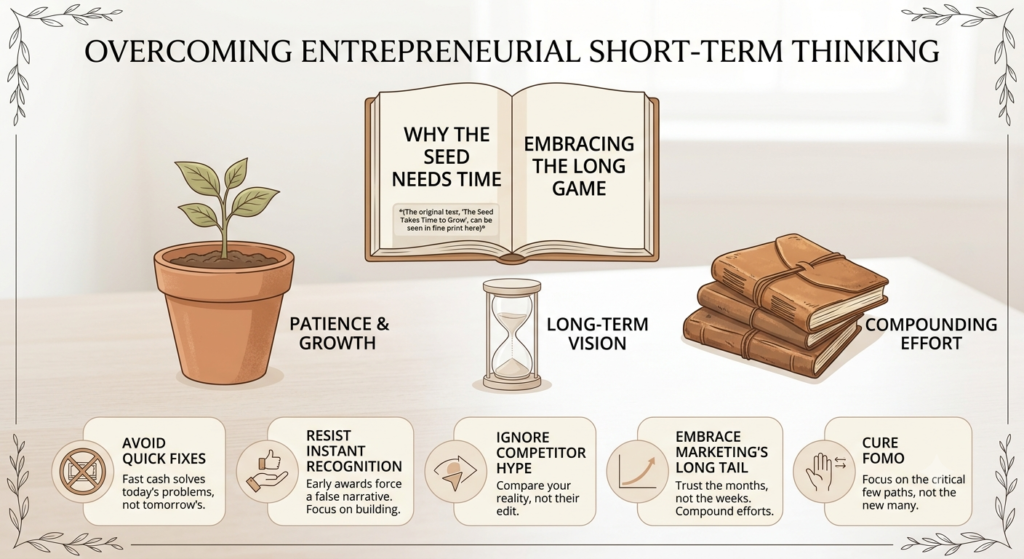
If patience were easy, every business would practice it. It isn’t, and there are specific, predictable reasons entrepreneurs default to short-term thinking.
Chasing Quick Profits
When cash flow is tight, and it often is in the early stages of a business, quick money starts to look irresistible. A discount that brings in fast sales, a low-quality but cheap product line, a client you know isn’t the right fit but pays immediately – all of these solve today’s problem while creating tomorrow’s. The pressure to keep the lights on is real, but decisions made purely to generate quick cash rarely build anything that lasts. They tend to attract the wrong customers, set the wrong pricing expectations, and quietly steer the business away from the position it actually wants to hold in its market.
Wanting Instant Recognition
Founders are human, and humans like to be seen doing well. It’s tempting to announce results before they’re proven, to chase press mentions before the product is ready, or to prioritize looking successful over being successful. Recognition earned too early can lock you into a story you haven’t actually lived up to yet, and it puts pressure on you to keep performing that story publicly, even while the real, unglamorous work of building the business is still happening behind the scenes.
Comparing Themselves to Competitors
Watching a competitor announce funding, launch a flashy campaign, or claim explosive growth can trigger a reactive decision. Entrepreneurs sometimes shift strategy not because it’s right for their business, but because someone else appears to be winning. Comparison is one of the fastest ways to abandon a long-term plan for a short-term reaction, and it’s worth remembering that you’re usually comparing your entire, messy, in-progress reality to someone else’s carefully edited highlight reel.
Expecting Immediate Results from Marketing
Marketing, especially content marketing, SEO, and brand-building, is a compounding activity. Results often take months to show up in a meaningful way. Many entrepreneurs give up on a channel just as it’s about to start working, because they expected week-two results from a strategy that needed month six to prove itself. This is one of the most common and most costly patterns in small business marketing: starting strong, losing patience, stopping, and never finding out what would have happened if the effort had continued.
Fear of Missing Out (FOMO)
New tools, new platforms, new “must-do” trends appear constantly. FOMO pushes entrepreneurs to chase every opportunity instead of committing to the few that actually matter for their business. Chasing everything usually means mastering nothing, and it spreads limited time and budget so thin across so many channels that none of them ever get the sustained attention needed to actually work.
The Hidden Cost of Wanting Everything Fast
Short-term thinking doesn’t just slow a business down. It actively erodes the foundation a business needs to survive. The data on business survival makes this painfully clear. According to the U.S. Bureau of Labor Statistics, roughly one in five new businesses closes within its first year, and nearly half don’t make it past the five-year mark. The businesses that fail rarely do so because the founder lacked a good idea. They fail because of decisions – many of them small, many of them made under short-term pressure – that compound in the wrong direction.
Here’s what wanting everything fast actually costs a business:
Poor financial decisions. Chasing quick cash often means taking on debt without a repayment plan, underpricing products to win sales, or spending on things that create the appearance of growth rather than the substance of it. A discount offered in a moment of panic can quietly retrain your customers to wait for the next sale instead of buying at full price, which makes every future launch harder, not easier.
Inconsistent branding. When every marketing decision is reactive, chasing whatever seems to be working for someone else this week, the brand ends up with no clear identity. Customers can’t build trust with a business that keeps changing who it is. A brand that shifts its voice, its offer, and its promise every few months forces its audience to keep re-learning who the business actually is, and most people simply won’t bother.
Giving up too early. Most meaningful business results are back-loaded. Content marketing, referral networks, and product refinement all take time to compound. Entrepreneurs who expect fast results often quit right before the payoff, sometimes just weeks before a channel would have started to show real traction. This is one of the most expensive mistakes in business, precisely because it’s invisible – you never see the results you would have gotten if you’d stayed the course.
Switching business ideas repeatedly. Every time you switch models or niches, you reset your learning curve back to zero. Repeated switching means you’re always a beginner, never an expert, and it also resets your audience’s trust. People who followed your last idea have no particular reason to follow the next one, which means every pivot costs you both time and the relationships you’d already started building.
Burnout from unrealistic expectations. When you measure yourself against unrealistic, fast timelines, every normal, slow week feels like failure. That constant sense of falling short is exhausting, and it’s one of the fastest routes to burnout. Founders who set patient, realistic benchmarks tend to sustain their energy far longer than those who expect every month to outperform the last.
How Delayed Gratification Creates Strong Businesses
Once you flip the lens, the pattern becomes obvious: nearly everything that makes a business genuinely strong is the product of delayed gratification.
Investing in skills. Time spent learning – whether it’s finance, sales, operations, or your craft – doesn’t pay off immediately. It pays off every single day after that, for years. Skills compound in a way that quick fixes never do.
Building trust before selling. Businesses that lead with value, education, and honesty before asking for the sale build relationships that last. Businesses that lead with the pitch burn through their audience fast.
Creating systems instead of shortcuts. A shortcut solves today’s problem. A system solves the problem permanently and makes the next hundred instances of that problem easier too. Systems take longer to build, but they free up time and reduce errors for the life of the business.
Reinvesting profits. Businesses that reinvest early profits into better equipment, better hiring, better marketing, or better product development are trading short-term owner reward for long-term business strength. It’s uncomfortable in year one. It’s the reason some businesses are still growing in year ten.
Developing a long-term brand. A brand isn’t built in a launch week. It’s built through hundreds of consistent touchpoints, delivered over years, that gradually shape how people think and talk about you.
Compounding customer relationships. A customer who trusts you enough to buy from you five times is worth vastly more than five different customers who each buy once. Long-term thinking treats the customer relationship as an asset that grows, not a transaction that ends at checkout.
Real Business Examples of Long-Term Thinking
Abstract principles are easier to trust when you can see them play out in real companies.
Amazon: Growth Over Short-Term Profit
In Amazon’s very first letter to shareholders in 1997, Jeff Bezos laid out a philosophy that still shapes the company today. He wrote plainly that Amazon would make investment decisions based on long-term market leadership rather than short-term profitability or quarterly Wall Street reactions. That wasn’t just a line in a letter – Amazon didn’t post its first profitable quarter until 2001, years after going public, and it continued to run unprofitable quarters well beyond that as it reinvested aggressively into infrastructure, logistics, and new business lines like AWS.
The lesson for entrepreneurs isn’t “lose money on purpose.” It’s that Amazon deliberately measured itself by different metrics than most public companies – customer growth, repeat purchase rates, and brand strength – because those were the metrics that predicted long-term value, even when they didn’t show up as profit on a quarterly statement. The company chose to look weaker in the short term in exchange for a much stronger long-term position.
Apple: Ecosystem Over Price Competition
Apple has never tried to win on price. Its entire strategy is built on product quality, design consistency, and an ecosystem that becomes more valuable to a customer the longer they stay in it. Every product Apple sells is designed to work seamlessly with the others, which means the value a customer gets from Apple increases over time rather than being captured in a single transaction. That’s a long-term bet on quality and integration over the short-term win of being the cheapest option on the shelf, and it’s a large part of why Apple customers tend to stay Apple customers for years.
Costco: Loyalty Built on Consistent Value
Costco is one of the clearest examples of long-term thinking translated directly into financial results. The company deliberately caps its markup on merchandise at a thin margin and makes the bulk of its profit from membership fees instead. That structure only works if members trust, year after year, that Costco is offering them the best possible price. As of fiscal year 2025, Costco’s membership renewal rate sat above 92% in the US and Canada, and around 90% worldwide, even after the company raised its membership fees. That kind of loyalty isn’t an accident. It’s the direct result of a business model built for decades of trust rather than a single quarter of margin.
What entrepreneurs can learn from each: Amazon shows that reinvestment can outperform early profit-taking. Apple shows that ecosystem and quality can beat price competition over time. Costco shows that thin, honest margins can build a loyalty so strong that customers keep paying just for the privilege of shopping with you. None of these companies got there quickly. All of them got there by consistently choosing the long-term decision over the short-term one.
Practical Ways to Build Delayed Gratification as an Entrepreneur
Understanding the concept is one thing. Practicing it under real pressure, when your bank balance and your inbox are both demanding your attention, is another. Here’s how to actually build this skill.
Set three-year goals instead of only monthly goals. Monthly goals are useful for execution, but they’re a poor lens for judging whether your business is actually working. A three-year goal forces you to ask a different, better question: what am I building, not just what am I closing this month. Write the goal down, revisit it quarterly, and use it as the filter for bigger decisions like hiring, pricing, and which markets to enter.
Track progress, not just outcomes. Outcomes like revenue and sales are lagging indicators – they tell you what already happened. Progress metrics, like number of pieces of content published, number of new relationships built, or number of systems documented, tell you whether you’re doing the things that create future outcomes. A business can have a slow revenue month while still making real progress, and tracking both numbers keeps you from mistaking a quiet month for a failing strategy.
Celebrate consistency. Most businesses celebrate wins – the big client, the big month. Fewer celebrate the unglamorous consistency that made those wins possible. Deliberately recognize the streaks: the twentieth week in a row you published content, the fiftieth day in a row you followed up with leads. Treating consistency itself as an achievement makes it far easier to keep showing up on the days when nothing exciting is happening.
Reinvest before rewarding yourself. This doesn’t mean never taking money out of the business. It means being deliberate about the order of operations. Before you upgrade your lifestyle, ask whether that same money reinvested in the business would compound into something bigger later. Many founders set a simple rule for themselves, such as reinvesting a fixed percentage of profit before any personal draw, so the decision doesn’t have to be made fresh, and emotionally, every single month.
Avoid comparison. You are not seeing the whole picture of any competitor’s business from the outside, only the parts they choose to show. Build your plan based on your own numbers and your own customers, not someone else’s highlight reel. If you need a benchmark, use your own business from a year ago rather than a stranger’s business today.
Focus on habits over motivation. Motivation is unreliable. It shows up when things are going well and disappears exactly when you need it most. Habits don’t ask how you feel – they just get done, which is why they’re the actual engine of long-term progress. Design your week so the important tasks happen on a schedule, not whenever you happen to feel inspired.
Build daily discipline. Long-term thinking is really just a series of short-term decisions made the same way, day after day. The entrepreneur who reviews their numbers every morning, follows up with every lead, and protects their focused work time isn’t relying on willpower. They’ve built a routine that removes the need for willpower, which is exactly why their business keeps moving forward even on days when motivation is nowhere to be found.
Signs You’re Thinking Too Short-Term
Sometimes short-term thinking is obvious. More often, it hides inside habits that feel like diligence. Watch for these patterns:
- Constantly checking revenue every day, to the point where a single slow day derails your mood or your strategy.
- Changing strategies every week, before any single approach has had time to actually prove or disprove itself.
- Quitting marketing too early, right around the point where compounding channels like SEO and referrals typically start to gain traction.
- Looking for “secret hacks,” instead of accepting that most durable results come from sustained, fairly ordinary effort.
- Prioritizing vanity metrics over customer value, like chasing follower counts or website traffic that never actually converts into paying, returning customers.
If more than one of these sounds familiar, it doesn’t mean you’re failing. It means it’s time to zoom out and re-anchor your decisions to a longer time horizon.
Long-Term Habits That Compound Into Massive Success
The entrepreneurs who build lasting businesses tend to share a set of unglamorous habits, repeated for years without much fanfare.
Continuous learning. Markets, tools, and customer expectations change. Entrepreneurs who keep learning stay relevant. Those who stop learning start falling behind, often without realizing it until the gap is already large.
Reading. Books condense years of someone else’s experience into a few hours of your time. Entrepreneurs who read widely, across business and outside it, tend to make better-informed decisions because they’re pulling from a larger pool of ideas.
Networking. Relationships built over years, not weeks, become some of a business’s most valuable assets – sources of referrals, partnerships, honest feedback, and opportunities that never get advertised publicly.
Customer-first thinking. Businesses that consistently prioritize what’s actually good for the customer, even when it costs them a short-term sale, build the kind of reputation that drives long-term growth.
Consistency. Showing up in the same way, at the same standard, again and again, is what turns a business from something people try once into something people rely on.
Financial discipline. Careful cash management, realistic budgeting, and resisting the urge to overspend during good months are what keep a business alive long enough to reach its long-term potential.
Brand building. Every interaction either adds to or subtracts from how people perceive your business. Long-term brand builders treat every touchpoint as part of a much longer story.
Patience with results. Perhaps the hardest habit of all – the willingness to keep executing a sound strategy even when the results haven’t shown up yet, because you trust the process enough to let it play out.
Delayed Gratification Doesn’t Mean Waiting Forever
It’s worth being clear about what this concept is not, because it’s easy to take “play the long game” as an excuse for inaction.
Delayed gratification isn’t about avoiding action. It’s about making decisions today that create larger rewards in the future – which requires you to actually act, consistently, not sit back and wait for something to happen on its own. Passive waiting isn’t patience. It’s stalling.
It’s about making decisions that create larger future rewards, not decisions that simply postpone effort. A three-year goal still needs a plan for this week. Long-term thinking without near-term execution is just procrastination wearing a nicer outfit.
Balance patience with consistent execution. The entrepreneurs who win the long game aren’t the ones who wait the longest. They’re the ones who execute the most consistently while they wait for compounding to do its work.
Long-term thinking should still include regular measurement and adaptation. Playing the long game doesn’t mean ignoring data or refusing to adjust course. It means judging your strategy on a realistic timeline instead of abandoning it after a single disappointing week, while still staying honest about whether the underlying approach is actually working.
Key Takeaways
- Delayed gratification in business means consistently choosing long-term value over short-term rewards, even when the short-term option is more tempting.
- The research behind the marshmallow test is more nuanced than most business content admits – environment and trust matter as much as raw willpower, which means you can build systems that make patience easier.
- Short-term thinking has a measurable cost: poor financial decisions, inconsistent branding, early quitting, and burnout.
- Companies like Amazon, Apple, and Costco built lasting advantages by consistently prioritizing long-term positioning over short-term wins.
- Practical habits – three-year goals, tracked progress, reinvestment, and daily discipline – turn delayed gratification from a personality trait into a repeatable system.
- Playing the long game still requires consistent action and regular course correction. It is not the same as waiting passively.
Conclusion
Lasting business success rarely comes from shortcuts. The businesses that are still standing five, ten, twenty years from now will almost certainly belong to entrepreneurs who consistently invested in learning, relationships, systems, and customer trust, long after the quick-win strategies around them faded out.
None of this requires waiting passively or ignoring results. It requires the harder, more disciplined choice: acting consistently today while measuring your success against a longer horizon than this week’s numbers. That willingness to sacrifice immediate comfort for meaningful, compounding results is, more than any single tactic, the real competitive advantage in business.
Frequently Asked Questions
What is delayed gratification in business, exactly?
It’s the practice of choosing decisions that create larger, more durable rewards later, instead of decisions that only produce a quick win today. It shows up in pricing, marketing, hiring, and nearly every other business decision.
Is delayed gratification the same thing as being risk-averse?
No. Delayed gratification is about your time horizon, not your appetite for risk. You can take a bold, risky bet on a long-term outcome – that’s still delayed gratification, as long as you’re prioritizing future value over an immediate, smaller reward.
How long should I wait before deciding a strategy isn’t working?
There’s no universal number, but most compounding channels, like content marketing, SEO, or referral networks, need at least several months of consistent effort before you have enough data to judge them fairly. Set a realistic timeline in advance, track leading indicators along the way, and evaluate at the end of that window rather than week to week.
Can delayed gratification be learned, or is it a fixed trait?
It can absolutely be learned. Research increasingly shows that environment and habits shape a person’s capacity for patience just as much as innate personality does. Structured goals, tracked progress, and supportive routines all make long-term thinking easier to sustain.
Doesn’t waiting too long mean missing opportunities?
It can, if “waiting” is used as an excuse for inaction. Genuine delayed gratification still requires consistent execution in the present. The goal is to avoid decisions driven purely by short-term impulse, not to avoid moving quickly when a real opportunity appears.
What’s the fastest way to start applying this in my own business?
Pick one area where you tend to make impulsive, short-term decisions – pricing, marketing, or hiring are common ones – and set a written three-year goal for it. Then, for every decision in that area, ask whether it moves you toward that three-year goal or simply solves today’s discomfort.