
Every business magazine cover tells the same story. A founder smiling next to a funding announcement. A leader accepting an award. A brand hitting a milestone nobody expected. What almost none of these stories show is the version of that same person a year, or five years, earlier – being turned down by investors, losing a client they were counting on, or watching a product they believed in fail to sell.
Rejection is not the exception in business. It is the baseline. If you have ever pitched an idea and been told no, sent a proposal that went unanswered, or watched a launch fall flat, you are not doing anything wrong. You are doing exactly what every entrepreneur before you has done.
The gap between people who eventually succeed and people who quietly give up is rarely about talent, luck, or timing alone. It comes down to how each person interprets a “no.” Some treat it as proof they are not good enough. Others treat it as information – a data point that tells them what to adjust next.
This article looks closely at how successful people handle failure, using research on entrepreneurial resilience, current startup data, and practical habits you can start using today. The goal is not to convince you that failure feels good. It rarely does. The goal is to show you that failure, handled correctly, is one of the most reliable tools for building a business and a career that lasts.
None of this is about pretending setbacks don’t hurt, or forcing false positivity onto a genuinely disappointing moment. It is about building a repeatable process for what happens after the disappointment settles – because that process, more than any single win or loss, is what determines whether you are still building five years from now.
Why Rejection Is a Normal Part of Building Something
Before getting into mindset and habits, it helps to see the numbers, because they change how you feel about your own setbacks.
According to U.S. Bureau of Labor Statistics data, roughly 20.4 percent of new American businesses close within their first year, climbing to 49.4 percent by year five and 65.3 percent by year ten. Among venture-backed and highly innovative startups specifically, failure rates run even higher, with research from Startup Genome placing the figure near 90 percent over a company’s lifetime.
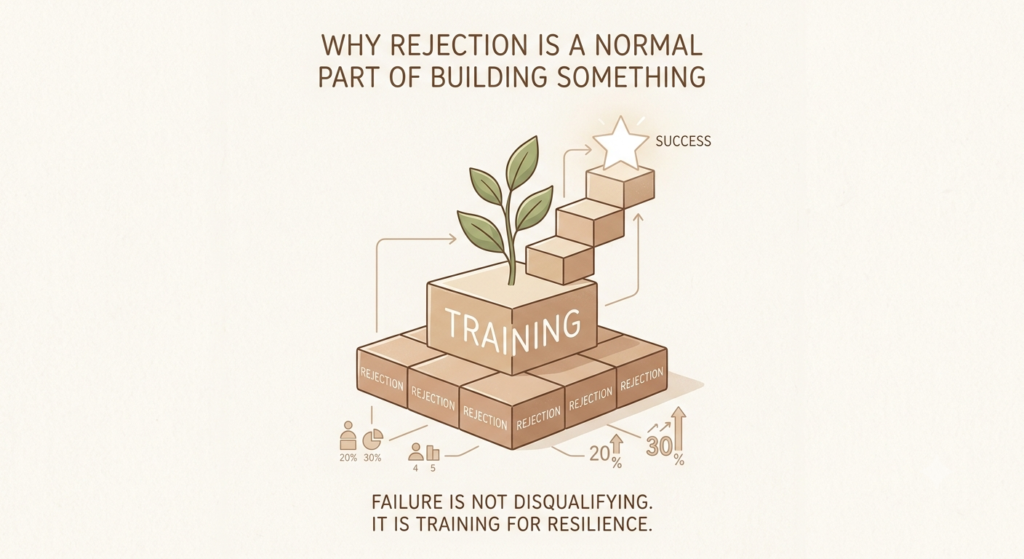
Here is the detail that matters most for this discussion: first-time founders succeed at a rate of roughly 18 percent, according to Startup Genome and Failory research. Founders who have already failed once succeed at a slightly higher rate of about 20 percent. Founders who have previously succeeded reach roughly 30 percent. In other words, the people most likely to win the next round are the people who already lost a round before.
That single statistic reframes everything. Failure is not disqualifying. It is training.
Research on entrepreneurial resilience backs this up from a different angle. A 2025 systematic literature review published in the Journal of Entrepreneurial Agility found that psychological resilience is not something people are simply born with – it can be built deliberately through self-efficacy, emotional regulation, and structured learning habits. The same review noted that interest in this area of research has grown sharply since 2020, a sign that the business world is finally taking resilience as seriously as it takes strategy or funding.
If resilience can be trained the way a skill can be trained, then the way you respond to your next rejection is not fixed. It is a choice you can get better at making.
1. Successful People Don’t Take Failure Personally
Separating Identity From Outcome
The single biggest difference between people who recover from setbacks and people who get stuck is whether they treat the failure as something they did or something they are.
A rejected pitch means the pitch was rejected. It does not mean you are unworthy of building a business. A missed promotion means the timing or the fit was not right in that specific moment. It does not mean you lack leadership ability. When you separate your identity from a single outcome, you free yourself to look at the outcome clearly instead of defensively.
Psychologists who study resilience describe this as “cognitive reframing” – consciously choosing to interpret an event in a way that supports recovery rather than despair. Entrepreneurs who practice this consistently report faster emotional recovery and are more likely to attempt another venture after a failure, according to entrepreneurship resilience research published in the Journal of Small Business Management.
Real Situations Where This Shows Up
- An investor passes on your startup after three meetings.
- A long-term customer chooses a competitor instead of renewing with you.
- You apply for a leadership role internally and someone else gets it.
- A product launch generates almost no sales in its first month.
In every one of these situations, there are two possible internal stories. One says, “I am not good enough.” The other says, “This specific attempt did not work, and here is why.” Only the second story leaves room for a next attempt.
Why Emotionally Intelligent Leaders Recover Faster
Leaders with strong emotional intelligence are better at naming what they feel without being controlled by it. They can say, “I am disappointed and frustrated right now,” without spiraling into self-criticism. This matters because emotional regulation is directly linked to entrepreneurial resilience in the academic literature. Founders who can regulate their emotional response to setbacks are more likely to keep making sound decisions instead of reactive ones.
Key takeaway: Failure is an event. It happened to your business, your pitch, or your application. It did not happen to your worth as a person.
A Simple Exercise to Practice This Shift
The next time a setback happens, try writing two separate sentences. The first describes the event in neutral, factual language: “The client chose a different vendor.” The second describes what you are tempted to conclude about yourself: “I am not good enough at sales.” Reading both sentences side by side usually makes the gap obvious. The first sentence is accurate and useful. The second is an emotional leap that the facts do not actually support.
This exercise sounds small, but it is one of the most repeatable tools available for building the identity-outcome separation that resilient leaders rely on. Over time, doing this consistently rewires the automatic response from self-blame toward analysis, which is exactly the shift that keeps people moving forward instead of shutting down.
2. They Treat Every Rejection Like Market Research
Changing the Question You Ask
There is a subtle but powerful shift that separates people who stay stuck from people who move forward quickly. It is the question they ask right after a setback.
Most people ask: “Why me?”
High performers ask: “What can I learn from this?”
The first question looks backward and searches for blame, often landing on either the self or an unfair world. The second question looks forward and searches for a next action. Neither question changes what already happened. Only one of them changes what happens next.
Turning Rejection Into Usable Data
When a customer says no, that is not the end of the conversation – it is the start of research. Ask what specifically didn’t meet their need. Was it price, timing, trust, or a missing feature? When an investor passes, ask what assumption in your pitch they were not convinced by. Was it the market size, the team, or the path to revenue?
This mirrors how experienced product teams operate. Businesses that treat customer feedback and lost deals as structured input, rather than as personal insults, are far more likely to pivot successfully. Data from startup failure research consistently shows that a lack of market need is the single largest cause of startup failure, cited by roughly 42 percent of failed founders in CB Insights research. The businesses that survive are often the ones that caught this signal early through rejection and adjusted before it was too late.
Practical Tip: Keep a Lessons Learned Journal
After every significant setback, write down three things:
- What specifically happened.
- What you believe caused it, based on evidence rather than assumption.
- One concrete change you will make before the next attempt.
This is not about journaling your feelings, although that has value too. It is about building a searchable record of patterns. After a year of this practice, most entrepreneurs can look back and see exactly which mistakes they stopped repeating.
Key takeaway: A rejection with no lesson attached is wasted pain. A rejection with a lesson attached is free consulting.
3. They Focus on the Next Opportunity Instead of the Last Mistake
Why Dwelling Kills Momentum
There is a real cost to replaying a setback over and over. Every hour spent re-litigating a lost deal or a failed launch is an hour not spent building the next one. Momentum in business compounds the same way debt does – small delays early on create larger gaps later.
This does not mean you should ignore what went wrong. It means there is a limited, useful window for reflection, after which continued dwelling produces diminishing returns and often makes decision-making worse, not better.
Action Creates Confidence, Not the Other Way Around
A common misconception is that confidence comes first and action follows. In practice, it usually works in reverse. Taking a small, concrete next step – sending the next outreach email, scheduling the next pitch, rebuilding the next version of a product – is what generates the confidence to keep going. Waiting to feel ready before acting often means waiting indefinitely.
Founders who bounce back quickest after a failed venture tend to already have another idea, project, or lead in motion before the dust from the last one settles. This is not recklessness. It is a deliberate habit of keeping a pipeline of next opportunities so that no single rejection can stall all forward motion.
One Door Closing Often Opens a Better One
It is worth remembering, without turning this into empty positivity, that opportunities lost sometimes make room for better ones. A canceled contract can free up the time needed to land a bigger client. A missed promotion can be the push that leads someone to start their own company instead. None of this is guaranteed. But it is common enough that it is worth staying open to.
Key takeaway: The fastest way out of a setback is rarely more analysis of the setback. It is the next small, decisive action.
4. They Build Emotional Resilience Like a Muscle
Resilience Is Trained, Not Inherited
One of the most useful findings from recent entrepreneurship research is that resilience behaves less like a fixed personality trait and more like a skill. A 2025 review in the International Journal of Applied Research in Business and Management concluded that entrepreneurs can meaningfully strengthen their resilience through cognitive adaptability, emotional regulation, and structured learning routines – the same way an athlete strengthens a muscle through repeated, deliberate training.
This is genuinely good news. It means you are not stuck with whatever resilience level you currently have. You can build more of it.
Handling Criticism Without Shutting Down
Not all feedback is delivered kindly, and not all of it is fair. High performers learn to separate the delivery of feedback from its content. A harshly worded critique can still contain a useful insight. Practicing this separation – asking “is there anything true in this, regardless of how it was said?” – prevents defensive reactions from blocking useful information.
Managing Emotions and Avoiding Negative Self-Talk
Internal dialogue after a setback tends to run in one of two directions. Either it stays specific (“that particular pitch needed a stronger financial model”) or it generalizes into identity attacks (“I always mess this up,” “I’m not cut out for this”). The second pattern is corrosive because it stops being about the event and starts being about the person, which makes every future setback feel heavier than the last.
Staying Calm Under Pressure
Founders and leaders who have weathered multiple setbacks often describe a noticeable shift over time – the same size of problem simply stops feeling as overwhelming. This is resilience compounding, much like physical training. The nervous system learns, through repeated exposure, that a hard conversation or a lost deal is survivable.
Habits That Build This Muscle
- Journaling – processing the event on paper rather than only in your head.
- Exercise – physical activity is one of the most consistently supported ways to regulate stress hormones and mood.
- Reflection – scheduled time, weekly or monthly, to review wins and setbacks with some distance from the emotion of the moment.
- Mentorship – talking to someone who has faced a similar setback and survived it puts your own situation into perspective.
Key takeaway: Emotional resilience is not something you either have or don’t. It is built through repeated, intentional practice.
5. They Understand That “No” Often Means “Not Yet”
Timing Matters More Than People Admit
It is tempting to treat a rejection as a final verdict. In reality, a “no” is frequently a statement about timing, context, or fit rather than a permanent judgment on the idea or the person.
Consider how many respected companies were rejected by investors before eventually finding the right backer at the right moment, once the market, the product, or the team had matured enough to make the opportunity obvious. This pattern shows up constantly across investors, clients, partnerships, and job interviews.
Wrong Timing, Wrong Audience, Wrong Strategy – Not the Wrong Person
There is a useful mental checklist worth running after any rejection:
- Was the timing off? Some ideas are pitched before the market is ready, and some are pitched after a window has closed.
- Was it the wrong audience? An investor focused on consumer apps will pass on a strong B2B pitch, not because it is weak, but because it does not match their focus.
- Was the strategy misaligned? Sometimes the underlying idea is sound, but the way it was presented or positioned did not connect with what the other side needed to hear.
Running through this checklist honestly, rather than defensively, often reveals that the rejection was circumstantial rather than a reflection of your capability.
Investors, Clients, Partnerships, and Interviews
This pattern is visible across every stage of building a business. Data on venture funding shows that only a tiny fraction of startups – roughly 0.05 percent, according to compiled venture capital data – ever receive institutional investment, and the average venture firm receives well over a thousand pitches a year. A single “no” from a single investor is a rounding error, not a verdict on your business. The founders who eventually close funding rounds are almost always the ones who kept pitching after being told no multiple times first.
Key takeaway: “No” is frequently a statement about circumstances, not a permanent judgment on your value or your idea.
Why Persistence Looks Different From Stubbornness
There is an important distinction worth making here, because “keep trying” advice can easily be misread as “never change anything.” Persistence that works is persistence paired with adjustment. Pitching the exact same idea, in the exact same way, to the exact same type of audience, after repeated rejection, is not resilience – it is repetition without learning.
Genuine persistence looks more like this: keep the underlying goal steady, but treat each rejection as a prompt to adjust the approach, the audience, or the timing. A founder who gets turned down by ten investors focused on consumer products might reasonably conclude the product needs work. A founder who gets turned down by ten investors who have never funded their category before might reasonably conclude they are pitching the wrong audience entirely. Telling these two situations apart is what separates productive persistence from wasted effort.
This is also where honest feedback becomes essential. Asking a specific, direct question after a rejection – “was this a fit issue or a quality issue?” – often reveals which type of “not yet” you are dealing with, and that answer should shape what you do next.
Key takeaway: “No” is frequently a statement about circumstances, not a permanent judgment on your value or your idea.
6. They Learn Faster Than Everyone Else
Average People Avoid Mistakes. Successful People Study Them.
There is a natural instinct to avoid situations where you might fail. It feels safer. But avoiding failure also means avoiding the fastest available source of learning. High performers tend to invert this instinct – they experiment more, not less, because each experiment, whether it succeeds or fails, produces information the business did not have before.
Experiment, Test, Measure, Improve
This is the same logic behind iterative product development. Rather than trying to build one perfect, fully-formed offering before ever showing it to a customer, successful teams build small versions, test them against real market feedback, and improve based on what they learn. Businesses that go through several rounds of this cycle tend to build something far closer to what the market actually wants than businesses that guess once and hope.
Startup failure data supports this directly. Research compiled from CB Insights and related sources shows that a significant share of startup failures trace back to a mismatch between the product and what the market actually needed – something iterative testing is specifically designed to catch early, before it becomes fatal.
Iterative Improvement Beats the Pursuit of Perfection
Waiting for a perfect product, a perfect pitch, or a perfect resume before taking action almost always means waiting too long. The market rewards businesses that get real feedback early and adjust quickly, not businesses that spend the longest amount of time preparing in isolation.
Key takeaway: Every rejection is a small, free experiment. The people who improve fastest are simply the people who run the most experiments.
The Compounding Effect of Fast Feedback Loops
There is a reason so many modern businesses talk about “shipping fast” or “failing forward.” A short feedback loop means you find out what is wrong within days or weeks instead of months or years. A founder who tests five small versions of a landing page in a month will learn more about what converts customers than a founder who spends that same month polishing a single version in isolation.
This same principle applies well beyond product design. A salesperson who makes fifty calls a week and tracks which openings get a response will improve their pitch far faster than a salesperson who makes five calls and agonizes over each one. Speed of feedback, not perfection of preparation, is usually the real driver of skill improvement.
It also explains why so many resilient founders describe their failures as investments rather than losses. Each failed experiment, correctly logged and reviewed, reduces the odds of repeating the same mistake in the next round. Over a long enough timeline, this is a significant and durable competitive advantage over founders who avoid testing anything until they feel certain.
7. They Stay Committed to the Long-Term Vision
One Bad Month Does Not Define a Business
It is easy, in the middle of a difficult stretch, to mistake a temporary setback for a permanent trend. A slow sales month, a paused project, or a difficult quarter can feel like proof that the whole venture is failing. In most cases, it is simply one data point in a much longer story.
Long-Term Thinking Beats Emotional Decision-Making
Some of the most damaging business decisions happen in the emotional aftermath of a setback – shutting down a promising product line too early, abandoning a strategy after a single disappointing result, or making an impulsive pivot without enough evidence to justify it. Founders who consistently succeed tend to build in a deliberate pause between the emotional reaction to bad news and the strategic decision that follows it.
Consistency Compounds
Just as debt compounds against you, consistent effort compounds in your favor. Showing up, adjusting, and continuing to build – even through a difficult stretch – tends to produce results that are not visible on any single day but become obvious over a year or more.
Businesses That Survive Downturns Often Emerge Stronger
Economic data on startup closures shows that funding slowdowns and tightening markets tend to remove the least adaptable businesses first. Companies that survive these periods typically do so because they adjusted their cost structure, diversified revenue, or found a more resilient niche, rather than because nothing difficult happened to them. Adaptation, not luck, is usually what separates the businesses that make it through a hard cycle from the ones that don’t.
Key takeaway: Long-term thinking is a competitive advantage precisely because so few people are willing to practice it during a hard month.
8. Practical Habits to Handle Failure Like Successful People
Understanding the mindset is only half the work. Building the daily habits that support it is what actually changes outcomes over time.
- Pause before reacting emotionally. Give yourself a set amount of time – even just an hour – before responding to bad news in writing or in a meeting.
- Ask for honest feedback. Rather than guessing why something didn’t work, ask the person directly. Most people are willing to give a straight answer if you ask calmly.
- Write down three lessons from every setback. This turns a one-time emotional event into a permanent, reusable resource.
- Improve one specific skill after every rejection. Rather than trying to fix everything at once, pick the single most relevant gap and work on that.
- Celebrate progress, not just wins. A better pitch that still gets rejected is still progress. Acknowledging that keeps motivation intact.
- Keep a rejection tracker to measure courage, not failure. Some of the most successful entrepreneurs and salespeople deliberately track how many times they were told no, treating a high number as evidence of effort rather than evidence of failure.
- Build a network of mentors and supporters. People who have already survived similar setbacks can normalize the experience and offer guidance that is hard to access alone.
Common Mistakes That Make Failure Worse
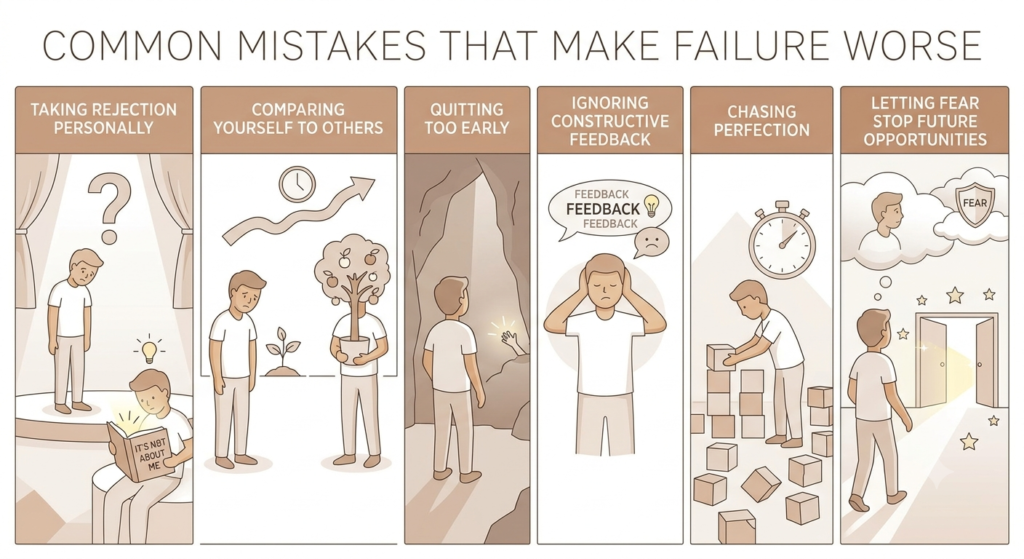
Just as important as knowing what to do is knowing what to avoid. These patterns consistently make setbacks harder to recover from.
- Taking rejection personally. Converting an event into an identity attack extends the emotional damage far longer than necessary.
- Comparing yourself to others. Every business and every career has a different timeline. Comparing your setback to someone else’s highlight reel distorts your perspective.
- Quitting too early. Many failures happen right before a turning point that never gets the chance to arrive.
- Ignoring constructive feedback. Feedback that stings is often the feedback most worth listening to.
- Chasing perfection. Waiting for flawless conditions before acting usually means never acting at all.
- Letting fear stop future opportunities. Avoiding new attempts because of a past rejection guarantees that the past failure remains the final chapter.
Final Thoughts
Success is rarely a straight line, no matter how clean it looks from the outside. Every entrepreneur, leader, and creator you admire has a long, mostly invisible list of rejections behind their visible wins. The difference between the people who eventually succeed and the people who quietly stop trying is almost never luck. It is a decision, made repeatedly, to treat failure as information rather than a verdict.
If you are in the middle of a setback right now – a lost client, a rejected pitch, a launch that didn’t land – it is worth remembering that this single event does not define your capability or your future. It is one data point, in one moment, that you get to interpret and respond to.
Every “no” carries a lesson that brings you one step closer to your next “yes.” The only question is whether you are willing to stay in the game long enough to hear it.
Key Takeaways
- Rejection is statistically normal in business – most founders face multiple failures before succeeding, and prior failure is linked to higher future success rates.
- Separating your identity from a single outcome is the foundation of fast emotional recovery.
- Treating rejection as market research turns pain into usable data for your next attempt.
- Resilience is a trainable skill, not a fixed trait, according to current entrepreneurship research.
- Long-term thinking and consistency outperform emotional, reactive decision-making after a setback.
Frequently Asked Questions
1. How do successful people handle failure differently from everyone else?
They separate their identity from the outcome, extract specific lessons from what went wrong, and take action quickly rather than dwelling on the setback. The failure is treated as a data point, not a verdict.
2. Is resilience something you’re born with, or can it be learned?
Research on entrepreneurial resilience shows it can be deliberately developed through emotional regulation, structured reflection, and repeated exposure to challenges – much like a physical skill.
3. What percentage of startups actually fail?
According to Bureau of Labor Statistics data, roughly 20.4 percent of new U.S. businesses fail in their first year, rising to 49.4 percent by year five. Among venture-backed startups specifically, failure rates run closer to 90 percent over the company’s lifetime, per Startup Genome research.
4. Why do founders who have failed before sometimes do better the second time?
Research from Startup Genome and Failory indicates that founders with a prior failure succeed at a slightly higher rate than first-time founders, likely because they have already learned from mistakes that first-timers have not yet encountered.
5. How can I stop taking rejection personally?
Practice separating the event from your identity by writing down what specifically happened and why, rather than what it says about you as a person. Over time, this becomes a habit that reduces the emotional weight of each individual setback.
6. What is the fastest way to recover momentum after a business setback?
Take one small, concrete next action rather than spending extended time analyzing what went wrong. Confidence tends to follow action, not the other way around.