

Most people who start a business are not short on ambition. They have the idea, the energy, and often the savings account to prove they are serious. What separates the ones who are still standing five years later from the ones who quietly close their doors is rarely talent or luck. It is what they do on an ordinary Tuesday, over and over again, whether they feel like it or not.
That is the real story behind the success habits of entrepreneurs. Not the highlight reel of product launches and funding announcements, but the unglamorous, repeatable behaviors that show up long before the results do. This article pulls together current research, survey data, and real-world patterns from 2025 and 2026 to show what actually works, what has been quietly disproven, and how you can start applying it without burning yourself out in the process.
What the Success Habits of Entrepreneurs Actually Have in Common
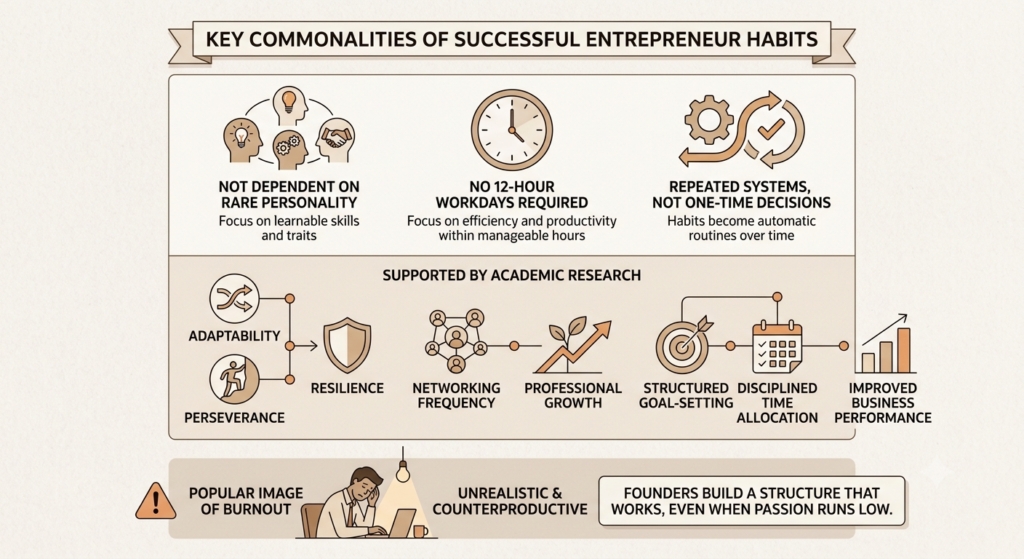
Before getting into specific habits, it helps to notice what they all share. None of them depend on a rare personality type. None of them require twelve-hour workdays. And none of them are one-time decisions. They are systems that get repeated so often they stop requiring willpower at all.
Academic research backs this up. A literature review published on essential entrepreneurial habits found that adaptability and perseverance were highly predictive of resilience, and that networking frequency correlated strongly with professional growth. The same research linked structured goal-setting and disciplined time allocation directly to improved business performance. In other words, the founders who win are not the ones who feel the most passionate on any given day. They are the ones who built a structure that keeps working even when passion runs low.
This matters because the popular image of entrepreneurship, the founder who sleeps four hours a night and runs on pure grit, is not just unrealistic. It is actively counterproductive. The data on burnout, which we will get into shortly, makes that painfully clear.
Habit 1: They Build a Morning Routine Around Judgment, Not Motivation
The early-riser myth vs. what the research actually shows
Wake up at 5 a.m. and conquer the day. It is one of the most repeated pieces of advice in business media, and it is only half true. There is a genuine physiological reason mornings matter: certain brain regions involved in goal-directed behavior, including the hippocampus and orbitofrontal cortex, tend to function more effectively earlier in the day, and the early hours simply carry fewer interruptions. Family members are asleep, inboxes are quieter, and the day has not yet handed you its first fire to put out.
But 2026 research on daily habits makes an important correction to the old advice. Success is described less as a function of working longer and more as a function of managing attention, energy, and judgment well. A parent, an entrepreneur, an artist, and a corporate leader will all structure mornings differently, and there is no single wake-up time that guarantees results. What matters is that the first block of the day is protected and used deliberately, not that it starts at a specific hour.
How to design a routine that survives a bad week
The mistake most founders make is designing a routine for their best day and expecting it to survive their worst one. A resilient morning routine should shrink gracefully instead of collapsing entirely.
- Anchor a habit to an existing routine, such as reviewing your top three priorities right after your first coffee, rather than inventing a brand-new standalone ritual
- Build a five-minute minimum version of every habit for chaotic mornings, so a short workout or a two-line journal entry still counts as a win
- Reserve your first sixty to ninety minutes for the task that actually moves the business forward, before opening email or messaging apps
- Review yesterday’s unfinished priorities before adding new ones, so the list does not silently grow every day
This is not about becoming a different person before 6 a.m. It is about giving your best hours to the decisions that matter most, since that early window offers fewer distractions and sharper judgment than the version of you answering messages at 4 p.m.
Habit 2: They Treat Discipline as a System, Not a Personality Trait
Founders love to talk about discipline as though it is something you either have or do not. The data suggests otherwise. In a survey of entrepreneurs conducted by National Business Capital and Services, self-discipline was cited by 38 percent of respondents as the top trait behind their success, with communication skills and passion tying for second at 37 percent. Discipline, more than motivation, is what keeps founders executing on the days when motivation has completely disappeared.
Why willpower alone fails founders
Relying on willpower is a fragile strategy because willpower fluctuates with sleep, stress, and blood sugar. Founders who treat discipline as a system instead of a mood build environments where the right action is the easy action.
Practical ways to do this include:
- Removing decisions rather than trying to out-willpower them, such as pre-scheduling client calls for the same two afternoons every week
- Using visible commitments, like a shared team scorecard, so slipping is noticed quickly instead of quietly for weeks
- Batching similar tasks, such as all invoicing or all content review, into one sitting instead of scattering them throughout the day
- Setting a hard stop time for work, since founders without one tend to let tasks expand to fill every available hour
Research on entrepreneurial mindset confirms that mindset itself is measurable and trainable. A Kauffman Foundation study of 300 founders found that growth-minded founders built stronger cultures and raised more capital than fixed-mindset peers, which reinforces that discipline and mindset are skills you build, not traits you are simply born with.
Habit 3: They Practice Structured Goal Setting and Weekly Reviews
Annual goal setting feels productive in January and forgotten by March. The founders who actually hit their targets tend to review progress far more often than once a year.
The goal-review cadence that outperforms annual planning
Structured goal-setting and disciplined time allocation have been shown to significantly improve business performance, with a study reporting a statistically significant link between goal-setting discipline and outcomes. Separately, industry research on strategic planning found that companies reviewing their strategy monthly grow roughly 30 percent faster than those that do not, and that only a minority of small businesses conduct any formal review of their strategy at all.
A practical goal-review rhythm looks like this:
- A five-minute daily check on your top three priorities
- A thirty-minute weekly review of what moved forward and what stalled
- A half-day monthly review of financials, pipeline, and one major decision to revisit
- A full quarterly reset of goals against what actually happened, not what you hoped would happen
The point of this cadence is not perfection. It is catching a stalled goal in week three instead of discovering it in month eleven. Done consistently, this kind of goal setting for entrepreneurs turns a vague yearly ambition into a series of small, checkable commitments.
Habit 4: They Build Sharper Judgment Through Deliberate Learning
Knowledge loses value faster than it used to. Artificial intelligence, shifting business models, and changing customer expectations are reshaping nearly every industry, and in 2026 continuous learning is less about collecting new qualifications and more about staying adaptable. Highly successful people build a daily learning habit long after their formal education has ended, whether that means reading an industry report, listening to an expert interview, or studying a new tool relevant to their business.
Daily learning habits of founders who stay relevant
This does not need to consume hours. A sustainable version looks like:
- Fifteen to twenty minutes of focused reading on your industry, not general news, each morning
- One structured conversation per month with someone further ahead in your field
- A running note of customer feedback patterns, reviewed monthly instead of read once and forgotten
- Deliberate exposure to ideas outside your industry, since cross-industry research is frequently cited as a source of unexpected innovation
This kind of adaptive thinking is not a fixed trait that some founders simply have. It is built through repeated, low-effort exposure to new information, applied consistently rather than in occasional bursts.
Habit 5: They Manage Time Like a Scarce Resource, Not an Elastic One
Time management for founders is not about cramming more into a day. It is about protecting the few hours that actually determine outcomes.
Priority lists, “to-don’t” lists, and single-tasking
Research into millionaire habits found that self-made entrepreneurs commonly used priority lists paired with “to-don’t” lists, so that low-value tasks were explicitly excluded rather than left to compete for attention. Multitasking, despite feeling productive, has been linked to increased stress and decreased performance among business owners, since switching between emails, calls, and paperwork fragments focus rather than saving time.
A workable time management approach includes:
- A single daily list capped at three genuinely important tasks, with everything else treated as optional
- A written “to-don’t” list of tasks you have decided are not worth your time this quarter
- Blocked, uninterrupted time for the task that most directly grows the business, protected the same way you would protect a client meeting
- A weekly audit of where your hours actually went, compared to where you planned for them to go
The founders who consistently execute are rarely the ones with the longest task lists. They are the ones with the shortest ones, defended fiercely.
Habit 6: They Delegate Repetitive Work, Including to AI
Time management only goes so far when the workload itself is too heavy for one person. The founders who protect their best hours are usually also the ones most willing to hand off the rest, whether to a person or to a tool.
What the delegation and AI-adoption data actually shows
Delegation has long been linked to stronger outcomes: Gallup research has found that CEOs with strong delegation skills generate meaningfully more revenue and faster three-year growth than those who hold onto every task themselves. Yet only a minority of small businesses outsource any function at all, despite the potential cost savings.
In 2026, a growing share of that delegation is going to AI tools rather than additional hires. Federal Reserve data shows that among employer firms already using AI, the most common uses are writing and marketing, individual productivity, and planning or analysis, and 71 percent of those users report increased productivity as a direct result. Separate research from Business.com puts the average time saved at 5.6 hours per week per employee, with business owners and managers saving more than seven hours weekly once tools are actually integrated into daily workflows rather than tested once and abandoned.
The gap between owners who benefit and owners who do not tends to come down to one thing: whether the tool is matched to a specific, recurring task and actually used, rather than added to the business as a vague general-purpose experiment. Ways to build this habit deliberately include:
- Naming the single task that eats the most hours each week, such as email triage, scheduling, or first-draft content, before choosing any tool
- Testing one tool against that one task for two weeks before deciding whether to keep it
- Delegating administrative and repetitive tasks, such as bookkeeping, invoicing, and calendar management, to either a person or a tool as soon as the business can support it
- Reviewing quarterly what has actually been delegated successfully, since tools and hires that are never followed up on quietly stop being used
Habit 7: They Invest in Mentorship Early and Often
Of every habit covered here, business mentorship has some of the strongest survival data behind it. Small businesses that receive mentoring survive five years or more at roughly double the rate of those that do not, according to a widely cited survey from The UPS Store, and separate industry analysis puts mentored businesses at three times more likely to survive past the five-year mark. In one study, 92 percent of small business owners agreed that mentors had a direct impact on the growth and survival of their business, yet only around one in five had a mentor when they actually started out.
What the mentorship survival data actually shows
The relationship is not just about survival. Mentored businesses have also been associated with meaningfully higher revenue growth compared to businesses without a mentor, and the benefit tends to scale with engagement: entrepreneurs who had five or more interactions with a mentor were considerably more likely to report business growth than those who had only one.
Ways to build this habit without waiting for the perfect formal match:
- Join a free mentoring program through an organization built for this, such as SCORE, rather than waiting to find a personal connection
- Treat one-sided mentoring as valid too: studying the interviews, writing, and public talks of people further along your path
- Come to every mentoring conversation with a specific decision you are wrestling with, not a vague request for advice
- Offer to mentor someone else once you have some traction, since teaching a concept is one of the fastest ways to test whether you actually understand it
Habit 8: They Bounce Back From Setbacks Faster Than Most Founders
Setbacks are not optional in entrepreneurship. What separates founders who recover quickly from those who spiral is largely how they interpret the setback in the first place.
Reframing setbacks as data, not identity
A study from North Carolina State University surveyed 709 entrepreneurs and found a strong association between a growth mindset and the ability to adapt to challenges. Founders who believed they could change and grow, rather than viewing their traits as fixed, reported more optimism about future success, less discouragement, and more effort spent identifying solutions after a setback. Separately, Harvard Business School research has found that entrepreneurs who failed once have a meaningfully higher chance of succeeding on their next venture than first-time founders, which supports treating failure as information rather than as a verdict on your ability.
Practical ways to build business resilience include:
- Writing down what specifically went wrong after a setback, rather than only how it felt
- Scheduling a short “lessons learned” review after any missed goal, separate from the emotional reaction to it
- Talking to a mentor or peer group about setbacks instead of hiding them, since concealment tends to prolong stress rather than resolve it
- Treating a bad quarter as one data point in a longer trend line, not as proof the whole venture is failing
Habit 9: They Protect Physical and Mental Health as a Business Asset
This is the habit most entrepreneurship content skips, and it is arguably the most urgent one in 2026.
The burnout numbers nobody talks about
The data here is hard to ignore. Recent survey work found that 84 percent of small business owners work more than 40 hours a week, and a separate 2026 survey of 1,000 small business owners found that 84 percent had sacrificed their health, sleep, or relationships for their business. Roughly a quarter described their stress or burnout levels as higher than expected, and just over half reported losing sleep several times a week because of the business. Only 57 percent of small business owners take any vacation at all, and among those who do, two-thirds still check in with work at least once a day.
None of this is a personal failing. It is a structural pattern across an entire population of business owners, and it has direct consequences for decision-making, since chronically stressed founders are more likely to make poor calls, delay hard conversations, and let that tone spread through their team. Much of this traces back to a lopsided work-life balance, where the business quietly absorbs hours that used to go toward rest, family, and everything else.
Small, sustainable recovery habits that actually stick
The good news is that the fix rarely requires a dramatic life overhaul. Founders who actively manage their wellbeing tend to rely on a few unglamorous habits repeated consistently:
- Regular movement, even something as simple as walking three or more times a week, which has been linked to meaningful improvements in fitness and general wellbeing
- Protecting sleep and basic nutrition as non-negotiable inputs to performance, not as rewards for a light week
- Keeping one truly offline day, or at minimum a few offline hours, on a fixed schedule rather than “whenever things calm down”
- Delegating administrative work such as bookkeeping, scheduling, or email management, since founders who delegate consistently report better decision quality and less chronic stress
Protecting your health is not a distraction from building the business. Given how directly burnout degrades judgment, it is one of the more overlooked success habits of entrepreneurs who manage to stay in the game long enough to actually win.
Habit 10: They Manage Cash Flow With Discipline From Day One
Cash flow problems, not lack of ambition, are cited as a contributing factor in the large majority of business failures. Financial discipline is less about strict frugality and more about visibility: knowing exactly where the money is at all times.
Founders who handle this well tend to share a few specific habits:
- A weekly, not monthly, review of cash position and upcoming payables
- A separate account for taxes and payroll obligations, so operating cash and obligated cash are never mentally merged
- A clear personal pay plan, since nearly half of small business owners report having skipped or delayed their own paycheck at some point, and a defined plan reduces how often that becomes necessary
- Comparing actual spending against a simple budget monthly, rather than reacting only when the bank balance looks alarming
Frugality itself is not a fixed trait either. Growth-mindset research on entrepreneurs found that founders who believed their own financial habits could improve over time were more resilient after financial setbacks than those who saw frugality as something you either have or do not.
This distinction matters more than it might seem. A founder who treats every cash crunch as proof they are simply bad with money tends to freeze or panic. A founder who treats the same crunch as a solvable problem tends to adjust pricing, renegotiate a vendor contract, or trim a specific expense, and moves on. The habit is not about never running short. It is about building the reflex to respond calmly and with data instead of reacting emotionally when the numbers get tight.
Habit 11: They Build Networks and Strategic Partnerships Deliberately
Entrepreneurship can feel like a solo sport, but the data says the opposite is true of the founders who actually scale. Industry analysis has found that businesses with strong networks and partnerships are considerably more likely to survive past the five-year mark, and recent global survey data from EY found that nearly all entrepreneurs surveyed pursued strategic partnerships as part of their growth strategy in 2025 or 2026, compared with a much smaller share of large enterprise executives doing the same. Partnerships increasingly give founders faster access to technology, talent, and new markets than trying to build everything internally.
Building this habit does not require a natural talent for networking. It requires consistency:
- Reaching out to one new, relevant contact per week, rather than only networking reactively when you need something
- Following up within 48 hours of any meaningful conversation, since most relationship value is lost in the follow-up gap, not the first meeting
- Looking specifically for complementary partners, such as a business that reaches your exact customer but does not compete with you
- Showing up consistently at the same one or two industry events or communities, since familiarity compounds faster than one-off appearances
How to Start Building These Habits This Month
Reading about ten habits and trying to install all of them on Monday is a reliable way to abandon all ten by Thursday. The founders who succeed with habit change tend to stack one new habit onto an existing routine at a time.
A simple 30-day habit-stacking plan
- Week 1: Pick one morning anchor habit and one evening shutdown habit. Nothing else changes yet.
- Week 2: Add a single weekly review, thirty minutes, same day and time every week, covering goals, cash position, and one lesson learned.
- Week 3: Add one relationship habit, such as a single outreach message per week to a potential mentor, partner, or peer.
- Week 4: Review what actually stuck from weeks one through three, drop what did not work, and only then consider adding anything new.
This slower pace feels counterintuitive when you are eager to transform your business overnight. But habits that survive a bad week are worth far more than an ambitious routine that collapses the first time life gets in the way.
Common Mistakes Entrepreneurs Make When Building New Habits
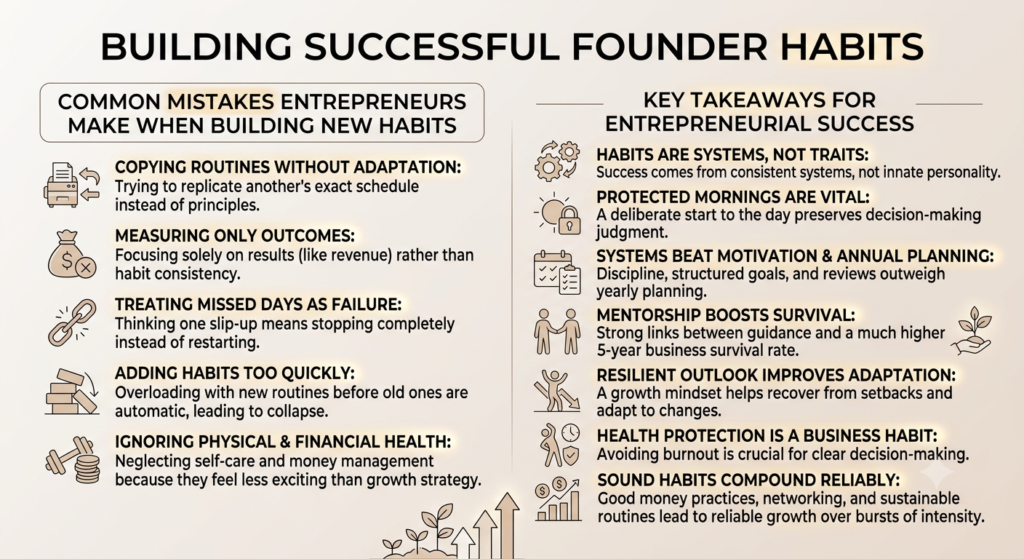
- Copying someone else’s exact routine instead of adapting the underlying principle to your own life and business
- Measuring success only by outcomes, like revenue, instead of tracking whether the habit itself was actually performed
- Treating a missed day as a failure instead of simply returning to the habit the next day
- Adding new habits faster than old ones become automatic, which usually causes all of them to collapse at once
- Ignoring the physical and financial habits entirely because they feel less exciting than strategy or growth hacking
Key Takeaways
- The success habits of entrepreneurs are systems repeated consistently, not personality traits some founders happen to have
- A protected, deliberate morning matters more for the judgment it preserves than for the specific wake-up time
- Discipline, structured goal setting, and weekly reviews consistently outperform annual planning and pure motivation
- Mentorship is one of the most strongly evidence-backed habits, linked to roughly double the five-year survival rate
- A resilient, growth-oriented outlook measurably improves how founders recover from setbacks and adapt to challenges
- Founder burnout is widespread and directly damages decision-making, making health protection a business habit, not a luxury
- Sound money habits, deliberate networking, and small sustainable routines compound far more reliably than occasional bursts of intensity
Conclusion
None of the founders behind these statistics became resilient, well-funded, or well-supported by accident. They built small, repeatable systems around their mornings, their goals, their relationships, and their health, and then they kept doing them long after the initial motivation wore off. That is really what the success habits of entrepreneurs come down to: not a single dramatic decision, but a quiet stack of ordinary ones, repeated on the days that do not feel inspiring at all. Start with one. Let it become automatic. Then add the next.
Frequently Asked Questions
What is the single most important success habit for a new entrepreneur? There is no single habit that guarantees success, but structured goal setting paired with a consistent weekly review tends to have the broadest impact, since it exposes problems early enough to actually fix them.
Do successful entrepreneurs really wake up at 5 a.m.? Some do, but the research supports the underlying principle more than the specific hour: a protected, distraction-free block early in the day tends to produce sharper decisions than the same tasks handled later, whenever that block happens to fall for you.
How important is mentorship compared to other habits? Mentorship has some of the strongest survival data of any habit discussed here, with mentored businesses reporting survival rates roughly double those of non-mentored businesses in multiple independent surveys.
Can discipline actually be trained, or is it a fixed trait? Research consistently treats discipline and mindset as trainable skills rather than fixed traits, particularly when supported by systems that reduce reliance on willpower alone.
How do I know if I am heading toward burnout? Common early signs include chronic irritability, trouble sleeping several nights a week, a sense of detachment from work you used to enjoy, and consistently working well past 50 hours a week without any offline recovery time.
Is it realistic to build all ten of these habits at once? No, and trying to is one of the most common reasons habit change fails. A gradual, one-habit-at-a-time approach over several weeks is far more likely to produce habits that actually last.