

Every founder I know has asked the same question at some point, usually at 11 p.m. with a laptop open and three tabs of spreadsheets: how do I actually grow this thing?
Not “grow” as in a vague, feel-good arrow pointing up and to the right. Grow as in more revenue, more customers who stick around, and a business that doesn’t fall apart the moment you take a week off.
Here’s the uncomfortable part. Most of the advice out there treats growth like a hack. Post more. Run more ads. Hustle harder. None of that is wrong exactly, but none of it addresses the thing that actually determines whether a business grows or stalls: whether it’s built to handle more.
This article is a practical, current playbook. It pulls from the latest small business data available in 2026, not recycled advice from a decade ago, and it walks through the levers that genuinely move revenue: positioning, systems, marketing, retention, pricing, hiring, and the role AI now plays in all of it.
By the end, you’ll have a framework you can actually apply this quarter, not just another list to bookmark and forget.
Why Most Businesses Stall Before They Scale
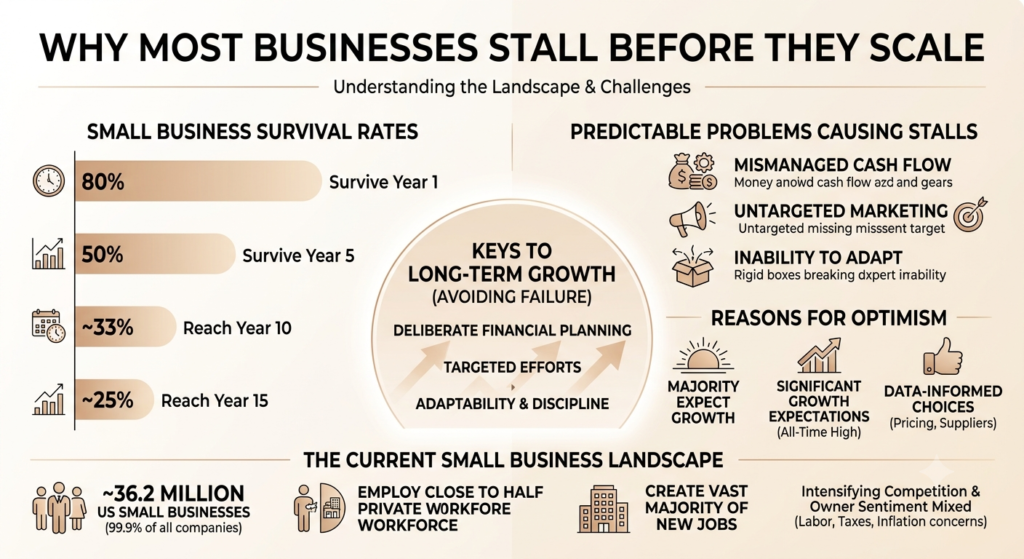
The data on small business survival is sobering, and worth sitting with before we get to solutions. About 20% of small businesses close within their first year, half don’t make it past five years, and only around a third reach the ten-year mark. Just one in four survives to year fifteen.
That’s not because most founders lack ambition or work ethic. It’s usually one of a handful of predictable problems: cash flow gets mismanaged, marketing efforts aren’t targeted at the right audience, or the business can’t adapt fast enough when customer needs shift.
The good news is that none of those are inevitable. Businesses that plan ahead, manage their finances deliberately, and stay adaptable have a meaningfully better shot at long-term growth. The failure rate isn’t a law of nature. It’s a pattern that disciplined operators consistently avoid.
There’s also reason for real optimism heading into this year. Recent industry surveys show that the vast majority of small business owners expect growth over the next twelve months, with nearly a third expecting significant growth, an all-time high for that measure. Owners are adjusting pricing, exploring new suppliers, and making deliberate, data-informed choices rather than just hoping things work out.
That optimism only pays off, though, if it’s paired with the right fundamentals. Let’s start there.
The Current Small Business Landscape
It’s worth understanding the environment you’re growing in. There are roughly 36.2 million small businesses operating in the United States today, making up 99.9% of all companies, and together they employ close to half of the entire private-sector workforce. Small businesses are also responsible for the vast majority of net new jobs created in recent years, which says a lot about how much economic weight sits on businesses exactly like yours.
New business formation remains strong too, with hundreds of thousands of new applications filed in a single recent month alone, well above pre-pandemic levels. That’s encouraging on one hand: entrepreneurship is durable. On the other hand, it also means competition for attention, talent, and customers is intensifying in almost every category.
Owner sentiment is a mixed picture worth knowing about honestly. Broad optimism indexes have dipped slightly below their long-run average recently, and owners consistently cite labor quality, taxes, and inflation among their top concerns. Most businesses, though, report revenue that’s stable or growing rather than declining, which suggests resilience even amid real headwinds. Understanding this backdrop helps set realistic expectations: growth right now tends to be incremental and earned, not explosive and easy, and that’s exactly why the fundamentals in this guide matter so much. Small business growth in this environment rewards patience and consistency far more than it rewards big, one-time bets, which is a theme you’ll see repeated throughout the rest of this guide.
How to Grow a Business: Getting the Foundation Right First
If you take one idea from this article, make it this one: how to grow a business is really a question about sequencing, not intensity. Founders who try to force growth before the foundation is solid usually end up rebuilding that foundation later, under pressure, while also trying to serve a larger customer base. That’s a brutal combination.
The founders who grow sustainably tend to nail four things before they push hard on acquisition:
- A specific, well-understood customer they’re solving a real problem for.
- Operational systems that don’t depend entirely on the founder’s attention.
- A pricing and cash flow structure that can absorb growth instead of being strained by it.
- A repeatable way to bring in and keep customers, not a one-off campaign.
None of this is complicated in theory. It’s just unglamorous, which is exactly why so many businesses skip it and jump straight to “how do we get more customers.” We’ll come back to acquisition, but only after covering the parts that make acquisition worth doing.
Think of business growth strategies less as a checklist and more as a set of interlocking systems. Weakness in one area shows up as a symptom somewhere else. Founders often diagnose a marketing problem when the real issue is retention, or a hiring problem when the real issue is pricing. Getting the sequence right saves you from solving the wrong problem.
Know Exactly Who You’re Building For
Vague targeting is one of the most common reasons marketing spend gets wasted. If your ideal customer could be “basically anyone who needs X,” your messaging will be generic enough that it resonates with no one in particular.
Strong positioning starts with market research that goes beyond assumptions. Talk to your best current customers directly and ask what almost stopped them from buying, what they compared you to, and what they’d miss most if you disappeared tomorrow. Those three questions surface more useful insight than most formal surveys.
Once you understand that customer clearly, narrow your messaging around their specific situation rather than trying to speak to everyone. A landscaping company that says “we help time-strapped homeowners in growing suburbs keep their yard show-ready without lifting a finger” will out-convert one that says “quality lawn care services” every time, because the first message makes a specific person feel seen.
This clarity also protects you from a subtle trap: chasing every customer who shows interest, even the ones who are a poor fit. Poor-fit customers cost more to serve, churn faster, and quietly drag down your margins and your team’s morale. Saying no to the wrong customer is often a growth decision, not a limitation.
Build Systems Before You Add More Customers
Here’s a pattern that shows up constantly with growing businesses: revenue goes up, but so does chaos. Orders get missed. Response times slip. The founder becomes the bottleneck for every decision, big or small.
That’s what happens when growth outpaces systems. The fix isn’t complicated, but it does take deliberate time investment before you need it, not after.
Start by documenting your core processes: how a lead becomes a customer, how an order gets fulfilled, how a complaint gets resolved. Write it down in enough detail that someone new could follow it without asking you twenty questions. This single habit is one of the highest-leverage business systems any founder can build, because it turns tribal knowledge into something transferable.
Next, separate the work that requires your specific judgment from the work that doesn’t. Founders frequently underestimate how much of their day is spent on tasks a system, a template, or another person could handle just as well. Reclaiming that time is often the real unlock for scaling a business, because it lets you spend your hours on the decisions only you can make: strategy, key relationships, and quality control.
A few practical starting points:
- Create standard operating procedures for your five most repeated tasks.
- Set up templates for recurring communications like onboarding emails or invoices.
- Build a simple dashboard that shows you the handful of numbers you actually check daily.
- Automate the manual, repetitive steps first; they’re the easiest wins.
None of this needs to be elaborate. A shared document and a consistent habit of updating it beats an expensive system nobody actually uses.
Marketing That Compounds Instead of Resetting Every Month
Marketing gets blamed for a lot of growth problems, and sometimes fairly. Roughly 14% of businesses that close point to poor marketing as a contributing factor, and a large share of owners privately admit they aren’t confident their marketing efforts are working at all.
But the deeper issue usually isn’t a lack of marketing. It’s marketing that starts from zero every month instead of compounding. Paid ads stop the moment the budget runs out. A blog post, a strong customer review, or a well-built email list keeps working long after you’ve stopped actively promoting it.
Content marketing is a good example of this compounding effect. It tends to generate several times more leads than traditional advertising over time, because a genuinely useful article or guide keeps attracting the right audience through search long after it was published. Email marketing shows a similarly strong return, consistently delivering one of the highest returns of any marketing channel per dollar spent, largely because you already own that audience relationship instead of renting it from a platform.
Social media deserves a mention too, but with a caveat. Most small businesses post regularly, yet a much smaller share actually engage back with the people commenting and messaging them, even though direct engagement is what most customers actually want from a brand. Posting without responding is like setting up a storefront and locking the door.
A grounded approach to marketing in 2026 looks something like this:
- Pick one or two channels where your specific customer actually spends time, rather than trying to be everywhere.
- Build an email list from day one; it’s an asset you own outright.
- Publish content that answers real questions your customers ask before they buy.
- Actually reply to comments, messages, and reviews instead of treating social media as a broadcast channel.
- Keep a simple website that clearly explains what you do; a surprising number of small businesses still operate without one, which quietly caps their credibility and reach.
Retention Over Acquisition: The Math Most Owners Ignore
This is the section I’d ask you to read twice, because the numbers here are genuinely striking, and most founders have never seen them laid out clearly.
Acquiring a new customer typically costs somewhere between five and twenty-five times more than keeping an existing one. That’s not a small gap. It’s the difference between a sustainable growth engine and a business that’s constantly running just to stay in place.
The profit impact of retention is even more dramatic. A modest five percent improvement in customer retention can lift overall profits by anywhere from twenty-five to ninety-five percent, depending on the industry and margin structure. Existing customers also convert at a much higher rate than new prospects, with purchase probability commonly landing around sixty to seventy percent for repeat buyers versus a much lower range for someone hearing about you for the first time.
There’s a reason for this. Existing customers already trust you. They’ve already made the decision once. Every dollar you spend nurturing that relationship works harder than a dollar spent trying to convince a total stranger.
Despite this, most businesses still pour the majority of their marketing budget into acquisition. That imbalance is exactly why retention represents one of the biggest untapped opportunities for small businesses right now. A few ways to act on this:
- Set up a simple check-in cadence with existing customers instead of only reaching out when you have something to sell.
- Ask directly what almost made them leave, and fix that root cause.
- Reward loyalty in a way that feels personal, not just a generic points program.
- Make it easy for happy customers to refer others; word of mouth from a retained customer is some of the cheapest, highest-trust acquisition you can get.
Growing a business doesn’t always mean finding new people. Sometimes it means giving the people already in your orbit a better reason to stay, and consistent effort here is what genuine brand loyalty is actually built from, not a logo or a slogan.
Pricing and Cash Flow: The Quiet Growth Killer
Pricing gets treated as a one-time decision, set once at launch and rarely revisited. That’s a mistake, and it’s one of the most common silent drags on growth.
Underpricing feels safe because it removes objections, but it also removes your margin for error. When costs rise, as they consistently have in recent years, a business with thin margins has almost no room to absorb the pressure without either cutting corners or bleeding cash.
Cash flow management deserves just as much attention as revenue. A business can be profitable on paper and still collapse because money isn’t arriving fast enough to cover payroll, inventory, or rent. Rising costs of goods, services, and wages have been the single most common financial pressure small business owners report recently, and a majority also cite the added strain of higher input costs on top of that.
Practical moves that protect growth here:
- Revisit pricing at least once a year against your actual costs, not just what feels comfortable.
- Build a cash buffer before you need it, not after a slow month forces the issue.
- Invoice promptly and follow up on late payments without letting awkwardness get in the way.
- Understand your break-even point at different growth stages, so you know exactly how much cushion you have.
Confidence in growth is running high across the small business landscape, but confidence and cash flow discipline need to move together. One without the other is how optimistic businesses end up in trouble.
Hire and Delegate Without Losing Control of the Business
At some point, growth requires more hands than you have. This is usually where founders either unlock the next stage of the business or quietly become the ceiling that limits it.
The instinct to hold onto everything yourself is understandable. You built this. You know it better than anyone. But that instinct, left unchecked, turns you into a bottleneck exactly when the business needs you focused on higher-level decisions.
Delegation works best when it’s structured, not improvised. Before you hire, write down what “done well” actually looks like for that role. Vague expectations lead to vague results, and then to the frustrating conclusion that “delegation doesn’t work here,” when really the handoff was never clear in the first place.
Start by delegating outcomes, not just tasks. Instead of telling someone exactly how to do something step by step, tell them what result you need and let them find their own path to it, checking in at agreed points. This builds real ownership rather than dependence on you for every decision.
A few principles that make hiring and delegating smoother:
- Hire for the next six to twelve months of need, not just today’s workload.
- Document the role’s core responsibilities before you post the listing.
- Set a short trial period with clear, specific check-in points.
- Resist the urge to take a task back the first time it’s done differently than you would have done it yourself.
Long-term thinking matters here too. Owners who think generationally about their business, building something meant to last and eventually be passed on rather than just optimizing for a quick exit, tend to make steadier hiring and delegation decisions. That mindset alone tends to produce more resilient teams.
Use AI as a Growth Multiplier, Not a Gimmick
AI adoption for small business has moved from novelty to mainstream extremely fast in a short window of time. A majority of small business owners now report using AI in some capacity, and the share reporting a positive impact from it is consistently high, often north of eighty-five percent among active users.
The businesses seeing real results aren’t the ones treating AI as a toy to poke around with occasionally. They’re the ones that picked one or two specific, recurring tasks and built AI into that workflow consistently: drafting marketing copy, handling first-line customer service questions, summarizing customer feedback, or speeding up admin work that used to eat hours every week.
There’s a meaningful gap worth being honest about. A large share of small business owners describe themselves as “explorers,” testing tools without fully committing, and relatively few reach a stage of deep, confident integration. That gap isn’t really about access to the technology anymore; the tools are cheap and widely available. It’s about having a clear plan for where AI actually fits into daily operations.
The growth correlation is hard to ignore, though. Small business owners who have adopted AI are meaningfully more likely to report year-over-year revenue growth than those who haven’t, and that gap tends to widen over time as AI-enabled operators compound their efficiency gains.
Practical starting points for using AI as an actual growth lever:
- Pick one repetitive task this month and commit to using AI for it consistently, rather than experimenting broadly and shallowly.
- Use it to draft first versions of marketing content, then apply your judgment and brand voice on top.
- Let it handle routine customer questions so your team can focus on the conversations that need a human touch.
- Track the time it actually saves you, so the investment feels tangible rather than abstract.
AI won’t build the foundation covered earlier in this article for you. But once that foundation exists, it’s one of the fastest ways to get more output from the same number of hours.
Track the Few Numbers That Actually Matter
Founders often either track nothing or track everything. Both extremes cause problems. Tracking nothing means you’re flying blind. Tracking everything means you’re drowning in dashboards and never acting on any of it.
A tighter approach works better: pick a small handful of numbers that genuinely reflect the health of your business, and check them consistently.
At minimum, most businesses benefit from watching:
- Revenue and profit margin, not just top-line sales.
- Customer acquisition cost against customer lifetime value, so you know whether growth is actually profitable growth.
- Customer retention rate, since even small movements here have an outsized effect on profit, as covered earlier.
- Cash on hand relative to your monthly operating costs.
The specific metrics matter less than the discipline of actually reviewing them on a set schedule, weekly or monthly, and asking what changed and why. Data that nobody looks at is just noise. Data reviewed consistently becomes an early warning system.
Common Growth Mistakes That Quietly Sabotage Momentum
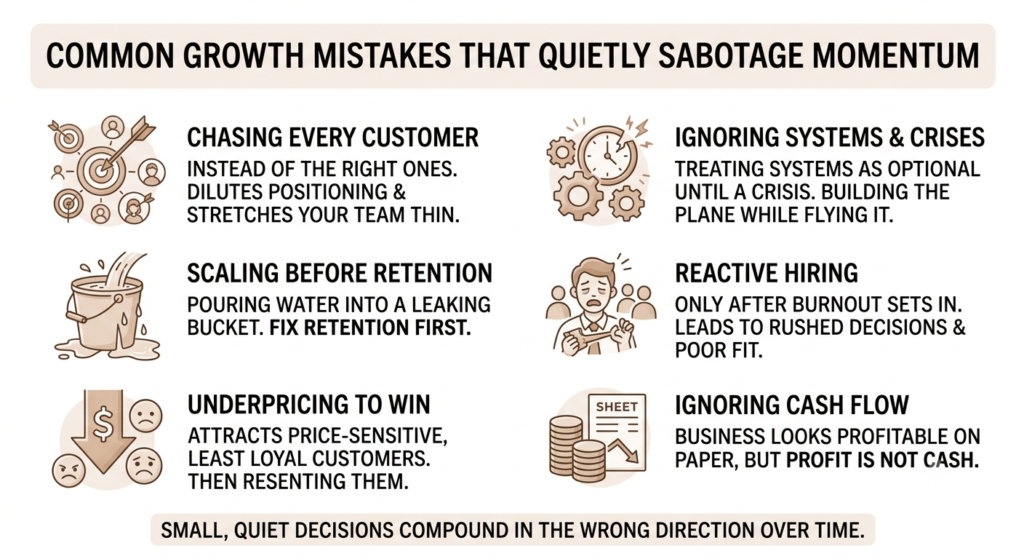
A few patterns show up again and again in businesses that stall out despite genuine effort:
- Chasing every customer instead of the right ones. This dilutes your positioning and stretches your team thin serving people who were never a great fit.
- Scaling marketing spend before fixing retention. You end up pouring water into a leaking bucket.
- Underpricing to win business, then resenting the customers it attracts. Low prices tend to attract the most price-sensitive, least loyal customers.
- Treating systems as optional until there’s a crisis. By then, you’re building the plane while flying it.
- Hiring reactively, only after burnout sets in. This leads to rushed decisions and a poor fit for the role.
- Ignoring cash flow because the business looks profitable on paper. Profit and cash are not the same thing, and the gap between them has closed more than one otherwise-healthy business.
None of these are dramatic failures. They’re small, quiet decisions that compound in the wrong direction over time, which is exactly why they’re worth naming directly.
Key Takeaways
- Sustainable growth starts with the foundation, not the acquisition push: clear positioning, working systems, and cash flow discipline come first.
- Know your specific customer well enough to say no to the wrong ones; narrow, clear positioning consistently outperforms trying to appeal to everyone.
- Document your core processes before you need to hand them off; this is what makes delegation and hiring actually work.
- Marketing that compounds, like content and email, beats marketing that resets to zero every month.
- Retention is dramatically cheaper and more profitable than acquisition; a small improvement in retention can meaningfully lift overall profit.
- Revisit pricing regularly and build a cash buffer before a slow period forces the issue.
- Delegate outcomes, not just tasks, and hire ahead of need rather than in reaction to burnout.
- Use AI consistently on one or two specific workflows rather than experimenting broadly without a plan.
- Track a small set of meaningful numbers consistently instead of everything sporadically.
Conclusion
Growth isn’t really about doing more of everything at once. It’s about getting a handful of fundamentals right, in the right order, and then applying steady effort on top of that foundation.
Know exactly who you’re serving. Build systems that don’t depend entirely on you. Protect the customers you already have as fiercely as you chase new ones. Price with enough margin to absorb the unexpected. Hire and delegate deliberately. Use AI where it genuinely saves time, not just because it’s trendy.
None of this is flashy advice, and that’s precisely why it works. The businesses that grow steadily over years, not just for one good quarter, are almost always the ones that treated growth as a discipline rather than a sprint.
Start with one section of this article. Fix one thing this month. That’s how real, lasting growth actually happens.
Frequently Asked Questions
What’s the fastest way to grow a small business? There isn’t a genuine shortcut, but the fastest sustainable path is usually improving retention and referrals from your existing customers while tightening your positioning, rather than immediately spending more on new customer acquisition.
How much should a small business spend on marketing to grow? This varies widely by industry and margin, but the more important question is where that spend goes. Channels that compound, like content and email, tend to deliver stronger long-term returns than one-off paid campaigns alone.
Is it better to focus on new customers or keeping existing ones? Existing customers are almost always the higher-return focus, given how much more expensive acquisition typically is and how much a small improvement in retention can lift profit. That said, you still need a steady, realistic pace of new customer growth to replace natural churn.
When should a small business start hiring? Ideally before burnout forces the decision. A good signal is when you’re consistently doing tasks that don’t require your specific judgment, or when a lack of capacity is directly costing you revenue or quality.
Do small businesses really need to use AI to grow? It’s not mandatory, but the data increasingly shows a real gap between businesses that have integrated AI into specific workflows and those that haven’t, particularly around marketing output and time saved on administrative work.
How do I know if my business is ready to scale? Look for three signs together: your core processes are documented and don’t rely entirely on you, your retention numbers are healthy, and your cash flow has enough buffer to absorb the bumps that come with serving more customers.