
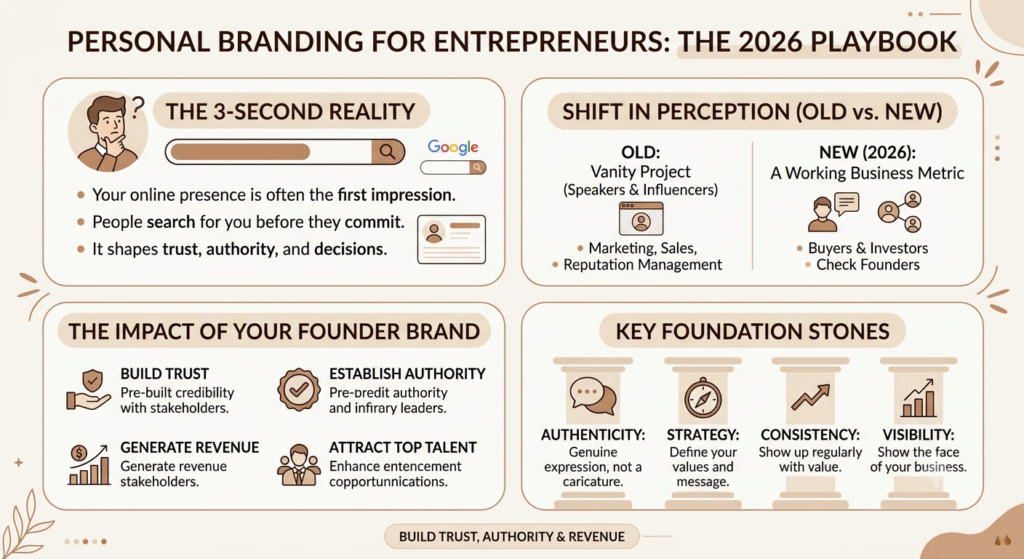
Somewhere between your last product launch and your next investor call, someone typed your name into Google. Or into ChatGPT. Or into Perplexity. What they found in those three seconds probably did more to shape their decision than your pitch deck ever could.
That is the quiet reality most founders are only now waking up to. Your company has a logo, a website, and a tagline. But your company does not have a face that people trust before they have even spoken to you. You do.
Personal branding for entrepreneurs used to sound like a vanity project – something for motivational speakers and Instagram influencers. Not anymore. In 2026, it has become a working part of the business itself, sitting somewhere between marketing, sales, and reputation management. Buyers research the founder before they research the product. Investors check the entrepreneur’s track record and public presence before they check the spreadsheet. Employees decide whether to join a company partly based on what its leader sounds like online.
This guide walks through what personal branding for entrepreneurs actually means today, why it has become harder to ignore, and how to build one that holds up under scrutiny – without turning into a caricature of yourself in the process.
1. What Personal Branding Really Means for Entrepreneurs
Personal branding is not a logo, a tagline, or a curated highlight reel. It is the sum of what people believe about you when your name comes up in a room you are not in. It is built from your expertise, your track record, the way you communicate, and the consistency between what you say and what you actually do.
For entrepreneurs specifically, this takes on extra weight because the line between “you” and “the business” is thinner than it is for an employee at a large company. When a founder speaks publicly, people do not just hear an opinion – they hear a signal about how the company itself thinks, operates, and treats people. That is why personal branding for entrepreneurs is different from personal branding for, say, a mid-level manager at a Fortune 500 company. The stakes are direct. Your reputation and your revenue are connected in ways that are hard to separate.
Personal Brand vs. Company Brand
A company brand belongs to a legal entity. It can be renamed, rebranded, sold, or shut down without a single person losing their reputation. A personal brand belongs to you. It follows you if you pivot, if the company fails, if you start something new. This is precisely why so many entrepreneurs are investing time in it now – it is one of the few business assets that cannot be acquired, copied, or automated away. Competitors can copy your product. They cannot copy your story, your judgment, or the trust you have earned with an audience over years of showing up consistently.
Why “You” Became the Strategy
The shift did not happen overnight. Tom Peters’ 1997 essay “The Brand Called You” first proposed that professionals should manage their reputations with the same rigor a company applies to its products. For two decades, that idea stayed mostly theoretical for most business owners. Social media, and later AI-driven search, turned it into something unavoidable. People no longer wait for a handshake to form an opinion about you – they form it the moment they search your name, and what they find sets the tone for everything that follows.
2. Why Personal Branding for Entrepreneurs Matters More Than Ever
If you are wondering whether this is worth the time investment, the data is fairly blunt about it.
Trust Has Shifted From Institutions to Individuals
Confidence in mass media and large institutions has been declining for years, and audiences have responded by putting their trust in individual voices instead of corporate ones. People are far more likely to trust a company when its leaders are visibly and consistently active, and financial audiences in particular trust leaders with an established public presence over those without one by a wide margin. This is not a fringe preference anymore – it has become the default expectation among buyers, employees, and investors alike.
The Numbers Behind the Shift
A few data points make the case clearly:
- Employers increasingly weigh a candidate’s or partner’s public reputation alongside – and sometimes above – a traditional resume or pitch document.
- A large share of consumers say they feel a stronger emotional connection to companies whose leaders show up authentically on social platforms, and that connection translates into purchasing decisions.
- Executives estimate that a meaningful portion of a company’s overall market value is tied directly to the reputation of its CEO or founder.
- Content shared by an individual consistently earns dramatically more engagement and reach than the same message posted from a branded company account, because people trust and interact with people, not logos.
Personal branding for entrepreneurs, in other words, is no longer a soft metric. It shows up in hiring outcomes, sales conversations, fundraising conversations, and even in how forgiving the market is when something goes wrong.
AI Has Changed the Front Door to Your Business
Here is the part that is genuinely new. A large and growing share of online searches now end without a single click, because the answer is delivered directly inside the search results or inside an AI chat interface. People are increasingly asking ChatGPT, Perplexity, or Google’s AI-driven overviews who the trusted voices are in a given field, rather than scrolling through search results themselves.
That means your reputation is being summarized and served up by systems you do not control, based on what already exists about you across the web. If there is little public, credible, well-structured content connected to your name, AI systems have nothing to draw from, and you simply will not appear in the answer. This has quietly raised the stakes for founders who assumed a decent LinkedIn profile was enough.
3. The Five Pillars of a Strong Personal Brand
A personal brand that actually holds up is built on five things working together, not any single viral moment.
Clarity
Clarity means people can describe what you do and what you stand for in one sentence, without hesitation. If your own team cannot explain your positioning simply, neither can your audience. Vague founders get scrolled past. Specific founders get remembered.
Consistency
A brand is not one great post – it is the same message, tone, and set of priorities showing up over months and years. Consistency is what separates a personal brand from a temporary burst of attention. It is also what search engines and AI systems reward, because repeated, coherent signals are easier to trust than a single spike of activity.
Credibility
Credibility is proof, not claims. Case studies, results, testimonials, media mentions, and a track record of follow-through all build credibility faster than any amount of self-description. Entrepreneurs who lead with evidence rather than adjectives tend to earn trust faster and lose it slower.
Community
The strongest personal brands today are not built on audience size alone – they are built around a smaller, more engaged group of people who actively participate, share, and advocate. A few hundred genuinely engaged followers in your specific niche will outperform a much larger, passive following almost every time, because engagement, not reach, is what actually drives referrals and opportunities.
Channel
Finally, a personal brand needs a home base – usually a website or blog you fully control – plus one or two platforms where you show up consistently. Renting an audience on a single social platform is risky. Owning a channel, like a blog or an email list, protects you if an algorithm changes or a platform loses relevance.
4. How to Build a Personal Brand Step by Step
This is where most guides get vague. Here is a practical sequence you can actually follow.
Step 1: Define Your Niche and Your Story
Start narrower than feels comfortable. “Entrepreneurship” is not a niche; it is a category with millions of voices already in it. “How service-based founders build repeatable systems without burning out” is a niche. The narrower and more specific your positioning, the easier it is for the right people to find you and for AI systems to categorize you correctly.
Pair that niche with a real story – the actual failures, decisions, and turning points that shaped how you think. Personal branding for entrepreneurs works best when it is rooted in lived experience rather than borrowed advice. Audiences, especially younger ones, are noticeably better at detecting when someone is repeating generic talking points versus sharing something they actually lived through.
Step 2: Choose Your Primary Platform
Do not try to be everywhere at once. Pick the one platform where your ideal audience already spends time, and commit to it before expanding. For most business-to-business entrepreneurs, that platform is still LinkedIn. For consumer-facing founders, it may be a video-first platform instead. The mistake is not picking the “wrong” platform – it is spreading effort so thin across five platforms that none of them build real momentum.
Step 3: Build a Content System, Not a Content Habit
A habit relies on motivation. A system runs even on the days you do not feel like posting. Build a simple, repeatable structure: one core idea per week, broken into a long-form piece for your blog, a shorter version for your main platform, and a few supporting posts pulled from the same idea. This is far more sustainable than trying to invent something new every single day, and it keeps your message consistent – which, as covered above, is one of the five pillars that actually compounds over time.
Step 4: Create Proof, Not Just Opinions
Opinions are easy to produce and easy to forget. Proof is what sticks. Document real results: a process that worked, a mistake that cost you money and what you learned from it, a before-and-after from a client or your own business. Data-backed, specific content consistently outperforms generic motivational posts, both with human audiences and with the AI systems now summarizing the web.
Step 5: Get Visible Beyond Your Own Channels
Guest appearances on podcasts, quotes in industry publications, and mentions on other people’s platforms all do something your own posts cannot: they borrow credibility from an already-trusted source. A single well-matched podcast interview can take an hour of your time and generate material for weeks of content, while also strengthening the third-party signals that AI systems and search engines use to decide who counts as a genuine authority in a given space.
5. Personal Branding Across Platforms
LinkedIn: Still the Default for B2B Founders
LinkedIn remains the primary arena for business-to-business personal branding for entrepreneurs, and the platform continues to reward frequency and authenticity over follower count. Founders who post consistently, several times a week, tend to build stronger and more durable visibility than those who post occasionally, even with a smaller starting audience. Engagement per post tends to shrink as a following grows, which is part of why resharing and revisiting older, high-performing ideas has become a normal and accepted practice rather than something to be embarrassed about.
Your Website and Blog: The Home Base
Social platforms come and go, and algorithms change without warning. A website you own is the one channel that cannot be taken from you by a policy update. It is also the clearest place for AI systems and search engines to pull structured, detailed, well-sourced information about you – which matters more now than it did even two years ago.
Podcasts and Guest Appearances
Hosting a podcast is a heavy operational commitment for most founders, and many who tried it discovered the return on their time did not justify the workload. Guesting on other people’s shows has become the more efficient alternative, offering visibility across multiple platforms – audio, video, and written recaps – from a single conversation, without the ongoing production burden of running a show yourself.
6. Personal Branding in the Age of AI and Answer Engines
This is the part of personal branding for entrepreneurs that has changed the fastest, and it deserves its own section.
What Answer Engine Optimization Means for Founders
Answer Engine Optimization, often shortened to AEO, is the practice of structuring your public content so that AI systems like ChatGPT, Perplexity, Gemini, and Google’s AI-driven search summaries can find, understand, and cite it directly in their answers. Unlike traditional search engine optimization, which is measured mostly by page rankings and clicks, AEO is measured by whether you actually get mentioned inside the answer itself – sometimes without the user ever clicking through to your website at all.
For entrepreneurs, this means a few practical things:
- Write clear, self-contained statements about your expertise, rather than relying only on personality-driven storytelling. AI systems favor content that is direct and unambiguous.
- Keep your public information consistent across platforms – your bio, your credentials, your area of focus. Conflicting information across your website, LinkedIn, and press mentions makes it harder for AI systems to trust any single source.
- Earn genuine mentions from credible third parties. AI systems weigh brand mentions and independent corroboration heavily when deciding which sources to trust and cite.
- Publish original insight, not recycled advice. Systems designed to summarize the web are, by definition, drawn toward content that says something not already said a thousand times elsewhere.
Staying Human While Using AI as an Assistant
There is a real tension founders are navigating right now. AI tools are genuinely useful for research, organizing thoughts, and speeding up early drafts. But the audiences reading your content can tell the difference between a founder’s actual thinking and a fully AI-generated post, and that difference is starting to matter. Leaders who let AI do the thinking and the writing tend to produce content that reads as interchangeable with everyone else’s – technically fine, but forgettable. The founders getting real traction are the ones using AI as a research assistant while keeping the actual perspective, judgment, and voice unmistakably their own.
This is, if anything, an argument in favor of personal branding rather than against it. When AI can replicate almost any product description or generic advice post, the thing that remains genuinely scarce is a specific human being with real experience and a distinct point of view.
7. Common Mistakes Entrepreneurs Make With Personal Branding
Trying to sound like everyone else. Scroll through any professional platform and you will notice the same phrases, the same “five lessons I learned” structure, repeated endlessly with slightly different headshots attached. That sameness is a direct result of outsourcing both thinking and writing to templates or AI without adding a real point of view.
Posting without a system. Inconsistent, sporadic activity signals low commitment to both human audiences and the algorithms that decide how far your content travels. A documented, repeatable plan consistently outperforms random bursts of enthusiasm.
Confusing visibility with vulnerability theater. Being real does not mean oversharing or manufacturing emotional moments for engagement. Public visibility carries genuine reputational risk, and audiences are quick to notice when personal disclosure feels performative rather than sincere.
Ignoring the written word in favor of only video or only short posts. Long-form content – blog posts, deep LinkedIn articles, detailed case studies – remains one of the strongest signals of real expertise, and it is also the format AI systems draw on most heavily when constructing answers about who the credible voices in a field actually are.
Neglecting consistency across platforms. A polished LinkedIn profile paired with an outdated website, or a bio that says something different depending on where someone finds it, undermines the very trust personal branding for entrepreneurs is supposed to build.
8. How to Measure the ROI of Your Personal Brand
Founders often assume personal branding is unmeasurable, but that is no longer accurate. A few concrete indicators tend to show up in a fairly predictable order:
- Early indicators (within roughly 90 days): inbound inquiries you did not chase, unsolicited speaking or podcast invitations, and partnership interest from people who found you rather than the other way around.
- Mid-term indicators (within about six months): a measurable shift in how sales conversations open, with prospects arriving already familiar with your perspective, which tends to shorten the overall sales cycle.
- Long-term indicators (six months and beyond): direct revenue attribution, where deals, hires, or investment conversations can be traced back to content, a mention, or a piece of visibility you built deliberately.
The key discipline is connecting brand-building activity to specific business outcomes from day one – inbound leads, qualified conversations, retention, hiring quality – rather than treating personal branding as a vague, long-term investment with no defined payoff.
Key Takeaways
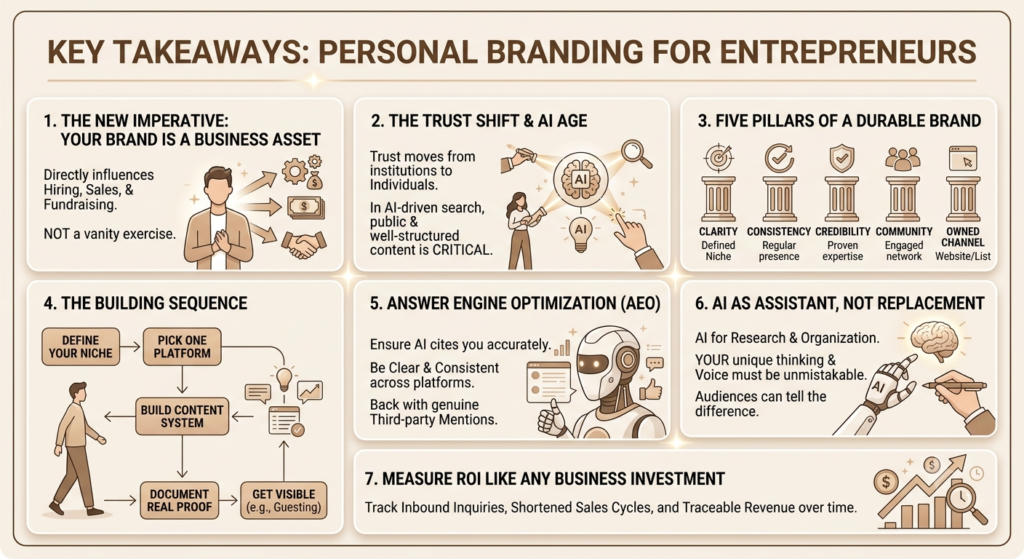
- Personal branding for entrepreneurs is now a functional business asset, not a vanity exercise, and it directly influences hiring, sales, and fundraising outcomes.
- Trust has shifted from institutions toward individuals, and AI-driven search has made public, well-structured content about you more important than ever.
- A durable personal brand rests on five pillars: clarity, consistency, credibility, community, and a channel you actually own.
- Building one is a sequence, not a single campaign: define your niche, pick one platform, build a repeatable content system, document real proof, and get visible on other people’s platforms too.
- Answer Engine Optimization means your public content should be clear, consistent across platforms, and backed by genuine third-party mentions if you want AI systems to cite you accurately.
- AI can assist your research and organization, but the thinking and the voice need to stay unmistakably yours – audiences and AI systems alike can tell the difference.
- Measure your personal brand the same way you measure any other business investment: through inbound inquiries, shortened sales cycles, and traceable revenue over time.
Conclusion
Personal branding for entrepreneurs is not about performing a more polished version of yourself online. It is about making sure the real substance of your work – your judgment, your track record, your specific way of solving problems – is actually visible to the people who need to find it, whether that person is a customer, an investor, a future employee, or an AI system summarizing who the trusted voices in your field are.
The founders who get this right in the years ahead will not necessarily be the loudest or the most polished. They will be the most consistent, the most specific about what they stand for, and the most willing to put their real thinking into the world before they feel fully ready. That, more than any single tactic in this guide, is what personal branding has always actually been about.
Frequently Asked Questions
Is personal branding still worth it for entrepreneurs in 2026, given how saturated social media has become? Yes, though the bar has risen. Audiences have grown more discerning, not more indifferent, which means generic content performs worse than it once did, while specific, well-documented expertise performs better. Saturation has raised the quality threshold rather than eliminating the opportunity.
How long does it take to see results from personal branding? Most founders start seeing early signals – inbound interest, invitations, unsolicited conversations – within about 90 days of consistent effort. Measurable revenue impact tends to follow within roughly six months, though this varies by industry and how narrow your niche is.
Do I need to be on every social media platform to build a personal brand? No. Spreading yourself across too many platforms usually dilutes your consistency, which is one of the core pillars a personal brand depends on. It is far more effective to commit fully to one or two platforms where your specific audience already spends time.
Is it acceptable to use AI tools when building a personal brand? Using AI for research, outlining, and organizing your thoughts is widely accepted and genuinely useful. The risk comes from letting AI generate the actual opinions and voice of your content, since audiences and AI systems themselves increasingly reward original, specific thinking over generic, templated output.
What is the single biggest mistake entrepreneurs make with personal branding? Inconsistency – both in how often they show up and in how they describe themselves across different platforms. A brand built on sporadic bursts of activity, or one that says something different on the website than it does on LinkedIn, struggles to build the trust that personal branding is meant to create.
Do I need a personal website if I am already active on LinkedIn? Yes. Social platforms can change their algorithms or relevance at any time, and you do not own that audience. A website is the one channel that is fully yours, and it is also where AI systems and search engines find the most structured, detailed information to draw from when representing your expertise.