

You block out your morning with good intentions. Then a notification pulls you away, a meeting runs long, and by 3 p.m. you are wondering where the day went. If that sounds familiar, you are not imagining it. Recent workplace research suggests the average employee is only productive for a fraction of the workday, even though everyone is putting in the hours.
The truth is uncomfortable but useful: most people do not have a motivation problem. They have a system problem. A handful of habits, tools, and workplace defaults are quietly eating hours out of every single day, and most professionals never stop long enough to notice.
This guide breaks down the biggest productivity killers that are working against you right now, backed by current research, and gives you practical, field-tested ways to remove them. You will not find generic hustle advice here. You will find the specific habits draining your time, why they happen, and what high performers do instead.
Why “Busy” and “Productive” Are Not the Same Thing
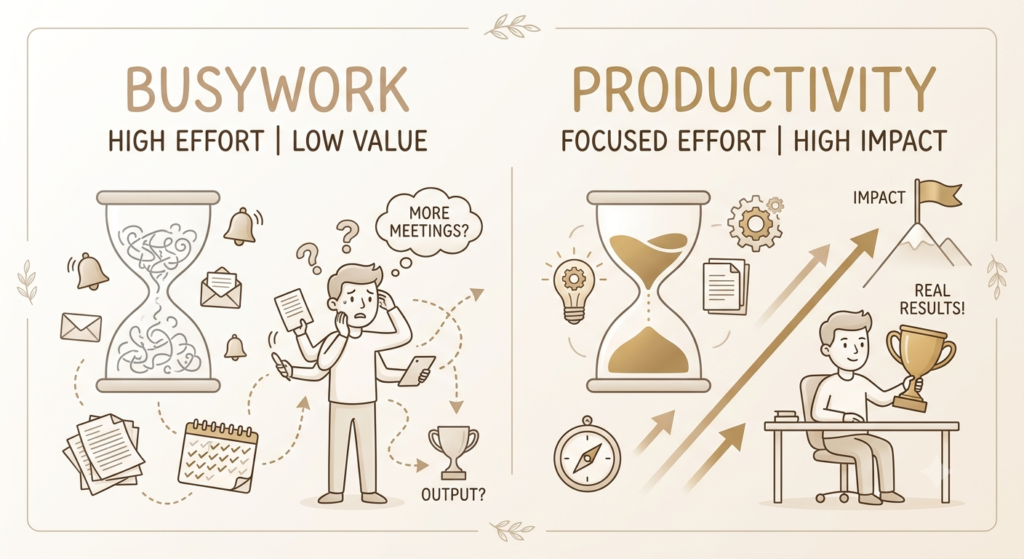
Recent workplace data paints a sobering picture. According to workplace productivity research compiled from Bureau of Labor Statistics and industry sources, the average employee is genuinely productive for only about 60 percent of the workday, meaning most people are getting fewer than five focused hours out of an eight-hour day. The rest disappears into interruptions, unnecessary meetings, and low-value busywork.
At the same time, Gallup’s 2026 State of the Global Workplace report found that global employee engagement fell to just 20 percent, the lowest level in years, and estimated that disengagement costs the world economy roughly 10 trillion dollars annually in lost productivity. That is not a small leak. That is a structural problem in how modern work is designed.
Here is the part that matters for you personally: you cannot fix a 10 trillion dollar global problem, but you can absolutely fix the specific habits inside your own day that are quietly working against you. That is what this article is for.
This is not about squeezing more hours out of an already full calendar. It is about learning to work smarter not harder, and that starts with seeing clearly where your time actually goes before trying to fix it.
1. Starting the Day Without a Clear Plan
Most people open their laptop and let their inbox decide what matters. This feels productive because you are “responding” to things, but it means someone else’s priorities are running your day instead of your own.
Reactive mornings create a pattern where you spend your highest-energy hours on other people’s requests, then hit your actual priorities late in the day when your focus has already been spent.
Why this happens
Email and chat apps are designed to feel urgent. Every unread message creates a small sense of unfinished business, and that pressure pulls your attention before you have even decided what today’s real priorities are.
The fix: the Top 3 Priorities method
Before you open email or Slack, write down the three outcomes that would make today a genuine success. Not tasks. Outcomes. Then work on the first one before you check anything else.
This single change reorders your day around what actually moves your business or career forward, instead of around what is loudest in your inbox. Plan tomorrow’s top three before you close your laptop today, and you remove the morning decision fatigue entirely. You already know where to start the moment you sit down.
2. Constant Notifications and Digital Distractions
This is arguably the single most damaging habit on this list, and the research on it is striking. A widely cited study from Gloria Mark at the University of California, Irvine found that it takes an average of about 23 minutes to fully regain deep focus after an interruption. The same research found that workers switch tasks or get interrupted roughly every three minutes throughout a typical day.
Microsoft’s own Work Trend Index data shows employees now face an interruption from meetings, email, or chat roughly every two minutes during core work hours, adding up to hundreds of disruptions across a single day. Under that kind of fragmentation, true deep work becomes nearly impossible. Most knowledge workers report only two to three hours of genuine focus time in an entire day.
Where these interruptions come from
- Email pings that arrive throughout the day, unrelated to urgency
- Social media checks that start as a “quick break” and stretch far longer
- Group chats where every message triggers a notification, whether it applies to you or not
- News alerts and app notifications competing for the same attention your work needs
Every one of these interruptions resets your concentration. It is not the 10 seconds you spend glancing at the phone that hurts you. It is the 20-plus minutes it takes your brain to rebuild the mental model of what you were doing before the interruption.
Solution
- Turn off every non-essential notification. If it is not a message from a client, your team, or someone in your household, it can wait.
- Schedule specific windows to check email and messages, rather than reacting the moment something arrives.
- Use your device’s Focus Mode or Do Not Disturb setting during your most important work blocks.
If you want to eliminate distractions at work in a way that actually sticks, the notification settings on your phone and laptop are the highest-leverage place to start. This is not about willpower. It is about removing the trigger entirely.
A practical layer beyond notification settings
Turning off alerts solves part of the problem, but how to stay focused for an entire work session usually requires one more layer: a visible signal to the people around you that you are unavailable. Whether that is a closed door, a status message, or headphones on, giving colleagues and family a clear signal reduces the number of “quick questions” that interrupt you before they even happen. Combine that with a single browser tab dedicated to your current task, closing everything unrelated, and you remove most of the environmental triggers that pull attention away from deep work.
3. Multitasking Is Reducing Your Efficiency
Multitasking feels productive. It is not. Your brain is not built to genuinely process two demanding tasks at once; what actually happens is rapid task-switching, and every switch carries a cost.
Recent workplace research indicates that task switching can reduce productivity by as much as 40 percent, particularly when work is fragmented across too many tools and channels at once. Separate research on task interruptions found that even brief switches, lasting just a few seconds, can double the error rate on the task you return to.
What is really happening in your brain
Every time you jump from writing to email to a phone call and back to writing, your brain has to reload context each time. That reloading is not instant. It costs real time, even if it feels seamless in the moment.
Solution
- Practice single-tasking. Pick one task, commit to it, and let everything else wait.
- Use time blocking to assign specific hours to specific types of work, so your brain stays in one mode at a time.
- Protect dedicated deep work sessions, ideally 60 to 90 minutes, where nothing else is allowed to interrupt.
This is one of the most overlooked productivity mistakes among ambitious professionals, because multitasking looks impressive from the outside while quietly costing you output on the inside.
4. Saying “Yes” to Everything
Every meeting you accept, every favor you agree to, and every low-value project you take on has an opportunity cost. Time spent on one thing is time that cannot be spent on the work that actually grows your business.
Entrepreneurs and small business owners are especially vulnerable here, because saying yes often feels like the responsible or generous choice. But every yes to something unimportant is quietly a no to something that matters more.
Solution
- Build a short list of polite ways to decline: “That sounds valuable, but it is not something I can take on right now,” or “Let me point you toward someone better suited for this.”
- Before accepting a new request, ask whether it moves your top priorities forward or simply feels urgent.
- Prioritize high-impact work over work that is easy to say yes to.
Protecting your time this way is one of the most practical productivity tips for entrepreneurs, because your calendar is a direct reflection of what you actually value, whether you intend it to be or not.
5. Endless Meetings That Produce Little Value
Meetings deserve their own section because the data on this is almost hard to believe. Research from Fellow’s State of Meetings report found the average employee now spends over 11 hours per week in meetings, close to 30 percent of a standard workweek. Harvard Business Review’s own survey of senior managers found that 71 percent believe their meetings are unproductive and inefficient.
The financial cost is just as striking. Research from Otter.ai and workplace analyst Steven Rogelberg found that companies pay an average of 80,000 dollars per professional employee each year just to attend meetings, and roughly 25,000 dollars of that, about 31 percent, goes toward meetings employees themselves consider completely unnecessary.
There is good news buried in this data too. A study reported by MIT’s Center for Information Systems Research found that when companies cut meeting volume by 40 percent, employee productivity rose by 71 percent. Fewer meetings do not just save time. They appear to unlock significantly more output.
Separate research from Asana adds another layer to this problem: knowledge workers spend roughly 60 percent of their time on what researchers call “work about work,” meaning coordination, status updates, and tool switching rather than the actual work itself. Meetings are one of the biggest contributors to that category, since a single one-hour meeting rarely just costs an hour. Preparation, follow-up, and the mental reset afterward routinely add another 30 to 45 minutes on top of the scheduled time.
Why meetings go wrong
- No agenda, so the conversation drifts without a clear purpose
- Too many attendees, most of whom did not need to be there
- Discussions that end without a single decision or next step
Solution
- Require an agenda before any meeting gets scheduled. No agenda, no meeting.
- Set a hard time limit and stick to it.
- End every meeting with clear next steps and named owners, so time in the room actually converts into progress.
If your team has grown used to meetings as the default way to communicate, shifting even a portion of that to async updates and short written summaries can free up hours every single week.
6. Perfectionism Is Delaying Progress
Perfectionism often disguises itself as high standards, but in practice it frequently becomes a sophisticated form of procrastination. Waiting until something is flawless before you ship it means your business, your content, or your product spends longer sitting unfinished than it needs to.
Quality versus perfection
Quality means the work is genuinely good and serves the people it is meant for. Perfection means chasing an ever-moving target that never quite feels finished. The first is achievable. The second is not.
Solution
- Aim for progress over perfection on every project.
- Apply the 80 percent rule: once something is 80 percent as good as you can realistically make it, ship it.
- Treat your first version as a starting point, not a final judgment. Iterate after launch based on real feedback, not imagined flaws.
This mindset shift alone can eliminate weeks of delay across a year, particularly for founders and content creators who are their own harshest critics.
7. Poor Energy Management
Time management gets most of the attention, but energy management matters just as much, arguably more. You can have a perfectly blocked calendar and still get nothing done if you are running on four hours of sleep and a skipped lunch.
What drains your energy
- Inconsistent or insufficient sleep
- Poor nutrition, particularly skipped meals or heavy reliance on caffeine and sugar
- No movement throughout the day
- Burnout from sustained overwork without real recovery
Energy is the resource that determines how well you use your time, not the other way around. Two people can have identical schedules and produce completely different results depending on how well they have managed their physical state.
Practical fixes
- Start the day with light movement, even a 10-minute walk, to boost alertness before you sit down to work.
- Build meals around real food rather than convenience snacks, especially during your most demanding work hours.
- Schedule short breaks throughout the day rather than pushing through until you crash.
- Protect a consistent sleep routine, even when work feels urgent enough to sacrifice it.
8. Context Switching Throughout the Day
Context switching is a close cousin of multitasking, but it deserves its own attention because it often happens without you noticing. You are writing a report, you check email, you take a quick call, you check social media, and then you try to return to writing. Each of those transitions carries the same 23-minute recovery cost mentioned earlier in this guide.
A typical example
Writing → checking email → a phone call → a quick scroll through social media → returning to writing. On paper this looks like four small tasks and one main task. In reality, it is closer to five separate cognitive reboots.
Solution
- Batch similar tasks together. Handle all your emails in one block, all your calls in another, rather than interspersing them throughout the day.
- Protect dedicated work blocks where switching is simply not allowed, and treat that boundary as seriously as you would a client meeting.
9. Working Without Systems
If you are making the same decisions from scratch every single day, searching for the same files repeatedly, or manually repeating tasks that could be automated, you are spending your energy on things that should not require thought at all.
What this looks like in practice
- Recreating a similar document or proposal from a blank page every time
- Digging through folders because there is no consistent naming or storage system
- Manually forwarding, formatting, or copying information between tools
Solution
- Build checklists for recurring processes so you never have to remember every step.
- Create templates for anything you produce more than twice.
- Use automation for repetitive digital tasks, from email sorting to scheduling.
- Document standard operating procedures for anything a team member might need to repeat.
Systems are one of the clearest ways to increase work efficiency without adding a single extra hour to your day. The time invested in building a system pays for itself the second or third time you use it.
10. Procrastination Disguised as “Research”
This is one of the sneakiest productivity killers because it feels like work. Watching another productivity video, reading one more article, or waiting until you feel fully “ready” all look like preparation. Often, they are avoidance.
How to recognize it
If you have been “researching” a topic for longer than it would take to simply attempt a first draft, you have likely crossed from preparation into procrastination.
Solution
- Take imperfect action instead of waiting for certainty. You learn more from a rough first attempt than from another hour of passive research.
- Set real deadlines, even for tasks nobody else is tracking.
- Start with the smallest possible version of the task to break the inertia.
11. Lack of Regular Reviews
Without a regular review habit, it is entirely possible to stay busy for months without actually improving. You repeat the same inefficient patterns because nothing ever forces you to look at them honestly.
Why most people skip this
Reviews feel like extra work on top of an already full schedule, so they are usually the first thing to get cut. But a 15-minute weekly review is one of the highest-leverage habits available, because it is the only step that turns experience into improvement.
Build a simple weekly reflection habit around three questions
- What wasted my time this week?
- What created the biggest results?
- What should I stop doing?
Tracking wins and setbacks over time reveals patterns that are invisible day to day. You might discover that a specific type of meeting, a specific client, or a specific hour of the day is consistently unproductive, and once you can see it clearly, you can actually fix it.
Where AI and Modern Tools Actually Help
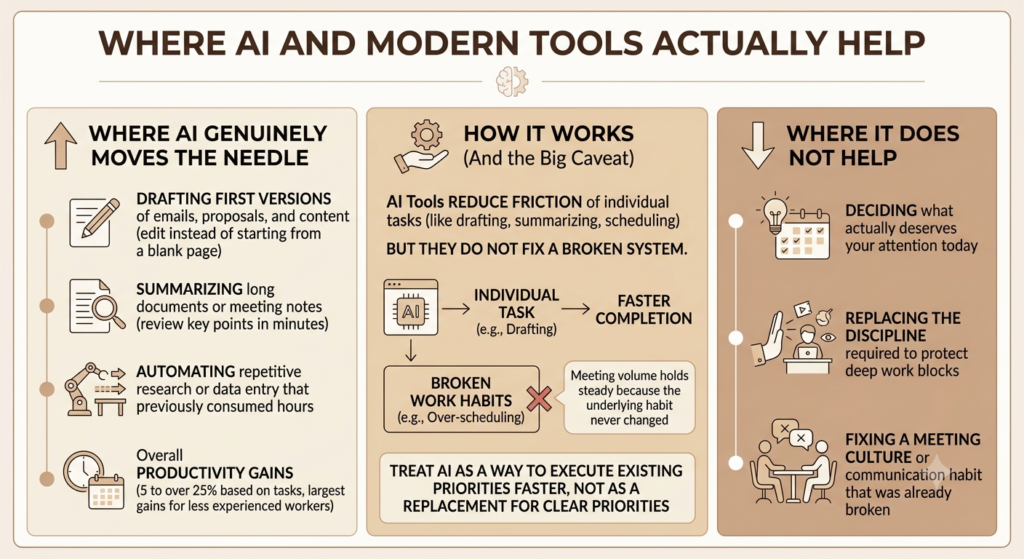
It would be incomplete to talk about eliminating time-wasting habits in 2026 without addressing artificial intelligence, since it has become one of the more genuine productivity hacks available to entrepreneurs and small teams. OECD research on AI adoption found productivity gains ranging from roughly 5 to over 25 percent depending on the task, with the largest gains going to less experienced workers who benefit most from AI handling routine steps. Separate industry research found that knowledge workers using generative AI tools reported saving time on 90 percent of tasks where they applied it, and 85 percent said it helped them stay focused on higher-value work.
The caveat is important. AI tools reduce the friction of individual tasks, like drafting, summarizing, or scheduling, but they do not fix a broken system on their own. Teams that adopt AI meeting assistants, for example, still report meeting volume holding steady rather than dropping, because the underlying habit of over-scheduling meetings never actually got addressed. Treat AI as a way to execute your existing priorities faster, not as a replacement for setting clear priorities and time management habits in the first place.
Where AI genuinely moves the needle for entrepreneurs
- Drafting first versions of emails, proposals, and content, so you edit instead of starting from a blank page
- Summarizing long documents or meeting notes so you can review key points in minutes
- Automating repetitive research or data entry that previously consumed hours
Where it does not help
- Deciding what actually deserves your attention today
- Replacing the discipline required to protect deep work blocks
- Fixing a meeting culture or communication habit that was already broken before the tool arrived
The Productivity Framework: E.L.I.M.I.N.A.T.E.
Reading about these habits is useful, but you need a simple way to apply them. Use this framework as a recurring checklist, not a one-time exercise.
- Evaluate your daily activities honestly, without judgment
- Limit distractions before they start, not after they pull your attention
- Identify high-value work and protect time for it first
- Minimize meetings, and require a real agenda for the ones that remain
- Ignore low-priority tasks that do not move your actual goals forward
- Nurture your energy through sleep, movement, and real food
- Automate repetitive work wherever a system can replace manual effort
- Track your progress with a short weekly review
- Execute consistently, because none of this works without follow-through
Among all of these, the biggest productivity killers tend to cluster around the same three root causes: fragmented attention, unclear priorities, and a lack of systems. If you only fix those three, most of the rest resolves itself.
Daily Productivity Checklist
Use this as a quick self-check at the start or end of each day.
- Planned my top 3 priorities before opening email
- Turned off non-essential notifications
- Completed at least one deep work session without interruption
- Avoided multitasking during focused work blocks
- Took scheduled breaks instead of pushing through fatigue
- Reviewed today’s progress honestly
- Prepared tomorrow’s plan before finishing today
Common Productivity Myths
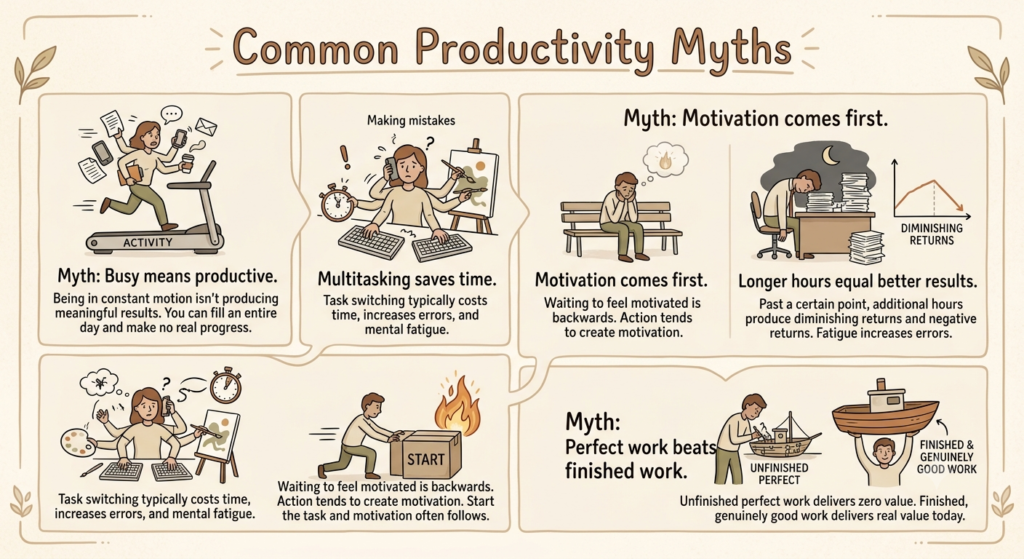
Myth: Busy means productive. Being in constant motion is not the same as producing meaningful results. You can fill an entire day with activity and still make no real progress on what matters.
Myth: Multitasking saves time. As covered earlier, task switching typically costs time rather than saving it, along with increasing errors and mental fatigue.
Myth: Motivation comes first. Waiting to feel motivated before starting is backwards. Action tends to create motivation, not the other way around. Start the task and the motivation often follows.
Myth: Longer hours equal better results. Past a certain point, additional hours produce diminishing returns, and eventually negative returns, as fatigue increases errors and decision quality drops.
Myth: Perfect work beats finished work. Unfinished perfect work delivers zero value to your customers, your audience, or your business. Finished, genuinely good work delivers real value today.
Key Takeaways
Before you move on, it is worth pulling these lessons together into a short list you can actually revisit. None of these require new software or a complete life overhaul. They require noticing, then choosing differently.
- The biggest productivity killers are rarely dramatic. They are small, repeated habits like notifications, unclear priorities, and unnecessary meetings that quietly compound across a day.
- Interruptions carry a real cost measured in minutes, not seconds, because your brain needs time to rebuild focus after every switch.
- Systems and templates remove the need to make the same decisions repeatedly, freeing up mental energy for higher-value work.
- Energy management deserves the same attention as time management. A well-planned schedule cannot compensate for poor sleep or constant burnout.
- A short weekly review is one of the highest-leverage habits available, because it turns your daily experience into actual improvement.
Conclusion
Productivity is not about doing more. It is about removing what is quietly holding you back. Every habit covered in this guide, from digital distractions to poorly run meetings to working without systems, is fixable once you can see it clearly.
You do not need to overhaul your entire routine today. Pick one productivity killer from this list, the one costing you the most right now, and eliminate it before you add a single new tool or technique. Small, consistent improvements compound. A year from now, the version of you who removed one distraction at a time will be working smarter than the version who kept adding more to an already overloaded system.
The businesses and professionals who consistently outperform their peers are rarely the ones working the longest hours. They are the ones who have quietly stripped away everything that does not need to be there, protected their focus, and built simple systems that carry the weight so willpower does not have to. Start with one change this week, measure how it feels, and build from there.
Frequently Asked Questions
What are the biggest productivity killers in a typical workday?
The most common ones are constant notifications and digital distractions, multitasking, unnecessary or poorly run meetings, unclear daily priorities, and working without systems or templates. Most professionals lose hours to a combination of these rather than just one.
How many hours a day is the average person actually productive?
Recent workplace research suggests the average employee is productive for roughly 60 percent of an eight-hour workday, meaning genuine focused output typically falls well short of a full workday’s worth of hours.
How long does it really take to refocus after an interruption?
Research from the University of California, Irvine found it takes an average of about 23 minutes to fully regain deep focus after being interrupted, even if the interruption itself only lasted a few seconds.
Is multitasking ever actually effective?
For simple, low-cognitive tasks like folding laundry while listening to a podcast, switching costs are minimal. For demanding cognitive work like writing, analysis, or strategic decisions, multitasking consistently reduces both speed and accuracy.
What is the fastest way to improve productivity without adding more tools?
Start by protecting one uninterrupted deep work block each day and eliminating non-essential notifications during that time. This single change addresses two of the biggest productivity killers at once without requiring any new software or systems.
How do I know if a meeting is actually necessary?
Ask whether the outcome could be achieved through a short written update instead. If there is no agenda, no clear decision to be made, and no need for real-time discussion, it likely does not need to be a meeting.