

Every entrepreneur starts with an idea they believe in. Some of those ideas are genuinely brilliant. But a brilliant idea has never been the thing that separates a business that survives from one that quietly disappears. What separates them is leadership.
You can have the best product in your category, the smartest pricing strategy, and a market that’s ready for you, and still watch the business stall because the people inside it aren’t being led well. Teams don’t fail because the spreadsheet was wrong. They fail because nobody communicated the plan, nobody owned the mistakes, and nobody made a decision when it mattered.
This is the shift almost every founder eventually has to make: from being a business owner to becoming a leader. Owning a business means you hold the equity, sign the cheques, and carry the risk. Leading a business means people choose to follow your direction, trust your judgment, and stay committed even when things get hard. Those are not the same job, and a lot of entrepreneurs run their companies for years before realizing they’ve only been doing the first one.
Leadership skills for entrepreneurs shape almost everything that determines whether a business becomes high-performing or stays stuck. They shape the culture your team works in every day. They shape whether new ideas get raised in a meeting or die in someone’s head because they’re afraid to speak up. They shape how customers experience your brand, because employees who are led well tend to treat customers well. And over years, they shape whether your company grows into something bigger than you, or stays capped at whatever you can personally manage.
This guide walks through the leadership skills for entrepreneurs that actually move the needle – not personality traits you’re born with, but abilities you can build deliberately. You’ll get a practical breakdown of twelve core skills, the most common mistakes that quietly sabotage founders, daily habits worth adopting, and a clear picture of how leadership needs to change as your business moves from startup to scale.
Why Leadership Is the Real Competitive Advantage for Entrepreneurs
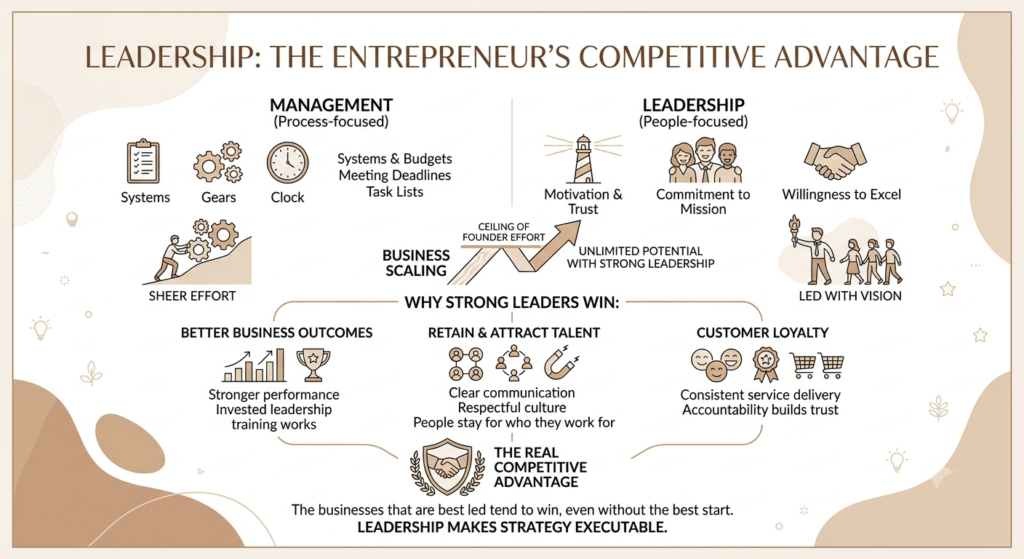
Managing a business and leading people are two different disciplines, and most entrepreneurs are only trained in the first one. Management is about processes, budgets, deadlines, and systems. Leadership is about people – their motivation, their trust, their willingness to give you their best effort when nobody is watching.
You can manage a task list. You cannot manage a person’s commitment to your mission. That has to be led.
This distinction matters more as a business scales. In the early days, a founder can push a small team through sheer effort and personal involvement. But that approach has a ceiling. Research on leadership effectiveness consistently shows that businesses with strong leadership outperform their competitors by a wide margin, and companies that invest seriously in leadership training see measurably stronger business outcomes than those that don’t. Leadership isn’t a soft add-on to strategy. It’s what makes strategy executable.
Strong leaders also have a quiet but powerful effect on talent. People don’t just take jobs for salary; they stay in jobs because of who they work for. A founder who communicates clearly, follows through on commitments, and treats people with respect will keep good employees far longer than one who doesn’t – and will attract the kind of talent that actively wants to work for them. The same logic extends to customers. Teams led with clarity and accountability tend to deliver more consistent service, and that consistency is what builds customer loyalty over time.
You can see this pattern across companies of every size. The founders who are remembered as exceptional builders – not just successful ones – are almost always described first as leaders, not just as strategists or inventors. Their products mattered, but their ability to rally people around a vision and hold them to a standard is what actually built the company.
This is the real competitive advantage available to every entrepreneur, regardless of industry, funding, or market conditions: the businesses that are best led tend to win, over a long enough timeline, even when they didn’t start with the best idea.
12 Leadership Skills Every Entrepreneur Must Master
Leadership isn’t one skill. It’s a set of capabilities that work together. Below are the twelve that matter most for entrepreneurs specifically – not generic corporate leadership theory, but the skills that show up in the actual, daily reality of running a business you built from nothing.
1. Vision and Strategic Thinking
Every team needs to know where it’s going and why it matters. A compelling long-term vision gives people something to work toward beyond the next deadline. It’s the difference between a team that shows up to complete tasks and a team that shows up because they believe in what they’re building.
Creating that vision is only half the job. The other half is translating it into priorities that people can actually act on this week. A founder who talks about “changing the industry” but can’t tell their team what to focus on this quarter isn’t leading – they’re inspiring without direction, which burns people out just as fast as no vision at all.
The strongest founders keep circling back to alignment. They connect the daily work – the emails, the deliverables, the sales calls – back to the bigger goal, so the team never loses sight of why the work matters. This is one of the leadership skills for entrepreneurs that has to be repeated constantly, not stated once in a kickoff meeting and forgotten.
2. Effective Communication
Communication problems are rarely about a lack of information. They’re about ambiguity. When expectations aren’t communicated clearly, people fill the gaps with assumptions, and those assumptions are usually wrong.
Strong leaders are specific. They say what “done” looks like, what the deadline is, and what success will be measured against. Vague instructions like “make it better” or “just handle it” create more rework than they save time.
Active listening is the other half of communication that founders often skip. It’s easy to listen just long enough to formulate a response. It’s harder to genuinely absorb what a team member is telling you about a problem before you react. Employees notice the difference immediately, and it directly affects whether they bring you bad news early – when it’s still fixable – or hide it until it becomes a crisis.
Constructive feedback closes the loop. Feedback that’s honest, specific, and delivered close to the moment it’s needed helps people improve. Feedback that’s vague, delayed, or avoided entirely leaves people guessing about where they stand.
3. Emotional Intelligence (EQ)
Emotional intelligence has moved from a “nice to have” leadership trait to one of the clearest predictors of leadership effectiveness. Studies examining leaders across industries have found that emotional intelligence correlates strongly with decision-making clarity, team cohesion, and how well a leader manages a crisis – often more strongly than technical expertise alone.
Self-awareness is the foundation. Leaders who understand their own triggers, biases, and default reactions are far less likely to make decisions from frustration or ego. Empathy builds on that self-awareness – the ability to understand what a team member is feeling and respond with genuine care, without necessarily agreeing with everything they say. Empathy and accountability are not opposites. You can understand why someone is struggling and still hold them to the standard the business needs.
Managing your own emotions under pressure is where EQ gets tested the most. Founders face cash flow scares, client losses, and staff conflicts regularly, often in the same week. A leader who stays composed – not emotionless, but composed – gives their team permission to stay calm too. Panic at the top cascades through an entire organization within hours.
The compounding effect of EQ is stronger workplace relationships: people trust leaders who understand them, and trust is the currency that makes fast decision-making, honest feedback, and real accountability possible in the first place.
4. Decision-Making Under Uncertainty
Entrepreneurs almost never get to make decisions with complete information. There isn’t a perfect market study, a guaranteed outcome, or a risk-free path. The skill isn’t eliminating uncertainty – it’s making confident, well-reasoned decisions despite it.
Analysis paralysis is one of the most common traps for capable founders. The instinct to gather “just a bit more data” before committing can quietly cost months of momentum. A good rule many experienced founders use: if you have roughly 70% of the information you’d ideally want, and the decision is reversible, move. Waiting for 100% certainty on a reversible decision is usually more expensive than being occasionally wrong.
Failure, when it happens, is data. Leaders who treat a wrong decision as a learning input – what did we miss, what will we watch for next time – build organizations that get sharper with every cycle. Leaders who treat failure as something to hide or blame create teams that hide their own mistakes too, which is far more dangerous long-term.
5. Delegation and Trust
Most entrepreneurs struggle to let go, and it’s understandable. You built this business with your own hands. You know exactly how you want things done, and it’s genuinely faster, in the short term, to just do it yourself.
But that instinct has a ceiling built into it. A business that depends entirely on the founder to function isn’t a company – it’s a very demanding job. If your business can’t run for two weeks without you personally intervening, you haven’t built a team yet.
Effective delegation isn’t just handing off tasks. It’s handing off ownership, along with the context and authority someone needs to make decisions within that task. Founders who delegate poorly tend to hand off the work but keep the decision-making, which just creates a bottleneck with extra steps.
Empowering employees means trusting them to solve problems their own way, even if it’s not exactly how you would have done it. Micromanagement signals – even unintentionally – that you don’t trust your team’s judgment, and that signal erodes confidence faster than almost anything else a leader can do.
6. Adaptability
Markets shift. Customer expectations change. Supply chains get disrupted. Competitors launch something you didn’t see coming. None of this is avoidable, and entrepreneurs who lead successfully treat change as a constant rather than an exception.
Leading through market changes means being willing to revisit assumptions that used to be true. What worked to acquire customers two years ago may not work today. A leader who clings to “this is how we’ve always done it” out of comfort, rather than because it’s still working, puts the whole business at risk.
Responding to customer needs requires the same flexibility. Customer expectations around speed, personalization, and transparency have risen sharply, and businesses that don’t adapt their service model accordingly lose ground quietly, deal by deal, long before it shows up in the revenue numbers.
Resilience during uncertainty is what keeps a team functioning when the plan changes mid-quarter. Adaptable leaders don’t pretend disruption isn’t stressful – they acknowledge it honestly, then move the team toward the next reasonable step instead of freezing.
7. Problem-Solving Mindset
Every business runs into obstacles – a client cancels, a hire doesn’t work out, a supplier raises prices. The leaders who build high-performing businesses treat these moments as problems to be solved rather than reasons to panic or place blame.
Critical thinking frameworks help here more than raw instinct does. Breaking a problem down into its actual root cause, rather than reacting to the symptom in front of you, usually produces a better solution. A client who churns because of a support issue needs a different fix than a client who churns because a competitor undercut your price – but both can look identical on the surface if you don’t dig in.
Creative solutions often come from involving the team rather than solving everything alone. Entrepreneurs who insist on being the only source of answers unintentionally train their team to stop bringing up problems, because they’ve learned the founder will just take over anyway.
8. Accountability
Accountability starts at the top. A leader who owns their mistakes openly – rather than deflecting or minimizing them – sets the standard for how the entire team handles accountability.
Building accountability within teams means setting clear expectations and following through consistently when those expectations aren’t met, without excuses on either side. This isn’t about punishment. It’s about making sure commitments actually mean something inside the business.
Leading by example is the multiplier. You can write “we value accountability” on the wall, but if the founder consistently misses their own deadlines or blames external factors for internal problems, no policy will fix the culture. Teams copy what leaders do, not what they say.
9. Conflict Resolution
Disagreements are inevitable in any team that’s actually engaged in the work. The goal isn’t to eliminate conflict – a team with zero visible disagreement is often a team that’s stopped speaking up. The goal is managing disagreement professionally, so it strengthens decisions instead of damaging relationships.
Leaders who avoid difficult conversations don’t make the conflict disappear; they just let it fester, usually until it surfaces in a much worse form – a resignation, a public blow-up, or a quiet drop in someone’s effort. Addressing tension early, directly, and respectfully protects team morale far more than avoidance ever does.
Healthy workplace communication is built through consistent, low-drama handling of small disagreements. When people see that raising a concern gets addressed fairly rather than punished, they keep raising concerns – which is exactly the information a leader needs to catch problems early.
10. Coaching and Mentoring
A business that depends entirely on one visionary founder is fragile. Developing future leaders inside your own company is one of the highest-leverage things you can do, because it multiplies your judgment across people you can’t personally supervise every hour of the day.
Coaching looks different from managing. Managing tells someone what to do. Coaching helps someone develop the judgment to figure it out themselves next time. That takes more patience upfront, but it pays back many times over as your team grows in capability.
Encouraging continuous learning – through stretch assignments, honest feedback, and exposure to bigger decisions – builds a culture of growth rather than a culture where people quietly plateau. Entrepreneurs who invest in their people’s development tend to retain their best performers longer, because ambitious people stay where they’re growing.
11. Time and Priority Management
Founders are pulled in every direction, constantly. The leadership skill here isn’t doing more – it’s protecting focus for the handful of activities that actually move the business forward, and being disciplined about saying no to the rest.
Founder burnout is common precisely because so many entrepreneurs treat every fire as equally urgent. Leading without constant firefighting requires building systems – checklists, clear ownership, escalation paths – so that small issues get resolved by the team without needing the founder’s personal attention every time.
High-impact activities usually aren’t the loudest ones. Answering every Slack message the moment it arrives feels productive but rarely is. Strategic planning, hiring decisions, and key customer relationships tend to be quieter, less urgent-feeling, and far more important to the business’s trajectory.
12. Continuous Learning
The entrepreneurs who keep building high-performing businesses over the long term are almost always the ones who never stop learning. The skills that got you through your first year rarely stay sufficient for year five, because the business itself – and its problems – keep changing shape.
This learning comes from multiple sources: books, mentors, peer networks, and direct feedback from your own team and customers. Founders who surround themselves only with people who agree with them tend to miss blind spots that eventually become expensive.
As the business grows, leadership itself has to evolve. The skills that worked when you had three employees won’t be enough when you have thirty. Leaders who keep learning stay ahead of that shift instead of getting caught by it.
Common Leadership Mistakes Entrepreneurs Should Avoid
Even well-intentioned founders fall into predictable traps. Recognizing them early is often the difference between a temporary rough patch and a leadership failure that damages the business long-term.
Trying to do everything alone. This is the most common mistake among first-time founders. It feels efficient in the moment, but it quietly caps how big the business can ever become, because growth eventually requires more hands and judgment than one person can provide.
Micromanaging employees. Checking every detail of every task signals a lack of trust, slows everything down, and drives capable people to leave for roles where they’re allowed to actually use their judgment.
Avoiding difficult conversations. Whether it’s addressing underperformance, resolving a conflict, or delivering bad news, avoidance doesn’t make the problem go away – it just delays it and usually makes it worse.
Ignoring employee feedback. Teams on the ground often see problems before leadership does. Founders who dismiss feedback, or ask for it and then never act on it, train their people to stop offering it.
Failing to communicate vision. A team that doesn’t understand where the company is headed can’t make good independent decisions, because they have no context to weigh options against.
Resisting change. Markets move fast. Leaders who cling to outdated strategies out of comfort or ego put the entire business at risk, especially as competitors adapt faster.
Leading through authority instead of influence. Title alone doesn’t earn commitment. Employees who follow instructions only because they’re told to – rather than because they trust the leader’s judgment – give the bare minimum, not their best work.
Practical Ways to Improve Your Leadership Skills
Leadership development doesn’t require a formal program. It requires consistency.
Seek mentorship and coaching. A mentor who has already navigated the stage you’re in can help you avoid mistakes that would otherwise cost you months.
Ask for regular team feedback. Create a simple, recurring channel – a quarterly survey, a one-on-one question – where your team can tell you honestly what’s working and what isn’t.
Practice active listening. In your next few meetings, deliberately hold off on responding until the other person has fully finished their point. It’s a small habit that changes how people experience talking to you.
Read leadership books consistently. Even fifteen minutes a day compounds into meaningful growth over a year. The specific book matters less than the habit of exposing yourself to new frameworks.
Attend workshops and conferences. Beyond the content, these events connect you with other founders facing similar challenges, which is often as valuable as the material itself.
Reflect after major decisions. A short, honest review – what worked, what didn’t, what you’d do differently – turns every decision into a leadership lesson instead of just an outcome.
Build systems that encourage leadership at every level. Give team members real ownership over parts of the business, not just tasks. Leadership grows fastest when people are given room to practice it.
Leadership Habits of Highly Successful Entrepreneurs
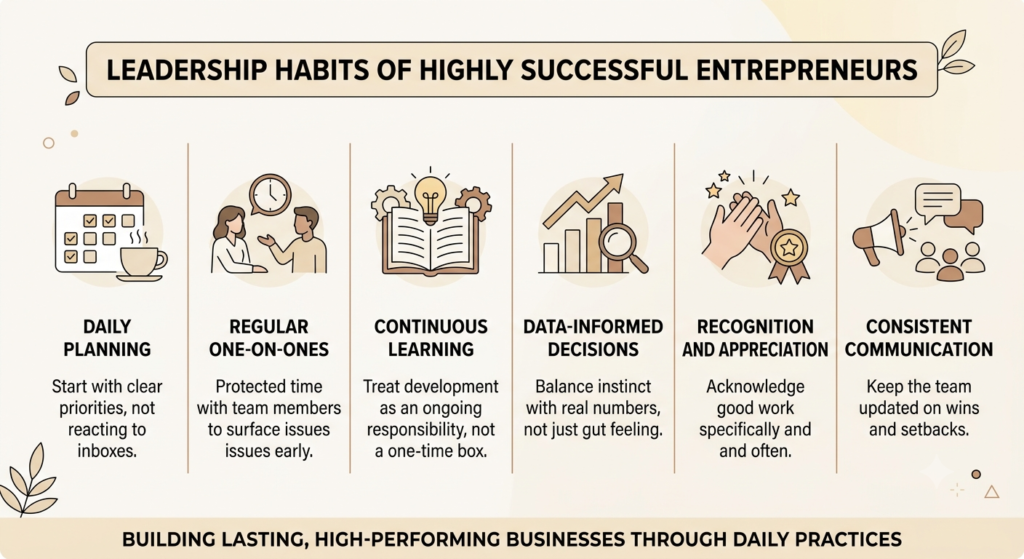
The founders who build lasting, high-performing businesses tend to share a set of daily habits, not just a set of traits.
- Daily planning. Starting the day with clear priorities, rather than reacting to whatever lands in the inbox first.
- Regular one-on-one meetings. Consistent, protected time with key team members to surface issues before they escalate.
- Continuous learning. Treating their own development as an ongoing responsibility, not a box to check once.
- Data-informed decision-making. Balancing instinct with real numbers, rather than relying on gut feeling alone.
- Recognition and appreciation. Acknowledging good work specifically and often – a low-cost habit with an outsized effect on morale and retention.
- Consistent communication. Keeping the team updated on both wins and setbacks, so people aren’t left guessing about where the business stands.
- Leading by example. Holding themselves to the same standards – punctuality, honesty, effort – that they expect from everyone else.
How Leadership Evolves as Your Business Grows
Leadership isn’t static. What works at five employees will actively hurt you at fifty. Understanding this progression helps you avoid getting stuck leading a growing company the same way you led a tiny one.
Startup Stage
In the earliest days, leadership is hands-on almost by necessity. You’re wearing every hat – sales, product, support, finance – often within the same afternoon. Leadership here looks like being deeply involved in the details, because there simply isn’t anyone else yet to hand things to.
Growth Stage
As revenue and headcount increase, the founder’s job has to shift. This stage is about hiring managers who can own entire functions, and building the first real processes – onboarding, reporting, decision-making frameworks – so the business doesn’t rely entirely on tribal knowledge in the founder’s head.
Scaling Stage
At scale, leadership becomes about empowering other leaders rather than directly managing individual contributors. The founder’s role shifts toward shaping culture, setting direction, and building systems that let good work happen without their constant supervision. Leading through systems, rather than through personal presence in every decision, is what allows a business to keep growing beyond what one person could ever manage alone.
Final Thoughts
Leadership is a skill developed through practice, not a personality trait you either have or don’t. Every entrepreneur featured in this guide – the confident communicator, the calm decision-maker under pressure, the founder who delegates without anxiety – built those abilities deliberately, often through years of getting it wrong before getting it right.
The improvements rarely feel dramatic in the moment. A slightly clearer piece of feedback. A decision made a week faster than it would have been last year. A conflict addressed directly instead of avoided. But these small, consistent improvements compound into stronger teams, healthier culture, and a business that can keep growing without the founder personally holding every piece together.
If you’re serious about building a high-performing business, invest in your leadership development with the same seriousness you bring to your business strategy. The strategy tells you where to go. Leadership is what actually gets you there.
FAQs
1. What are the most important leadership skills for entrepreneurs?
The core skills include vision and strategic thinking, effective communication, emotional intelligence, decision-making under uncertainty, delegation, adaptability, and accountability. Together, these leadership skills for entrepreneurs determine how well a founder can guide a team through both steady growth and unexpected challenges.
2. Can leadership skills be learned, or are they natural?
While some people have natural tendencies toward confidence or communication, leadership itself is a learnable, practiced skill. Founders who deliberately work on decision-making, delegation, and communication improve measurably over time, regardless of their starting personality.
3. Why is emotional intelligence important for entrepreneurs?
Emotional intelligence directly affects how well a leader manages stress, builds trust, and makes clear decisions under pressure. Entrepreneurs with strong emotional intelligence tend to retain talent longer and navigate crises with more composure.
4. How does delegation improve business growth?
Delegation frees the founder from being a bottleneck in every decision, allowing the business to operate and grow even when the founder isn’t personally involved in every task. Without it, growth is capped by how much one person can physically manage.
5. What leadership mistakes do first-time entrepreneurs make?
The most common mistakes include trying to handle everything personally, micromanaging the team, avoiding difficult conversations, and failing to communicate the company’s vision clearly enough for the team to act on it independently.
6. How can entrepreneurs improve their leadership abilities every day?
Small, consistent habits make the biggest difference: daily planning, regular one-on-one check-ins with the team, asking for honest feedback, and reflecting after major decisions to identify what to do differently next time.
7. What’s the difference between management and leadership?
Management focuses on processes, tasks, and systems. Leadership focuses on people – their motivation, trust, and willingness to give their best effort. Entrepreneurs need both, but leadership is what determines whether people stay committed long-term.
8. How does strong leadership impact company culture?
Leaders set the tone for everything from how mistakes are handled to how feedback is received. A founder who leads with accountability, respect, and clear communication builds a culture that attracts and retains strong talent, while poor leadership drives good people away.