

I have sat across the table from dozens of entrepreneurs and property owners who had a good idea sitting in a drawer for years. Not because the idea was weak. Not because the market wasn’t ready. But because they kept refining it in their heads instead of testing it in the real world.
Overthinking feels like work. It has the shape of productivity – you are gathering information, weighing options, running scenarios. But most of the time, it is simply a more comfortable way of avoiding a decision. You get to feel busy without ever having to face the risk of being wrong.
The hidden cost is rarely obvious in the moment. It shows up later, as the opportunity someone else took while you were still “researching,” the promotion that went to the colleague who spoke up first, or the business idea that a competitor launched six months after you first thought of it. Waiting for the perfect moment is not a strategy. It’s a delay tactic dressed up as caution.
Here is the part most people get backwards: confidence is not a prerequisite for action. It is a byproduct of it. You don’t feel ready and then act. You act, and the doing itself builds the readiness. Every experienced entrepreneur I know built their confidence through a long series of imperfect first attempts, not through thinking their way into certainty.
In this guide, you will learn what overthinking actually is and why your brain is wired to default to it, the real reasons you get stuck (which usually have nothing to do with lacking information), the true cost overthinking has on your career and business, ten practical methods to break the cycle, a simple daily framework you can start using today, and a 7-day challenge to help you rebuild the habit of taking action.
What Is Overthinking (And Why Your Brain Loves It)
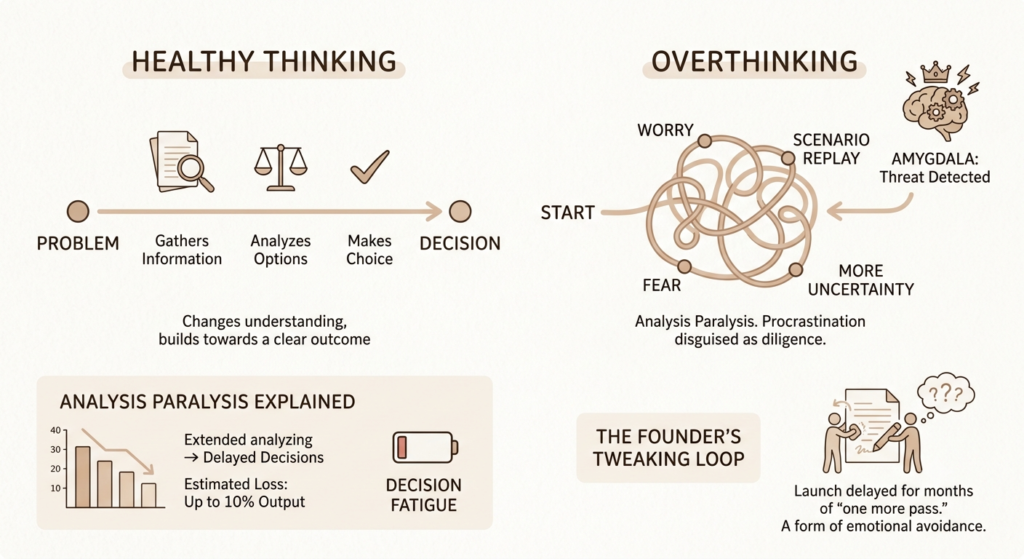
Healthy Thinking vs. Overthinking
There is a real difference between thinking something through and overthinking it. Healthy thinking has a destination – it gathers just enough information to make a reasonably good decision, then stops. Overthinking has no destination. It loops. You revisit the same worries, run the same scenarios, and somehow end up more uncertain than when you started, despite having spent hours “figuring it out.”
A simple test: if additional thinking is changing your understanding of the problem, it’s productive. If it’s just replaying the same fears in a different order, it’s overthinking.
Analysis Paralysis Explained
Analysis paralysis is what happens when the process of analyzing a decision becomes so extended that the decision itself never gets made. It typically shows up when there are too many variables, too much information, or too much perceived risk attached to getting it wrong.
Research on decision-making in organizations shows just how widespread this is. Analysis paralysis restricts effective decision-making, and a substantial share of workers report real distress around making decisions in the first place, especially when stakeholder opinions conflict, data sets are complex, and deadlines are tight.
The financial cost is not abstract either. Organizations lose measurable value through delayed decisions, and some estimates put that loss as high as 10% of an organization’s potential output – not from bad decisions, but from decisions that simply took too long to make.
Why the Brain Mistakes Thinking for Progress
Your brain is not built to optimize for good outcomes. It’s built to keep you safe. When a decision carries any perceived risk – financial loss, social judgment, failure – the amygdala, your brain’s threat-detection center, activates. It treats an uncertain business decision with some of the same alarm circuitry it would use for a physical threat.
Deliberating further, in that moment, feels like protection. Not deciding means not failing, at least not yet. One researcher described this pattern well: overthinking is a way to avoid a difficult emotional situation while feeling like you’re accomplishing something by analyzing it. It is procrastination wearing the costume of diligence.
There’s also a resource-depletion angle. Mental energy behaves something like a battery – it depletes with every decision made throughout the day. This is decision fatigue, and it’s one of the quiet reasons overthinking gets worse as the day goes on, or as a decision drags on for weeks. The longer you sit with an unresolved choice, the less mental capacity you have left to actually make it.
Real-Life Examples
Picture a property manager deciding whether to switch to a new booking platform. She reads reviews for two weeks, compares five tools, and asks six colleagues for their opinion – while her current, outdated system keeps costing her bookings every single day she delays. Or a founder who has a landing page ready to launch but keeps “one more tweaking pass” going for a month, while a competitor with a rougher version is already collecting emails.
Neither of these people lacks intelligence or information. What they lack is a mechanism for saying “this is enough – now I act.”
The Hidden Reasons You Keep Overthinking
Most people assume they overthink because they don’t know enough yet. In reality, research consistently links overthinking to self-doubt, perfectionism, and a low tolerance for uncertainty – not a lack of knowledge. Here are the five drivers that show up again and again.
Fear of Failure
Fear of failure is one of the strongest, most consistently documented predictors of both procrastination and overthinking. Studies on students and professionals alike show that people are often more motivated by the fear of losing something than by the prospect of gaining a reward – which means the fear of a bad outcome frequently outweighs the pull of a good one, leading to hesitation rather than action.
In a business context, this shows up as a founder who won’t send the pitch deck until it’s “perfect,” because a rejected pitch feels more painful than a delayed one.
Perfectionism
Perfectionism and procrastination are closely linked, but the connection isn’t really about high standards – it’s about fear. Research shows that fear of failure fully explains the relationship between perfectionism and procrastination: strip away the fear, and high standards on their own don’t actually cause people to freeze up.
This is an important distinction for business owners. Having high standards is not the problem. Being unwilling to act until those standards are guaranteed to be met – before you even have market feedback – is.
Fear of Judgment
Closely tied to perfectionism is the fear of how others will perceive a decision or its outcome. A well-known study out of York University found a strong link between procrastination and the fear of disapproval – people delay action not because the task is hard, but because they’re avoiding the discomfort of being judged for the result.
For entrepreneurs, this often looks like withholding a new offer, a price increase, or a public announcement because of what a peer group, an investor, or even social media might think.
Too Many Choices
More options do not lead to better decisions – they lead to more hesitation. When decision-makers are flooded with data, competing recommendations, and endless alternatives, the natural response is to keep gathering more information rather than commit to one path. This “endless data gathering” is one of the clearest warning signs of analysis paralysis in teams and individuals alike.
A small business owner comparing twelve different accounting software options is not being thorough. Past a certain point, they are avoiding the decision by dressing the avoidance up as research.
Waiting Until You Feel Ready
This is the quiet trap. Many people treat “feeling ready” as a signal they’re supposed to wait for, rather than a feeling they’re supposed to generate through action. But confidence is built retroactively, through evidence of your own competence. If you wait for the feeling to arrive before you begin, you may be waiting indefinitely, because the feeling is usually a result of starting, not a precondition for it.
The Real Cost of Overthinking
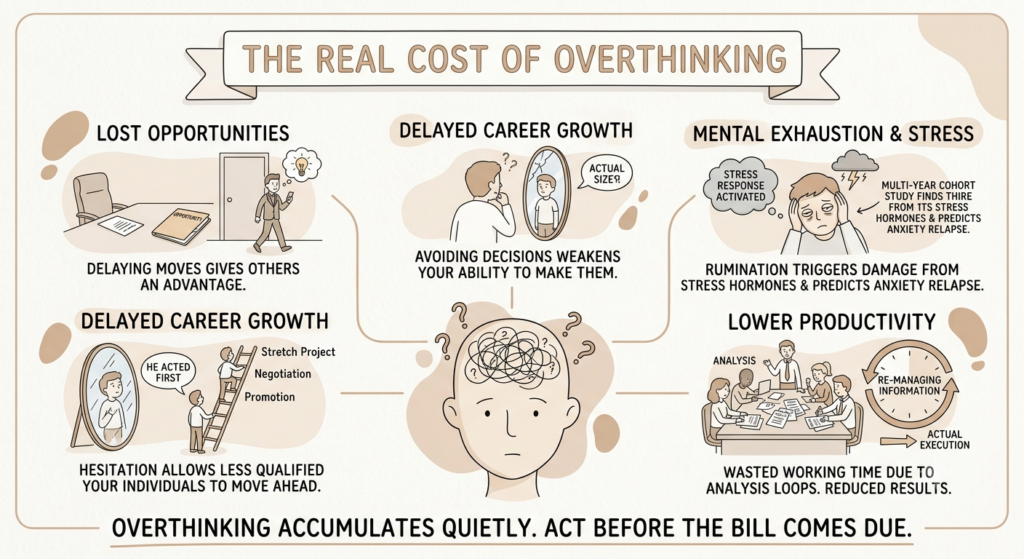
Overthinking rarely announces its cost in the moment. It accumulates quietly, and the bill comes due later.
Lost opportunities. Every day spent deliberating is a day a competitor, a colleague, or a market condition can move without you. Opportunities in business are rarely available indefinitely.
Delayed career growth. People who hesitate to raise their hand for a stretch project, negotiate a raise, or apply for a promotion often don’t lose out because they were unqualified – they lose out because someone less qualified acted first.
Reduced confidence. Ironically, the more you avoid decisions, the less confident you become in your ability to make them. Confidence is a muscle, and avoidance atrophies it.
Mental exhaustion. Rumination keeps your body’s stress response system switched on. The constant, low-grade release of stress hormones meant for real physical threats becomes damaging when it’s triggered by thought loops instead, creating an ongoing sense of fatigue that has nothing to do with how much physical work you actually did that day.
Increased stress. A multi-year cohort study following nearly 2,000 adults found that repetitive negative thinking, including rumination, predicted the persistence and relapse of anxiety and stress-related symptoms over time. Overthinking is not a neutral habit – it has a measurable effect on wellbeing.
Lower productivity. Teams and individuals stuck in analysis loops report wasting a large share of their working time managing and re-managing information instead of acting on it. That’s time taken directly away from execution, the part of the work that actually produces results.
10 Practical Ways to Stop Overthinking and Start Taking Action
If you want to stop overthinking, you need more than willpower. You need small, repeatable systems that make action the path of least resistance. These ten strategies are built to do exactly that.
1. Follow the 5-Minute Rule
Don’t wait for motivation to show up before you start – motivation typically arrives after you’ve already begun, not before. Commit to just five minutes on the task you’ve been avoiding. Open the document. Draft the first email. Make the first call. Five minutes is small enough that your brain won’t resist it, and once you’re in motion, continuing is far easier than starting was.
2. Focus Only on the Next Step
You do not need the entire plan mapped out before you move. You need to know the next action. Planning every detail in advance is often just another form of overthinking wearing a productivity disguise. Ask yourself: “What is the one thing I need to do right now?” – then do only that.
3. Replace “Perfect” With “Progress”
Perfect is a moving target that keeps you standing still. Progress is measurable and it compounds. A landing page that’s live and imperfect will teach you more in a week than a landing page that’s “almost ready” for a month. Ship the 80% version. You can improve it once it exists in the real world and has real feedback attached to it.
4. Set Decision Deadlines
Give every decision – even small ones – a firm cutoff. “I will decide on the vendor by Friday at 5pm, based on the information I have by then.” A deadline forces your brain to work with what’s available instead of chasing the illusion that more research will eventually produce certainty. Certainty, in most business decisions, doesn’t exist. You are working with probabilities, not guarantees.
5. Accept That Mistakes Are Feedback
Reframe failure as data, not verdict. A decision that doesn’t work out is not proof that you’re incapable – it’s information about what to adjust next time. The entrepreneurs who scale fastest are usually not the ones who make the fewest mistakes. They’re the ones who extract lessons quickly and move again.
6. Limit Information Consumption
There is a point at which more research stops improving your decision and starts becoming a way to delay it. Give yourself a hard limit – three sources, one hour, five comparisons – and then commit. If you notice you’re seeking out opinions after you’ve already gathered enough to decide, that’s usually a sign you’re looking for permission, not information.
7. Break Big Goals Into Tiny Actions
A goal like “grow the business” is too abstract to act on, which is exactly why it invites overthinking. Break it down: one outreach message today, one piece of content this week, one process documented this month. Tiny, concrete actions are hard to overthink because there’s nothing ambiguous left to deliberate over.
8. Build Momentum With Small Wins
Every completed task, no matter how small, sends your brain a signal: you are capable of finishing things. That signal compounds. Completing small tasks measurably increases confidence and reduces the hesitation that shows up before the next task. Start your day with one quick win before tackling the harder, more ambiguous work.
9. Use Action-Based Questions Instead of Fear-Based Questions
The questions you ask yourself shape the direction your mind moves in. Fear-based questions keep you circling the risk. Action-based questions point you toward the next move.
- ❌ What if I fail?
- ✅ What’s one thing I can do today?
- ❌ What if people judge this?
- ✅ What’s the smallest version of this I can put out right now?
Small shifts in the framing of your internal dialogue can be the difference between another day of deliberation and your first real step.
10. Track Actions, Not Results
Results are often outside your direct control – a client’s budget, market timing, a competitor’s move. Actions are entirely within your control. Build a simple action scorecard: each day, log the actions you took, not the outcomes you got. Over a month, this becomes visible proof that you are someone who follows through, which is one of the fastest ways to dismantle the identity of “I’m someone who overthinks everything.”
Daily Habits That Keep You Out of the Overthinking Trap
Strategies work best when they’re supported by daily structure. These habits create the conditions where overthinking has less room to take hold.
- Morning planning. Decide your top three priorities before the day’s noise sets in, while your decision-making energy is at its highest.
- Time blocking. Assign a fixed window to a task or decision. When the block ends, you move on with whatever you have.
- Digital distraction limits. Constant notifications feed the urge to seek more input before deciding anything. Reducing them protects your focus for the decisions that matter.
- Journaling. Five minutes of writing down what’s actually worrying you often reveals that the fear is smaller and vaguer than it felt in your head.
- Exercise. Physical movement lowers stress hormones and clears the mental fog that fuels rumination, making it easier to think clearly rather than anxiously.
- End-of-day review. Spend two minutes noting what you completed. This reinforces the habit of measuring your day by action taken, not by thoughts had.
The Action Loop: A Simple Framework You Can Use Every Day
Here is a straightforward framework you can apply to almost any decision, big or small:
Think → Decide → Act → Learn → Repeat
Think. Give yourself a defined, limited window to consider the problem. Gather only what you genuinely need to make a reasonable decision – not a perfect one.
Decide. Commit to a direction before the window closes. A decided “good enough” choice beats an undecided “perfect” one every time, because only the decided choice can produce results.
Act. Execute the smallest meaningful version of that decision. Don’t wait for the full-scale version – start with what you can move on today.
Learn. Look honestly at what happened. What worked? What didn’t? This step is where the real value gets extracted, and it only exists because you acted.
Repeat. Feed what you learned back into the next Think stage, and go around again – faster and with more clarity each time.
Example: An entrepreneur launching a new service. She thinks for two days about her ideal client and pricing (Think). She picks a price and a target client type by the end of day two (Decide). She reaches out to five potential clients that same week with the offer, even though the sales page isn’t polished yet (Act). Two say yes, three go quiet – she notices the two who said yes both cared about turnaround time, not price (Learn). She adjusts her messaging to emphasize speed and reaches out to ten more people the following week (Repeat). Nothing here required certainty. It required a loop that moved.
Common Mistakes People Make When Trying to Stop Overthinking
- Waiting for motivation. Motivation is a result of action, not a prerequisite for it. Waiting for it keeps the cycle going.
- Seeking everyone’s opinion. More opinions rarely produce more clarity – they usually produce more competing inputs to reconcile, which restarts the overthinking loop.
- Setting unrealistic goals. A goal so large it feels impossible invites paralysis. Smaller, well-defined targets are easier to act on.
- Comparing yourself with others. Someone else’s timeline, resources, or starting point are not yours. Comparison adds pressure without adding useful information.
- Consuming too much self-help content without implementation. Reading about action is not the same as taking it. At some point, the next book, podcast, or article becomes its own form of productive-feeling avoidance.
A 7-Day Challenge to Build an Action Mindset
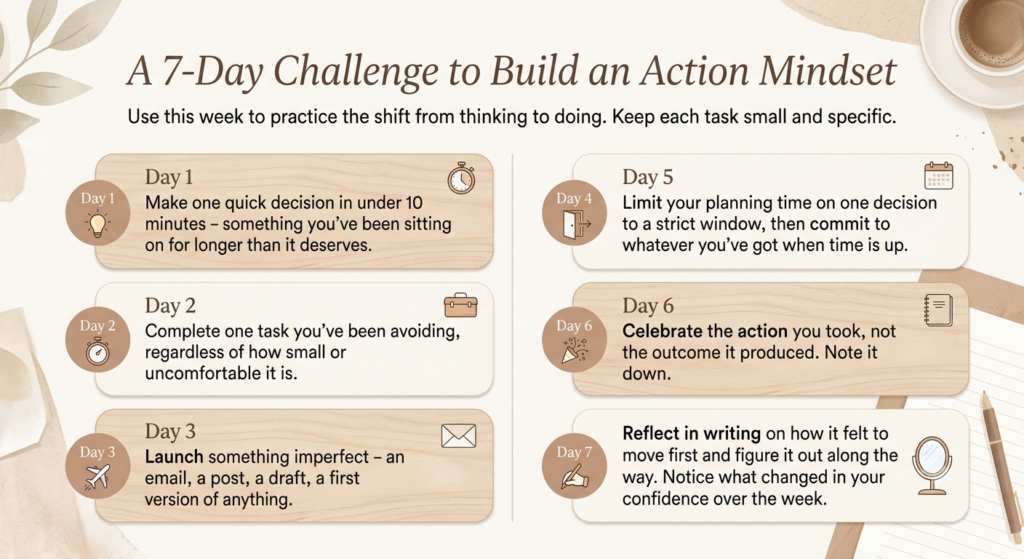
Use this week to practice the shift from thinking to doing. Keep each task small and specific.
- Day 1: Make one quick decision in under 10 minutes – something you’ve been sitting on for longer than it deserves.
- Day 2: Complete one task you’ve been avoiding, regardless of how small or uncomfortable it is.
- Day 3: Launch something imperfect – an email, a post, a draft, a first version of anything.
- Day 4: Say yes to one opportunity that makes you slightly uncomfortable.
- Day 5: Limit your planning time on one decision to a strict window, then commit to whatever you’ve got when time is up.
- Day 6: Celebrate the action you took, not the outcome it produced. Note it down.
- Day 7: Reflect in writing on how it felt to move first and figure it out along the way. Notice what changed in your confidence over the week.
Final Thoughts
Action creates clarity that thinking alone never will. You cannot think your way into certainty about how the market will respond, how a client will react, or how a new venture will unfold – you can only find out by moving and adjusting as you go.
Confidence is earned through experience, not granted in advance. You don’t need perfect conditions to begin, because perfect conditions rarely arrive on their own schedule. Every entrepreneur worth learning from started before they felt fully ready, made adjustments in real time, and built their certainty through the process of doing the work – not before it.
The next time you catch yourself circling a decision for the fifth time this week, ask one simple question: what is the smallest version of this I can start today? Then start.
Key Takeaways
- Overthinking mimics productivity but usually functions as a more comfortable form of avoidance.
- Analysis paralysis is driven by fear of failure, perfectionism, fear of judgment, too many options, and waiting to “feel ready” – not by a lack of information.
- Unresolved overthinking carries real costs: lost opportunities, stalled career growth, lower confidence, mental exhaustion, and reduced productivity.
- Small, repeatable systems – time limits, decision deadlines, tiny next steps – beat willpower for breaking the cycle.
- Confidence follows action; it does not precede it.
- The Think → Decide → Act → Learn → Repeat loop turns any decision into forward motion instead of a standstill.
Frequently Asked Questions
How do I stop overthinking everything?
Start by setting firm limits on how long you’ll deliberate before committing to a decision. Use small, time-boxed actions (like the 5-minute rule) to interrupt the thought loop, and track the actions you take rather than the outcomes, since this builds evidence that you’re capable of following through.
Why do I overthink before making decisions?
Overthinking is usually driven by fear of failure, fear of judgment, or perfectionism, rather than a genuine lack of information. Your brain treats an uncertain decision as a potential threat, and deliberating longer feels like a way to stay safe, even when it isn’t actually improving the outcome.
Can overthinking be a sign of perfectionism?
Yes. Research shows perfectionism is closely tied to procrastination and overthinking, primarily through fear of failure. It’s rarely the high standards themselves that cause the freeze – it’s the fear that a real attempt won’t measure up to them.
How can I take action when I don’t feel confident?
Treat confidence as something you build through action, not something you need before starting. Begin with the smallest possible version of the task, and let the evidence of having completed it build your confidence for the next step.
What is analysis paralysis?
Analysis paralysis is a state where over-analyzing a decision prevents you from ever making it. It typically shows up when there’s too much information, too many options, or too much perceived risk attached to getting the decision wrong.
Does taking small actions really build confidence?
Yes. Completing small, defined tasks gives your brain concrete evidence of your own follow-through, which reduces hesitation on the next task. This is why momentum, not motivation, is the more reliable path to consistent action.
How long does it take to overcome overthinking?
There’s no fixed timeline, since it depends on how deeply the habit is ingrained. What matters more than speed is consistency – a structured practice like the 7-day challenge in this article is a realistic starting point for noticeably shifting the pattern, with continued practice needed to make it stick long-term.