

Most people don’t fail because they lack ambition. They fail because they’re waiting to feel motivated before they act.
Motivation is unreliable. It shows up strong on a Monday morning and disappears by Wednesday afternoon. Anyone who has built a business, a career, or a body of meaningful work will tell you the same thing: success isn’t created in a single burst of inspiration. It’s built through small, repeated actions that compound quietly over months and years.
This is the core idea behind daily habits for long-term success – the everyday, almost boring routines that don’t feel impressive in the moment but reshape your trajectory over time. A single focused hour of work today looks unremarkable. A thousand of those hours, stacked over three years, is how real businesses and real careers get built.
Research consistently shows that sustainable performance comes from repeatable behaviors rather than dramatic routines. It’s not the occasional all-nighter or the one big pitch that determines whether you succeed. It’s what you do on the ordinary, unremarkable Tuesday when nobody is watching and motivation is nowhere to be found.
In this article, we’ll walk through seven daily habits you can start practicing immediately – habits that don’t depend on willpower, don’t require a personality transplant, and don’t fall apart the moment life gets busy. We’ll also look at why these habits work, what the current research says about building them, and how to avoid the mistakes that quietly sabotage most people’s efforts.
Why Daily Habits Matter More Than Talent
Talent gets people started. Habits are what keep them going long after the initial excitement fades.
The Science Behind Consistency
For years, the popular belief was that it takes 21 days to build a new habit. That number was never based on real science – it came from a 1960s book on plastic surgery recovery, not behavioral research.
More recent, rigorous studies paint a very different picture. A 2024 systematic review and meta-analysis published in the journal Healthcare, led by researcher B. Singh and colleagues, examined health-related habit formation across dozens of studies and found that new habits typically begin forming within about two months, though the full range extends much further depending on the behavior and the person. An earlier landmark study on habit creation found that people took anywhere from 18 to 254 days to make a new behavior feel automatic, with an average close to 66 days.
The takeaway isn’t the exact number. It’s the pattern: habit formation is slow, individual, and dependent on repetition in a stable context – not on how motivated you feel on day one. If you’ve tried to build a routine and abandoned it after three weeks because it “wasn’t working,” the research suggests you likely quit right before it would have started to feel natural.
Why Habits Reduce Decision Fatigue
Every choice you make throughout the day draws from the same limited pool of mental energy. Researchers estimate that the average adult makes somewhere in the range of 30,000 to 35,000 decisions a day – from what to eat, to which email to answer first, to how to respond to a difficult client.
This constant stream of small decisions leads to what psychologists call decision fatigue: the decline in the quality of your choices after a long stretch of deciding things. It’s the same mechanism behind a well-documented study of parole board judges, whose approval rates dropped sharply the longer they went without a break, regardless of the merits of each case.
Habits solve this problem by removing decisions from the equation entirely. When your morning routine, your work blocks, and your evening wind-down are automatic, you preserve mental energy for the decisions that actually matter – the ones that shape your business and your future.
How Small Improvements Create Exponential Growth
A 1 percent improvement each day doesn’t look like much in isolation. But small gains compound the same way interest compounds in a savings account. The visible results often lag far behind the invisible work, which is exactly why so many people quit right before the payoff.
This is the uncomfortable truth about long-term success: most of the growth happens beneath the surface, in the repetitions nobody sees.
Success Is a System, Not a Single Achievement
Chasing one big win – a viral post, a lucky deal, a single good year – creates fragile success. It depends on circumstances outside your control.
A system built from daily habits is different. It doesn’t rely on a lucky break. It relies on you showing up, doing the work, and trusting that the process itself produces results over time. This is the foundation every entrepreneur eventually has to build, whether they’re managing a growing property portfolio, running a service business, or scaling a personal brand.
Habit #1 – Start Every Day With Clear Priorities
Most people start their day by reacting: checking notifications, answering the loudest request, and letting other people’s priorities set their agenda. High performers do the opposite. They decide what matters before the noise starts.
What this looks like in practice:
- Identify your top three priorities before you open your inbox or your phone.
- Focus on outcomes – what needs to actually get done – instead of maintaining an endless, growing to-do list.
- Decide in advance so that when distractions appear, you already know what deserves your attention.
The idea of deciding your priorities before the day begins isn’t new, but it remains one of the most consistently cited habits among founders and executives who manage demanding schedules. When you don’t decide in advance, everything starts to feel equally urgent – and equally urgent usually means nothing important gets finished.
Action Tip: Spend five minutes every morning defining your Most Important Task (MIT) – the one thing that, if completed, would make the rest of the day feel like a win even if nothing else got done.
Habit #2 – Protect Time for Deep, Distraction-Free Work
Not all work hours are equal. An hour spent fully focused on a single task produces more value than three hours split across constant interruptions.
This idea, often referred to as deep work, is one of the more reliable predictors of high output among knowledge workers and entrepreneurs. The principle is simple: your brain does its best thinking when it’s allowed to stay on one problem long enough to go deep, rather than skimming the surface of ten different tasks.
How to build this habit:
- Turn off notifications during your most important work blocks. Every ping pulls your attention away and costs you time to refocus – often several minutes per interruption.
- Batch similar tasks together instead of switching between unrelated types of work throughout the day.
- Protect at least one block of time daily where you work with full concentration, free from meetings and messages.
- Remember that quality beats quantity. A shorter, focused session almost always outperforms a longer, distracted one.
Pro Tip: Even one hour of focused, distraction-free work daily produces remarkable long-term results. Over a year, that’s more than 250 hours of your best thinking applied directly to your most important goals – far more than most people manage in scattered, reactive workdays.
Consider what this looks like for a business owner managing rental properties, a service business, or a growing personal brand. The tasks that actually move the needle – refining a pricing strategy, writing a proposal that wins a client, planning next quarter’s growth – rarely happen in the gaps between phone calls and messages. They happen in the blocks of time you deliberately protect. Entrepreneurs who build this habit tend to notice the same thing: their calendar stops controlling them, and they start controlling their calendar. That shift alone changes how much meaningful work gets done in a week.
Habit #3 – Learn Something Every Single Day
The entrepreneurs and professionals who stay relevant over the long run share one trait: they never stop learning. Markets shift, tools change, and customer expectations evolve. Standing still is the same as falling behind.
Ways to build a daily learning habit:
- Reading – even 15–20 minutes a day of books or long-form articles in your industry adds up to dozens of books a year.
- Podcasts – useful during commutes, workouts, or admin tasks when your hands are busy but your mind is free.
- Courses – structured learning for skills you need to develop deliberately, rather than picking up by accident.
- Industry news – staying aware of shifts in your market, your competitors, and your customers’ expectations.
- Learning from mistakes – perhaps the most underrated source of growth. Every setback contains information, if you’re willing to look at it honestly.
Continuous learning keeps entrepreneurs competitive in a rapidly changing world. The businesses that struggle most are often the ones run by people who stopped learning the moment they found something that worked – and then watched the market move on without them. Lifelong learning is a recurring pattern among high performers across multiple studies and expert analyses, and it rarely happens by accident. It happens because people build it into their day.
This doesn’t mean turning every free moment into a study session. It means treating learning as a non-negotiable input, the same way you’d treat checking your bank balance or reviewing last month’s numbers. A property manager who reads one article a week on changing rental regulations stays ahead of compliance issues before they become expensive problems. A founder who listens to one podcast episode a month from someone further along the same path picks up lessons that would otherwise take years of trial and error to learn firsthand. The compounding effect of daily learning is slow and invisible at first, but over several years it becomes one of the clearest dividing lines between businesses that adapt and businesses that get left behind.
Habit #4 – Take Care of Your Physical and Mental Energy
You can have the best strategy in the world, but if your energy is depleted, your execution will suffer. Productivity depends on energy, not just time on the clock.
The five pillars of sustainable energy:
- Exercise – regular physical activity is consistently linked to lower stress and greater emotional resilience, both essential for handling the pressure that comes with running a business.
- Sleep – this is the one entrepreneurs sacrifice first, and the one that costs them the most. Research on sleep and cognitive performance has found that performance tends to peak around seven hours of sleep per night, with both shorter and longer durations associated with measurable declines in reaction time, focus, and decision quality. Separate research on business leaders has found that even moderate sleep debt is linked to reduced executive function – the exact mental capacity entrepreneurs rely on to make sound calls under pressure.
- Hydration – a simple, often-overlooked factor that directly affects concentration and energy levels throughout the day.
- Nutrition – what you eat shapes your energy curve; heavy, sugar-loaded meals tend to produce an afternoon crash exactly when focus matters most.
- Stress management – practices like short walks, breathing exercises, or simply stepping away from your desk help regulate the nervous system so you can return to work clear-headed rather than reactive.
Research increasingly links sleep, movement, and overall wellness with sustained performance, not just short-term output. Entrepreneurs who treat their energy as seriously as they treat their business metrics tend to make sharper decisions, recover faster from setbacks, and sustain their pace over years rather than burning out in months.
There’s a broader pattern worth noting here: many founders operate under the assumption that sacrificing sleep or exercise buys them more productive hours. In practice, the opposite tends to happen. A tired, depleted version of you takes longer to complete the same task, makes more errors along the way, and is far more likely to make an emotionally reactive decision instead of a considered one. Treating rest and recovery as part of your business strategy – not a reward you earn after the work is done – is one of the quieter shifts that separates entrepreneurs who sustain success for a decade from those who peak for a year and then burn out.
Habit #5 – Reflect Before You End the Day
Growth requires feedback, and most people never pause long enough to get it. A short nightly reflection turns each day into a lesson instead of a blur.
Three questions worth asking every evening:
- What went well today?
- What needs improvement?
- What will I do differently tomorrow?
This doesn’t need to take more than five or ten minutes. Journaling is one of the simplest tools for this kind of reflection – writing down even a few honest sentences forces clarity that thinking alone rarely produces. Over weeks and months, these small daily reflections build a record you can look back on, revealing patterns you’d otherwise miss entirely.
Self-reflection isn’t about self-criticism. It’s about course correction – the same way a pilot makes constant small adjustments to stay on route rather than waiting until the plane is far off course to react.
Habit #6 – Eliminate One Time-Wasting Habit
Adding new habits gets most of the attention, but removing the habits that quietly drain your time and energy often has a bigger impact.
Common time-wasters worth examining:
- Endless scrolling – a few minutes here and there adds up to hours lost to content you won’t remember tomorrow.
- Unnecessary meetings – many meetings could have been a short message; they fragment your day and interrupt deep work.
- Procrastination – often a sign of an unclear priority or a task that feels overwhelming rather than genuine laziness.
- Multitasking – switching between tasks feels productive but actually slows you down, since your brain needs time to refocus after every switch.
You don’t need to eliminate all of these at once. Pick the one that costs you the most time and attention, and remove it deliberately for a week. Most people are surprised by how much capacity opens up once a single distraction is gone.
Habit #7 – Stay Consistent Even on Low-Motivation Days
This is the habit that makes all the others work. Motivation is unpredictable – some days you’ll feel driven, other days you won’t want to do anything at all. Long-term success belongs to the people who show up regardless.
Core principles for staying consistent:
- Never miss twice. Missing one day is normal. Missing two starts to build a new, unwanted habit of skipping.
- Progress over perfection. A short, imperfect work session still moves you forward. Waiting for the perfect conditions rarely does.
- Build systems instead of relying on willpower. Willpower is a limited resource that depletes throughout the day. Systems – routines, checklists, and environments designed to make the right action the easy action – don’t run out.
- Consistency wins every time. The person who works moderately hard every single day will almost always outperform the person who works intensely for a week and then disappears for a month.
Habits become easier through repetition. The version of this habit that feels difficult in month one will feel automatic by month three, precisely because you kept showing up on the days it would have been easier to quit. This is the quiet engine behind nearly every long-term success story – not talent, not luck, but the discipline to continue when motivation runs dry.
Common Mistakes That Destroy Good Habits
Even well-intentioned people sabotage their own progress. Here are the mistakes worth watching for:
- Trying to change everything at once. Overhauling your entire routine in one week almost always leads to burnout and abandonment. Pick one habit, build it, then add the next.
- Expecting immediate results. As the research on habit formation shows, meaningful change takes weeks or months, not days. Expecting overnight transformation sets you up for disappointment and early quitting.
- Comparing your progress with others. Everyone’s starting point, constraints, and timeline are different. Comparison distracts from the only progress that actually matters: your own, measured against where you started.
- Depending only on motivation. Motivation is a feeling, and feelings are unreliable. Systems and habits carry you through the days motivation doesn’t show up.
- Giving up after one bad day. A single off day doesn’t erase weeks of progress. The habit dies not from the bad day itself, but from the decision to give up after it.
There’s a common thread running through all five of these mistakes: they treat habit-building as an event instead of a process. An event has a start and an end date. A process doesn’t – it simply continues, adjusting as you learn what works for your schedule, your energy, and your goals. The people who succeed long-term aren’t the ones who never stumble into these mistakes. They’re the ones who notice the pattern, correct course, and keep going instead of treating the misstep as proof that the whole effort has failed.
A Simple 30-Day Habit Challenge
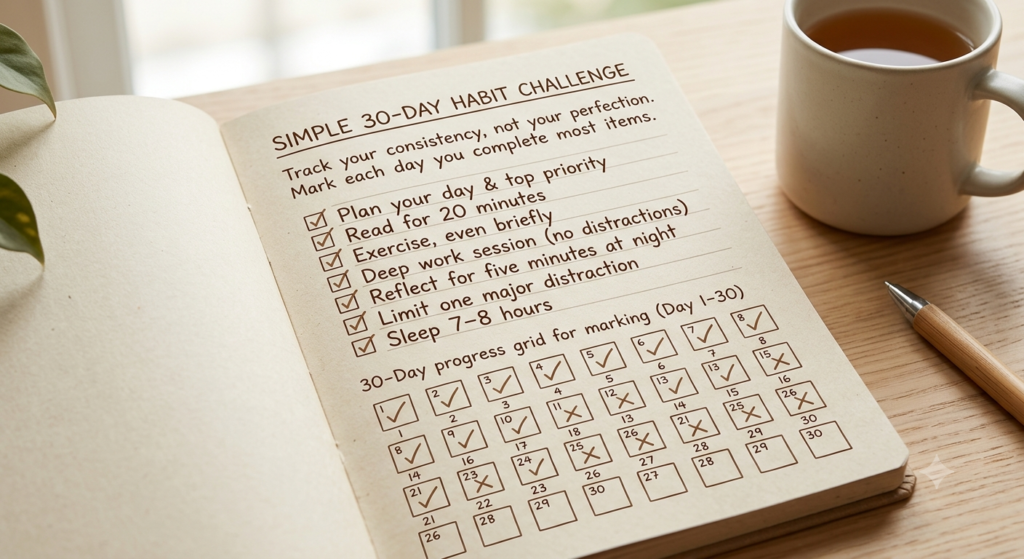
If you want a practical way to start applying everything above, use this daily checklist for the next 30 days:
- [ ] Plan your day and identify your top priority
- [ ] Read for 20 minutes
- [ ] Exercise, even briefly
- [ ] Complete one deep work session, free from distractions
- [ ] Reflect for five minutes at night
- [ ] Limit at least one major distraction
- [ ] Sleep 7–8 hours
Track your consistency, not your perfection. A simple checkmark for each day you complete most of these items will show you, in black and white, how much you’re actually showing up – which is usually far more motivating than any single dramatic result.
By day 30, you won’t have transformed your life. But you’ll have built the foundation that makes transformation possible over the following months.
Final Thoughts
Success is built quietly, in the repetitions nobody applauds and the ordinary days nobody remembers individually. Daily actions – not dramatic moments – shape long-term outcomes.
The biggest achievements, whether in business, health, or personal growth, begin with small, repeatable habits practiced long after the initial excitement fades. That’s the real difference between people who talk about change and people who experience it.
You don’t need to adopt all seven habits at once. Choose one from this list – the one that feels most relevant to where you are right now – and commit to it for the next month. Once it feels automatic, add the next. That’s how sustainable, long-term success is actually built.
FAQs
1. What are the best daily habits for long-term success?
The habits with the strongest track record include starting each day with clear priorities, protecting time for focused work, learning consistently, managing your physical and mental energy, reflecting daily, removing time-wasting behaviors, and staying consistent even when motivation is low. None of these require talent – they require repetition.
2. How long does it take to build a successful habit?
Research suggests it typically takes around two months for a new habit to start feeling automatic, though the full range can run anywhere from about three weeks to nearly a year depending on the behavior and the person. There’s no universal number – consistency matters more than hitting a specific day count.
3. Is motivation necessary for success?
Motivation helps you start, but it isn’t reliable enough to sustain long-term success on its own. Systems and habits are what carry you through the days motivation doesn’t show up, which is most days.
4. Which habit has the biggest impact on productivity?
Protecting time for deep, distraction-free work tends to produce the most noticeable results, since focused hours consistently outperform hours fragmented by interruptions and multitasking. That said, consistency across all seven habits compounds far more powerfully than excelling at just one.
5. Can small daily habits really change your life?
Yes. Small habits compound the same way small amounts of interest compound in a savings account – slowly at first, then significantly over time. The results are rarely visible in the first weeks, which is exactly why so many people quit before the compounding effect becomes noticeable.