

Running a business is, at its core, an unbroken chain of choices. What to build. Who to hire. What to charge. When to walk away. Most of these decisions never make it into a board deck or a strategy meeting – they happen quietly, in the space of a few minutes, between emails.
That volume adds up faster than most founders realize. Researchers estimate that the average adult makes roughly 35,000 conscious decisions a day, and for an entrepreneur, a disproportionate share of those decisions carry real financial and reputational weight. By early afternoon, many founders have already made more high-stakes calls than a typical employee makes in a week. That is not an exaggeration – it is simply what ownership looks like.
The hidden cost of this is not always visible on a profit and loss statement. It shows up as slower response times, second-guessing, snapping at your team over small things, or defaulting to whatever choice requires the least mental effort rather than the one that’s actually best for the business. Psychologists call this decision fatigue: the well-documented decline in judgment quality that sets in after a long stretch of choosing. It explains why a well-rested founder makes a sharper call at 9 a.m. than the same founder, staring at the same data, at 9 p.m.
Founders who scale sustainably rarely rely on raw instinct alone. They build repeatable systems for thinking. A framework does not remove judgment from the equation – it structures it, so that judgment gets applied where it matters most and skipped where it doesn’t. That is the real difference between a founder who is constantly firefighting and one who is calmly steering.
In this guide, we will walk through nine decision-making frameworks that entrepreneurs, executives, and operators actually use – from Jeff Bezos’s reversible-decision philosophy to the pre-mortem technique used by high-stakes planning teams. You will learn what each framework is, when to reach for it, how it plays out in a real business scenario, and the mistakes people commonly make when applying it. By the end, you will have a practical map for matching the right tool to the right decision – and a five-step process for building your own decision-making system going forward.
Why Every Entrepreneur Needs a Decision-Making Framework
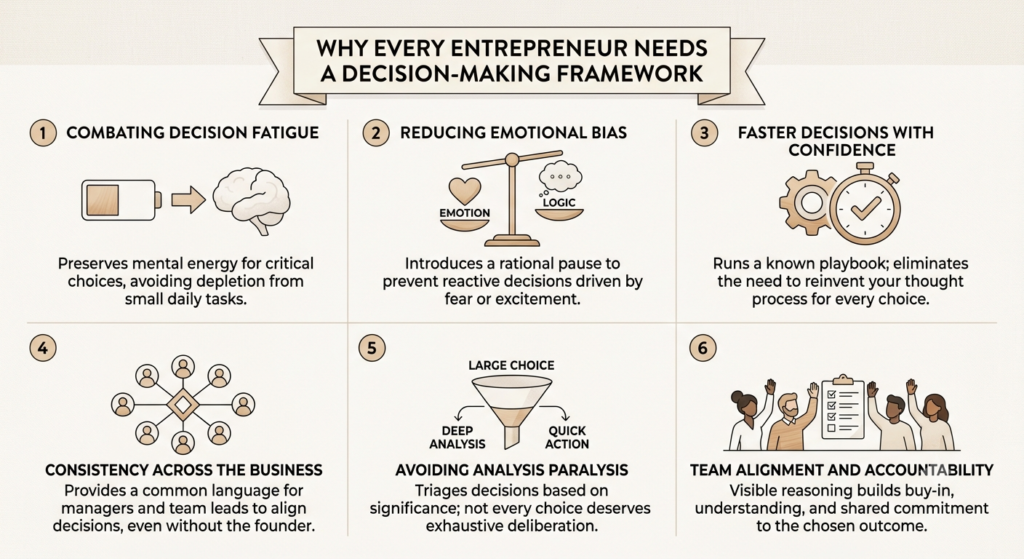
Before diving into the frameworks themselves, it helps to understand why an unstructured, instinct-only approach eventually breaks down as a business grows.
Decision Fatigue Is Real
Every choice you make draws from the same limited pool of mental energy, regardless of how small it feels. Deciding on a lunch order and deciding on a pricing change pull from the same cognitive reserve. Left unmanaged, this constant depletion pushes founders toward impulsive choices, procrastination on the decisions that matter most, or simply defaulting to whatever option requires the least thought. This is precisely why well-known executives have historically simplified low-stakes daily choices – wearing the same outfit, eating the same breakfast – to preserve mental bandwidth for decisions that actually move the business forward. A framework does the same job at a larger scale: it automates the process so your energy goes toward the content of the decision.
Reducing Emotional Bias
Emotion is not the enemy of good decision-making, but unexamined emotion often is. Fear of loss, excitement about a new opportunity, or frustration with a difficult employee can all distort judgment in the moment. Structured frameworks introduce a pause – a set of questions you have to answer before you act – which naturally filters out purely reactive choices.
Making Faster Decisions With Confidence
Counterintuitively, having a framework often makes decisions faster, not slower. When you already know which category a decision falls into and which questions you need to answer, you are not reinventing your thought process every time. You are running a known playbook.
Improving Consistency Across the Business
As a company grows beyond a single founder, decisions get made by managers, team leads, and department heads who were not in the room when the founder built their intuition. A shared framework – something as simple as “how reversible is this?” – gives everyone in the business a common language for weighing choices, which keeps decisions consistent even when the founder is not personally involved.
Avoiding Analysis Paralysis
Not every decision deserves a week of deliberation. One of the quiet dangers in early-stage businesses is treating every choice, from a vendor swap to a company pivot, with the same heavyweight process. Frameworks help you triage: some decisions need deep analysis, and most do not.
Better Team Alignment and Accountability
When a decision is made through a visible process rather than a gut call, it is easier for a team to understand the reasoning behind it, buy into it, and hold each other accountable to the outcome – rather than quietly disagreeing and disengaging.
1. First Principles Thinking – Solve Problems From the Ground Up
What it is
First principles thinking means breaking a problem down to its most basic, undeniable truths and reasoning upward from there, rather than reasoning by analogy to how things have always been done. Instead of asking “how do our competitors price this?” you ask “what does this actually cost to produce, and what value does it genuinely deliver?”
When to use it
Reach for first principles thinking when you are stuck inside an industry assumption that no longer serves you – pricing models inherited from competitors, a business model copied from a “successful” peer, or a process that exists simply because “that’s how it’s always been done.” It is especially valuable for pivots, radical cost reduction, and product redesigns.
Business example
A founder running a subscription meal-kit service assumes packaging costs are fixed because “every competitor packages this way.” Reasoning from first principles, the team strips the problem to its basics: what does the food actually need to stay fresh for 48 hours, and what is the cheapest material that achieves that? The exercise reveals that half the packaging cost was inherited industry convention, not a genuine requirement – opening the door to a redesign that cuts costs without sacrificing quality.
Common mistakes
The biggest mistake is stopping too early – accepting an assumption as a “first principle” when it is actually just a common industry practice dressed up as a fact. A second mistake is using first principles thinking for every decision; it is mentally expensive and best reserved for foundational questions, not day-to-day operations.
Quick action tip
The next time you catch yourself saying “that’s just how it’s done in our industry,” stop and ask: is this a physical, legal, or economic constraint – or just a convention? Write down the actual constraints separately from the assumed ones.
2. Type 1 vs. Type 2 Decisions (One-Way vs. Two-Way Doors)
Reversible vs. Irreversible Decisions
This framework comes from Amazon founder Jeff Bezos, who introduced it in a shareholder letter to explain how the company avoids slowing down as it scales. Bezos described some decisions as “one-way doors” – consequential and difficult or impossible to reverse – which deserve careful, methodical deliberation. Most decisions, however, are “two-way doors”: reversible choices that can and should be made quickly, often by a single capable person or a small team, because a wrong call can simply be corrected.
Why Speed Matters
Bezos observed that as companies grow, there is a natural tendency to apply the same heavyweight, slow process to every decision – including the reversible ones. The result is organizational slowness, unnecessary risk aversion, and fewer experiments, which ultimately means less innovation. Notably, Bezos has pointed out that even major initiatives like AWS and Amazon Prime were, at launch, closer to two-way doors than most people assumed – they could have been scaled back quietly if they hadn’t worked.
Examples
- Hiring: A junior hire on a standard contract is often a two-way door – a mismatch can be corrected. A key executive hire with significant equity and cultural influence leans closer to a one-way door and warrants deeper diligence.
- Pricing: Testing a promotional discount for two weeks is reversible. Publicly repositioning your entire brand as “premium” is much harder to undo.
- Product launches: A limited beta launched to a small user segment is a two-way door. A full public launch tied to a major press campaign is closer to one-way.
- Partnerships: A short-term referral arrangement is reversible. Signing an exclusive, multi-year distribution agreement is not.
Practical takeaway
Before spending days deliberating, ask a single question: if this goes badly, how hard is it to reverse? If the answer is “not very hard,” make the call quickly, using roughly 70 percent of the information you wish you had, and correct course later if needed. Reserve deep deliberation for decisions where the door genuinely locks behind you.
3. The Eisenhower Matrix
Urgent vs. Important
The Eisenhower Matrix, popularized from a principle attributed to former U.S. President Dwight D. Eisenhower, sorts tasks and decisions along two axes: urgency and importance. The insight behind it is simple but easy to forget – what feels urgent in the moment is often not what actually matters most for the business.
The Four Quadrants Explained
- Urgent and important: Handle these yourself, immediately. A payment processor outage affecting live customers falls here.
- Important but not urgent: Schedule dedicated time for these. Long-term planning, hiring strategy, and relationship-building typically live here – and are the tasks most founders neglect under pressure.
- Urgent but not important: Delegate these wherever possible. Many routine emails and small operational requests fall into this box.
- Neither urgent nor important: Eliminate or minimize these. Low-value meetings and busywork belong here.
Daily Entrepreneur Examples
A founder juggling a product bug, a partner introduction, a routine invoice question, and a scroll through industry news can sort all four instantly: fix the bug now, schedule real time for the partner conversation, hand the invoice question to a team member, and skip the scroll until decisions are made.
Productivity Benefits
Used consistently, the matrix prevents the common trap of spending an entire day reacting to whatever feels loudest, while the genuinely important, non-urgent work – the strategic thinking that actually grows the business – keeps getting pushed to “someday.”
Simple Template Readers Can Apply Today
Draw a simple two-by-two grid on paper or in a notes app. Each morning, sort your open decisions and tasks into the four boxes before you open your inbox. Anything landing in quadrant two – important, not urgent – gets a specific block of time on your calendar that week, not just a mental note.
4. The OODA Loop
Observe, Orient, Decide, Act
The OODA Loop was developed by U.S. Air Force strategist John Boyd to describe how a fighter pilot outmaneuvers an opponent by cycling through four stages faster than the enemy can: Observe the situation, Orient yourself using your experience and available information, Decide on a course of action, and Act on it – then repeat, continuously, as new information arrives.
Why Startups Benefit From Rapid Decision Cycles
The core insight Boyd offered was that the advantage does not always go to whoever has the best resources – it goes to whoever can complete this cycle faster and more accurately than their competition. For an early-stage business competing against larger, slower incumbents, a tighter OODA Loop is often the single biggest structural advantage available.
Real Business Scenario
Fast-fashion retailer Zara is frequently cited as a real-world example of OODA thinking in practice, even though the company has never explicitly framed it that way. Traditional apparel retailers typically run a four-to-six-month cycle from design to store shelf. Zara compresses that cycle dramatically by having store managers report sales data twice a week, feeding directly into factory production decisions – allowing the company to observe demand, orient around what’s actually selling, decide on new designs, and act by getting new stock into stores in a fraction of the industry-standard time.
For a smaller business, the same discipline applies at a simpler scale: watch what customers are actually doing (not just what they say), interpret that data quickly using your accumulated experience, commit to a next step, and ship it – then loop back and observe again.
5. SWOT Analysis for Strategic Decisions
Strengths, Weaknesses, Opportunities, Threats
SWOT analysis maps a decision or a business against four categories: internal Strengths and Weaknesses, and external Opportunities and Threats. It remains one of the most widely used strategic planning tools because it forces a balanced look at both what you control and what you don’t.
When SWOT Works Best
SWOT is most useful for big-picture strategic questions – entering a new market, launching a new product line, or evaluating a potential partnership – rather than for quick, tactical calls. It works best as a group exercise, since different team members often see different strengths, weaknesses, opportunities, and threats than the founder does alone.
Sample Startup Example
A regional cleaning-services company considering expansion into a neighboring city might map it out as: strengths (strong local reputation, trained staff), weaknesses (limited cash reserves for a second office), opportunities (underserved demand in the new city, a competitor recently closed), and threats (higher operating costs, unfamiliar local regulations). Laid out this way, the decision becomes about sequencing and risk mitigation – perhaps starting with a smaller footprint – rather than a binary yes or no.
6. Cost-Benefit Analysis
Measuring Gains vs. Risks
Cost-benefit analysis is the most straightforward framework on this list: list what a decision will cost against what it stands to deliver, and compare the two as objectively as possible. Its simplicity is exactly why it remains a foundational tool for entrepreneurs evaluating almost any resource allocation decision.
Financial and Non-Financial Factors
The mistake many founders make is limiting the analysis to dollars alone. A genuinely useful cost-benefit analysis also accounts for time investment, opportunity cost, team morale, brand reputation, and customer trust – all of which carry real, if harder-to-quantify, value.
Best Use Cases
This framework shines for decisions with fairly well-understood inputs: whether to invest in new equipment, whether a marketing campaign is worth the spend, or whether to bring a function in-house versus outsourcing it.
Simple Evaluation Checklist
- List every direct financial cost, including hidden or recurring ones.
- List every direct financial benefit, including projected revenue and cost savings.
- Note non-financial costs: time, team bandwidth, stress, reputational risk.
- Note non-financial benefits: skill development, brand strength, customer goodwill.
- Compare total costs and benefits over a realistic timeframe, not just month one.
7. Expected Value Thinking
Thinking in Probabilities Instead of Certainty
Expected value thinking asks you to weigh not just the potential outcome of a decision, but the probability of that outcome actually happening, multiplied by its impact. Instead of asking “will this work?” – a binary, often unanswerable question – you ask “what is the range of outcomes, how likely is each, and what is the weighted average result?”
Why Entrepreneurs Should Evaluate Upside and Downside
Many business decisions are not really about being right or wrong on a single guess. They are about consistently making bets where the expected value is positive, even knowing that any individual bet might fail. This is the same logic professional investors use: no single investment needs to succeed for the overall portfolio to win, as long as the expected value math holds across many decisions.
Startup Investment Example
A founder is deciding whether to invest in a new advertising channel that costs 10,000 dollars. If there’s a 30 percent chance it generates 50,000 dollars in new revenue and a 70 percent chance it generates nothing, the expected value is 15,000 dollars – still worth the bet, even though failure is the more statistically likely single outcome. Reasoning this way keeps a founder from either overreacting to one bad result or overcommitting to one lucky win.
Avoiding Emotional Decisions
Expected value thinking is a useful antidote to both excessive caution and reckless optimism, because it forces both the upside and the downside onto the same page, in the same units, before a decision gets made.
8. Pre-Mortem Analysis
Imagine the Project Failed
A pre-mortem flips the traditional retrospective on its head. Instead of waiting until a project fails and asking what went wrong, the team imagines, before the decision is made, that it is now some months in the future and the initiative has already failed – then works backward to identify why.
Identify Possible Causes
Because the failure is treated as a given rather than a hypothetical, team members tend to surface risks and doubts more openly than they would in a standard planning meeting, where voicing skepticism about a decision that’s already gaining momentum can feel socially risky.
Reduce Future Mistakes
By naming the most plausible failure causes in advance – underestimated timeline, a key dependency on one vendor, an unvalidated assumption about customer demand – a team can build safeguards into the plan before launch, rather than discovering them the hard way.
Team Collaboration Benefits
The pre-mortem also functions as a psychological safety valve. It gives cautious team members permission to voice concerns without appearing to be obstructive, since the exercise is explicitly framed as constructive risk-spotting rather than personal criticism of the decision-maker.
9. WRAP Framework
Business authors Chip and Dan Heath developed the WRAP framework in their book Decisive to counter four common decision-making traps: narrow framing, confirmation bias, short-term emotion, and overconfidence.
Widen Your Options
Most difficult decisions get framed as a binary – do this or don’t. The Heaths recommend deliberately generating more than two options, since research on this kind of “multitracking” suggests it consistently leads to better, more creative outcomes than comparing a single option against inaction.
Reality-Test Assumptions
Rather than seeking information that confirms what you already believe, actively look for evidence that would prove you wrong. Ask what a skeptic on your team would say, and seek their honest opinion before, not after, the decision is made.
Attain Distance
Short-term emotion can distort judgment on high-stakes calls. A well-known technique here is asking how you’ll feel about the decision in ten minutes, ten months, and ten years – which naturally filters out choices driven purely by momentary pressure.
Prepare to Be Wrong
Since no one can predict the future with certainty, build in safeguards: set a specific “tripwire” – a metric or date that automatically triggers a review of the decision – and know the first step of your backup plan before you need it.
Ideal for High-Impact Decisions
Because it takes real time to run through all four steps properly, WRAP is best reserved for decisions with lasting consequences – a pivot, a major hire, a significant investment – rather than for routine, everyday choices.
Which Decision Framework Should You Use?
Different situations call for different tools. Here’s a practical comparison to help you match the framework to the moment.
| Business Situation | Best Framework | Why It Works |
| Hiring | Type 1 vs. Type 2 Decisions | Weighs long-term impact and reversibility before committing time and resources |
| Product Launch | OODA Loop | Enables rapid adaptation as real market feedback comes in |
| Market Expansion | SWOT Analysis | Provides structured strategic planning across internal and external factors |
| Time Management | Eisenhower Matrix | Prioritizes based on urgency versus true importance |
| New Investment | Cost-Benefit Analysis | Delivers a clear financial and non-financial evaluation |
| Business Pivot | First Principles Thinking | Challenges inherited assumptions and rebuilds from fundamentals |
| High-Risk Choice | WRAP Framework | Reduces cognitive bias through a structured, multi-step process |
| Marketing Spend | Expected Value Thinking | Weighs probability-adjusted outcomes instead of a single guess |
| New Initiative Planning | Pre-Mortem Analysis | Surfaces risks and blind spots before resources are committed |
Common Decision-Making Mistakes Entrepreneurs Should Avoid
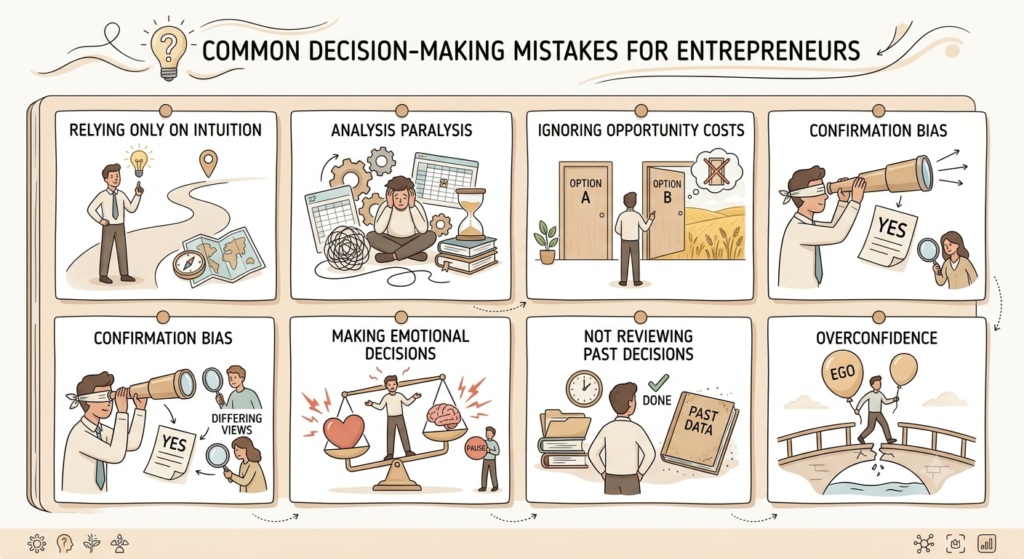
Even with the right frameworks in hand, certain habits quietly undermine good decision-making.
Relying only on intuition. Experience-based instinct has real value, especially for experienced operators, but it is not infallible – and it tends to fail most in unfamiliar situations, which is exactly when a structured framework matters most.
Analysis paralysis. Over-researching a two-way-door decision wastes time that could be spent testing and correcting course. If a decision is reversible, bias toward speed.
Ignoring opportunity costs. Every yes is also a no to something else. A decision that looks fine in isolation can still be the wrong choice if it consumes resources better spent elsewhere.
Confirmation bias. Seeking out information that supports a decision you have already emotionally committed to is one of the most common – and most invisible – decision-making traps. Actively invite disagreement before finalizing important choices.
Making emotional decisions. Fear, excitement, and frustration are useful signals, but they make poor sole decision-makers. Build a pause into your process for anything high-stakes.
Not reviewing past decisions. Without a habit of looking back at what worked and what didn’t, a founder’s judgment improves far more slowly than it could. Treat past decisions as data, not just history.
Build Your Own Decision-Making System
Frameworks are only useful if they become habits. Here is a simple, repeatable five-step process you can apply to almost any business decision, regardless of which specific framework you end up using.
- Define the problem clearly. Vague problems produce vague decisions. Write down, in one sentence, exactly what you are deciding and why it matters.
- Choose the right framework. Use the comparison table above as a starting point. Ask how reversible the decision is, how much data you already have, and how much time it genuinely deserves.
- Gather relevant data. Collect just enough information to make a confident call – remember Bezos’s guidance of roughly 70 percent of the information you wish you had, rather than waiting for certainty that rarely arrives in time.
- Make the decision with confidence. Once you’ve run the framework, commit. Half-hearted decisions, revisited constantly, waste more energy than a clear, confident one.
- Measure the outcome and refine your process. Set a date to review the result. Did it play out as expected? What would you do differently? Feed that answer back into how you make the next decision.
Conclusion
Great entrepreneurs are not born with flawless judgment. What separates founders who scale calmly from those who burn out chasing every decision is a reliable system for thinking – one that tells them when to move fast, when to slow down, and when to bring in a second opinion.
You do not need to master all nine of these decision-making frameworks at once. Start with one or two that map naturally onto the decisions you face most often – perhaps Type 1 versus Type 2 thinking for hiring and partnerships, and the Eisenhower Matrix for daily prioritization. Build the habit, then expand your toolkit as new kinds of decisions demand it.
The businesses that scale sustainably are rarely the ones with the most talented founder in the room. They are the ones where good decisions happen reliably, again and again, because the system – not just the person – is built to produce them. Start building that system today, one decision at a time.
Key Takeaways
- Entrepreneurs face an unusually high volume of consequential decisions, which makes decision fatigue a real, measurable risk to business performance.
- Structured frameworks don’t replace judgment – they focus it, applying deep deliberation only where it’s actually warranted.
- Reversibility is one of the most useful filters for deciding how much time a decision deserves: reversible choices should be made quickly, irreversible ones deserve careful deliberation.
- Different situations call for different tools – pricing decisions, hiring calls, and market expansions each benefit from a different framework.
- Building a personal or team-wide decision-making system, reviewed and refined over time, compounds into a genuine competitive advantage.
Frequently Asked Questions
1. What is the best decision-making framework for a new entrepreneur?
There isn’t a single best framework for everyone. Most new entrepreneurs benefit from starting with the Eisenhower Matrix for daily prioritization and the Type 1 versus Type 2 distinction for bigger calls like hiring or partnerships, since both are simple to apply without extensive training.
2. How do I know if a business decision is reversible or not?
Ask what it would take to undo the decision if it doesn’t work out. If you can course-correct within weeks with limited cost, treat it as reversible and decide quickly. If undoing it would require significant time, money, or reputational repair, treat it as a one-way door and slow down.
3. Can decision-making frameworks eliminate risk entirely?
No framework removes risk from business decisions. What a good framework does is make risk visible and deliberate, rather than accidental – so you are choosing your risks consciously instead of stumbling into them.
4. How often should entrepreneurs review past decisions?
A simple habit is a monthly or quarterly review of your most significant decisions, checking outcomes against what you expected. This is also the core discipline behind the “prepare to be wrong” step of the WRAP framework.
5. Is intuition ever a reliable basis for decisions?
Yes, particularly in areas where you have deep, hands-on experience – intuition built on genuine expertise can be fast and accurate. The risk is relying on intuition in unfamiliar territory, where a structured framework will usually outperform a gut call.
6. How can a small team without dedicated analysts use frameworks like SWOT or cost-benefit analysis?
These frameworks don’t require specialized tools – a whiteboard, a shared document, and thirty focused minutes are enough. The value comes from the structured thinking, not from sophisticated software.