

Running a business today feels a little like juggling on a moving train. You’re closing sales, answering emails, reviewing invoices, coaching your team, and somehow also trying to think about next quarter’s strategy, all before lunch. If that sounds familiar, you’re not imagining things. Nonfarm business productivity grew just 0.3 percent in the first quarter of 2026, one of the smallest gains on record, even as compensation and workloads keep climbing. Business owners are being asked to do more with the same 24 hours everyone else has.
The good news is that productivity isn’t about working longer. It’s about working with intention. This guide walks through practical, research-backed productivity tips for business owners who want to get more done without burning out in the process. You’ll find real strategies for managing your time, sharpening your focus, delegating well, and using today’s tools to reclaim hours you didn’t know you had.
Why Productivity Tips for Business Owners Matter More Than Ever
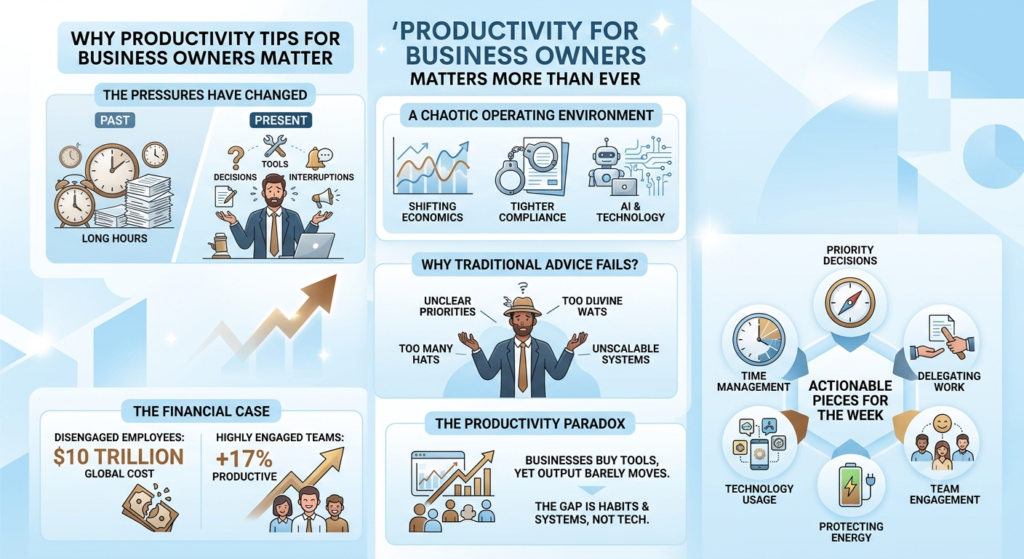
The pressure on business owners has changed shape in the last few years. It isn’t just about long hours anymore. It’s about the sheer number of decisions, tools, and interruptions competing for attention every single day. Managers are advised to focus on no more than three or four major initiatives at a time, because the more priorities someone juggles, the higher their stress climbs. Business owners routinely blow past that number before their first coffee is finished.
Layer on top of that a genuinely chaotic operating environment. Shifting economic conditions, tighter compliance requirements, and fast-moving technology like AI are reshaping how businesses run, often faster than owners can adjust their habits. The result is a wave of simultaneous burnout among managers and employees alike, which is exactly why productivity tips for business owners can’t just be recycled advice about waking up earlier. They need to address the real bottlenecks: unclear priorities, too many hats worn by one person, and systems that were never built to scale.
There’s also a hard financial case for getting this right. Disengaged employees cost the global economy an estimated 10 trillion dollars in a single recent year, and highly engaged teams are roughly 17 percent more productive than disengaged ones. When a business owner improves their own habits and the systems around them, that improvement doesn’t stay contained to one person. It ripples through the whole team.
Globally, the picture looks similar. Productivity growth across major economies averaged less than half a percent in the most recent measured year, despite years of heavy investment in new technology and software. Economists have started calling this the productivity paradox: businesses keep buying tools meant to save time, yet overall output barely moves. That gap usually isn’t a technology problem. It’s a habits and systems problem. A new app rarely fixes a scheduling system built on chaos, and no dashboard can substitute for a clear sense of what actually deserves your attention today.
This article breaks productivity down into pieces you can actually act on this week: how you manage your time, how you decide what deserves your attention, how you hand off work, how you use technology, how you protect the energy that makes all of it possible, and how your whole team factors into the equation. None of these ideas are complicated. What matters is choosing a few and sticking with them long enough to see the compounding effect.
Start With Your Time: What Actually Works
Before you can fix how you spend your time, you need an honest picture of where it currently goes. Most business owners are surprised by the gap between how they think they spend their days and how they actually do. A simple week of tracking, using a notebook or a time-tracking app, is often the single most eye-opening productivity exercise available.
Once you know where your hours go, these approaches tend to make the biggest difference.
Time-Block Your Calendar
Instead of working from an open-ended to-do list, assign specific blocks of time to specific tasks. Reserve mornings for deep, focused work like strategy or content creation, and push meetings, calls, and admin into designated afternoon blocks. When a task has a defined start and end time, it’s far less likely to expand and swallow your whole day.
Try the Pomodoro Technique
The Pomodoro Technique breaks work into 25-minute focused sprints followed by a 5-minute break, with a longer break after four cycles. It sounds almost too simple, but the built-in breaks prevent the slow mental fatigue that creeps in during long, unstructured stretches at your desk, and the short sprints make large projects feel far less intimidating.
Choose Single-Tasking Over Multitasking
It’s tempting to answer emails while on a call or draft a proposal between meetings, but switching between tasks actually costs you time. Every time your brain reorients to a new task, you lose momentum, which means multitasking often takes longer overall than handling one thing at a time. Committing to single-tasking, even for short stretches, tends to produce cleaner, faster work.
Build In Weekly Review Sessions
Set aside 15 to 30 minutes at the end of each week to look back honestly. What moved forward? What stalled? What needs to change next week? This single habit turns your calendar into a feedback loop instead of a fixed schedule, and it’s one of the simplest time management strategies available to any owner willing to protect that half hour.
Plan the Night Before, Not the Morning Of
Deciding what matters most for tomorrow works better the evening before than first thing in the morning. When you start the day with a plan already in place, you skip the slow, distracted warm-up period where email and social media quietly steal the first hour. Even five or ten minutes the night before, jotting down the top two or three priorities, changes how the next day unfolds.
Guard Your Most Productive Hours
Most people have a window, often mid-morning, when focus and energy peak naturally. Pay attention to when you personally do your best thinking, then protect that window fiercely for the work that actually requires it, like strategy, writing, or complex problem-solving. Save the lower-energy hours for routine tasks like replying to emails or approving invoices, work that doesn’t need your sharpest thinking to get done well.
Prioritize Ruthlessly: Frameworks for Deciding What Matters
Time management only helps if you’re spending your protected hours on the right things. Business owners face a constant stream of tasks that all feel urgent, which is exactly why a clear prioritization framework matters as much as any calendar trick.
The Eisenhower Matrix
Sort every task into one of four boxes: urgent and important, important but not urgent, urgent but not important, and neither. Tackle the first category immediately, schedule time for the second, delegate the third wherever possible, and drop the fourth entirely. This one shift, thinking in categories instead of a flat list, is one of the more durable productivity tips for business owners because it forces you to separate what’s loud from what’s actually valuable.
Apply the 80/20 Rule
A large share of your results usually comes from a small share of your efforts. Look honestly at which clients, products, or activities generate most of your revenue or impact, and protect time for those first. Everything else gets evaluated for whether it deserves a spot on your calendar at all.
Watch for Late-Day Decision Drift
Every choice you make throughout the day draws from the same limited pool of mental energy, and by late afternoon that pool often runs low, a pattern researchers refer to as decision fatigue. That’s one reason judgment tends to slip on choices made near the end of a long day. Reducing the number of small daily decisions, such as standardizing routine choices around meals, outfits, or approval processes, frees up sharper thinking for the decisions that genuinely need it.
Delegate and Outsource: Get Out of the Weeds
Many business owners hold onto tasks long after they should have handed them off, often because it feels faster to just do it themselves. In the short term that might be true. Over months and years, it’s one of the biggest drags on growth.
Know Your Hourly Value
Calculate roughly what your time is worth based on the revenue-generating work only you can do. If a task pays less per hour than that number, and someone else could reasonably do it, it’s a strong candidate for delegation. This reframing makes the decision to hand off tasks feel less personal and more like basic business math.
Build a Delegation-Ready Team
Delegation only works if the people around you have the context and authority to actually own a task, not just execute it under close supervision. Document your expectations clearly, check in at reasonable intervals, and resist the urge to take a task back the moment it’s done differently than you would have done it yourself.
Know When to Outsource
You don’t need a full-time hire for every gap. Bookkeeping, graphic design, virtual assistance, and specialized admin work can often be outsourced to freelancers or agencies without adding payroll overhead. For many solo owners and small teams, a single well-matched outsourcing relationship recovers several hours a week almost immediately.
Consider a small service business owner who spends four or five hours a week on invoicing, scheduling, and inbox management. Hiring a part-time virtual assistant to take over those tasks might cost a modest monthly fee, but it frees up an entire workday every week for client work or business development, activities that generate far more revenue than the cost of the help. The math almost always favors outsourcing once an owner is honest about what their time is actually worth.
Not every delegation attempt works on the first try, and that’s normal. The most effective delegation strategies treat the first handoff as a starting point, not a final verdict, refining instructions and checkpoints based on what actually goes wrong rather than abandoning the task and taking it back. Delegation and outsourcing carry a real emotional hurdle for many owners, especially in the early stages of a business. Letting go of a task you’ve always handled personally can feel like losing control. In practice, the opposite tends to happen. Owners who delegate consistently report meaningfully lower stress and more capacity for the strategic work that actually needs their attention, precisely because they’re no longer the bottleneck for every small decision.
Put AI and Technology to Work
If there’s one shift reshaping daily operations for business owners right now, it’s the rapid, mainstream adoption of AI. As of 2026, the large majority of businesses report using AI in at least one capacity, a sharp jump from just a few years ago, and owners who have moved past experimenting into real workflow integration are seeing meaningful gains: efficiency, accuracy, and hours reclaimed every week.
Where AI Tools Save the Most Time
AI productivity tools are proving most useful for the repetitive, low-judgment work that eats up disproportionate time: drafting emails and proposals, summarizing meetings, scheduling, generating first drafts of content, and handling routine customer questions. Business owners using AI for administrative tasks report reclaiming several hours a week, time that can be redirected toward strategy, sales, or simply going home on time.
Automate the Repetitive Layer
Beyond AI chat tools, dedicated automation software can handle recurring workflows without manual input at all: invoice reminders, appointment confirmations, lead follow-ups, and routine reporting. The businesses seeing the strongest returns tend to match one automation tool to one specific, well-defined workflow rather than trying to overhaul everything at once.
Avoid Tool Overload
It’s easy to end up with five or six overlapping apps that each promise to save time but collectively add friction. Before adding a new tool, ask what specific bottleneck it solves and whether an existing tool in your stack could already do the job. A smaller, well-integrated toolkit almost always outperforms a sprawling one.
Train Before You Deploy
One pattern shows up consistently in the data on AI adoption: businesses that spend even a few hours training their team on a new tool see dramatically better results than those that simply roll it out and hope employees figure it out on their own. A short internal training session, or even a single afternoon spent documenting how to use a new tool for your specific workflows, pays for itself many times over in adoption and consistency.
It’s also worth noting where adoption still lags. Professional and technical service businesses tend to lead on AI adoption, while trades and food service businesses have been slower to integrate these tools, often because the day-to-day work is more hands-on and less document-based. If your business falls into a slower-adopting category, that’s not a reason to skip AI altogether. It usually just means the highest-value use case is somewhere less obvious, like automated appointment reminders or AI-assisted inventory tracking, rather than the content-drafting tools that get the most attention.
Protect Your Energy: Preventing Burnout as a Business Owner
No list of productivity tips for business owners is complete without addressing the thing that quietly undermines all of it: burnout. Burnout prevention deserves the same deliberate planning as any other part of running a business, rather than being treated as an afterthought you’ll deal with once things calm down. A meaningful share of entrepreneurs report that their workload interferes with sleep, and long hours consistently top the list of reasons founders describe feeling emotionally exhausted. Burnout doesn’t just hurt how you feel. It measurably lowers decision quality, creativity, and output.
Recognize the Warning Signs Early
Persistent fatigue that doesn’t lift after a weekend, irritability with your team, and a growing sense of dread about routine tasks are all early signals worth taking seriously rather than pushing through. Entrepreneurs who catch these signs early and adjust tend to recover far faster than those who wait until something breaks.
Build Boundaries Into the Schedule
Owners who set clear boundaries between work and personal life report noticeably lower burnout levels than those who don’t. That might mean a firm cutoff time for email, a no-meetings block on your calendar, or simply protecting your evenings the same way you’d protect a client deadline. Boundaries work best when they’re scheduled, not just intended.
Treat Rest as a Business Strategy
It can feel counterintuitive, but taking real breaks, including actual vacations, tends to improve output rather than reduce it. Owners who regularly delegate and step away report meaningfully lower burnout than those who don’t, and a rested decision-maker consistently outperforms an exhausted one, even if the exhausted one logged more hours that week. Protecting a healthy work-life balance isn’t a reward for good performance. It’s a precondition for it.
Push Back on Hustle Culture
Entrepreneurship has long celebrated the founder who never takes a day off, treating exhaustion almost like proof of commitment. That mindset is quietly costly. Burnout has been linked to a meaningful share of startup failures, not because the underlying business idea was flawed, but because a depleted founder eventually makes worse decisions, moves slower, and loses the clarity that got the business off the ground in the first place. Recognizing that rest is part of running a serious business, not a departure from it, is one of the harder mindset shifts on this list, and also one of the most important.
Protect Uninterrupted Focus Time
Some of your most valuable thinking, the kind that shapes strategy, pricing, or a difficult client decision, needs uninterrupted stretches of focused attention that most business owners rarely get. Protecting even 90 minutes of genuine deep work a few times a week, away from Slack notifications, email alerts, and the temptation to check your phone, tends to produce sharper decisions than the same amount of time spent in a constantly interrupted state.
Build Systems, Not Just To-Do Lists
Productivity tips that live only in your head disappear the moment you’re busy or distracted. Systems, by contrast, keep working even when you’re not actively thinking about them.
Write Down How Repeat Tasks Get Done
Documenting your standard operating procedures turns a task that only you know how to do into something your team can handle consistently. Start with the tasks you repeat most often or the ones that create bottlenecks whenever you’re unavailable, and write them down step by step. This single habit is one of the most underrated productivity tips for business owners, because it compounds: every documented process is one less thing that depends entirely on you.
Batch Similar Tasks Together
Grouping similar work, like answering all your emails in two set windows instead of constantly throughout the day, or recording a week’s worth of social content in one sitting, cuts down on the mental switching cost that comes with jumping between unrelated tasks. Batching won’t work for everything, but for routine, low-urgency work it’s one of the easiest wins available.
Reduce Meeting Overload
Not every conversation needs a meeting, and not every meeting needs to be an hour. Before scheduling one, ask whether an email, a shared document, or a five-minute call would accomplish the same thing. For meetings that are genuinely necessary, a clear agenda and a hard end time keep them from expanding to fill whatever space they’re given.
Leverage Your Team for Collective Productivity
Your own habits matter, but a business owner’s productivity is ultimately capped by how well the people around them are working too. Highly engaged teams are roughly 17 percent more productive than disengaged ones, and employees who feel recognized are significantly less likely to leave, which means investing in team culture is also an investment in output. Employee engagement isn’t a soft metric reserved for large corporations. It shows up directly in how quickly small teams execute and how much they catch before a mistake reaches a customer.
Clear roles reduce the back-and-forth that eats up everyone’s day. When each person knows exactly what they own and who to go to for decisions, work moves faster and fewer things fall through the cracks. Regular, brief check-ins, rather than constant ad hoc interruptions, give your team a predictable way to flag problems before they grow. And recognizing good work, even informally, does more for sustained effort than most owners expect.
Owners often assume that engagement is something HR handles at a large company and doesn’t apply at their scale. In practice, a five-person team feels the effects of disengagement just as sharply, if not more, because there’s no layer of middle management to absorb the friction. A short weekly huddle where wins get acknowledged out loud, paired with clear ownership of tasks, does more for a small team’s motivation than any formal engagement program.
Track, Measure, and Adjust
Productivity efforts tend to fade without a way to see whether they’re actually working. You don’t need a complicated dashboard, just a handful of numbers that tell you something real: hours spent on revenue-generating work versus admin, how long your priority tasks actually take compared to your estimates, or how quickly your team resolves customer requests.
Review these numbers monthly, not daily. Daily fluctuations are mostly noise, but a monthly trend tells you whether your systems are actually improving or just feel like they are. When something isn’t working, treat it as information rather than failure, and adjust the system rather than trying to push through it with more willpower.
Keep the review simple enough that you’ll actually do it. A single page with three or four numbers you genuinely trust beats an elaborate dashboard that gets opened once and forgotten. The goal isn’t to measure everything. It’s to notice, early, when a habit that used to work has quietly stopped working, so you can adjust before a small inefficiency turns into a much bigger one.
Common Productivity Mistakes Business Owners Make
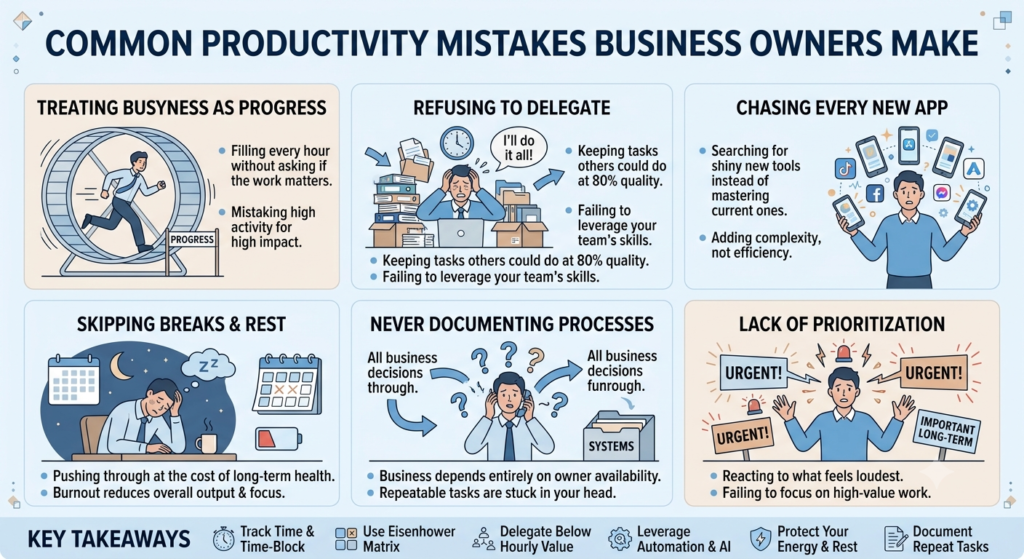
Even well-intentioned owners fall into a few recurring traps, often because these habits felt necessary in the early, scrappy days of the business and simply never got revisited as the business grew.
- Treating busyness as the same thing as progress, and filling every open hour without checking whether the work actually matters.
- Refusing to delegate tasks that someone else could do at 80 percent of the owner’s quality for a fraction of the cost.
- Chasing every new productivity app instead of mastering a smaller set of tools.
- Skipping breaks and rest under the belief that pushing through will pay off, when the research consistently shows the opposite.
- Never documenting processes, which means the business quietly depends on the owner being available at all times.
Avoiding these patterns often does more for output than adding a single new tactic ever could.
Key Takeaways
- Track your time honestly before trying to fix it, and use time-blocking to protect your most important work.
- Prioritize with a clear framework like the Eisenhower Matrix instead of reacting to whatever feels loudest.
- Delegate and outsource tasks that fall below your hourly value, and give your team real ownership.
- Use AI and automation for repetitive, low-judgment work, but keep your toolkit small and intentional.
- Protect your energy with real boundaries and rest. Burnout undermines every other productivity effort.
- Write down how your repeat tasks get done so your business doesn’t depend entirely on you being available.
- Review a few meaningful metrics monthly and adjust your systems based on what they show.
Conclusion
None of this requires a complete overhaul of how you run your business. Pick one or two of these productivity tips for business owners, apply them consistently for a few weeks, and build from there. The owners who sustain real growth aren’t the ones working the most hours. They’re the ones who’ve built habits and systems that make their time, energy, and team work together instead of against each other. Start small, stay consistent, and let the compounding do the rest.
Frequently Asked Questions
What are the most important productivity tips for business owners just starting out? Start with time tracking so you understand where your hours actually go, then build a simple prioritization habit like the Eisenhower Matrix. Everything else, from delegation to automation, works better once those two foundations are in place.
How much time can AI tools realistically save a small business owner? Reports vary, but many owners using AI regularly for administrative tasks report saving several hours a week. The gains are largest for owners who match a tool to one specific workflow rather than adopting several tools at once without a clear plan.
Is multitasking ever a good productivity strategy? Generally, no. Switching between unrelated tasks costs more time overall than finishing one task before starting the next, even though multitasking often feels more efficient in the moment.
How do I know when it’s time to delegate a task instead of doing it myself? Compare the task to your estimated hourly value from revenue-generating work. If the task pays less than that and someone else could reasonably handle it, it’s usually worth delegating, even if it takes some time upfront to train them.
What are early warning signs of burnout in business owners? Persistent fatigue that doesn’t improve with rest, irritability with your team, and dread around routine tasks are common early signals. Addressing these early, through boundaries and delegation, tends to be far easier than recovering from full burnout later.
Does writing down repeat processes really improve productivity for a small team? Yes. Documenting how repeat tasks get done means the business isn’t dependent on one person’s memory or availability, which reduces bottlenecks and makes it easier to delegate with confidence.