

There is a moment almost every founder recognizes. Sales are coming in, the calendar is full, and yet somehow there is less breathing room than when the business was smaller. That contradiction is the clearest sign that a company has hit its ceiling. It is not a demand problem. It is a design problem.
Growth adds more of the same: more orders, more clients, more hours. Scaling is different. It means your revenue can climb without your costs, your stress, or your personal involvement climbing at the same rate. Learning how to scale a small business is really about learning how to build something that keeps working when you are not the one holding it together.
This guide walks through what scaling actually requires in 2026 – the systems, the financial discipline, the people decisions, and the technology choices – using current data on how small businesses are growing, where they are getting stuck, and what separates the ones that break through from the ones that stall out.
What Scaling a Small Business Actually Means
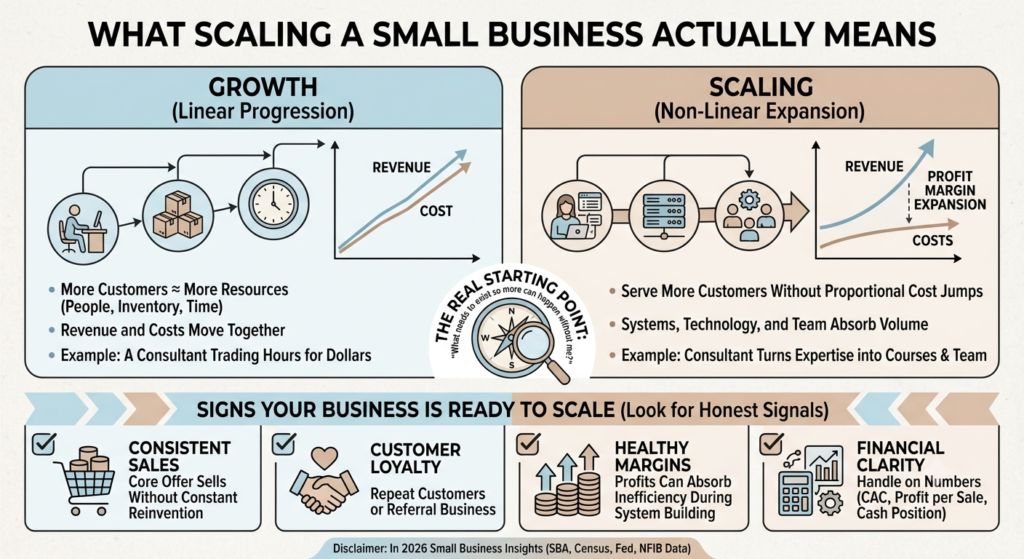
Before diving into tactics, it helps to separate two words that get used interchangeably but describe very different situations.
Growth is linear. If you want to serve twice as many customers, you roughly need twice as many people, twice as much inventory, and twice as many hours in the day. Revenue and cost move together.
Scaling is not linear. A business that scales well can serve significantly more customers without a proportional jump in cost or effort, because the systems, technology, and team structure absorb the added volume.
Think of a consultant who trades hours for dollars versus one who has turned their expertise into a course, a certification program, and a small team of delivery specialists. Both might earn the same amount today. Only one of them can double their revenue next year without doubling their workload.
Understanding this distinction is the real starting point for anyone trying to figure out how to scale a small business, because it changes what you optimize for. You stop asking “how do I do more” and start asking “what needs to exist so more can happen without me.”
Signs Your Business Is Ready to Scale
Scaling too early is one of the fastest ways to damage a healthy business. Before you invest in growth, look for a few honest signals.
Your core offer sells consistently without heavy discounting or constant reinvention. You have repeat customers or referral business, which tells you the product or service holds up beyond the initial sale. Your margins can absorb a bit of inefficiency while you build new systems. And critically, you have at least a rough handle on your numbers: cost of acquisition, profit per sale, and monthly cash position.
If any of these are shaky, the priority is not scaling. It is stabilizing. Scaling amplifies whatever is already true about a business. A well-run operation scales into a bigger, well-run operation. A chaotic one scales into a bigger, more expensive mess, faster than most owners expect.
Recent data backs up why this matters. According to a 2026 analysis pairing SBA, Census Bureau, Federal Reserve, and NFIB research, the United States is home to 36.2 million small businesses, representing 99.9% of all American firms and nearly half the private-sector workforce, yet owners are operating in a genuinely tougher environment, with inflation, elevated borrowing costs, and staffing strain topping the list of pressures. Scaling into that environment without a stable foundation is a recipe for burning through the cash and goodwill you have already built.
Step 1: Build Business Systems and Processes That Don’t Depend on You
If there is one idea at the center of how to scale a small business, it is this: nothing scales that lives only in your head.
Every task that only you know how to do is a ceiling on your company’s size. It caps how many customers you can serve, how many hours you can be away, and how much the business is worth if you ever want to sell it or bring in a partner.
Document the Repeatable Work First
Start with the tasks that happen every week: onboarding a new client, fulfilling an order, responding to a common support question, publishing content, closing the books. Write down exactly how each one is done, step by step, the way you would explain it to a new hire on their first day.
You do not need polished manuals. A shared document, a short screen recording, or a checklist is enough to start. The goal is simply to get the process out of your head and into a format someone else could follow.
Turn Processes Into Standard Operating Procedures
Once a process is documented, refine it into a standard operating procedure, or SOP: a clear sequence with defined inputs, steps, and outputs, plus who owns it. SOPs are what let a task move from “the way I do it” to “the way our company does it,” which is the actual definition of a scalable business model.
Build in Quality Checkpoints
As you hand off work, build in a lightweight review step, at least at first. A weekly spot check on customer emails, a monthly review of financial reports, a quarterly audit of your sales process. This is not about micromanaging. It is about catching drift early, before a small inconsistency becomes a pattern that damages your reputation.
Centralize Where Your Systems Live
One overlooked reason SOPs fail is that nobody can find them when they need them. A process buried in an old email thread or a forgotten folder might as well not exist. Pick one central place, a shared drive, a simple internal wiki, or a project management tool, and commit to keeping every process there. The tool matters far less than the habit of actually using it consistently across the team.
Revisit Systems as the Business Changes
A process built for a five-person team will not survive contact with a fifteen-person team unchanged, and that is fine. Treat your SOPs as living documents, not permanent rules. Schedule a recurring review, quarterly is reasonable for most small businesses, where you ask whether each core process still reflects how work actually gets done, or whether it has quietly drifted out of date while everyone worked around it.
Step 2: Get Your Financial Foundation Right
Nothing exposes weak infrastructure faster than growth, and nowhere is that more true than in the numbers. This is where scaling ambitions most often collide with reality.
The data on why small businesses struggle is remarkably consistent across sources. Multiple 2026 analyses point to cash flow problems as the single biggest cause of small business failure, with roughly eight in ten failed businesses citing cash flow issues and close to a third running out of money before ever reaching profitability. A separate breakdown attributes business closures to running out of capital and insufficient market demand as the two leading causes, ahead of factors like team composition or competition. Cash flow management is not a back-office detail. It is the mechanism that determines whether growth strengthens your business or quietly bleeds it dry.
Separate Growth Capital From Operating Cash
Before you invest in scaling, know exactly how much cash your day-to-day operations require to stay healthy, and ring-fence it. Growth initiatives, whether that is new hires, new tools, or new marketing spend, should be funded from a separate pool, ideally profit or dedicated financing, not from the working capital that keeps the lights on.
Know Your Unit Economics Cold
You should be able to answer, without opening a spreadsheet: what does it cost to acquire a customer, what is the profit on an average order or engagement, and how long does it take to recover your acquisition cost. If your customer acquisition cost is climbing faster than your average order value, scaling your marketing will simply scale your losses.
Build a Cash Buffer Before You Scale, Not During
Access to capital remains a real constraint. Federal Reserve survey data cited in 2026 small business reporting shows only 42% of small business loan applicants received all the financing they sought, meaning you cannot assume outside funding will be there exactly when you need it. A cash reserve, even a modest one, buys you room to make deliberate decisions instead of reactive ones when scaling inevitably creates short-term cash strain.
Step 3: Create a Scalable Business Model
Some business models scale naturally. Others fight you every step of the way, no matter how good your systems are.
A useful test: if your revenue doubled tomorrow, would your workload double too? If the honest answer is yes, you are running a business that grows, not one that scales. The fix usually falls into one of a few categories.
Productize What You Can
If you sell services, look for the parts of your delivery that are repeated for nearly every client, and package them. A signature process, a fixed-scope offer, a tiered service menu. Productizing reduces the custom decision-making required for every new customer, which is often the hidden labor cost behind service businesses that struggle to grow.
Diversify Revenue Without Diversifying Attention
Adding a second revenue stream that leverages what you already have, an existing audience, an existing supply chain, an existing team’s skills, tends to scale far better than chasing an unrelated opportunity that requires building new capabilities from scratch.
Price for Growth, Not Just for Today
Many small businesses underprice their offer to win early customers and then struggle to scale profitably at those same margins. Revisiting pricing as part of a scaling plan is not just for cash flow. It also determines how much room you have to invest in the team and systems that make growth sustainable.
Step 4: Hire, Delegate, and Outsource Strategically
At some point, systems alone are not enough. You need other people executing them, and this is where many owners hesitate the longest, often because letting go feels riskier than doing it themselves.
The current data suggests most small businesses are moving past that hesitation. More than half of small businesses in the United States now outsource at least one key function, according to recent industry reporting, and nearly half list expanding outsourcing as part of their growth strategy over the next year. The two leading reasons owners give are cost reduction and access to expertise they could never justify hiring full time for, followed closely by the ability to scale support functions quickly without a lengthy hiring and training cycle.
Decide What to Hire, What to Outsource, and What to Automate
A simple framework: hire in-house for anything core to your competitive advantage or requiring deep institutional knowledge. Outsource specialized or intermittent work, like bookkeeping, design, or compliance, where a freelancer or agency can plug in without a long ramp-up. Automate repetitive, rules-based tasks that do not need human judgment at all.
Delegate Outcomes, Not Just Tasks
Handing someone a checklist without context creates a bottleneck where they wait for your approval on everything. Handing someone a clear outcome, along with the SOP and the authority to make small decisions, is what actually frees up your time. This shift, from task delegation to outcome ownership, is often the real unlock in how to scale a small business without the owner becoming the bottleneck all over again.
Hire Ahead of the Breaking Point, Not After It
Waiting until your team is visibly overwhelmed to bring in help almost always costs more, in burnout, mistakes, and rushed hiring decisions, than hiring slightly ahead of demand. Watching leading indicators, like a rising response time to customers or a backlog that never quite clears, gives you an earlier warning than waiting for revenue to force the decision.
Build a Trial Period Into Every New Working Relationship
Whether you are hiring an employee, bringing on a contractor, or signing with an outsourcing partner, treat the first stretch of the relationship as a structured trial rather than a permanent commitment made on day one. Define what success looks like in the first thirty to sixty days, put it in writing, and check in against it. This protects you from a costly long-term mismatch and gives the new person or partner a clear target to work toward, rather than a vague sense that they need to prove themselves indefinitely.
Invest in Onboarding, Not Just Recruiting
A well-recruited hire who receives a weak onboarding experience often performs like a poor hire, simply because nobody set them up to succeed. A short onboarding process, built around the SOPs you have already documented, pays for itself many times over in reduced ramp-up time and fewer early mistakes that a manager has to catch and correct.
Step 5: Use Automation and AI to Multiply Your Capacity
Few forces have changed the economics of small business growth as fast as accessible automation and artificial intelligence have over the past two years.
Recent survey data shows AI use among small businesses has become close to standard practice rather than an experiment. One 2026 report found that a majority of small businesses now use AI regularly to automate tasks, personalize customer interactions, and optimize marketing, with adoption highest in marketing and customer service functions. Separately, small businesses that actively use AI report meaningful time savings, and a large share say the technology has had a measurably positive impact on revenue and operational efficiency. Notably, businesses classified as growing are substantially more likely to have adopted AI tools than businesses that are declining, suggesting the technology is now correlated with momentum, not just novelty.
Start With the Bottleneck, Not the Tool
The businesses getting real value from automation typically start by identifying their single most time-consuming manual task, whether that is scheduling, invoicing, customer support replies, or content production, and automate that one thing well before expanding further. Broad, unfocused AI adoption tends to underdeliver compared to a targeted fix applied to a genuine bottleneck.
Automate the Back Office First
Scheduling, invoicing, follow-up emails, basic customer service triage, and reporting are typically the fastest wins, because they are repetitive, rules-based, and directly free up hours that can be redirected to growth work rather than admin.
Keep a Human in the Loop Where Trust Matters Most
Automation should handle volume. People should still handle relationships, judgment calls, and anything where a mistake would cost you a customer’s trust. The goal of business automation software is not to remove people from the business. It is to remove people from the parts of the business that never needed them in the first place.
Budget Time for Training, Not Just Tool Selection
Buying the right software is only half the equation. Teams that receive proper training on new tools consistently get more value out of them than teams that are simply handed access and expected to figure it out. Before rolling out a new automation or AI tool across your business, budget real time for your team to learn it properly, and designate one person to own the tool going forward so questions and improvements do not fall through the cracks.
Avoid the Trap of Automating a Broken Process
Automation speeds up whatever process you point it at, including bad ones. If a workflow is confusing, redundant, or full of unnecessary steps, automating it just means you now produce errors and inefficiency faster than before. Fix and simplify a process first, then automate it, rather than the other way around.
Step 6: Strengthen Customer Acquisition and Retention
Scaling without a reliable way to bring in and keep customers just means scaling your marketing spend, and that is not the same thing as building a durable business.
Fix Retention Before You Pour Fuel on Acquisition
It is almost always cheaper to keep an existing customer than to win a new one. Before investing heavily in new customer acquisition, look at your repeat purchase rate, your churn, and your referral rate. Small improvements here often fund a large share of your growth budget without spending an extra dollar on ads.
Diversify How Customers Find You
Businesses that depend on a single acquisition channel, one ad platform, one marketplace, one referral partner, are exposed every time that channel’s rules or costs change. A scalable customer acquisition strategy usually blends at least two or three channels so no single disruption can stall growth.
Let Your Best Customers Do Some of the Selling
Referral programs, case studies, and simple review requests are inexpensive relative to paid acquisition and tend to bring in customers who already trust you before the first conversation, which shortens your sales cycle as you scale.
Step 7: Protect Culture and Leadership as You Grow
Systems and technology get most of the attention in scaling conversations, but leadership breakdown is one of the most cited, and most preventable, causes of failure once a business starts to grow.
Analysis of small business failures consistently flags weak leadership and team composition as major factors, with close to a quarter of failures tied to not having the right team in place, and a comparable share tied to management struggles once things start scaling. Growth stresses relationships, decision-making speed, and communication in ways that a smaller, simpler operation never tested.
Communicate the Plan, Not Just the Results
Teams tolerate a lot of change if they understand where it is heading. As you scale, over-communicate the reasoning behind new processes, new hires, and new priorities, not just the announcements themselves.
Promote or Hire Leadership Before You Need It Desperately
If you are the only person who can make final calls, every new hire and every new customer routes back through you, no matter how good your systems are. Identifying and developing a second layer of leadership, even informally, is one of the clearest markers of a business that is actually ready to scale rather than just grow.
Protect What Made the Business Work in the First Place
Whatever built your early reputation, whether that is responsiveness, quality, or personal relationships, needs a deliberate plan to survive at a larger scale. It rarely survives by accident.
Common Mistakes That Derail Scaling
A few patterns show up again and again in businesses that scale too fast or too carelessly.
Growing headcount before growing systems, so new hires inherit chaos instead of clarity. Expanding into new products, markets, or locations before the core offer is fully stable. Treating financing as a substitute for profitability instead of a bridge to it. Automating customer-facing work that genuinely needed a human touch. And perhaps most common of all, confusing being busy with being productive, and mistaking constant motion for real progress.
Industry data on business failure reinforces how costly some of these mistakes are. Overexpansion, growing faster than the business’s resources or actual demand can support, is cited as a contributing factor in a meaningful share of small business failures, right alongside more familiar culprits like cash flow and weak market fit. Scaling deliberately, with the systems in this guide in place first, is what separates ambitious growth from reckless growth.
Current Trends Shaping Small Business Scaling in 2026
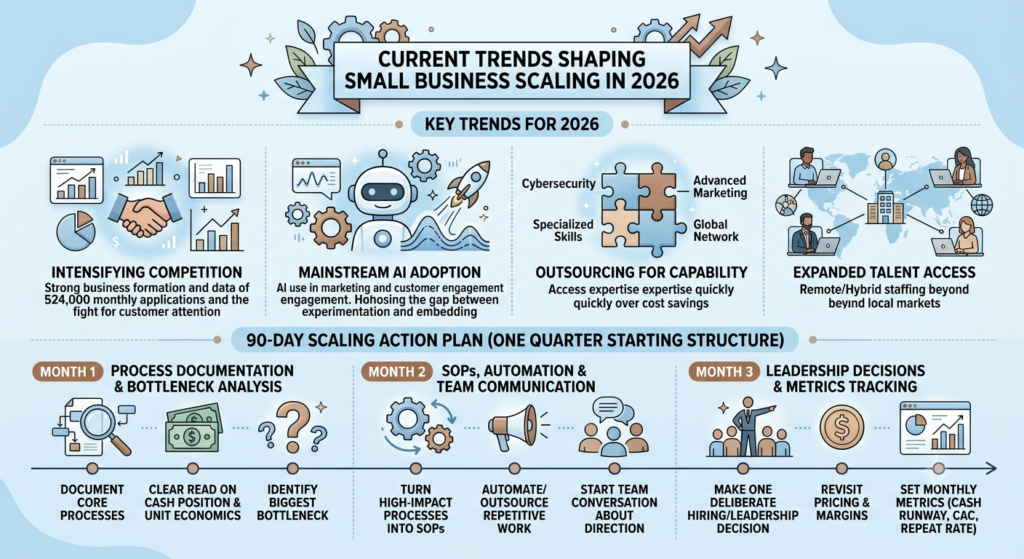
A few shifts are worth watching closely if you are actively working through how to scale a small business right now.
New business formation remains historically strong, with roughly 524,000 new business applications filed in a single recent month, according to Census data referenced in 2026 small business reporting, meaning competition for customer attention is only intensifying even as opportunity remains real.
AI adoption has moved from early adopter territory into the mainstream, with a large majority of small businesses now using some form of AI, most heavily in marketing and customer engagement, though a meaningful gap remains between businesses lightly experimenting with the technology and those that have fully embedded it into daily operations.
Outsourcing has shifted from a pure cost play to a capability play. Businesses increasingly outsource not because they cannot afford to hire, but because they cannot hire specialized skills, like cybersecurity or advanced marketing, fast enough on their own, and they are combining in-house leadership with outsourced execution rather than choosing one model exclusively.
Remote and hybrid staffing continues to expand access to talent beyond a business’s local market, giving smaller companies a genuine ability to compete for skills that used to be reserved for larger employers with bigger budgets.
Together, these trends point in one direction: the tools and talent required to scale a small business are more accessible than ever, but the businesses that benefit most are the ones pairing that access with disciplined systems, not the ones hoping technology alone will solve structural problems.
A 90-Day Scaling Action Plan
If the sections above feel like a lot to tackle at once, here is a simplified sequence to work through over roughly one quarter.
In the first month, document your core processes, get a clear read on your cash position and unit economics, and identify the single biggest bottleneck in your business right now. In the second month, turn your highest-impact processes into SOPs, automate or outsource one meaningful piece of repetitive work, and start a conversation with your team about where the business is headed and why. In the third month, make one deliberate hiring, delegation, or leadership decision based on what you learned, revisit your pricing and margins in light of any new costs, and set a simple set of metrics you will track monthly going forward, such as cash runway, customer acquisition cost, and repeat customer rate.
This is not a complete transformation. It is a starting structure, built to create momentum without recreating the chaos that scaling is meant to eliminate.
Key Takeaways
Scaling is not the same as growing. It means increasing revenue without a matching increase in cost, chaos, or personal involvement.
Document your processes and turn them into SOPs before you try to hand off more work to a growing team.
Cash flow discipline matters more during scaling than at almost any other stage of a business, because growth strains working capital fastest.
Outsourcing and automation are no longer optional extras. They are how lean teams access capabilities and capacity they could never afford to build entirely in-house.
Leadership and culture need as much deliberate attention as systems and technology, because most scaling failures trace back to people problems, not product problems.
Move in a disciplined sequence: stabilize, systemize, then scale, rather than trying to do all three simultaneously.
Frequently Asked Questions
What is the difference between growing a business and scaling a business? Growth means revenue and costs increase together. Scaling means revenue increases faster than costs, because systems, technology, and team structure absorb added volume without a proportional rise in effort or expense.
How do I know if my small business is ready to scale? Look for consistent sales without heavy discounting, a track record of repeat customers, margins healthy enough to absorb some inefficiency while you build new systems, and a clear handle on your core financial numbers. If these are not stable yet, focus on stabilizing before scaling.
What should I automate first when scaling a small business? Start with your single most time-consuming repetitive task, often scheduling, invoicing, customer service replies, or reporting, rather than trying to automate broadly across the entire business at once.
Is outsourcing better than hiring when trying to scale? Neither is universally better. Hire in-house for work central to your competitive advantage or requiring deep institutional knowledge. Outsource specialized or intermittent work where a freelancer or agency can contribute quickly without a long ramp-up period.
How much cash reserve should I have before scaling? There is no single universal number, but you should have enough to cover your core operating costs independent of new scaling initiatives, so a temporary cash flow strain from growth does not threaten day-to-day operations.
What is the biggest reason small businesses fail while trying to scale? Cash flow problems remain the most commonly cited cause of small business failure, frequently made worse when a business scales spending, hiring, or inventory faster than its systems and cash position can support.
Conclusion
Learning how to scale a small business is less about finding one big breakthrough and more about building a series of small, deliberate decisions: a documented process here, a smarter hire there, a piece of automation that quietly buys back a few hours every week. None of it is dramatic in the moment. All of it compounds.
The businesses that scale well are rarely the ones working the hardest. They are the ones that stopped being the single point of failure in their own company, and built something sturdy enough to grow without them holding every piece together by hand. That shift, more than any tool or tactic, is what turns a business that is simply busy into one that is genuinely built to last.