
Somewhere between the 4 a.m. alarm videos and the cold plunge selfies, the idea of a morning routine got a little dishonest.
It started sounding less like a habit and more like a competition. Wake up earlier than the next founder. Meditate longer. Read more pages before sunrise. Post about it before 7 a.m., just to prove it happened.
But if you actually sit down with founders who have built real, lasting businesses, their mornings look far less dramatic than the content suggests. They are not chasing an aesthetic. They are protecting a resource: their attention, before the world gets a vote on how to spend it.
That is really what this article is about. Not a rigid script to copy, but an honest look at the morning routine of successful entrepreneurs, what the research actually says about why it works, and how you can build a version that fits your business, your energy levels, and your life, instead of someone else’s highlight reel.
By the end, you will have a practical, flexible framework you can start using tomorrow morning, not a checklist that quietly falls apart by Thursday.
Why Your Morning Actually Matters (And It’s Not About Hustle)
Here is the part most productivity content skips: your morning matters less because of what you do in it, and more because of what it prevents.
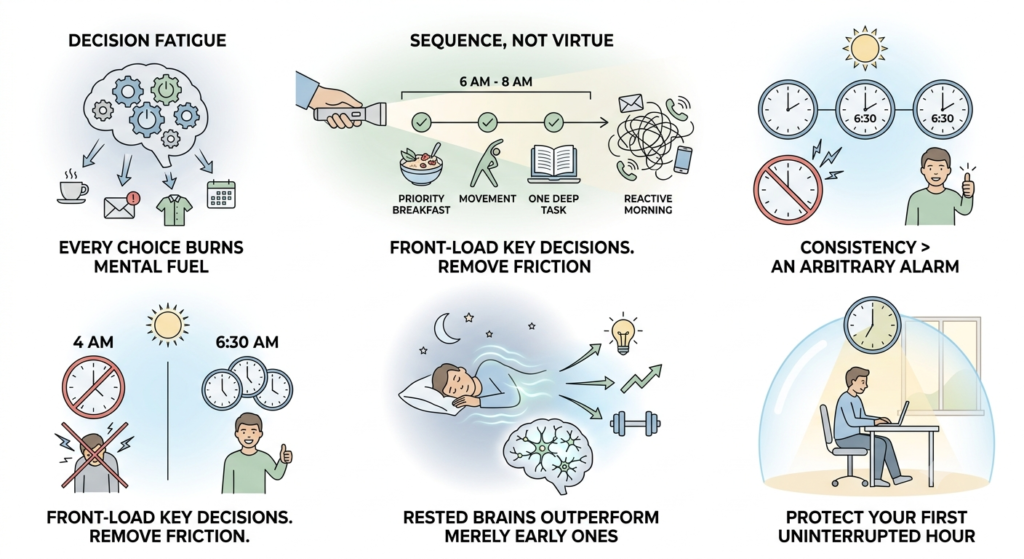
Every decision you make burns a little bit of mental fuel. Psychologists call this decision fatigue, and it is a well-documented phenomenon: the more choices you make in a day, the lower the quality of your later decisions becomes. Judges hand out harsher rulings later in the day. Shoppers make worse impulse decisions after a long day of browsing. Founders, it turns out, are not exempt.
An entrepreneur who wakes up and immediately starts making decisions, replying to messages, reacting to overnight emails, deciding what to wear, what to eat, what fire to put out first, has already spent meaningful mental energy before the actual work of the business has even started.
A structured morning routine is not about virtue. It is about sequencing. It front-loads your day with the few decisions that matter (what am I eating, when am I moving, what is the one thing that has to get done today) so that your best mental energy is not wasted on autopilot decisions before 8 a.m.
This is the real reason a consistent morning routine of successful entrepreneurs tends to look calmer than the average person’s morning, not busier. It is designed to remove friction, not add ritual for its own sake.
The 4 A.M. Myth, And What the Research Actually Supports
There is a very specific image that “successful morning routine” content likes to sell: an alarm before dawn, a cold shower, and hours of deep work before most people have opened their eyes.
Some entrepreneurs genuinely do wake up early. Apple’s Tim Cook has spoken publicly about rising before 5 a.m. to go through customer and employee emails before his workout. Other founders and CEOs, across surveys of hundreds of executives, cluster their wake times somewhere between 5 and 6:30 a.m.
But extreme early rising is not, by itself, what the research credits with better performance. A 2026 review examining how morning routines shape cognitive performance, mood, and circadian rhythm points to sleep timing and sleep consistency, not an arbitrarily early alarm, as the stronger predictor of next-day mental sharpness. In other words, going to bed and waking up at roughly the same time every day matters more than how early that time is.
That lines up with what a growing body of sleep science has been saying for years. A randomized crossover study published in the journal Life found that a single night of extended, quality sleep meaningfully improved both physical and cognitive performance the next day, regardless of what time participants got up. Rested brains simply outperform merely early ones.
This matters because chasing a 4 a.m. wake-up you cannot sustain, at the cost of five or six hours of sleep, is not discipline. It is a slow erosion of the exact cognitive sharpness you are trying to build a routine to protect.
The honest version of the morning routine of successful entrepreneurs is less about the clock and more about consistency, sequencing, and protecting your first uninterrupted hour, whatever time that hour happens to start.
What Actually Separates a Founder’s Morning From Everyone Else’s
If wake-up time is not the differentiator, what is?
Three things tend to show up again and again when you look past the headlines: what they avoid doing first, what they do instead, and how repeatable it is.
What they avoid: reactive attention. Most entrepreneurs with structured mornings deliberately delay email, Slack, and news until after their own priorities are set. Jeff Bezos has been open about refusing to schedule high-stakes meetings before mid-morning, preferring a slower start with coffee, breakfast with family, and no rush. That is not laziness. It is a founder protecting his highest-leverage hours from other people’s agendas.
What they do instead: something that puts them in charge of the day’s direction before anyone else can. That might be reviewing the day’s priorities, moving their body, or simply having a quiet, unstructured hour to think. The specific activity varies. The principle, deciding your agenda before the world hands you one, does not.
How repeatable it is: the routines that last are boring by design. They are simple enough to survive a bad night’s sleep, a canceled flight, or a stressful week. A 24-minute routine that always happens beats a 90-minute routine that only happens on good days.
Keep those three principles in mind as you read the habits below. None of them require you to own a company, wake up before sunrise, or buy a plunge tub.
Why This Is Harder to Build in 2026 Than It Used to Be
If protecting your morning feels harder than it did a few years ago, that is not just in your head.
Screen time has climbed steadily for over a decade, and the numbers for 2026 are striking. Adults now average close to seven hours of total screen time a day globally, with smartphones alone accounting for roughly four and a half of those hours. Push notifications compound the problem: the average smartphone user receives dozens of them daily, and nearly half of all adults now describe themselves as phone-dependent in some form.
The morning is where this shows up first and worst. Close to 80 percent of adults check their phone within ten minutes of waking, often before getting out of bed, brushing their teeth, or speaking to another person. That single habit means the phone, not your own priorities, becomes the first input your brain processes every single day.
This is precisely why a deliberate morning routine matters more now than it did a generation ago. It is not competing against a quieter world. It is competing against a phone engineered, quite deliberately, to be the most interesting thing in the room the moment you pick it up. A short digital detox in the first hour of the day is no longer a nice-to-have habit. For most entrepreneurs, it is the single highest-leverage change available to them before 8 a.m.
15 Habits Behind the Morning Routine of Successful Entrepreneurs
1. They Protect the First Hour From Their Phone
This is the single most common thread across research on high performers, and also the single most common habit people struggle to build.
The numbers explain why it matters. Recent survey data shows that roughly 80 percent of adults check their phone within ten minutes of waking, and separate research puts a large share of users reaching for their device within the first five minutes of opening their eyes. Once you check your phone, you have handed the first decision of your day, and your attention, to whoever sent the most urgent-looking notification overnight.
Opening email or social media before you have decided what matters today puts you in reactive mode before you have had a chance to set your own agenda. You are now responding to someone else’s priorities instead of executing your own.
You do not need a dramatic digital detox. Charging your phone outside the bedroom, or simply committing to a fixed delay (30 to 60 minutes) before you unlock it, is usually enough to break the reflex.
2. They Wake Up at a Consistent Time
Not necessarily an early time, a consistent one. Your circadian rhythm responds to regularity far more than it responds to how early your alarm is set. Waking at 6 a.m. on weekdays and 9 a.m. on weekends creates the biological equivalent of mild jet lag every single week.
Founders who protect their mornings tend to protect their bedtime just as fiercely, because they understand that a good morning is decided the night before.
3. They Hydrate Before They Caffeinate
You have gone six to eight hours without water by the time you wake up. Kat Cole, president of Focus Brands, has spoken about prioritizing a large glass of water before anything else in the morning, and she is far from alone among executives who do the same.
This is a small habit, but it is a useful one to stack at the very start of your routine, because it requires zero willpower and gives you an easy first win before you have made a single hard decision.
4. They Move Their Body, Even Briefly
Exercise does more than build physical health. Studies consistently link movement, even light movement, to improved memory, creativity, and cognitive function later in the day. Tim Cook is known for an intense early workout. Other founders simply take a 15-minute walk or do a short set of stretches.
The specific form of movement matters far less than the consistency of doing something. If a full workout is not realistic most mornings, a short walk paired with your coffee is still enough to shift your energy and mental clarity for the hours ahead.
5. They Decide Their Most Important Task Before Checking Messages
Before opening email, many high-performing founders identify the single task that would make the day a win if nothing else got done. This is sometimes called the MIT, or Most Important Task, method.
Deciding this before your inbox opens means your day’s priorities come from your own judgment, not from whoever emailed you overnight.
6. They Use Some Form of Journaling or Reflection
This does not have to be an elaborate practice. For many entrepreneurs, it is a few sentences: what matters today, what is on their mind, or a quick gratitude note. The value is not in the writing itself but in the mental decluttering it creates, moving scattered thoughts out of your head and onto a page so they stop competing for attention during the workday.
7. They Review Goals Before Reacting to the World
Weekly or monthly goals are easy to lose sight of when your inbox is on fire. A short daily glance at your core priorities, even 60 seconds, keeps your daily actions tethered to your actual direction instead of whatever feels urgent in the moment.
8. They Eat a Protein-Forward Breakfast
Blood sugar spikes and crashes are a real, physical driver of the mid-morning energy slump many professionals blame on being “just tired.” Executives who eat with intention tend to favor protein and healthy fats over sugary, carbohydrate-heavy breakfasts, precisely because it produces steadier energy and sharper focus through the first stretch of the workday.
9. They Delay Email and Slack Until Their Own Priorities Are Set
This bears repeating because it is one of the most consistent patterns among high performers: checking email first thing in the morning outsources your attention to other people’s demands before you have had a chance to set your own.
That does not mean ignoring communication all day. It means processing it in a dedicated block later in the morning, rather than as the first thing you look at when you open your eyes.
10. They Time Block Instead of Working From a To-Do List Alone
A to-do list tells you what needs doing. It does not tell you when. Founders with structured mornings often spend a few minutes assigning their priorities to specific blocks of time, which research on executive routines links to a meaningful increase in strategic, high-value work completed and a real reduction in time lost to low-value tasks.
11. They Build in Quiet, Unstructured Time
Not every high-performing morning is packed. Some of the most consistent routines include a stretch of genuinely quiet time: reading a newspaper, sitting with coffee, or simply thinking without an agenda. This kind of unstructured space is where a lot of strategic thinking actually happens, away from the pressure of a task list.
12. They Protect Time With Family or People They Care About
Several well-known founders deliberately avoid scheduling early meetings so they can have breakfast with their families before the workday begins. This is not incidental. Protecting personal connection in the morning is part of what makes an intense, demanding career sustainable over years rather than months.
13. They Read or Learn Something Outside of Work Fires
Whether it is industry news, a book chapter, or a newsletter, many entrepreneurs build a small amount of intentional learning into their mornings, separate from the reactive scanning of headlines that phones make so easy.
14. They Win the Morning the Night Before
The best morning routines are not built at 6 a.m. They are built the evening before, when you lay out your clothes, review tomorrow’s calendar, or write down your top priority for the next day. This single habit removes a surprising number of small morning decisions before they even happen.
15. They Stay Flexible Instead of Rigid
This is the habit that gets left out of most lists, and it might be the most important one. A morning routine that shatters the moment a flight gets delayed, a child gets sick, or a bad night’s sleep happens is not actually a system, it is a streak waiting to be broken.
The founders whose routines last for years tend to have a “minimum viable version,” a stripped-down five or ten minute version of their routine they can run on the hardest days, rather than an all-or-nothing ritual.
What Real Entrepreneurs’ Mornings Actually Look Like
It helps to see how these habits show up in practice, not as a template to copy exactly, but as proof that there is no single “correct” formula.
Tim Cook rises before dawn, spends focused, quiet time reading and responding to customer and employee emails, then moves into a rigorous workout before the workday formally begins. His structure is almost military in its consistency, and by his own account, that predictability is exactly the point: the early hours are the part of the day he can control most.
Jeff Bezos takes nearly the opposite approach. He wakes without an alarm, refuses to schedule demanding meetings before mid-morning, and spends his early hours with coffee, the newspaper, and breakfast with his family. His highest-stakes thinking is deliberately scheduled for later, once he has had this slower runway into the day.
Kat Cole starts with hydration and a clear sense of her non-negotiables before anything else competes for her attention. Kevin O’Leary, whose business is built on financial markets, begins by checking overseas markets because that information is directly tied to decisions he needs to make that day.
None of these routines look alike. What they share is intention: each founder has decided, in advance, what the first hour of their day is for, instead of letting it be decided for them by whichever notification arrives first.
It is worth noting that even within the same industry, these approaches diverge sharply. Mark Zuckerberg has spoken about starting his day by checking his own platforms rather than avoiding screens altogether, a routine that would look like a mistake on paper if you judged it purely against the “no phone first” rule. The lesson here is not that any single tactic is mandatory. It is that each of these founders made a conscious choice about their first hour, rather than defaulting into it. The specific choice mattered less than the fact that it was, in fact, a choice.
This is also where a lot of morning routine advice goes wrong. It presents one founder’s habits as a universal formula, when the actual research points somewhere more useful: structure and intention are what correlate with better outcomes, not any single ritual. A study tracking several hundred executives found that those with structured morning routines made noticeably faster decisions, reported meaningfully higher energy levels throughout the day, and rated their overall life satisfaction well above executives without any consistent morning structure. The specific components varied. The presence of structure itself was the common thread.
How to Build Your Own Morning Routine, Step by Step
You do not need to adopt all 15 habits above at once. In fact, trying to do that is the fastest way to abandon the whole idea by the end of the week. Here is a more realistic way to build your own version of the morning routine of successful entrepreneurs.
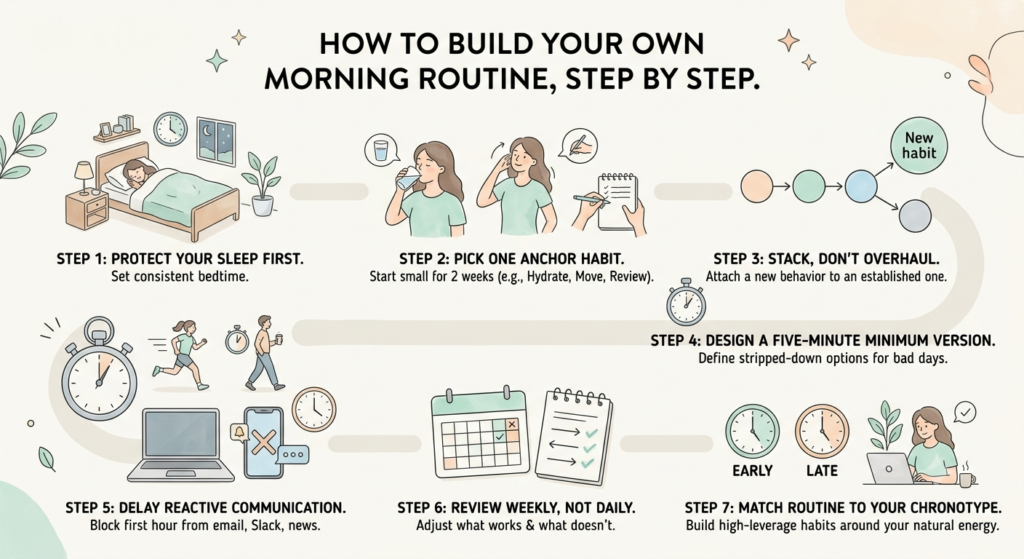
Step 1: Protect your sleep first. No morning routine survives five hours of sleep. Set a consistent bedtime before you touch your wake time.
Step 2: Pick one anchor habit. Choose the single habit from the list above that feels most valuable to you right now, phone delay, hydration, movement, or a quick priority review, and commit to just that one for two weeks.
Step 3: Stack, don’t overhaul. Once the first habit feels automatic, add a second one next to it. This is habit stacking: attaching a new behavior to one that already runs on autopilot, rather than redesigning your entire morning at once.
Step 4: Design a five-minute minimum version. For every habit you build, decide what the stripped-down version looks like on a bad day. A five-minute walk instead of a workout. Three sentences instead of a full journal entry. This is what keeps the routine alive through busy weeks instead of collapsing entirely.
Step 5: Delay reactive communication. Whatever else you build, protect the first block of your morning from email, Slack, and news. Decide in advance when you will check them, and treat that time as a scheduled task, not a reflex.
Step 6: Review weekly, not daily. Once a week, take five minutes to notice what is working and what is not. Routines that survive long term are adjusted, not abandoned, when life gets in the way.
Step 7: Match the routine to your actual chronotype. Not everyone thinks most clearly at 6 a.m. Some entrepreneurs do their best strategic thinking late in the evening and simply use their morning to prepare, rather than to produce. Forcing deep, creative work into hours that do not suit your natural energy pattern is a common reason routines feel forced rather than useful. Pay attention to when your own thinking is sharpest over a week or two, and build your highest-leverage habit around that window instead of an arbitrary hour borrowed from someone else’s schedule.
Common Mistakes That Sink a Morning Routine
Even well-intentioned founders derail their own progress in a few predictable ways.
The first is copying someone else’s routine wholesale instead of adapting the underlying principle. A single parent running a business from home cannot replicate a CEO’s 5 a.m. gym-and-cafeteria routine, and trying to often just produces guilt instead of results.
The second is treating the routine as all-or-nothing. Missing one day does not mean the system failed. It means you had one off day, which is normal and expected.
The third, and perhaps the most common, is checking the phone “just for a second” before starting the routine. That single glance is often enough to pull your attention into someone else’s priorities before your own morning has even begun.
The fourth is over-scheduling the morning to the point that it becomes another source of stress rather than a source of calm. If your routine has twelve steps and takes ninety minutes, it is fighting against the busy reality of running a business, not supporting it.
Key Takeaways
- The real value of a structured morning is reduced decision fatigue, not the appearance of discipline.
- Sleep consistency predicts next-day performance better than an early wake-up time does.
- Delaying phone, email, and news until after your own priorities are set is one of the most consistently observed habits among high-performing founders.
- Small, repeatable habits (hydration, a short walk, a one-line priority list) outperform elaborate routines you cannot sustain.
- The strongest routines have a stripped-down “bad day” version built in from the start.
- There is no single correct morning routine of successful entrepreneurs; the goal is intention, not imitation.
Frequently Asked Questions
Do I need to wake up before 5 a.m. to have a successful morning routine? No. Research consistently points to sleep consistency and quality as stronger predictors of next-day performance than an early wake-up time. A routine that starts at 7 a.m. but happens every day will outperform an inconsistent 5 a.m. routine built on too little sleep.
How long should an entrepreneur’s morning routine be? There is no fixed length. Some effective routines take under 30 minutes; others run closer to two hours. What matters more than duration is consistency and having a shorter backup version for busy or difficult days.
Should I check email first thing in the morning? Most high-performing founders deliberately avoid this. Checking email or messages before setting your own priorities puts you in reactive mode before the day has properly started. A better approach is to set your top priority first, then check communication in a dedicated block later in the morning.
What is the single most important habit to start with? If you can only build one habit, delaying your phone for the first 30 to 60 minutes after waking tends to have the widest ripple effect, since it protects the mental space needed for everything else on this list.
Can a morning routine really improve business decisions? Yes, indirectly. Structured mornings reduce decision fatigue and protect your highest-focus hours for meaningful work rather than reactive tasks. Over time, that compounds into clearer thinking and better decisions, not because of the routine itself, but because of what it protects you from.
What if my schedule is unpredictable, like caregiving or shift work? Focus on the underlying principles rather than a fixed clock time: protect your first block of attention from your phone, decide your top priority before reacting to messages, and build a five-minute minimum version of whatever routine you choose. Consistency of principle matters more than consistency of clock time.
Conclusion
The morning routine of successful entrepreneurs was never really about waking up before the sun or performing discipline for an audience. It is about deciding, on purpose, what the first hour of your day is for, before anyone else gets to decide it for you.
Start with one habit. Protect your sleep. Build a version small enough to survive your worst weeks, not just your best ones. That is what actually separates a routine that lasts for years from one that quietly disappears by February.
Your mornings are one of the few parts of running a business you fully control. Use that control deliberately, and the rest of the day tends to follow.