

A few years ago, your resume did most of the talking for you. Today, someone is far more likely to Google you before they ever open your CV.
What they find in those first ten seconds now shapes whether they trust you, hire you, refer you, or scroll right past you. That is the entire game of personal branding in one sentence: it is the reputation people form about you when you are not in the room.
Most people think building a brand around themselves is something reserved for influencers, motivational speakers, or people who enjoy being on camera. That is a misunderstanding that costs careers and businesses real money. A personal brand is not about becoming famous. It is about becoming known, trusted, and remembered for something specific, by the exact people who can open doors for you.
This guide walks through how to build a personal brand from the ground up, using a process that works whether you are a first-time founder, a mid-career professional trying to get noticed inside your industry, or a business owner whose face is quietly becoming the face of your company whether you planned it or not.
Anyone searching for how to build a personal brand today will find no shortage of generic advice telling them to “just be authentic” or “post consistently.” That advice is not wrong, but it is incomplete. Authenticity without a clear strategy behind it rarely produces results, and consistency without a defined message just means showing up regularly with nothing memorable to say.
We will cover the strategy, the platforms, the content systems, and the mistakes that quietly sabotage most people who try this without a plan. Nothing here is theoretical. Every recommendation is built to be used this week, not filed away as inspiration.
What a Personal Brand Actually Is in 2026
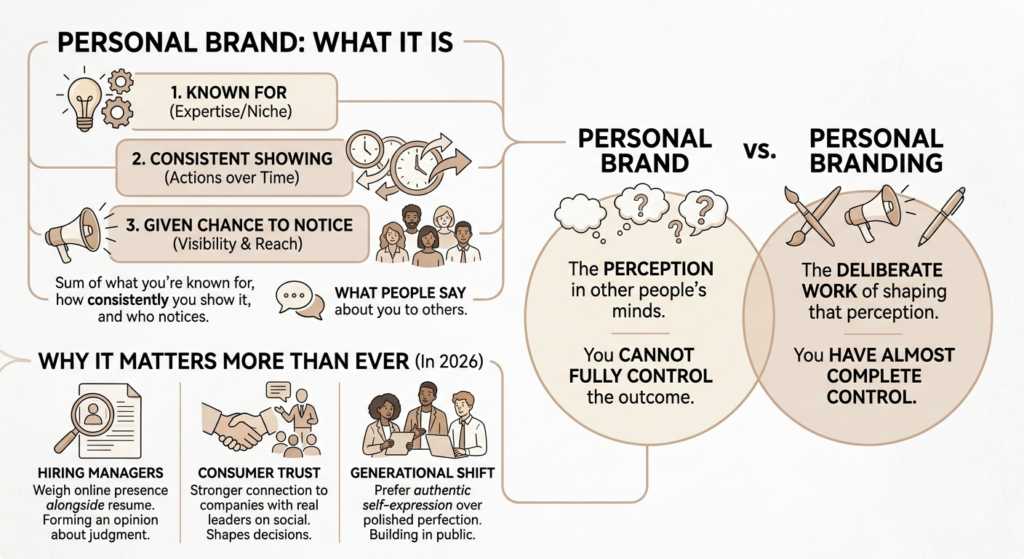
Strip away the marketing language, and a personal brand is simply the sum of three things: what you are known for, how consistently you show that, and who has been given the chance to notice it.
It is not a logo. It is not a tagline you write once and forget. It is not a curated highlight reel of your best moments. Your personal brand is what people say about you when they are describing you to someone else in a single sentence. If that sentence is vague, generic, or nonexistent, that is the actual problem you are solving here, not a lack of followers or likes.
There is a useful distinction worth making early. A personal brand is different from personal branding. The brand is the perception that exists in other people’s minds. Personal branding is the deliberate, ongoing work of shaping that perception through what you say, what you create, and how you show up over time. You cannot fully control the first. You have almost complete control over the second.
This matters because so many people approach the topic backwards. They chase visibility first and clarity second, which is why so much content on the internet feels like noise. The people who build brands that last do the opposite. They get painfully specific about their positioning before they ever hit publish.
Why Personal Branding Matters More Than Ever
If you are wondering whether this is worth the time investment, the data answers that question clearly.
Employers increasingly weigh what they find about a candidate online alongside, and sometimes above, the resume itself. A large share of hiring managers report having hired someone specifically because of the impression left by their personal brand, and a comparable share admit to rejecting a candidate because of a weak or messy online presence. Recruiters are not just checking that you exist online; they are forming an opinion about your judgment based on what you post.
The trust math has shifted too. Consumers report feeling a noticeably stronger connection to companies whose leaders show up as real people on social platforms, and a majority say that visible, authentic leadership directly shapes their purchasing decisions. This is not a soft, feel-good statistic. It is a direct line between an individual’s visibility and a company’s revenue.
There is also a generational shift happening underneath all of this. Younger professionals entering the workforce are far more comfortable building in public than the generation before them, and research shows a measurable preference for authentic self-expression over polished perfection. That is quietly rewriting the standard for what “professional” looks like online, and it is opening space for people who are willing to be specific and honest rather than corporate and safe.
None of this means you need to become a full-time content creator. It means the compounding advantage now sits with the people who treat their reputation as an asset they actively manage, rather than something that just happens to them.
Step 1: Get Brutally Clear on Your Niche
Every strong personal brand starts with narrowing, not expanding. This is the step almost everyone wants to skip, and it is the one that determines whether everything after it works.
Why broad positioning fails
If you describe yourself as someone who “helps businesses grow” or “talks about leadership,” you are indistinguishable from a few million other profiles saying the exact same thing. Vague positioning is comfortable because it feels safe, but safety is exactly what makes it forgettable.
Niche positioning works because it reduces uncertainty for the person evaluating you. A specific, well-defined lane tells your audience precisely what problem you solve, for whom, and why you are credible enough to solve it. That clarity is what earns trust faster than broad appeal ever could.
The positioning exercise
Sit down and answer these four questions honestly, in writing:
- What specific outcome do I help people achieve, and for whom?
- What do I know or believe that most people in my field either miss or get wrong?
- What experience or track record backs that up?
- If someone only remembers one thing about me, what should it be?
Your answer to that last question is your positioning statement. It should be specific enough that a stranger could repeat it back to a colleague in one sentence. “I help Airbnb hosts turn underperforming listings into fully booked properties without raising prices” works. “I’m passionate about hospitality and helping people succeed” does not.
Depth beats width
The instinct to appeal to everyone is understandable, but it works against you. A tightly defined niche lets you go deep enough that you actually become the reference point people think of first, rather than one voice among thousands saying something similar but shallower. This is one of the clearest levers available when you are figuring out how to build a personal brand that people actually remember.
Step 2: Define Your Core Message and Story
Once your niche is locked, the next job is turning it into language and a story other people can carry for you.
Your core message
Your core message is the belief or perspective that shows up across everything you create, in different forms. It is the thread that connects a LinkedIn post, a podcast appearance, and a client conversation. Without it, your content feels scattered even if every individual piece is good.
A useful test: if you removed your name from ten pieces of your content, would a stranger be able to guess it was written by the same person? If not, your message is not yet consistent enough.
Your story
Facts tell, stories sell trust. The story is not your entire life history; it is the specific turning point that explains why you care about the problem you now help people solve. Maybe it was a failed first business, a bad hire that taught you everything about leadership, or a client win that revealed a gap nobody else was talking about.
Keep the story short enough to tell in under a minute, and specific enough that it could not be told by anyone else. Generic stories create generic brands.
Write it down once, reuse it everywhere
Draft a one-paragraph bio, a three-sentence version, and a one-line version. Use these consistently across your LinkedIn About section, your website, speaker introductions, and guest appearances. Consistency here is what turns a message into a recognizable identity rather than a moving target.
Step 3: Choose the Right Platforms for Your Brand
You do not need to be everywhere. You need to be consistently excellent in one or two places your audience already spends time.
LinkedIn remains the strongest platform for professional authority
For entrepreneurs, consultants, and B2B professionals, LinkedIn is still the highest-leverage platform for building credibility, and the way it distributes content has changed significantly. The platform’s ranking system now weighs topical consistency and depth of engagement far more heavily than follower count or post frequency alone. A newer account with clear subject-matter focus can outperform a large, unfocused profile.
Practical implications worth building into your routine:
- Post two to five times a week rather than daily; consistency of topic matters more than volume.
- Native video and document carousels are currently getting stronger initial distribution than plain text links.
- Avoid stuffing hashtags or hiding links purely to game the algorithm; the system now reads the substance of your writing to decide who sees it.
- Comments that add genuine insight to other people’s posts are one of the most underused ways to build visibility without publishing constantly yourself.
Short-form video for reach, long-form for depth
Short-form video on platforms like Instagram, YouTube Shorts, or TikTok is currently the fastest way to reach people who have never heard of you. It builds awareness. Long-form content, whether that is a newsletter, a blog, or a podcast, is where you build the depth of trust that actually converts a stranger into a client, a follower into a referral source.
Do not overlook audio
Podcasts and other audio formats have quietly become one of the most trusted channels for building professional authority, particularly for time-pressed audiences who consume content during commutes or workouts rather than sitting in front of a screen. Guesting on established shows in your niche is often faster than starting your own, since you borrow an existing audience’s trust the moment the host introduces you. Voice search is also becoming a real discovery channel, which means writing your online bio and website content in a natural, conversational way can help you get surfaced when someone asks a voice assistant a question related to your niche.
Pick your primary platform first
Choose one platform where your ideal audience already spends time, master it for three to six months, and only then consider expanding. Splitting your attention too early is one of the fastest ways to produce mediocre content everywhere instead of strong content somewhere.
Step 4: Build a Content System That Builds Trust
Personal branding lives or dies on consistency, and consistency requires a system, not motivation.
Build content pillars
Choose three to five recurring themes that map directly back to your niche and your core message. These become your content pillars, and every piece of content you publish should trace back to one of them. Pillars keep your output focused and make it far easier to come up with ideas, because you are no longer starting from a blank page every time.
For example, someone building a brand around small business operations might use pillars like team systems, customer experience, decision-making frameworks, and financial discipline. Every post, video, or article slots into one of those four buckets.
Write your pillars down somewhere you will actually see them, whether that is a simple spreadsheet or a note pinned to your desk, and label every piece of content you publish with the pillar it belongs to. After a month, look back at which pillar generated the strongest response. That single review often tells you more about what your audience actually wants from you than any amount of guessing upfront, and it lets you adjust the mix without abandoning the system entirely.
Prioritize depth over virality
The platforms that once rewarded engagement bait, quick hot takes, and comment-farming tactics are actively de-ranking that kind of content now. What is winning instead is substance: posts that teach something specific, share a real framework, or walk through an honest lesson from experience. If your content only works because of a clever hook and falls apart on a second read, it will not build a durable brand.
A simple weekly content rhythm
- One piece of original, opinion-driven content that reflects your core message.
- One piece of educational content that teaches a specific, usable framework.
- One piece of story-driven content drawn from a real client, project, or personal experience.
- Regular, genuine engagement on other people’s content in your niche.
This rhythm is sustainable because it does not demand constant novelty. It simply asks you to rotate through formats you already understand.
Repurpose instead of reinvent
A single strong idea can become a LinkedIn post, a short video script, a newsletter section, and a slide in a future talk. Repurposing is not laziness; it is how sustainable creators avoid burning out while staying consistent, which is the single biggest predictor of whether a personal brand actually compounds over time.
Step 5: Optimize Every Profile for Discovery
Content brings people to your door. Your profiles decide whether they trust what they find once they arrive.
Your bio should pass the five-second test
A stranger should understand what you do and who you help within five seconds of landing on your profile. Lead with the outcome you create, not your job title. “Helping small property managers automate guest communication” tells a visitor more in seven words than “Entrepreneur | Operator | Builder” ever will.
Treat your profile photo and banner as real estate
A clear, current, well-lit photo signals professionalism before anyone reads a single word. Your banner image is free advertising space that most people leave blank; use it to reinforce your positioning statement.
Keep your story consistent across platforms
Your LinkedIn About section, your website bio, and your podcast guest introduction should all tell a recognizably consistent version of your story. Fragmented, inconsistent bios across platforms quietly undermine the trust you are trying to build.
Make it easy to take the next step
Every profile should have one clear next action, whether that is booking a call, joining a newsletter, or visiting your website. A profile with no clear next step turns interested visitors into people who admired you for thirty seconds and then forgot you existed.
Step 6: Build Relationships, Not Just an Audience
The temptation with personal branding is to obsess over follower counts. The professionals who actually benefit from their brand focus somewhere else entirely: relationships.
Small, engaged communities outperform large passive ones
A modest group of people who genuinely trust you and regularly engage with your work will generate more referrals, collaborations, and opportunities than a much larger audience that scrolls past without reacting. If you have to choose between growing your numbers and deepening real relationships with the people already paying attention, choose depth.
Be generous before you ask for anything
Answer questions in the comments. Introduce two people in your network who should know each other. Share credit publicly when someone helps you. None of this shows up on a dashboard, but it is exactly what turns an audience into a network that actively advocates for you.
Show up consistently in conversations, not just in posts
Publishing is only half of building a brand. The other half is participating, genuinely, in conversations happening in your niche. Thoughtful comments on other people’s work often introduce you to new audiences faster than your own posts do, because you are borrowing distribution from someone who already has the reach you are building toward.
Step 7: Monetize and Protect What You Build
A personal brand that never converts into opportunity is a hobby, not an asset. At some point, the trust you have built needs a bridge to real outcomes.
Turn attention into offers
This might mean consulting, speaking, a course, an advisory role, or simply a stronger pipeline of inbound clients for your existing business. The mistake is waiting until your brand feels “big enough” before you introduce any kind of offer. Even early on, a clear, occasional call to action tells your audience how they can actually work with you.
Protect your reputation deliberately
The same visibility that builds trust can damage it quickly if you are careless. Be honest about what you know and do not know. Do not exaggerate outcomes or borrow credibility you have not earned. A personal brand built on inflated claims collapses the first time reality does not match the story, and rebuilding trust after that is far harder than building it the first time.
Diversify where you are seen, not what you stand for
Expanding to a second platform, starting a newsletter, or accepting more speaking opportunities is smart growth. Changing your core message every few months to chase whatever is trending is not. Longevity comes from staying recognizable while expanding your reach, not from reinventing yourself every quarter.
Common Mistakes That Quietly Kill Personal Brands
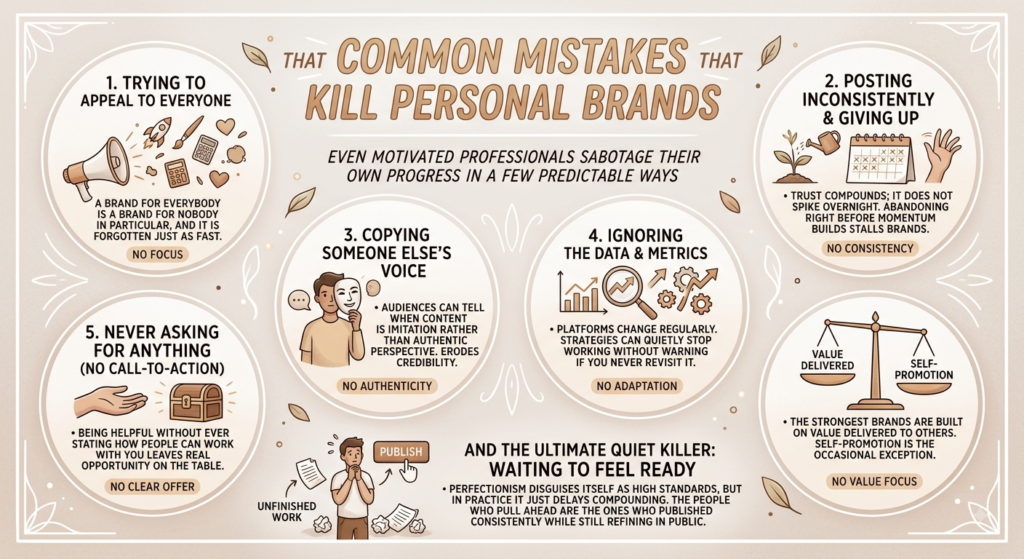
Even motivated professionals sabotage their own progress in a few predictable ways.
- Trying to appeal to everyone. A brand for everybody is a brand for nobody in particular, and it is forgotten just as fast.
- Posting inconsistently and then giving up after a slow month. Trust compounds; it does not spike overnight, and abandoning the effort right before momentum builds is the most common reason brands stall.
- Copying someone else’s voice instead of developing your own. Audiences can tell when content is imitation rather than authentic perspective, and it quietly erodes credibility.
- Ignoring the data on what is actually working. Platforms change how they distribute content regularly; a strategy that worked two years ago can quietly stop working without any warning if you never revisit it.
- Never asking for anything. Being helpful without ever stating how people can work with you leaves real opportunity on the table.
- Confusing personal branding with self-promotion. The strongest brands are built primarily on value delivered to others, with self-promotion as the occasional, well-earned exception rather than the constant tone.
- Waiting to feel ready before publishing anything. Perfectionism quietly disguises itself as high standards, but in practice it just delays the moment your positioning starts compounding. The people who pull ahead are rarely the most polished; they are the ones who published consistently while still refining their craft in public.
A 90-Day Action Plan to Build Your Personal Brand
If you want a straightforward way to put everything above into motion, use this simple three-phase plan.
Days 1–30: Foundation Nail your positioning statement, write your core story in three lengths, choose your primary platform, and rebuild your profile bio, photo, and banner around your niche.
Days 31–60: Consistency Publish using your content pillars on a fixed weekly rhythm, engage daily in your niche’s conversations, and track which formats and topics get genuine engagement rather than surface-level likes.
Days 61–90: Expansion Introduce a clear way for people to work with or follow up with you, start repurposing your strongest content into a second format or platform, and begin actively building relationships with a handful of peers in your space through comments, collaborations, or direct outreach.
Ninety days will not make you a household name, but it is more than enough time to move from invisible to recognizable within your specific niche, which is the entire point.
Treat this plan as a loop rather than a one-time sprint. Once you complete the first ninety days, run the cycle again with the benefit of real data: which topics landed, which format your audience responded to, and which relationships turned into genuine opportunities. Personal branding rewards the people who revisit and refine their approach every few months instead of setting a strategy once and never looking at it again. The market, the platforms, and your own expertise are all moving targets, and the brands that stay relevant are the ones built to evolve alongside them.
Key Takeaways
- A personal brand is the reputation people form about you when you are not in the room; personal branding is the deliberate work of shaping it.
- Narrow positioning builds trust faster than broad appeal; specificity is a strength, not a limitation.
- Consistency in message and platform choice matters more than being everywhere at once.
- Depth and substance are outperforming engagement bait as platforms refine how they distribute content.
- Relationships and community engagement compound faster than raw follower counts.
- A brand only becomes an asset once it is connected to a clear offer or next step.
Conclusion
Building a personal brand is not about becoming louder than everyone else. It is about becoming clearer than everyone else, consistently, in front of the people who matter most to your career or your business.
The professionals who get this right are rarely the most talented people in the room. They are the ones who decided to stop being invisible, picked a specific lane, and showed up in it long enough for people to notice, trust, and remember them.
You do not need a large following to start. You need a clear positioning statement, a consistent voice, and the discipline to keep showing up after the first few weeks feel like nothing is happening. That is where almost everyone quits, and it is exactly where the compounding begins for everyone who does not.
Start with one platform. Start with one clear message. Start this week.
Whatever stage you are at, the fundamentals of how to build a personal brand do not change with the size of your audience. Get your positioning right, protect your credibility, and give the process enough time to compound before you judge whether it is working.
Frequently Asked Questions
How long does it take to build a personal brand? Meaningful recognition within a specific niche typically takes three to six months of consistent effort, while a fully established, referral-generating brand often takes twelve to eighteen months. The timeline depends far more on consistency than on talent or luck.
Do I need to be on every social media platform? No. Choosing one primary platform where your audience already spends time and mastering it produces better results than spreading thin content across five platforms at once.
What if I am not comfortable showing my face on camera? Video helps, but it is not mandatory. Well-written text posts, carousels, and audio formats like podcasts can build strong personal brands, especially when the writing or ideas themselves are distinctive.
Is personal branding only for entrepreneurs and influencers? No. Employees, consultants, freelancers, and job seekers all benefit, since hiring managers and clients increasingly research people online before ever meeting them in person.
How do I know if my personal brand is working? Look beyond follower counts. Track whether the right people are reaching out to you, whether your content generates meaningful conversation, and whether opportunities like speaking invitations, referrals, or client inquiries are increasing over time.
Should I hire an agency to build my personal brand for me? An agency can help with strategy and production, but the perspective, story, and voice have to come from you. A brand built entirely on outsourced content usually feels hollow and is difficult to sustain once the agency relationship ends.