

Somewhere along the way, “passive income” turned into a buzzword. Scroll through social media and you will find people promising you can quit your job in ninety days by selling a course about selling courses. That is not passive income. That is a sales pitch wearing a nicer shirt.
Real passive income is quieter than that. It is a rental property that deposits rent into your account whether you thought about it that week or not. It is a dividend stock portfolio that pays you every quarter regardless of what is happening in the news cycle. It is a digital product you built once that keeps selling while you sleep, take a vacation, or work on something else entirely.
I have spent years building and managing income-generating assets, from short-term rental properties to systemized businesses that run without me micromanaging every decision. What I have learned is simple: passive income is real, but it is never instant, and it is never truly free of effort. Every stream starts with active work. The passivity comes later, and only if you build it correctly.
This guide walks through what is actually working right now, backed by current data, not recycled advice from five years ago. No exaggerated promises. Just a clear, honest look at your options so you can pick what fits your life, your capital, and your risk tolerance.
What Passive Income Actually Means
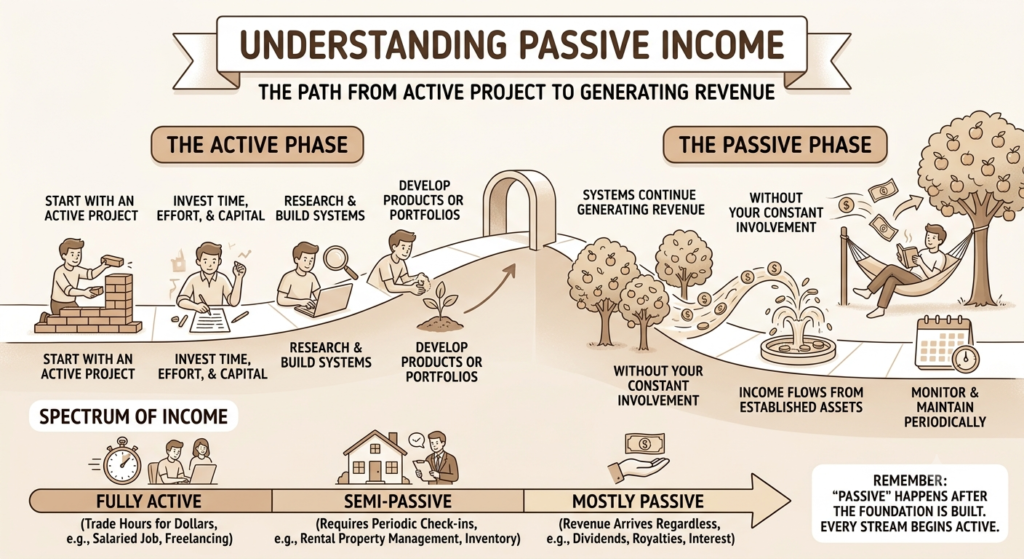
Passive income is money earned from an asset or system that continues generating revenue without your constant, active involvement. That is the textbook definition, and it is mostly right. But it misses the part that matters most for people just starting out: every passive income stream begins as an active project.
You do not wake up one day owning a dividend portfolio. You save money, choose your investments, and let time and compounding do the work. You do not publish a digital product that sells itself. You research a real problem, build the product, market it, and refine it based on what customers tell you. The “passive” part is what happens after the foundation is built, not instead of building it.
This distinction matters because so many people get discouraged in month two of a “passive income” project when they realize it still requires their attention. That is not a sign the idea failed. That is simply the active phase of every passive income stream that has ever existed.
There is also a useful way to think about the spectrum here. Some income is fully active – you trade hours directly for dollars, like a salaried job or freelance work. Some income is semi-passive – it requires periodic check-ins, like managing a rental property or restocking a small inventory business. And some income is close to fully passive – dividend payments, royalties, or interest that arrives regardless of what you do that day. Most people building wealth end up with a mix of all three, and that mix shifts over time as systems mature.
Why 2026 Is a Different Landscape Than Even Two Years Ago
A few real shifts are shaping how people build income today, and they are worth understanding before you pick a strategy.
Interest rates have stabilized, but not fallen sharply. The Federal Reserve held its target rate steady through much of 2026 after a series of cuts in late 2025, which means savers are still finding competitive yields on cash. As of early August 2026, top high-yield savings accounts were paying <cite index=”8-1″>up to roughly 4.15% APY</cite>, a meaningful contrast to <cite index=”8-1″>the average traditional savings account rate of just 0.38%</cite>. That gap is one of the simplest, lowest-risk passive income opportunities available right now, and most people are still leaving it on the table.
Side hustles have become mainstream, not niche. Recent data shows roughly <cite index=”4-1″>27% of Americans now earn from side hustles</cite>, and the busiest performers are averaging meaningful monthly income from that work. Passive income ideas, once seen as a fringe pursuit for finance hobbyists, are now a standard part of how people plan their household budgets.
Dividend income is holding up well. Analysts project <cite index=”4-1″>U.S. aggregate dividends will grow by roughly 6.5% in 2026, reaching close to $827 billion</cite> in total payouts. That growth reflects companies prioritizing shareholder returns even amid broader economic uncertainty, which is good news if income-generating equities are part of your plan.
Real estate income has diversified beyond direct ownership. REITs remain a core option, and while yields vary significantly by sector, the structure itself is durable. REITs are legally required to distribute the large majority of taxable income to shareholders, which is why they have historically traded at higher dividend yields than the broader stock market.
Digital products and creator-driven income continue expanding. Platforms tracking creator payout data across thousands of active sellers show that digital products remain one of the most scalable passive income ideas available to someone with no starting capital, only time and a skill worth packaging.
The gig and side hustle economy has scaled into a genuine parallel income system. Data from recent workforce studies shows side hustlers earning meaningful monthly income for a relatively modest number of hours committed each month, translating into an hourly return well above the national average hourly wage. That efficiency, more money per hour than a typical job, is exactly why so many people are now treating a side hustle not as a temporary hustle but as the first building block of a longer-term passive income plan.
Understanding these shifts is not about chasing trends. It is about recognizing where the real opportunities sit today so you are not building a strategy around outdated assumptions.
15 Ways to Build Real Income Streams in 2026
Here is where most articles either oversell dropshipping or undersell the boring stuff that actually works. I am going to give it to you straight, organized by category, with realistic expectations for each.
Investment-Based Passive Income
These require capital upfront but demand very little ongoing effort once set up.
1. Dividend Stocks and Dividend ETFs
Buying shares in companies that pay regular dividends is one of the oldest and most reliable ways to generate income without active management. Dividend aristocrats, companies with 25 or more consecutive years of dividend increases, typically yield between 2% and 4% annually, plus potential share price appreciation. If you want built-in diversification, dividend-focused ETFs spread your risk across dozens or hundreds of companies in a single purchase.
The real advantage here is dividend reinvestment. When you automatically reinvest dividends instead of cashing them out, you compound your position year over year without adding new capital. Over a decade or two, that compounding effect becomes the engine that does most of the heavy lifting.
2. Real Estate Investment Trusts (REITs)
If owning physical property sounds appealing but managing tenants does not, REITs solve that problem. You buy shares of a company that owns income-producing real estate, and you collect a portion of the rental and lease income as dividends. As of early 2026, publicly traded U.S. equity REITs posted a one-year average dividend yield of roughly 3.98%, though this varies widely by sector. Office and self-storage REITs have recently posted some of the highest yields in the space, while industrial and health-care REITs have trended lower.
REITs are also one of the most accessible ways to add real estate exposure to a portfolio without needing a down payment, a mortgage, or a maintenance budget.
3. High-Yield Savings Accounts
This is the least glamorous entry on this list, and also one of the most underused. Moving your emergency fund and short-term cash reserves out of a traditional bank account and into a high-yield savings account can mean the difference between earning a fraction of a percent and earning close to 4% annually with essentially zero risk, since these accounts are typically FDIC-insured up to standard limits. It will not make you wealthy, but it is free money you are currently leaving on the table if your cash is sitting in a checking account earning nothing.
4. Bonds and Bond Funds
Government and corporate bonds pay fixed interest over a set period, offering predictable income with lower volatility than stocks. Treasury bonds are considered among the safest income-generating assets available, while corporate bonds typically offer higher yields in exchange for slightly more risk. Bond funds let you diversify across many issuers without picking individual bonds yourself.
5. Peer-to-Peer Lending
Platforms that let you lend money directly to individuals or small businesses in exchange for interest payments have matured significantly over the past several years. Returns can range from modest to attractive depending on the risk tier you choose, but this comes with real default risk. Diversifying across many small loans rather than concentrating in a few is the standard way experienced lenders manage that risk.
Real Estate and Physical Asset Income
These require more upfront capital and occasional active management, but can generate substantial cash flow.
6. Rental Properties
Owning a residential or commercial rental property remains one of the most tested passive income ideas, generating monthly cash flow plus long-term appreciation. The tradeoff is that “passive” here usually means hiring a property manager, since tenant issues, maintenance, and vacancies require real attention. Once systemized with the right property manager and screening process, a rental property can run with minimal weekly involvement from the owner.
7. Real Estate Crowdfunding
Platforms that pool investor capital to fund real estate projects have lowered the barrier to entry dramatically. Where direct property ownership might require a six-figure down payment, some crowdfunding platforms allow you to start with a few hundred dollars, giving you fractional exposure to commercial or residential projects you could never afford to buy outright.
8. Vacation and Short-Term Rentals
Short-term rental income, when systemized properly, can outperform traditional long-term rentals significantly in the right market. This is where I have the most direct experience, and I will be honest: it is more operationally intensive than long-term rental ownership at first. But with the right systems, cleaning teams, and automated guest communication tools in place, it becomes genuinely semi-passive rather than a second job.
9. Storage Unit and Land Investing
Vacant land and self-storage facilities are two of the more overlooked real estate income categories. Land can be purchased at low cost, leased for agricultural, storage, or recreational use, and requires almost no maintenance. Self-storage has historically posted strong dividend yields within the REIT sector, reflecting steady demand that holds up even during economic downturns.
Digital and Content-Based Passive Income
These require little to no starting capital, but demand significant upfront time and skill.
10. Digital Products
Ebooks, templates, printables, presets, and online courses are some of the most scalable passive income ideas because your production cost stays flat no matter how many units you sell. Creator payout data from platforms tracking thousands of active sellers shows digital products remain one of the strongest options for someone starting with no capital, only expertise worth packaging into something buyable.
The key is building something that solves a specific, narrow problem for a specific audience rather than a broad, generic product nobody urgently needs.
11. Affiliate Marketing
Recommending products or services you genuinely use, and earning a commission when your audience buys through your link, has grown into one of the more accessible entry points into online income. It works best when paired with an existing audience, whether that is a blog, a newsletter, or a social following, since trust is what actually drives conversions, not just traffic volume.
12. Print-on-Demand and Royalties
Designing merchandise, publishing books, or licensing photography and music are all ways to earn ongoing royalties from creative work you produce once. Print-on-demand platforms handle manufacturing and shipping, meaning your only real job is creating designs people want to buy and getting them in front of the right audience.
13. YouTube and Content Ad Revenue
Building a library of evergreen video or written content that continues earning ad revenue and sponsorship income long after publication is one of the more time-intensive routes on this list, but also one of the most durable once an audience is established. The first twelve to eighteen months are almost entirely active work. What comes after that can become a genuinely passive backlog of earning content.
Business and Automation-Based Income
14. Vending Machines and Automated Retail
Modern vending has moved well beyond snacks and soda. Automated retail kiosks, including higher-end machines dispensing fresh food or specialty coffee, are gaining traction as an income stream that combines a modest upfront investment with a local operator or restocking service handling the day-to-day logistics.
15. Licensing a System or Franchise Model
If you have already built a successful, systemized business, licensing that system to others or converting it into a franchise model allows you to earn ongoing royalties without operating every location yourself. This is an advanced strategy, best suited for someone who has already proven a business model works and wants to scale it through other people’s capital and labor.
How Much Capital You Actually Need to Start
One of the most persistent myths about passive income is that you need tens of thousands of dollars to begin. That is true for some paths and completely false for others.
You can start a high-yield savings account with as little as $100. You can begin building a digital product with no capital at all, only time. Real estate crowdfunding platforms have brought minimum investments down to a few hundred dollars in many cases, a dramatic shift from the six-figure down payments direct property ownership typically requires.
On the other end, rental property ownership, storage facility investment, and larger dividend portfolios do require meaningful upfront capital to generate income that actually moves the needle in your monthly budget. The honest advice here is to match your starting strategy to your starting capital, not the other way around. Someone with $500 and strong writing skills is better served building a digital product than trying to force their way into real estate ownership before they are ready.
How Long Before You See Real Money
This is the question nobody wants to hear the real answer to, so here it is: it depends entirely on the path you choose, and none of them are instant.
High-yield savings accounts and dividend stocks pay out on a predictable schedule, monthly or quarterly, starting almost immediately after you invest, though the amounts will be small until your capital base grows. Affiliate marketing and digital products typically take one to three months to generate a first sale if you already have some audience or distribution in place, and considerably longer if you are building an audience from zero. Rental properties and larger real estate investments take longer to set up but tend to scale into significantly larger income once operational.
The pattern that matters most: speed and scale trade off against each other. The fastest paths to first income are usually the smallest in ceiling. The paths with the highest long-term ceiling almost always take the longest to get moving. Plan your timeline honestly around that tradeoff instead of expecting both speed and scale from the same strategy.
The Tax Side Nobody Talks About
Passive income is still taxable income, and the rules vary depending on the type of income you are generating. Dividend income, interest income, rental income, and business income from digital products are all treated differently under most tax systems, and the deductions available to you differ significantly by category.
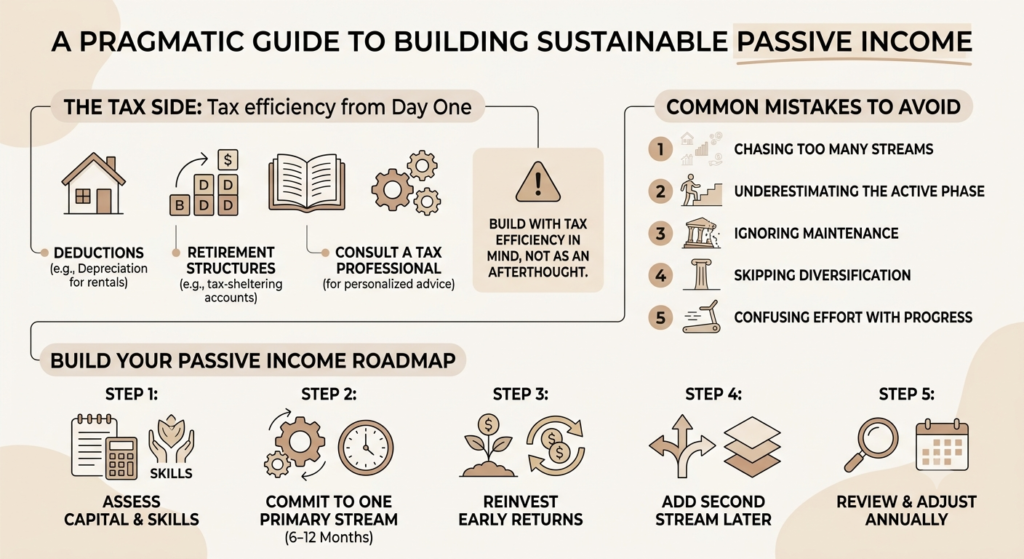
Rental property owners, for example, typically have access to depreciation deductions that can meaningfully offset taxable rental income, something REIT dividend income does not offer in the same way. Retirement account structures can also shelter certain types of investment income from taxes until withdrawal, which is worth exploring with a qualified tax professional before you scale any single stream significantly.
This is not the section where I am going to pretend to give you personalized tax advice, because I am not your accountant. What I will say is this: build your passive income strategy with tax efficiency in mind from day one, not as an afterthought once the money starts coming in. It is far easier to structure things correctly from the beginning than to reorganize a mature income stream later.
Mistakes That Quietly Kill Passive Income Plans
After years of building and advising on income-generating systems, I keep seeing the same handful of mistakes derail otherwise solid plans.
Chasing too many streams at once. Spreading your limited time and capital across five half-built passive income ideas usually produces worse results than committing fully to one or two until they are genuinely running themselves.
Underestimating the active phase. Every stream on this list requires real work upfront. People who expect immediate passivity quit during the exact phase where persistence would have paid off.
Ignoring maintenance entirely. Even the most passive income streams need periodic attention. A rental property needs occasional inspection. A digital product needs updates as the market shifts. Treating any stream as fully “set and forget” eventually leads to decay.
Skipping diversification. Relying on a single passive income source concentrates your risk in a way that active income from a job typically does not. If that one stream underperforms, you have nothing to fall back on.
Confusing effort with progress. Working long hours on a passive income project does not automatically mean you are moving closer to a passive outcome. The goal is building systems that work without you, not simply working harder on the project itself.
Building Your Own Passive Income Roadmap
Rather than trying to launch everything on this list simultaneously, here is a more realistic framework.
Start with your capital and skill inventory. Be honest about what you actually have right now: available cash, existing skills, spare time, and risk tolerance. This determines which category of passive income ideas makes sense as your starting point.
Pick one primary stream and commit for six to twelve months. Consistency matters more than intensity here. A modest, consistent effort applied to one well-chosen stream will outperform scattered effort across several half-finished ones almost every time.
Reinvest early returns rather than spending them. The fastest way to accelerate any passive income stream is to funnel early profits back into it, whether that means buying more shares, investing in better tools, or expanding a digital product line.
Add a second stream once the first is genuinely running itself. This is the point where true diversification starts to matter. Layering a second, uncorrelated income stream on top of a working first one is how most people eventually build meaningful financial independence rather than a single fragile source of extra cash.
Review and adjust annually. Markets shift, platforms change their rules, and your own life circumstances evolve. A passive income plan built in 2024 should not run unexamined through 2030. Revisit your streams at least once a year to confirm they are still worth your continued attention.
Here is what that looks like in practice. Someone starting with $2,000 in savings and a marketable skill in writing might begin by opening a high-yield savings account for that cash while spending their evenings building a single digital product, say, a template pack or a short guide, around a problem they understand well. For the first three to six months, nearly all of the effort goes into building, marketing, and refining that one product. Once it produces consistent monthly sales without daily involvement, the profits get redirected into a dividend-focused ETF rather than spent. Only after both of those streams are stable does a third get added, whether that is affiliate income layered onto the same audience or a small real estate crowdfunding position. Nothing about that sequence is fast, but every step compounds on the one before it, which is the entire point.
Key Takeaways
- Passive income always starts as active work; the passivity is earned through the setup phase, not skipped over.
- High-yield savings accounts are currently offering rates near 4%, a low-risk starting point most people overlook.
- Dividend stocks and REITs remain reliable income generators, with U.S. aggregate dividend payouts projected to keep growing in 2026.
- Digital products and content-based income offer the lowest capital barrier but require significant time investment upfront.
- Real estate income has diversified well beyond direct property ownership, with crowdfunding platforms lowering the entry cost substantially.
- The biggest risk to any passive income plan is spreading yourself too thin across too many unfinished streams.
- Tax treatment varies significantly by income type, so plan for efficiency from the start rather than after the fact.
Conclusion
Building real passive income is less about finding a secret shortcut and more about choosing one or two solid paths and giving them the consistent attention they need to eventually run without you. The businesses and portfolios that generate genuine income years down the line were rarely built overnight. They were built by people who did the unglamorous active work early, reinvested what came back, and had the patience to let systems mature.
Pick the stream that matches your capital, your skills, and your available time. Commit to it fully before adding another. That is how sustainable income gets built, one deliberate decision at a time, not through a shortcut you saw in someone else’s highlight reel.
Frequently Asked Questions
What is the most realistic passive income idea for a complete beginner?
For most beginners with limited capital, a high-yield savings account or a simple dividend-focused ETF is the most realistic starting point. Both require minimal ongoing management and let you build the habit of consistent investing before moving into more complex or capital-intensive strategies.
How much money can you actually make from passive income?
This varies enormously depending on the stream and the capital or time invested. A high-yield savings account with modest savings might generate a few hundred dollars a year, while a well-established rental property portfolio or digital product line can generate thousands monthly. There is no universal number, and anyone promising a fixed figure without knowing your specific situation is not being honest with you.
Is passive income actually taxed the same as a regular job?
No. Different types of passive income, including dividends, rental income, interest, and business income from digital products, are often taxed under different rules with different available deductions. It is worth consulting a tax professional once any single stream starts generating meaningful income.
How long does it take to build a passive income stream that actually replaces a salary?
This depends heavily on your starting capital, the stream you choose, and how consistently you reinvest early returns. Most people who reach that point took several years of consistent, focused effort rather than a single fast breakthrough. Anyone promising a much faster timeline at scale is typically selling something rather than describing reality.
Do I need a lot of money to start building passive income?
No. Several paths, including digital products, affiliate marketing, and content creation, require little to no starting capital, only time and a skill worth packaging. Capital-intensive paths like rental property ownership do require meaningful upfront investment, but they are not the only route to building real income over time.
What is the biggest mistake people make when starting out?
Trying to build too many income streams at once instead of committing fully to one or two until they are genuinely self-sustaining. Focus beats breadth in the early stages of almost every successful passive income strategy.