

I have spent years building businesses, managing properties, and watching people around me either grow steadily or stall out completely. The difference was rarely talent. It was rarely even luck. What separated the people who kept climbing from the people who kept starting over was something much less exciting: a small set of habits they repeated on ordinary days, without an audience, without applause.
That is the uncomfortable truth about success habits. They are not glamorous. Nobody posts a video of themselves reviewing their calendar for ten minutes before bed. But that unglamorous consistency is exactly what compounds into a career, a business, or a life that actually works.
This article is not another list of things billionaires supposedly do before 5 a.m. It is a practical, research-informed breakdown of the habits that genuinely move the needle, why they work from a behavioral science standpoint, and how you can start building them this week, regardless of your schedule, industry, or personality type.
What the Research Actually Says About Success Habits
Before getting into specific routines, it is worth understanding what actually happens when a behavior becomes a habit, because most advice on this topic skips the science entirely.
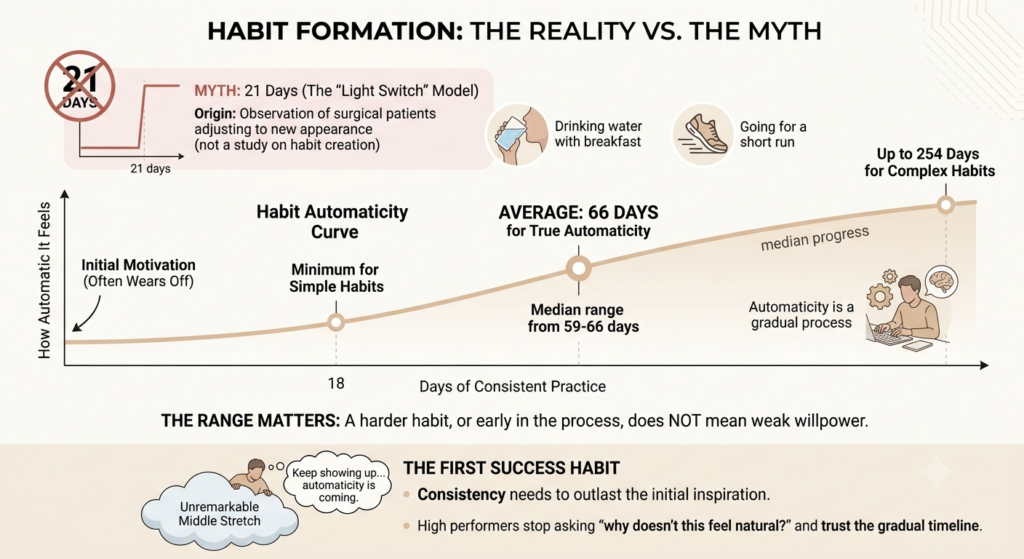
For decades, the popular claim was that it takes 21 days to form a new habit. That number traces back to a 1960 book by a plastic surgeon who noticed his patients took about three weeks to adjust to their new appearance after surgery. It was never a study on habit formation at all.
The real research tells a different story. A landmark study from University College London tracked participants for 84 days as they tried to build a simple daily behavior, such as drinking a glass of water with breakfast or going for a short run. Researchers measured how automatic the behavior felt each day. The result: it took an average of 66 days for a behavior to become truly automatic, with individual results ranging from as little as 18 days to as long as 254 days depending on the complexity of the habit and the person.
That range matters. It means the habit you are struggling to build is not a sign of weak willpower. It is simply a harder habit, or you are earlier in the process than you think. A more recent analysis of 20 studies involving over 2,600 participants confirmed a similar median of 59 to 66 days, reinforcing that automaticity is a gradual curve, not a light switch.
This is the first real success habit: understanding that consistency needs to outlast the initial motivation, because the payoff arrives later than most people expect. Success habits are not built in a burst of inspiration. They are built in the unremarkable middle stretch where the novelty has worn off and the results have not shown up yet.
High performers who understand this stop asking “why doesn’t this feel natural yet” and instead just keep showing up, because they know automaticity is coming on a predictable, if gradual, timeline.
Why Motivation Fails and Systems Win
Motivation is a feeling, and feelings are unreliable. Anyone who has set a New Year’s resolution knows the pattern: high energy in week one, some effort in week two, and by week four the plan is quietly abandoned.
High performers do not rely on feeling motivated. They rely on systems that work whether they feel like it or not. This is one of the most repeated ideas across performance research and among high-achieving entrepreneurs, executives, and athletes.
A system removes decisions. If your system says “I write for 45 minutes every morning after coffee,” you are not deciding each day whether to write. You are simply executing a plan you already made when your judgment was clearer and your energy was higher.
This matters because willpower is a limited resource over the course of a day. Every decision you make, from what to wear to how to respond to an email, draws from the same mental reserve. By the afternoon, that reserve is often running low, which is why so many good intentions die at 4 p.m. rather than at 9 a.m.
Building your important success habits into a fixed system, ideally earlier in the day, protects them from the decision fatigue that accumulates as hours pass. This is not about being a morning person. It is about recognizing when your discipline is strongest and designing around it.
Morning Habits of High Performers
Morning routines get an outsized amount of attention online, and much of it is exaggerated. You do not need to wake up at 4:30 a.m., take a cold plunge, and meditate for an hour to be successful. That version of the morning routine is mythology dressed up as science.
What the research and real-world patterns actually support is simpler: successful people tend to protect the first part of their day from other people’s priorities.
That does not mean waking up absurdly early. People have different chronotypes, family obligations, and natural peaks in alertness, and forcing a 5 a.m. wake-up on a natural night owl usually backfires. What matters is the sequence, not the clock time.
A strong morning sequence usually includes a few consistent elements:
- A buffer before checking email or messages, so the first decisions of the day are yours rather than reactive
- A clear priority identified the night before, so there is no wasted time figuring out what to work on
- Some form of movement or fresh air, even ten minutes, to shift out of a groggy state
- A specific time block for the most important task of the day, tackled before smaller distractions pile up
The common thread is intentionality. High performers rarely start their day by immediately surrendering their attention to other people’s inboxes, notifications, or demands. They give themselves a short runway to set direction before the world starts pulling at them.
Deep Work and Focus Habits
If there is one skill that has become more valuable, not less, in an age of constant notifications, it is the ability to concentrate on one thing for an extended period. This is often called deep work, and it is one of the clearest success habits that separates people who produce meaningful output from people who stay busy without much to show for it.
The science behind this is tied to something researchers call attention residue. When you switch from one task to another, part of your attention stays stuck on the previous task instead of fully transferring to the new one. Check your phone in the middle of a project, and even after you put it down, a portion of your mental bandwidth is still processing what you just saw. The result is slower, lower-quality work on whatever you turn to next.
High performers protect against this by batching similar tasks and by carving out blocks of time where communication tools are closed. This is not about willpower alone. It is about environment design.
Practical ways to build this habit:
- Block 60 to 90 minutes on your calendar for your highest-value task, with notifications off
- Do administrative work such as email and messaging in two or three defined windows rather than continuously throughout the day
- Choose one metric that tells you whether the deep work session actually produced something, rather than just tracking hours spent
Notice that none of this requires extraordinary discipline. It requires a decision made once, about how your day is structured, that then protects you from dozens of smaller decisions later.
Habits That Protect Physical and Mental Energy
For years, exhaustion was treated as a badge of honor in business culture. Entrepreneurs bragged about running on four hours of sleep and treated rest as something to be earned rather than something the brain requires to function.
That model is being corrected by the research. Adequate sleep supports memory, attention, emotional regulation, and decision-making. Studies on healthy adults consistently associate roughly seven or more hours of stable sleep with stronger working memory and better cognitive control. Poor sleep does not just make you tired. It measurably degrades judgment, which is the exact resource high performers depend on most.
Exercise carries a similar weight. Large-scale reviews of the research consistently report benefits for cognition, memory, and executive function tied to regular physical activity. This is one of the highest-return habits available, because the benefit is not confined to physical health. It directly supports the mental sharpness needed for demanding decisions.
Nutrition plays a quieter but real role as well. Protein-rich meals and consistent eating patterns help avoid the energy crashes that derail focus mid-afternoon, which is often when important decisions or client conversations happen.
None of this requires a dramatic overhaul. The habit worth building is protection, not perfection: protecting a consistent sleep window, protecting a few movement sessions per week, and protecting meals that do not leave you running on fumes by 3 p.m.
Stress management belongs in this same category, even though it rarely gets discussed alongside sleep and exercise. High performers do not wait for stress to become overwhelming before addressing it. They build recovery into the routine itself, whether that is a short walk between meetings, a few minutes of quiet before a difficult conversation, or a firm boundary around when work communication stops for the day. One well-known example is Bridgewater Associates founder Ray Dalio, who has credited a decades-long meditation practice as one of the most important habits behind his career. The specific method matters less than the underlying principle: recovery is scheduled, not left to chance.
Reading consistently is another energy-related habit worth naming on its own, because it sits at the intersection of mental fitness and continuous learning. Well-known examples are often cited precisely because the pattern is so consistent: heavy, regular reading shows up again and again among people who sustain success over long careers, not because reading itself is magic, but because it is a low-cost way to keep encountering new frameworks, mental models, and perspectives outside your own daily experience. Even twenty to thirty minutes a day, whether through a physical book or an audiobook during a commute, compounds into dozens of books absorbed per year, each one adding a small amount of judgment and context that a busy schedule would otherwise never allow.
Decision-Making and Goal-Setting Habits
High performers are not necessarily smarter decision-makers. They are more structured decision-makers. One of the clearest findings from goal-setting research is that specific, challenging goals consistently outperform vague ones like “do your best.” A goal such as “grow monthly recurring revenue by 15 percent this quarter” gives your brain something concrete to organize effort around, while “grow the business” does not.
Ambitious people who accomplish a lot rarely try to chase everything at once. They pick a small number of priorities, often no more than one to three, and let everything else wait. A full year is also often too long a planning window to stay genuinely focused, which is why many high performers work in shorter cycles of roughly twelve weeks, reviewing and resetting priorities more frequently than an annual plan allows.
One underrated tool here is what psychologists call implementation intentions, essentially “if this happens, then I will do that” planning. Research shows this kind of specific, pre-decided planning has a meaningfully positive effect on whether people actually follow through on their goals, compared to a general intention alone. Deciding in advance that “if a client pushes back on scope, then I will point to the written agreement” removes the need to improvise under pressure, when your judgment is least reliable.
Success habits around decision-making, in other words, are less about being decisive in the moment and more about doing the thinking in advance, so the moment itself requires less effort.
This is also where the difference between outcome goals and lead measures becomes important. An outcome goal, like “close five new clients this quarter,” tells you what you want but nothing about what to do on a Tuesday morning to get there. A lead measure, like “send fifteen qualified outreach messages per week,” is something you can actually control on a daily basis and track honestly. High performers tend to set the outcome once and then shift almost all of their daily attention to the lead measures underneath it, because obsessing over an outcome you cannot directly control on any given day tends to produce anxiety rather than progress. Choosing the right lead measures, and reviewing them weekly rather than only at the end of the quarter, is itself one of the most practical success habits available to anyone running a business or managing a team.
Relationship and Communication Habits
Success is rarely a solo achievement, no matter how it is portrayed. High performers deliberately invest in relationships that are not immediately transactional. They return calls, follow up after meetings, and check in with people even when there is nothing to ask for.
This is not just a nice personality trait. Research from social network studies has shown that the people around you meaningfully influence your behavior, your health, and even your income over time. The environment you surround yourself with shapes the standards you hold yourself to, often without you noticing.
In a business context, this shows up as habits like:
- Following up with a short note after important meetings, rather than letting them fade into silence
- Checking in with key team members or partners on a predictable cadence, not only when something is wrong
- Actively mentoring or being mentored, which research increasingly ties to stronger long-term career outcomes
A related and increasingly important habit is learning to work alongside new tools rather than resisting them. As workplaces continue to change, professionals who treat new technology as a collaborator, rather than a threat, tend to adapt faster and stay more relevant in their field.
Success Habits in a Changing, AI-Driven Workplace
The habits that build a successful career are not static. What counted as a career advantage a decade ago looks different today, and one of the clearest shifts researchers point to is how professionals relate to new technology, particularly artificial intelligence.
A recent analysis of career success drivers found that lasting career growth in an AI-transformed workplace depends less on formal credentials and more on a small set of daily habits, including work-life integration, situational leadership, ongoing mentorship, and actively partnering with AI tools rather than avoiding or fearing them. The professionals thriving in this environment are not the ones treating new tools as a threat to their value. They are the ones learning to direct these tools effectively, freeing up their own attention for the judgment calls that still require a human.
This matters for anyone building success habits today, because it reframes what “staying sharp” actually means. It used to be enough to simply master your craft and stay current on industry news. Increasingly, it also means developing the habit of experimenting with new tools early, rather than waiting until they become mandatory, and treating that experimentation as a routine part of professional development rather than a one-time adjustment.
Nimbleness has also become a habit in its own right. Surveys of business leaders show a strong majority now see the ability to move quickly and adjust course as their primary competitive advantage, ahead of rigid long-term planning. This does not mean abandoning strategy. It means building the habit of revisiting your plans on a shorter cycle, treating a quarterly or even monthly check-in as normal practice rather than a sign that the original plan failed.
Continuous learning fits into this same pattern. High performers increasingly treat skill development as an ongoing habit woven into the week, rather than a course completed once and set aside. This can look as simple as reading industry analysis for twenty minutes a few times a week, following a handful of credible voices in your field, or setting a recurring reminder to review what has changed in your industry over the past month. The specific format matters less than the recurring nature of the habit itself.
The common thread across these shifts is that adaptability itself has become a core success habit, not just a personality trait some people happen to have. It can be practiced, scheduled, and built the same way any other habit is built: through small, repeated actions rather than a single dramatic reinvention.
Reflection and Self-Awareness Habits
One of the oldest documented success habits comes from Benjamin Franklin, who tracked his daily adherence to thirteen personal virtues in a notebook for years. The specific format matters far less than the underlying habit: pausing regularly to evaluate what is working and what is not.
Journaling, weekly reviews, or simply sitting quietly to process the day are common practices among people who sustain success over long periods. The value is not the writing itself. It is the act of creating a regular checkpoint that turns raw daily experience into a pattern you can actually learn from.
Without this kind of review, most people repeat the same mistakes because they never step back far enough to notice the pattern. With it, a recurring problem, like consistently underestimating how long a project takes, becomes visible after the third or fourth time rather than the twentieth.
A simple weekly review might ask three questions:
- What moved forward this week that mattered
- What repeatedly got in the way
- What is the one adjustment worth making next week
This habit takes fifteen minutes and requires no special tools, yet it is one of the most consistently mentioned practices among people who sustain strong performance for years rather than a single good quarter.
How to Build These Habits Without Burning Out
Knowing which habits matter is the easy part. Building them without quitting after two weeks is where most people struggle. A few principles make this far more sustainable.
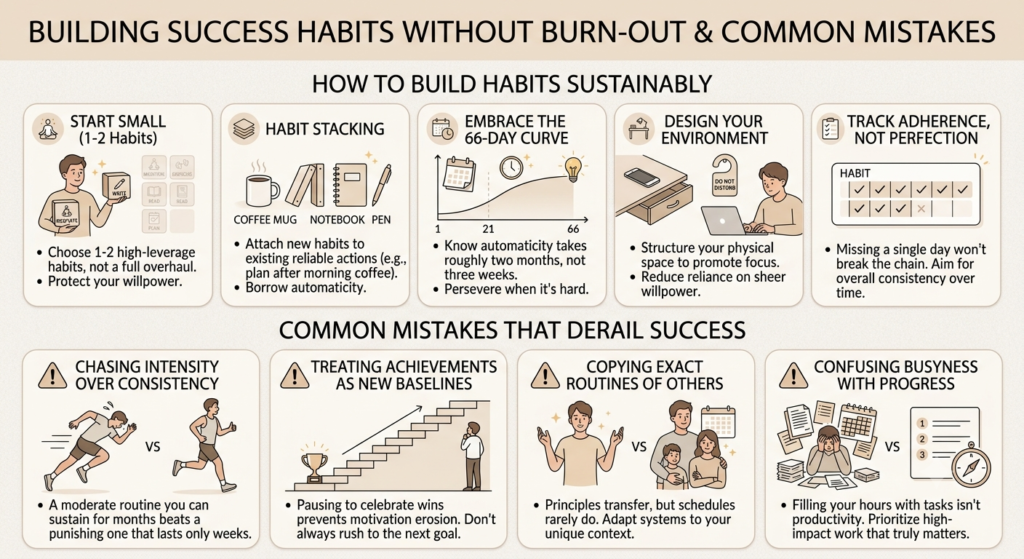
Start with one or two habits, not ten. Trying to overhaul your morning routine, exercise habit, sleep schedule, and reading practice simultaneously spreads your limited willpower too thin. Pick the one or two habits that would create the most leverage in your current situation, and let the rest wait.
Use habit stacking. Attach a new habit to an existing one you already do reliably, such as reviewing your top priority for the day right after you make coffee. This borrows the existing habit’s automaticity instead of trying to build motivation from zero.
Expect the 66-day curve, not the 21-day myth. Knowing that automaticity typically develops over roughly two months prevents the common trap of quitting right when the habit is about to become easier.
Design your environment, not just your willpower. If deep work is the goal, physically remove the phone from the room rather than relying on the discipline to ignore it. Environment design consistently outperforms willpower alone in behavioral research.
Track adherence, not perfection. Missing a single day does not meaningfully damage habit formation, according to the same research that established the 66-day timeline. What damages habit formation is missing enough days in a row that the behavior never gets the repetition it needs to become automatic.
Common Mistakes That Derail Success Habits
Even well-intentioned people sabotage their own progress in a few predictable ways.
Chasing intensity over consistency. A punishing routine that lasts eight days beats nothing, but a moderate routine that lasts eight months beats both. High performers optimize for what they can sustain, not what looks impressive for a week.
Treating every achievement as the new baseline. A pattern known among high achievers is that each accomplishment quietly becomes the new normal before it is even acknowledged, with the next goal appearing on the horizon before the last one is celebrated. Over time, this erodes motivation and makes success feel hollow rather than rewarding. Deliberately pausing to mark progress is itself a habit worth building.
Copying someone else’s exact routine. A habit that works for a founder with no children and a personal assistant will not transfer cleanly to someone managing a team and a household. The underlying principles, like protecting focus time or reviewing progress weekly, transfer. The specific schedule usually does not.
Confusing busyness with progress. Long hours and a full calendar can create the feeling of productivity while very little that actually matters gets done. The habit worth building is choosing the few priorities that move things forward, not filling every available hour.
Key Takeaways
- Success habits are built gradually, typically taking around 66 days to become automatic, not the commonly cited 21 days
- Systems and pre-made decisions outperform relying on daily motivation, especially as willpower fades later in the day
- Protecting the first part of the day from other people’s priorities sets the tone for everything that follows
- Deep, uninterrupted focus time is increasingly rare and increasingly valuable as a competitive advantage
- Sleep, movement, and consistent nutrition are not indulgences; they directly support the judgment high performers depend on
- Specific goals and pre-planned decisions, or implementation intentions, meaningfully improve follow-through
- Investing in relationships and mentorship compounds over years, not weeks
- Regular reflection turns daily experience into learnable patterns instead of repeated mistakes
- Starting with one or two habits and designing your environment around them beats trying to change everything at once
Conclusion
None of the habits covered here are exciting on their own. Protecting your mornings, sleeping enough, blocking focus time, planning your decisions in advance, checking in on the people around you, and reviewing your week are not the kind of things that make for dramatic before-and-after stories.
That is exactly the point. Success habits work because they are boring enough to repeat on a Tuesday in February when nobody is watching and nothing feels urgent. The compounding happens quietly, over months, not in a single decisive moment.
If you take one thing from this article, let it be this: stop waiting to feel ready, and stop expecting the habit to feel natural in three weeks. Pick one or two of the practices above, build them into a system rather than a burst of motivation, and give them the two months the research says they actually need. That is how consistent, sustainable success gets built, one ordinary day at a time.
Frequently Asked Questions
How long does it actually take to build a success habit? Research from University College London found habits take an average of 66 days to become automatic, though the range varies widely from about 18 to over 250 days depending on the complexity of the behavior and the individual.
Do I need to wake up at 5 a.m. to be successful? No. Early rising is not what the research supports as essential. What matters more is protecting the first part of your day, whenever it starts, from immediately reacting to other people’s priorities.
What is the single most impactful success habit to start with? There is no universal answer, since it depends on your current bottleneck, but protecting a daily block of uninterrupted focus time and prioritizing consistent sleep tend to have the broadest downstream effect on everything else.
Is it normal to miss a day while building a new habit? Yes. Research on habit formation shows that occasionally missing a day does not meaningfully disrupt the process, as long as the behavior resumes soon after and does not lapse for an extended stretch.
How many habits should I try to build at once? Start with one or two. Attempting to overhaul your entire routine at once spreads your limited willpower too thin and is a common reason habit-building attempts fail within the first few weeks.
Do successful people rely on motivation to stay consistent? Generally no. High performers tend to build systems and pre-made decisions that function even on low-motivation days, rather than relying on feeling inspired to follow through.