

Most people think financial freedom means a number in a bank account. A figure so large that work becomes optional and worry disappears overnight.
That is not quite how it works, especially if you are running a business.
For entrepreneurs, financial freedom is less about hitting a magic number and more about building a system where your business, your savings, and your investments work together so that no single setback can take you down. It is the difference between owning a business that owns you, and owning a business that eventually sets you free.
This guide breaks down exactly what financial freedom looks like in 2026, what the latest research says about how people define and pursue it, and a step-by-step roadmap built specifically for founders, small business owners, and self-employed professionals who cannot rely on a steady paycheck to get there.
What Financial Freedom Really Means
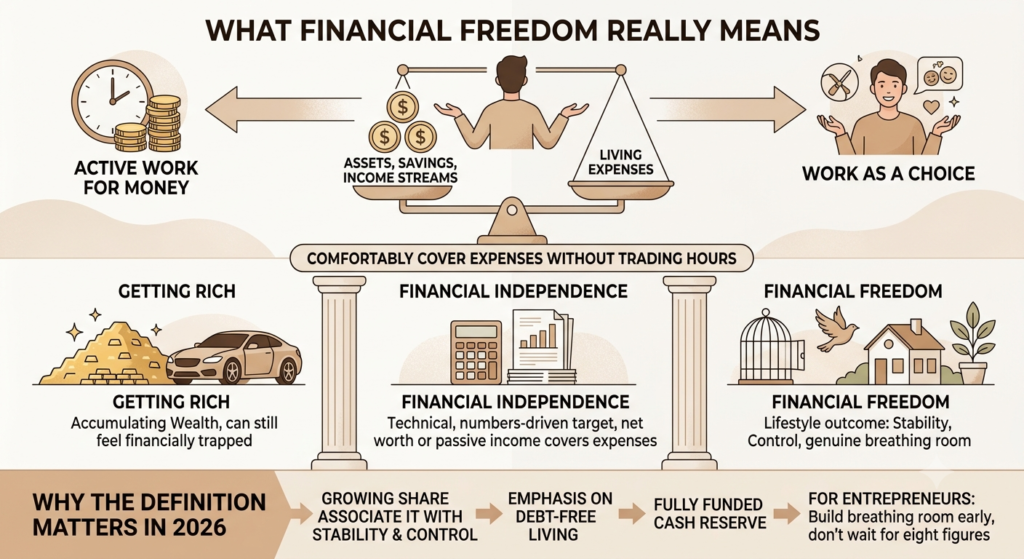
The phrase gets thrown around so often that it has almost lost meaning. So let’s define it properly before going further.
Financial freedom is the point at which your assets, savings, and income streams can comfortably cover your living expenses without you having to trade active hours for money. It does not necessarily mean you stop working. It means work becomes a choice rather than a requirement.
This is different from two related ideas people often confuse it with.
Financial Freedom vs Financial Independence vs Getting Rich
Financial independence is the technical, numbers-driven version of financial freedom. It usually refers to reaching a specific net worth or passive income figure that covers your expenses indefinitely.
Getting rich is about accumulating wealth, often without a clear endpoint. Someone can be rich on paper and still feel financially trapped if their money is tied up in illiquid assets or if their spending grows as fast as their income.
Financial freedom sits above both. It is a lifestyle outcome, not just a balance sheet outcome. You can reach a modest version of financial freedom with far less money than you think, simply by controlling your expenses and building reliable income that does not depend on you clocking in every day.
Why the Definition Matters More in 2026
The way people define financial freedom has shifted noticeably in the last two years. A growing share of consumers now associate it with stability and control rather than luxury. Being debt-free, having a fully funded cash reserve, and not depending on family for money now rank as strong markers of financial freedom, sometimes ahead of hitting a specific net worth target. This growing emphasis on debt-free living is one of the clearest shifts in how people describe feeling financially secure.
For entrepreneurs, this shift is useful. It means you do not need to wait until you have sold your company for eight figures to feel free. You can build genuine financial breathing room much earlier, if you approach it deliberately.
The State of Financial Freedom in 2026: What the Data Shows
Recent research paints a fairly clear picture of where people stand today.
A widely cited 2026 survey found that the average American associates financial independence with earning around ninety-four thousand dollars a year, and a majority feel optimistic they can get there. Interestingly, when people were asked what financial freedom actually feels like day to day, “not needing money from family or friends,” “reaching a certain net worth,” and “contributing consistently to a retirement account” topped the list, ahead of flashier markers like owning a second home or driving a luxury car.
At the same time, a separate 2026 consumer study found that roughly a third of people now define financial success primarily as being debt-free, with wealth-building treated as a second-stage goal that comes after debt freedom, not before it. Among younger respondents, flexibility and control over time ranked as important as the money itself.
There is also a persistent gap between wanting financial freedom and feeling confident about reaching it. Financial stress remains high enough that a large share of employees report it affecting their focus and motivation at work, which is part of why so many people are drawn to entrepreneurship and side income in the first place. Ironically, business ownership can either close that stress gap or widen it, depending on how it is managed.
The takeaway from this data is simple. Financial freedom in 2026 is being redefined around resilience, not excess. That plays directly into the hands of entrepreneurs who build their businesses with discipline rather than pure hustle. It also underscores a gap worth naming: broader financial literacy has not caught up with how eager people are to reach these goals, which is exactly why having a clear, step-by-step plan matters so much.
Why Entrepreneurs Walk a Different Path to Financial Freedom
Employees pursuing financial freedom generally follow a linear path: save a percentage of a predictable paycheck, invest it consistently, and let compounding do the work over a few decades. Entrepreneurs rarely get that luxury.
The Income Volatility Trap
Business income is lumpy. Some months bring more revenue than a full year of a typical salary. Other months bring almost nothing, especially in the early years or during slow seasons. This volatility makes standard financial planning advice, built around consistent monthly contributions, harder to apply directly.
Many founders fall into a trap where they treat “the business” as their entire retirement plan. They reinvest everything back into growth and personally hold almost nothing outside the company. This works fine as long as the business keeps growing. It becomes extremely risky the moment the business slows down, gets disrupted, or simply fails, which happens to the majority of small businesses within their first several years.
The Upside: Equity and Ownership
The flip side is that entrepreneurs have access to a wealth-building lever employees generally do not: equity. A business you own and grow can appreciate in value far beyond what a salary ever could, and it can eventually be sold, licensed, or handed off to generate ongoing income with far less of your direct time.
The entrepreneurs who reach financial freedom fastest are usually the ones who treat their business as one asset among several, rather than their only asset. They pay themselves properly, invest outside the business, and build a personal financial foundation that does not rise or fall entirely with company revenue.
What Entrepreneurs Can Borrow From FIRE
You have probably heard of the FIRE movement, short for Financial Independence, Retire Early. It has grown into one of the most talked-about approaches to money among millennials and Gen Z, many of whom are also entrepreneurs or side-hustlers, and it is having a bit of a resurgence as people look for more control over their income in an uncertain job market.
The core idea is straightforward: save an aggressive percentage of income, often fifty percent or more, invest it consistently, and reach a point where investment income alone covers your living expenses. Once that threshold is crossed, working becomes optional rather than mandatory.
The Four Variations of FIRE, Explained
The movement has branched into several distinct approaches over the past few years, and each one maps surprisingly well onto different stages of entrepreneurship.
Lean FIRE focuses on extreme minimalism, keeping annual expenses very low so the target number is smaller and reachable sooner. This suits early-stage founders who are already living lean while bootstrapping.
Fat FIRE targets a much larger portfolio to support a higher standard of living without cutting back. This fits established business owners who want financial freedom without downsizing their lifestyle.
Coast FIRE means you have invested enough that compounding alone will get you to financial independence by a target age, even if you stop actively contributing. Many founders unknowingly practice a version of this by building a business, selling it, and letting the proceeds grow untouched.
Barista FIRE blends part-time or flexible work with investment income, covering some expenses through low-stress work and the rest through a portfolio. This is common among entrepreneurs who scale back their business to a part-time operation once it becomes stable.
Applying FIRE Principles Without the Extremes
You do not need to save seventy percent of your income or retire at thirty to benefit from FIRE thinking. The two principles worth borrowing are a high, intentional savings rate and a clear number you are working toward. Even a modified version, saving twenty to thirty percent of personal income consistently while reinvesting into the business, moves you meaningfully closer to financial freedom for entrepreneurs than no plan at all.
Step 1 – Know Your Numbers Before You Chase Freedom
You cannot hit a target you have not defined. This is the step most business owners skip, and it is the one that matters most.
Calculating Your Target Number
Start by figuring out your annual living expenses, not your business expenses, your personal ones. Rent or mortgage, food, insurance, transportation, and discretionary spending all count.
A commonly used shortcut, based on the four percent rule, suggests that a portfolio worth twenty-five times your annual expenses can sustainably support you long term through withdrawals. If your personal expenses run sixty thousand dollars a year, that puts your financial independence number around one and a half million dollars in investable assets.
This number will feel intimidating at first, and that is fine. The point is not to hit it next year. The point is to have a concrete target so every financial decision, from how much you save to how you price your services, can be measured against real progress rather than a vague feeling of “doing okay.”
Tracking Net Worth as a Founder
Most entrepreneurs track revenue obsessively and personal net worth almost never. That needs to change.
Set a recurring date, monthly or quarterly, to add up everything you personally own, cash, investments, retirement accounts, real estate, and the estimated value of your business equity, then subtract everything you owe. Watching this single number move over time is one of the most motivating and clarifying habits you can build as a founder, because it separates your personal financial health from your business’s monthly ups and downs.
Step 2 – Separate Business Cash Flow From Personal Freedom
One of the fastest ways to sabotage your own progress is blending business and personal finances so thoroughly that you cannot tell how you are actually doing.
Paying Yourself Consistently
Set yourself up on a consistent, modest salary or owner’s draw, even if the business could technically afford to pay you more in a good month. This forces discipline into the business, builds a cash buffer for slow periods, and gives you a stable number to build a personal budget and savings plan around.
Founders who pay themselves inconsistently, taking large draws in good months and nothing in bad ones, tend to struggle far more with saving and investing, simply because there is no predictable baseline to plan against.
Avoiding the “Business Is My Retirement Plan” Trap
It is tempting to tell yourself the business itself is your retirement plan and skip building anything outside it. This is one of the riskiest assumptions in entrepreneurship. Businesses get disrupted by new competitors, changing regulations, economic downturns, and shifts in consumer behaviour that no one saw coming.
Treat personal investing as non-negotiable, even if it means growing the business slightly slower. A founder with a modest but consistent personal investment account is in a dramatically stronger position than one whose entire net worth is tied up in a single company, no matter how well that company is currently performing.
Step 3 – Build a Cash Buffer That Fits a Founder’s Reality
For employees, the standard advice is three to six months of expenses in cash. For entrepreneurs, that number often needs to stretch further, because income disruptions tend to last longer and recovery can take more time. This cash cushion is often called an emergency fund, and it deserves its own line item in your plan, separate from any business reserves.
A more realistic target for most founders is six to twelve months of personal living expenses held in a liquid, easily accessible account, separate from any business reserves. This is not money for slow-season business expenses. It exists purely to protect your household if the business hits a genuinely rough patch.
Building this fund can feel slow, especially early on, but a few practices speed it up considerably:
- Automate a fixed transfer into a dedicated savings account every time you pay yourself.
- Direct a percentage of any unusually good month straight into the fund before it gets absorbed into lifestyle spending.
- Keep the account at a separate bank from your everyday spending account, so it is not sitting in plain sight tempting you.
Once this fund is fully built, the psychological shift is significant. Decisions about the business stop being driven by fear of personal financial collapse, and that alone tends to lead to better business decisions.
Step 4 – Eliminate High-Interest Debt Strategically
Debt is not automatically the enemy. A reasonable business loan used to fund genuine growth can be a smart tool. Credit card balances carried month to month at high interest rates are a different story entirely, and they are one of the biggest drags on reaching financial freedom.
The order of operations that tends to work best:
- List every debt with its interest rate and minimum payment.
- Keep making minimum payments on everything.
- Direct any extra money toward the highest-interest debt first, regardless of balance size.
- Once that debt is cleared, roll the payment amount into the next highest-interest debt.
This approach, often called the avalanche method, minimizes the total interest paid over time. Some people prefer paying off the smallest balance first for a psychological win, which works too, as long as you actually stick with it. The best debt strategy is the one you will follow consistently, not the one that looks best on a spreadsheet.
Being debt-free has become one of the clearest markers people associate with feeling financially free, and for good reason. Debt payments quietly cap your savings rate every single month, no matter how much the business grows.
Step 5 – Diversify How You Earn
Relying entirely on one business for all your income is one of the biggest structural risks an entrepreneur can carry, even if that business feels rock solid today. Building multiple income streams doesn’t mean juggling five unrelated side hustles, it means adding one or two additional sources that don’t disappear if your main business has a bad quarter.
Active vs Passive Income for Business Owners
Active income requires your ongoing time and effort, your core business, consulting work, or a day job if you are still building your venture on the side. Passive income streams come from assets that generate money with little to no daily involvement, dividends, rental property, royalties, or automated digital products.
Most entrepreneurs start with one active income stream and gradually layer in passive ones as the business stabilizes and generates surplus cash. Trying to build several passive streams before the core business is solid usually spreads attention too thin and slows everything down.
Realistic Passive Income Ideas in 2026
A few approaches that continue to hold up well for entrepreneurs looking to diversify:
- Dividend-paying investments and index funds, which require capital but almost no ongoing effort once set up.
- Real estate investment trusts, which offer property exposure without the operational headache of being a landlord.
- Digital products, such as templates, courses, or tools built once around expertise you already have from running your business.
- Licensing or royalty arrangements, useful if your business has developed intellectual property, branding, or content with reuse value.
- Rental income, whether from residential property or from business assets you already own that sit idle part of the time.
None of these are truly “set and forget,” they all require upfront work and periodic maintenance. But compared to actively trading hours for dollars, they meaningfully reduce how tightly your income is tied to your daily effort, which is the entire point of building financial freedom for entrepreneurs in the first place.
Step 6 – Invest With an Ownership Mindset
Reinvesting in Your Business vs Outside Investments
There will always be a temptation to funnel every spare dollar back into the business, and sometimes that is the right call, especially in the early growth phase when returns on reinvestment are high. But this decision should be deliberate, not automatic.
A useful gut check: if this money were sitting in a diversified investment account instead of going back into the business, would it realistically earn a better risk-adjusted return? If the honest answer is no, keep reinvesting. If the business has matured and growth is slowing, shifting a larger share of profits toward outside investments usually makes more sense.
Using a Safe Withdrawal Rate to Plan Ahead
The 4% rule, mentioned earlier when calculating your target number, also guides how you draw down investments later. It suggests that withdrawing roughly four percent of a well-diversified portfolio annually, adjusted for inflation, has historically allowed portfolios to last thirty years or more without running out.
It is a guideline, not a guarantee, and market conditions can shift the safe withdrawal rate up or down. But it gives entrepreneurs a concrete, evidence-based framework to plan around instead of guessing.
Step 7 – Protect What You Build
Financial freedom is not just about accumulating assets, it is about not losing them to a single bad event. Insurance, in particular, is one of the most overlooked pieces of a founder’s financial plan.
At minimum, most entrepreneurs benefit from health coverage appropriate to their situation, some form of income protection or disability coverage given that their earning ability is the engine behind everything else, and adequate business liability coverage so a single lawsuit or claim cannot wipe out years of progress.
A basic estate plan matters too, even for younger founders. Without one, decisions about your business and personal assets can end up tied up in unnecessary legal complexity if something happens to you.
It is also worth thinking through a basic continuity plan for the business itself. If you were suddenly unable to work for a few months, would the business survive without you at the wheel? Writing down key processes, giving a trusted employee or partner limited access to critical systems, and keeping essential documents somewhere other than your own head are simple steps that protect both the business and your family’s financial position if the unexpected happens.
Protection also extends to how you structure the business legally. Operating without the right legal entity, or letting business and personal liability blur together, exposes your personal assets to risks that a properly structured company would shield you from. A short conversation with an accountant or attorney early on is far cheaper than untangling a mess later.
Common Mistakes That Delay Financial Freedom
A few patterns show up again and again among entrepreneurs who take far longer than necessary to reach financial freedom.
- Lifestyle creep tied to business success. Every revenue milestone triggers a matching increase in personal spending, so the gap between income and expenses never actually widens.
- Treating the business as the only asset that matters. All capital goes back into the company with nothing building up personally on the side.
- No clear number. Without a defined financial independence target, it is impossible to know whether current decisions are actually moving the needle.
- Inconsistent owner pay. Irregular draws make budgeting and saving nearly impossible to sustain.
- Ignoring insurance and contingency planning. A single uninsured event can erase years of disciplined saving in one stroke.
- Waiting for “enough” before starting to invest. Founders often delay investing until the business feels fully stable, which can take years longer than expected, while compounding time is lost in the meantime.
Recognizing these patterns early is often enough to course-correct before they cause real damage. Most of them are not one-time errors either, they are habits that quietly compound over years. A founder who overspends slightly every time revenue jumps, or who skips a single insurance policy to save on premiums, may not feel the impact immediately. The cost usually shows up much later, at exactly the moment it is hardest to fix, which is why catching these patterns early is worth far more than it seems in the moment.
A Simple Roadmap You Can Start This Year
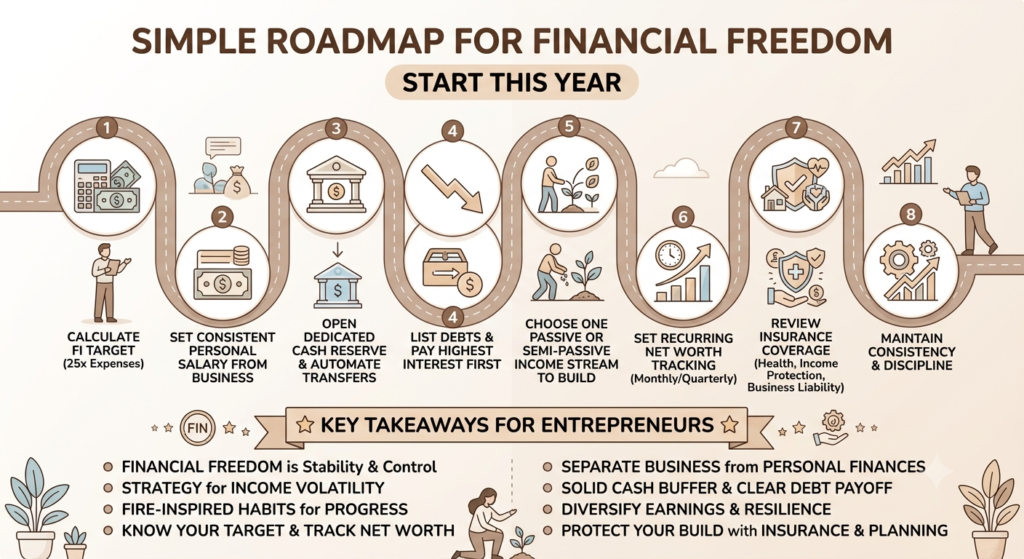
If the full picture feels like a lot, here is a condensed version you can start acting on this month.
- Calculate your personal FI target using the twenty-five times expenses guideline.
- Set up a consistent, fixed personal salary or draw from the business.
- Open a dedicated cash reserve account and automate a transfer into it.
- List all debts by interest rate and start applying extra payments to the highest one.
- Choose one passive or semi-passive income stream to begin building alongside your core business.
- Set a recurring monthly or quarterly date to track your personal net worth.
- Review your insurance coverage, health, income protection, and business liability, at least once this year.
None of these steps require a windfall or a lucky break. They require consistency, which is something entrepreneurs already understand better than most, having applied it to build their businesses in the first place.
Key Takeaways
- Financial freedom is a lifestyle outcome built on stability and control, not just a specific net worth figure.
- Entrepreneurs face unique income volatility that requires a different approach than standard employee financial planning.
- FIRE-inspired habits, even applied in a modified form, can accelerate progress without requiring extreme sacrifice.
- Knowing your target number and staying on top of net worth tracking turns vague goals into measurable progress.
- Separating business cash flow from personal finances protects you from the business’s inevitable ups and downs.
- A solid cash buffer and a clear debt payoff strategy remove much of the stress that derails long-term financial plans.
- Diversifying how you earn and investing with an ownership mindset builds resilience beyond the business itself.
- Protecting what you build with proper insurance and planning is just as important as accumulating it in the first place.
Conclusion
Financial freedom for entrepreneurs is not about waiting for a dramatic exit or a lucky break. It is built through consistent, unglamorous decisions made month after month: paying yourself properly, tracking your numbers, building a buffer, clearing debt, and putting money to work outside the business as well as inside it.
The entrepreneurs who reach it fastest are rarely the ones with the biggest revenue. They are the ones who treat their personal financial foundation with the same discipline they bring to building their companies. Start with one step from this guide today, and let the rest compound from there.
Frequently Asked Questions
What is a realistic financial freedom number for a small business owner?
It depends entirely on your personal living expenses, not your business revenue. A common starting point is multiplying your annual personal expenses by twenty-five, based on a four percent sustainable withdrawal rate.
Can I pursue financial freedom while still growing my business aggressively?
Yes, though it requires intentional balance. Paying yourself consistently and directing even a modest percentage of that pay toward savings and investments, alongside reinvesting in growth, keeps both goals moving forward together.
Is pursuing FIRE realistic for entrepreneurs?
Full FIRE, retiring extremely early on savings alone, is a stretch goal for most. But the underlying habits, a high savings rate and a clear target number, apply well to entrepreneurs and can meaningfully speed up financial freedom even without full early retirement.
How much should I keep in a cash reserve as a founder?
Most financial planners suggest six to twelve months of personal living expenses for entrepreneurs, more than the standard three to six months often recommended for salaried employees, given the higher likelihood of extended income disruption.
Should I pay off debt or invest first?
Generally, clear high-interest debt, anything above roughly seven or eight percent, before prioritizing investing, since that interest rate is hard to reliably beat through investment returns. Lower-interest debt can often be paid down alongside investing rather than before it.
What is the biggest mistake entrepreneurs make on the path to financial freedom?
Treating the business as their only financial asset. Without personal savings and investments outside the company, a single business setback can undo years of progress.