

Most people think building a business starts with an idea. It doesn’t. It starts with how you think.
You can hand two people the exact same business plan, the same starting capital, and the same market opportunity, and one will quit within eighteen months while the other builds something that lasts a decade. The difference rarely comes down to talent or luck. It comes down to mindset.
Research backs this up in a way that used to sound like a motivational poster but now has real data behind it. About 80 percent of new U.S. businesses survive their first year, according to Bureau of Labor Statistics figures, yet the businesses that close almost always share the same underlying pattern: no real market validation, weak cash management, and a founder who treated entrepreneurship as a personality trait instead of a set of skills that can be trained. That last point matters more than it sounds. If an entrepreneur mindset were something you’re simply born with, this article would be pointless. It isn’t. It’s learnable, and that’s the whole premise of what follows.
This guide breaks down what an entrepreneur mindset actually is, why it matters more now than it did a decade ago, the specific traits that show up again and again in founder research, and a practical, step-by-step approach to building that mindset even if you don’t feel like a “natural” entrepreneur today.
What Is an Entrepreneur Mindset
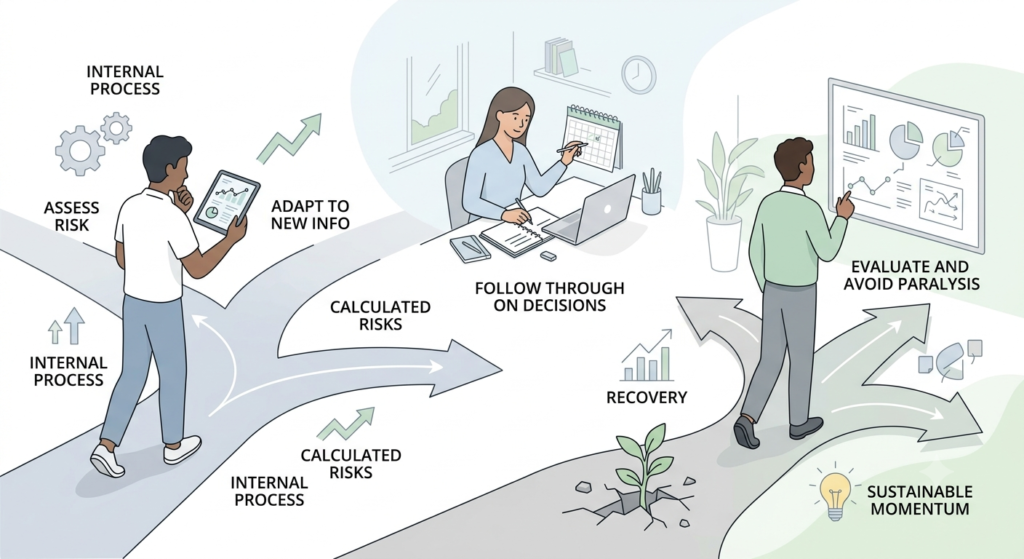
An entrepreneur mindset is a specific way of processing uncertainty, risk, and failure that allows someone to keep moving a business forward when the outcome isn’t guaranteed. It’s not about being fearless. It’s not about working eighteen-hour days. And it’s definitely not a personality type you either have or don’t.
At its core, the entrepreneur mindset is a combination of a few learnable skills working together: the ability to assess risk without freezing up, the discipline to follow through on decisions without constant motivation, and the flexibility to change course when new information shows up. Founders who have developed this mindset don’t necessarily take bigger risks than everyone else. They take better-calculated ones, and they recover faster when those risks don’t pay off.
This distinction matters because so much of the popular conversation around entrepreneurship focuses on outcomes – the exit, the funding round, the revenue milestone – while ignoring the internal process that got someone there. The entrepreneur mindset is that internal process. It’s the operating system running underneath every decision a founder makes, long before any of those decisions become visible to the outside world.
It’s also worth being clear about what this mindset is not limited to. You don’t need to be running a venture-backed startup to benefit from thinking this way. Property managers making pricing decisions, freelancers pitching new clients, and side-hustlers testing a product idea on weekends are all operating in the same uncertain terrain that traditional founders navigate. The mindset transfers.
Why This Way of Thinking Matters More Right Now
Entrepreneurship isn’t a niche pursuit anymore. Recent data shows entrepreneurial activity in the United States hit record highs in 2022 and has stayed elevated since, with younger founders driving much of that growth. Alongside that surge, 76 percent of entrepreneurs reported year-over-year growth in 2024, and 73 percent were already seeing revenue increases early in 2025 despite ongoing macroeconomic pressure. More people are starting businesses, which means the competitive bar for resilience, adaptability, and execution keeps climbing.
At the same time, the tools available to entrepreneurs have changed faster in the past two years than in the previous decade combined. Founders now have to make judgment calls about which technologies genuinely move their business forward and which ones are just noise. That’s not a technical skill so much as a mindset skill: the ability to evaluate, adapt, and avoid getting paralyzed by too many options.
There’s also a quieter shift happening in how founders define success. A growing number of researchers and practitioners are pointing out that survival-mode entrepreneurship – reacting to crisis after crisis, treating burnout as a badge of honor – is being replaced by a model built on sustainable momentum. That’s not a soft trend. It’s a practical one, because founders who burn out don’t build long-term companies. They build short-term ones that collapse the moment the founder does.
None of this changes the fundamentals of what makes a founder successful. It just raises the stakes for actually developing the mindset instead of hoping it shows up on its own.
Core Traits That Define Strong Founders
Entrepreneurship researchers who study founder behavior across industries keep landing on a similar shortlist of traits. They don’t always use identical language, but the pattern is consistent: adaptability, calculated risk-taking, persistence, vision, customer focus, and – more recently – the ability to work well with modern tools. None of these are traits you’re issued at birth. They’re built through repetition, feedback, and deliberate practice.
Seeing Ability as Something You Build, Not Something You’re Given
The single biggest predictor of long-term founder success isn’t intelligence, funding, or connections. It’s whether someone believes their abilities can improve with effort. Psychologists call this a growth mindset, and the research on it is remarkably consistent: people who believe skills are trainable persist longer, recover faster from setbacks, and are more willing to attempt things they haven’t mastered yet.
A study out of North Carolina State University, which surveyed more than 700 entrepreneurs, found that founders who believed their habits and traits could change over time were significantly better at adapting to venture-related setbacks than those who saw their traits as fixed. The founders who believed change was possible reported lower negative emotion after a setback and higher optimism about what came next. That’s not a small effect. It’s the difference between a bad quarter ending a business and a bad quarter becoming a turning point.
This matters for the entrepreneur mindset specifically because so much of business is failure disguised as data. A product launch that flops, a marketing campaign that underperforms, a hire that doesn’t work out – none of these are verdicts on your worth as a founder. They’re information. Whether you can treat them that way depends almost entirely on whether you believe you’re capable of getting better at this.
Taking Risks on Purpose, Not by Accident
Popular culture loves the image of the entrepreneur as a reckless risk-taker, betting everything on a hunch. Actual research paints a very different picture. Founders with a strong entrepreneur mindset take calculated risks – they run small, structured tests before making major commitments, and they size their bets to what they can afford to lose while still learning something valuable.
This looks less like a leap of faith and more like a series of controlled experiments. A founder considering a new product line doesn’t bet the company on it. They run a limited pilot, watch how customers actually respond, and use that real-world signal to decide whether to scale up or walk away. The willingness to act despite uncertainty is real, but it’s paired with a discipline about how much uncertainty is acceptable at any given moment.
Bouncing Back Faster Than the Setback Hits
Resilience gets used so often in business writing that it’s started to lose meaning, but the underlying skill is specific and trainable. It’s the ability to experience a real setback, process the disappointment without spiraling into it, and get back to productive action within a reasonable window of time.
One in four entrepreneurs will experience some form of mental health challenge over the course of their career, which is a sobering statistic and a reminder that resilience isn’t about pretending setbacks don’t hurt. It’s about building the internal and external systems that let you keep functioning while they do. Founders who develop this capacity tend to build it the same way: through consistent learning routines, support from other founders, and staying grounded even when a specific outcome falls apart.
Treating Consistency as a Competitive Advantage
Ask a large sample of founders what actually drove their success, and the answer that comes up most often isn’t funding or connections. In a survey conducted by National Business Capital and Services, 38 percent of entrepreneurs named self-discipline as the single biggest factor behind their success – more than any other single trait. People and communication skills came in second at 37 percent, followed by passion and drive.
What’s notable is what didn’t make that list: venture capital, a prestigious business degree, or a perfect market opportunity. The traits founders point to are almost entirely internal and almost entirely learnable. Discipline in this context doesn’t mean working around the clock. It means identifying procrastination early, following through on commitments even when motivation dips, and maintaining routines that keep the business moving forward regardless of how you feel on any given day.
Executives known for disciplined routines – from CEOs who start their mornings at four or five in the morning to founders who protect a nightly wind-down ritual – aren’t disciplined because they have more willpower than everyone else. They’re disciplined because they’ve built structures that don’t depend on willpower in the first place.
Adjusting Course Without Losing the Plot
Markets shift, customer expectations change, and tools that felt cutting-edge eighteen months ago can become table stakes overnight. Founders with a strong entrepreneur mindset don’t treat a change in direction as a failure of the original plan. They treat it as evidence that the plan is working the way it’s supposed to.
This is a harder skill than it sounds, because it requires holding two things at once: enough conviction to keep pushing through short-term difficulty, and enough humility to recognize when the underlying assumption behind a decision has stopped being true. The founders who get this wrong usually err in one direction or the other – either abandoning good ideas at the first sign of resistance, or clinging to bad ones long after the market has made its verdict clear.
Knowing Which Tools Actually Move the Business Forward
A newer trait has entered founder research over the past couple of years: the judgment to evaluate which technologies genuinely accelerate a business and which ones are just adding complexity. This isn’t about becoming a technical expert in every new tool that launches. It’s about developing enough fluency to ask the right questions, run a real test, and make a decision instead of either ignoring new capabilities entirely or adopting them indiscriminately because everyone else seems to be.
This trait separates founders who use modern tools as genuine leverage from those who either fall behind or waste time chasing every new release. It’s less a technical skill than a discipline skill, applied to a fast-moving category.
The Psychology Behind This Kind of Thinking
Understanding why this mindset works requires a quick look at where the research actually comes from. Psychologist Carol Dweck’s work on growth versus fixed mindsets, originally developed in educational settings, has since been applied extensively to entrepreneurship, and the findings translate cleanly.
A randomized controlled trial studying necessity entrepreneurs – people who start businesses out of economic need rather than pure opportunity – found that technical training alone wasn’t enough to change outcomes. Entrepreneurs who received only skills-based training but retained a fixed mindset about their own capability were far less likely to act on what they’d learned. The ones who received mindset training alongside the technical training were significantly more likely to translate knowledge into actual entrepreneurial behavior. In other words, knowing what to do matters far less than believing you’re capable of doing it.
A separate multi-month study tracking potential entrepreneurs over sixteen months found that holding more of a growth mindset positively predicted whether someone actually took entrepreneurial action, and predicted that they’d take it sooner rather than later. Interestingly, this effect was strongest in more difficult, resistant environments – exactly the conditions where most people would expect mindset to matter least, and it turned out to matter most.
This is also where the conversation about founder wellbeing becomes unavoidable. Entrepreneurship carries a real psychological cost, and pretending otherwise doesn’t help anyone build a sustainable business. What the research consistently shows is that founders who approach setbacks with a growth-oriented lens report lower stress and better coping outcomes than those who interpret every setback as proof of a fixed personal limitation. Protecting against founder burnout isn’t a separate concern from building an entrepreneur mindset. It’s part of the same skill set.
How to Build This Mindset Step by Step
Knowing the traits that matter is only useful if you have a practical way to actually build them. Here’s a sequence that reflects how the research says mindset change actually happens – gradually, through repeated practice, not through a single decision to “think differently.”
Start by Naming Your Current Default
Before you can shift your mindset, you need an honest read on where it currently sits. Pay attention to how you talk to yourself after a setback this week. Do you default to “I’m just not good at this” or to “I haven’t figured this out yet”? That single word difference – yet – is one of the clearest markers of a growth-oriented mindset, and noticing your own default language is the fastest way to catch a fixed-mindset pattern before it shapes a bigger decision.
This isn’t about journaling for the sake of journaling. It’s about building enough self-awareness that you can interrupt an unproductive thought pattern in the moment it happens, rather than three weeks later when it’s already cost you momentum.
Reframe Setbacks as Information, Not Verdicts
Every founder collects a string of things that didn’t work. The mindset shift isn’t about avoiding those moments – that’s not realistic – it’s about what you do with them immediately afterward. Instead of asking “why did I fail,” ask “what did this specific attempt teach me that I didn’t know before I tried it.”
That question does two things at once. It keeps you moving instead of stalling in self-judgment, and it forces you to extract something useful from an otherwise costly experience. Over time, founders who consistently ask this question build a mental library of lessons that compound, while founders who skip this step end up repeating the same mistakes in slightly different packaging.
Build Habits That Don’t Depend on Motivation
Self-discipline isn’t a personality trait you either have or don’t. It’s largely a design problem. Founders who stay consistent tend to build small, repeatable routines rather than relying on willpower in the moment. That might mean protecting the first ninety minutes of the day for the business’s single most important task, before email or messages get a chance to hijack your attention. It might mean a short weekly review where you check actual progress against what you planned, rather than letting weeks blur together.
The specific habit matters less than the fact that it’s automatic. Once a behavior becomes a routine instead of a decision, it stops requiring the daily willpower that eventually runs out.
Get Around People Who Are Further Along
Mindset shifts happen faster with social reinforcement. Founders who spend time with other founders – through a mastermind group, an accountability partnership, or even a handful of honest peer relationships – tend to normalize both the struggle and the recovery process in a way that’s hard to replicate alone. Isolation is one of the fastest ways to let a temporary setback calcify into a permanent belief about your own limitations.
This doesn’t require a formal network. It can be as simple as one or two people you talk to regularly who are willing to tell you the truth instead of just validating whatever you already believe.
Practice Doing Hard Things on Purpose
Adaptability and resilience aren’t built during comfortable stretches. They’re built by deliberately putting yourself in situations that are slightly outside your current comfort zone – a cold pitch you’d normally avoid, a skill you’ve been putting off learning, a decision you’ve been delaying because the outcome is uncertain. Each time you follow through on something uncomfortable and survive it, you’re providing your own nervous system with direct evidence that discomfort isn’t dangerous. That evidence is what eventually makes bigger risks feel manageable instead of paralyzing.
Common Mindset Traps That Hold Founders Back
Even founders who understand all of the above intellectually can still get stuck in a handful of predictable traps.
Perfectionism is one of the most common. It disguises itself as high standards, but in practice it usually means delaying launches, decisions, or outreach until conditions feel “ready” – a state that rarely arrives on its own. The entrepreneur mindset treats a workable version shipped today as more valuable than a perfect version that never ships at all.
Comparison is another. It’s easier than ever to see a curated highlight reel of someone else’s business and measure your unfinished middle against their polished result. This comparison rarely accounts for the setbacks that happened off-camera, and it quietly erodes the growth-oriented belief that your own trajectory is still unfolding.
Fear of a specific kind of failure – public failure, in front of people whose opinion matters to you – often does more damage than the failure itself would. Founders who get stuck here tend to avoid the exact actions that would generate the feedback they need most: pitching, publishing, asking directly for what they want. Naming this fear directly, rather than letting it operate quietly in the background, is usually the first step to moving past it.
There’s also a subtler trap worth naming: imposter syndrome, the persistent feeling that you’re not qualified to be doing what you’re doing despite evidence to the contrary. Left unaddressed, it pushes founders toward either overworking to “prove” their worth or avoiding opportunities where they might be exposed as underqualified. Recognizing it as a common, well-documented experience rather than a personal defect takes away much of its power.
This Mindset in Practice
Theory only goes so far. It’s worth looking at what this actually looks like in day-to-day decision-making.
Consider a founder testing a new service offering. A fixed mindset response to early lukewarm interest might be to conclude the whole idea was wrong and quietly abandon it, treating the outcome as a verdict on their judgment. A growth-oriented entrepreneur mindset response looks different: examine what specifically didn’t land – was it the price, the positioning, the audience – adjust one variable at a time, and run another small test before drawing a permanent conclusion.
Or consider a founder who loses a major client unexpectedly. The fixed-mindset reaction spirals into anxiety about whether the business is fundamentally unstable. The growth-oriented reaction treats the loss as a prompt to audit client concentration risk, strengthen the pipeline, and extract a specific lesson about what made that relationship vulnerable in the first place. Same event, completely different trajectory afterward, and the difference is entirely internal.
This is why the entrepreneur mindset shows up more clearly in ordinary Tuesdays than in dramatic pivot moments. It’s the accumulation of thousands of small interpretive choices – is this setback data or a verdict – that eventually determines whether a business survives its inevitable rough patches.
Signs You Already Think Like a Founder
Most people assume they need to feel like a “founder type” before any of this applies to them. In practice, the mindset often shows up in smaller, less obvious ways long before someone starts a company.
If you’ve ever kept working on a project after the initial excitement wore off, that’s persistence, not just interest. If you’ve noticed yourself asking “how could this be better” instead of simply accepting how something currently works, that’s the beginning of opportunity recognition. If a plan falling apart makes you start problem-solving within a day or two rather than staying stuck for weeks, that’s an early form of resilience, even if it doesn’t feel dramatic in the moment.
The point of naming these signs isn’t to hand out a participation trophy. It’s to correct a common misconception: that the entrepreneur mindset arrives fully formed, all at once, usually after some kind of dramatic turning point. For most founders, it doesn’t. It shows up first in small, unremarkable moments, long before it shows up in a business plan.
Daily Habits That Reinforce This Way of Thinking
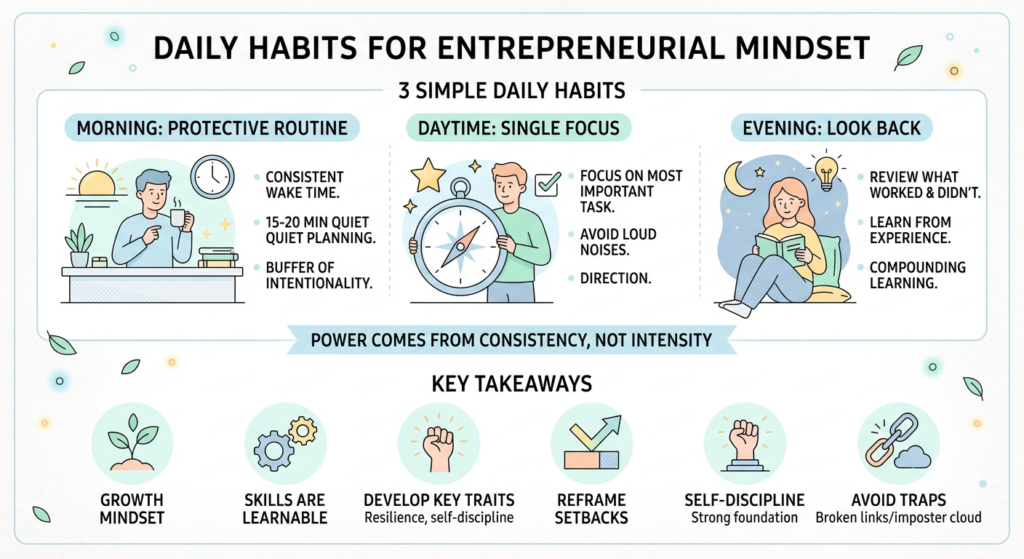
Mindset isn’t maintained through occasional insight. It’s maintained through repetition. A handful of daily habits show up consistently among founders who sustain this way of thinking over years rather than months.
Protecting a consistent wake time and a short morning routine – even fifteen or twenty minutes of quiet planning before the day’s noise starts – gives founders a buffer of intentionality before reactive demands take over. Reviewing the single most important task for the day, rather than working from an undifferentiated list, keeps effort pointed at what actually matters instead of what’s simply loudest. Ending the day with a brief look back at what worked and what didn’t, rather than letting the day dissolve into the next one unexamined, is what turns ordinary experience into compounding learning.
None of these habits are complicated. Their power comes from consistency, not intensity. A founder who reflects for five honest minutes every single day will out-develop one who does an elaborate quarterly retreat and nothing in between.
Key Takeaways
- An entrepreneur mindset is a learnable combination of skills, not a fixed personality trait you’re born with or without.
- Believing your abilities can improve – a growth mindset – is one of the strongest predictors of how well founders adapt to setbacks and take entrepreneurial action.
- Calculated risk-taking, resilience, self-discipline, and adaptability show up consistently in research on founder success, and each one can be developed through deliberate practice.
- Self-discipline, not funding or connections, is the factor entrepreneurs most often credit for their success.
- Reframing setbacks as information rather than verdicts is one of the fastest practical shifts a founder can make.
- Perfectionism, comparison, fear of public failure, and imposter syndrome are common traps that quietly undermine an otherwise strong mindset.
- Small, consistent daily habits do more for long-term mindset development than occasional bursts of motivation.
Conclusion
The businesses that last aren’t necessarily built by the most talented people in the room. They’re built by the people who kept adjusting, kept showing up, and kept treating every setback as something to learn from rather than something to be defined by. That’s the entrepreneur mindset in its simplest form – not a personality you either have or don’t, but a set of habits and interpretations you can start practicing today, one ordinary decision at a time.
You don’t need to feel ready to start building it. You just need to start.
Frequently Asked Questions
Is the entrepreneur mindset something you’re born with, or can it be learned? It can be learned. Research consistently shows that most entrepreneurial competencies, including risk assessment, resilience, and adaptability, respond to deliberate practice and mindset training rather than being fixed at birth.
What’s the single biggest factor behind entrepreneurial success, according to research? Surveyed entrepreneurs most often point to self-discipline as the top factor behind their success, ahead of funding, connections, or a strong initial idea.
How long does it take to build a stronger entrepreneur mindset? There’s no fixed timeline, since it depends on consistency rather than a single decision. Founders who practice reframing setbacks and building small daily habits typically notice a meaningful shift within a few months of consistent effort.
Does having an entrepreneur mindset mean ignoring fear or risk? No. Founders with a strong mindset still feel fear and still assess risk carefully. The difference is that they take calculated, tested risks rather than either avoiding risk entirely or taking reckless ones.
Can an entrepreneur mindset help outside of running a business? Yes. The same skills – adaptability, resilience, calculated risk-taking, and self-discipline – apply directly to careers, freelance work, and any situation involving uncertainty and decision-making under pressure.
What’s the difference between a growth mindset and an entrepreneur mindset? A growth mindset is one core component of the broader entrepreneur mindset. The entrepreneur mindset also includes calculated risk-taking, resilience, adaptability, and consistent execution, all built on top of the underlying belief that your abilities can develop over time.