

Most people think financial independence is something that happens to other people – tech founders, inheritors, or someone who got lucky with a stock. It isn’t. It’s a math problem with a behavioral solution, and the math is more accessible than the internet makes it look.
I want to walk you through what financial independence actually means in 2026, what the current numbers say about where most people stand, and the exact steps that separate someone who talks about financial freedom from someone who actually builds it. No hype, no “quit your job tomorrow” nonsense. Just a system you can start using this week.
What Financial Independence Really Means Today
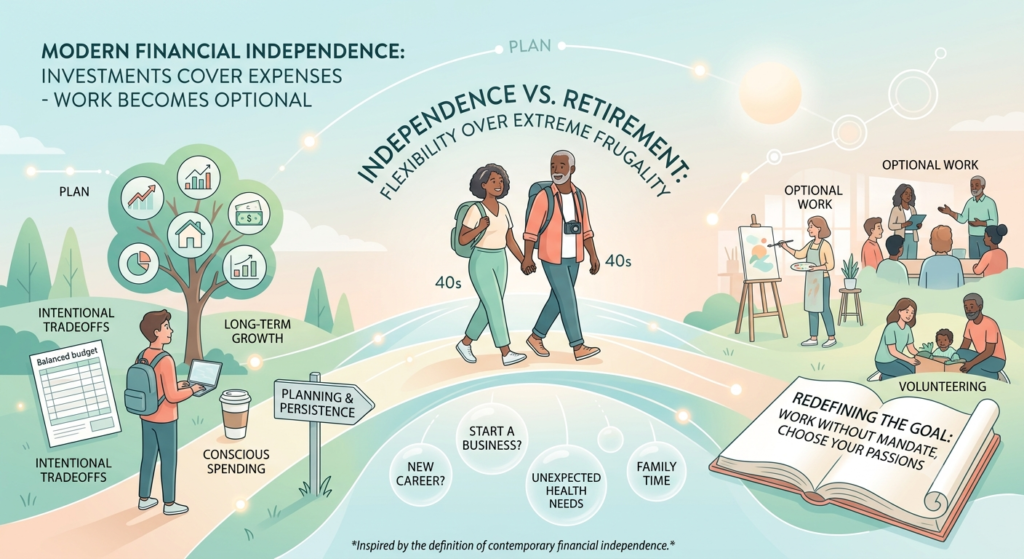
Financial independence is the point where your investments and assets can cover your living expenses without you needing to trade time for a paycheck. That’s it. Achieving financial independence doesn’t require a windfall or a rare stroke of luck – it requires a plan you stick to for longer than most people are willing to. It doesn’t require a private island. It doesn’t require retiring at 30. It requires enough invested capital that work becomes optional rather than mandatory.
This distinction matters because the popular image of financial independence – someone sipping a drink on a beach at 35 – has scared off a lot of people who could otherwise benefit from the underlying principles. You don’t need to adopt an extreme lifestyle to move toward this goal. You need a plan, and you need to follow it longer than most people are willing to.
Independence vs. Retirement: Not the Same Goal
The FIRE movement – Financial Independence, Retire Early – popularized the idea of aggressively saving 50 to 70 percent of income to stop working decades early. That’s one version of the goal, and it’s not for everyone. A growing number of people pursuing financial independence today have no interest in quitting work entirely. They want the option. They want to know that if a layoff hits, if a health scare happens, or if they simply want to change careers, their finances won’t force their hand.
That reframing matters because it removes the all-or-nothing pressure. You don’t have to choose between “save nothing and hope Social Security works out” or “eat rice and beans until you’re 35.” There’s a wide, workable middle.
Redefining the Goal: Flexibility Over Frugality
The original version of this movement, built on the 1992 book Your Money or Your Life, leaned heavily on extreme frugality. Today’s approach looks different. Housing costs, insurance costs, and the price of a normal life have all shifted since the 1990s, and the modern pursuit of financial independence reflects that. It’s less about deprivation and more about intentional tradeoffs – spending consciously on what you value and cutting hard on what you don’t.
Where Most People Stand Right Now
It helps to know the starting line before you plan the route. The numbers below come from current 2026 data, and they’re worth sitting with for a moment, because they explain why this topic feels urgent to so many people right now.
The median American household holds roughly $8,000 in transaction accounts, while the average sits far higher at around $62,410 – a gap driven by a small number of high-balance households pulling the mean upward. Net worth tells a similar story. According to Federal Reserve data adjusted for 2026, the median total household wealth for households under 35 is about $39,000, rising to $135,600 for ages 35–44, $247,200 for 45–54, and peaking around $409,900 for ages 65–74 before declining in retirement. The overall median figure across all ages sits close to $192,900, while the average is skewed upward to roughly $1.06 million by wealth concentrated among a small group of very high earners.
On the savings side, the Bureau of Economic Analysis reported a personal saving rate of about 4.9 percent for 2025, with the year-to-date figure for 2026 running closer to 4.4 percent. That’s a fraction of the 15 to 20 percent that most financial planners recommend as a baseline for building real wealth over time.
The Gap No One Talks About
Here’s the part that should reframe how you think about your own progress: how you rank against your peers financially tells you almost nothing useful. Your savings rate does. A 30-year-old sitting exactly at the national median for their age, earning $80,000 and saving 50 percent of take-home pay, can realistically cross $1.5 million in around 16 years at a 7 percent real return – enough to sustain a $60,000 annual lifestyle indefinitely using a standard withdrawal approach. Meanwhile, someone earning twice as much but saving 5 percent will still be years behind.
This is the single most important idea in this entire article: income determines your ceiling, but the gap between what you earn and what you spend determines your timeline. Everything else in this guide exists to widen that gap and put it to work.
It also helps to look at retirement-specific numbers rather than total household wealth alone, since retirement accounts now make up roughly a third of all household financial assets in the United States, totaling close to $47.6 trillion nationally. Contribution rates climb steadily by age, from around 6.4 percent among workers aged 25–34 up to roughly 9.5 percent among those aged 55–64 – and even that top tier still falls short of the 15 percent minimum most planners recommend. That gap between what people are contributing and what the math actually requires is exactly why the steps in this guide focus so heavily on closing it deliberately, rather than assuming it will close on its own as income rises.
One more data point worth sitting with: home equity accounts for close to 29 percent of the average household’s total assets, which means for a large share of Americans, real estate – not a brokerage account – is quietly doing most of the heavy lifting in their household balance sheet. That’s not a bad thing, but it’s worth knowing whether your own progress is coming from paying down a mortgage, from market growth in a retirement account, or from actual new savings, because each of those responds differently to the strategies covered below.
The Core Math Behind the FIRE Number
Once you understand the goal, the calculation itself is refreshingly simple.
The 25x Rule and the 4% Withdrawal Rate
Your target number – often called your “FIRE number” – is your expected annual expenses multiplied by 25. If you plan to spend $50,000 a year, your target is $1.25 million invested. This comes from the 4 percent rule, developed from the 1994 Trinity Study, which analyzed rolling 30-year periods of U.S. stock and bond returns and found that a 60/40 portfolio withdrawing 4 percent annually, adjusted for inflation, survived roughly 95 percent of historical 30-year stretches.
The formula looks like this:
FIRE Number = Annual Expenses × 25
Lower your annual expenses, and your target shrinks. Raise your income and invest the difference, and you reach that target faster. Both levers matter, but as the data above shows, the spending and saving side is usually more controllable than the income side, especially in the short term.
Why Early Retirees Often Use a More Conservative Rate
The Trinity Study modeled 30-year retirements. Someone stepping away from work at 35 or 40 might need their money to last 50 years or more, which introduces more exposure to poor early returns – a risk researchers call sequence-of-returns risk. Because of this, many people pursuing an early exit from full-time work now plan around a 3 to 3.5 percent withdrawal rate instead of the traditional 4 percent, which simply means saving a somewhat larger cushion before calling it done.
Step 1 – Get a Clear Picture of Your Finances
You cannot build a plan around numbers you don’t know. This step is unglamorous, and it’s the one most people skip, which is exactly why it matters.
Track Every Dollar for 60 to 90 Days
Pull three months of bank and credit card statements and categorize every transaction. Not a rough guess – the actual number. Most people underestimate their discretionary spending by a wide margin, and you can’t fix a leak you haven’t found. Apps like YNAB, Monarch Money, or a plain spreadsheet all work; the tool matters less than the honesty you bring to it.
Calculate What You’re Actually Worth
Add up everything you own – cash, retirement accounts, brokerage accounts, real estate equity, vehicles – and subtract everything you owe, including credit cards, student loans, and your mortgage balance. The result is your financial position, and it’s the single number you should track quarterly from here forward. Don’t obsess over how it compares to national averages; obsess over whether it’s moving in the right direction from your own baseline.
Step 2 – Calculate Your Number
With your expenses tracked, you can now calculate your personal target using the 25x formula above. But before you lock that number in, it’s worth understanding that there isn’t one single flavor of this goal. There are several, and choosing the right one changes both your required percentage of income you save and your timeline.
Choosing Your Path
Lean Approach
This path targets a smaller nest egg, usually built around annual expenses under $40,000. It requires more discipline on the spending side, but it also means reaching your number considerably faster than the alternatives below.
Comfortable or “Fat” Approach
This version targets a larger number – often $80,000 to $120,000 or more in annual spending – for people who want a more cushioned lifestyle after leaving full-time work. It takes longer to reach but doesn’t require the same degree of lifestyle compression along the way.
Barista-Style Approach
This hybrid keeps part-time or flexible work in the picture, often specifically to retain access to employer health benefits. If you need $60,000 a year and can earn $20,000 from part-time work, you only need to withdraw $40,000 from your portfolio, which drops your required nest egg from $1.5 million to $1 million and can shave three to five years off your timeline while preserving flexibility.
Coast-Style Approach
This path front-loads the saving. Once your invested balance is large enough that compound interest alone will carry it to your full number by a traditional retirement age, you stop adding new savings and simply cover current living costs. It’s a popular middle ground for people who want breathing room in their 30s and 40s without abandoning the long-term goal entirely.
Step 3 – Widen the Gap Between Income and Spending
This is where the real work happens, and it’s worth repeating: the rate at which you save is the most powerful lever you have. A person saving 25 percent of income reaches full financial independence in roughly 32 years. Push that to 50 percent, and the timeline drops to about 17 years. Push it to 70 percent, and you’re looking at roughly 8.5 years. These aren’t small differences – they’re the difference between working until 65 and working until 45.
Cut Fixed Costs First
Discretionary cuts – fewer takeout orders, a canceled streaming subscription – matter, but they’re small compared to what happens when you tackle your three biggest fixed costs: housing, transportation, and food. A cheaper apartment, one fewer car payment, or a more efficient grocery routine will move the needle far more than skipping your morning coffee ever will. Start with the big three before you worry about the small stuff.
Automate the Gap
Once you know your target share of income you put away, automate it. Set up automatic transfers into retirement and brokerage accounts on the day you get paid, before the money has a chance to disappear into everyday spending. This single habit – paying your future self first – removes the willpower requirement from the equation almost entirely.
Step 4 – Build Multiple Income Streams
Cutting expenses has a floor. You can only trim so much before quality of life suffers. Income, on the other hand, has no ceiling. That’s why the second half of this equation matters just as much as the first.
Extra Income Streams in the 2026 Gig Economy
The numbers here are striking. Nearly half of American workers now report earning some form of secondary income, and the reasons have shifted noticeably in recent years – rising costs have pushed this from a lifestyle choice toward something closer to financial necessity for a large share of workers. Average monthly earnings from a side hustle now land somewhere in the $900 to $1,275 range across major surveys, though the median is considerably lower, since a small number of high earners in consulting, coaching, and content creation pull the average upward. Freelance professionals in consulting, design, and coding are earning close to six figures annually on platforms like Upwork, and AI tools are increasingly cited by workers as a genuine accelerant for launching and scaling these efforts with less upfront time investment.
The strategic point isn’t to chase every gig trend. It’s to pick one skill-based income stream you can build consistency around, then reinvest a meaningful share of what it earns directly into your investment accounts rather than letting it blend into everyday spending.
It’s also worth being clear-eyed about who this income actually serves. Survey data shows a real split in motivation: a little over half of people with a secondary income stream say they need it to cover essential expenses, while the rest are building it deliberately, either to accelerate savings or to eventually replace a primary paycheck entirely. Neither reason is wrong, but they call for different strategies. If the income is covering essentials, the priority is stability – a repeatable hustle with predictable hours. If the income is a deliberate accelerant toward your number, the priority is scalability – something that can grow without a proportional increase in your time, since your ultimate goal is to reduce your dependence on trading hours for dollars, not extend it into a second job indefinitely.
Burnout is the honest cost side of this equation, and it shows up in the data too: the large majority of people juggling a gig-based income alongside full-time work report at least some degree of burnout, with only a small minority saying they never feel it. Build in a review point every few months – if the extra income isn’t materially moving your proportion of income saved or isn’t sustainable at the hours it demands, it’s worth reconsidering rather than treating it as permanent.
Building Income That Doesn’t Need You
Passive income is often misunderstood. Almost nothing is truly passive on day one – a rental property needs to be bought and managed, a digital product needs to be created and marketed, dividend-paying investments need capital before they pay anything back. What makes an income stream passive is that the ongoing effort required drops sharply after the upfront work is done. Digital products, affiliate content, dividend-focused portfolios, and rental real estate are the four most common paths people use to build income that keeps arriving whether or not they’re actively working that day.
Step 5 – Invest With a Long-Term System
Saving money without investing it is one of the most common ways people delay their own progress. Cash sitting in a checking account loses purchasing power to inflation every single year.
Low-Cost, Diversified Investing
For most people pursuing this goal, low-cost index funds remain the backbone of the strategy – broad, diversified exposure to the stock market at a fraction of the cost of actively managed funds, with decades of data showing that most active managers fail to beat these benchmarks over long periods after fees. The goal isn’t to pick winning stocks. It’s to consistently buy a diversified basket of the entire market and let time do the heavy lifting.
Tax-Advantaged Accounts to Prioritize
Before investing in a regular taxable brokerage account, most people benefit from filling tax-advantaged space first. Contribute enough to your employer 401(k) to capture the full match – that’s an immediate, guaranteed return before you’ve earned a cent of market growth. From there, a Roth IRA or Roth 401(k) is worth strong consideration, especially for younger savers, since qualified withdrawals in retirement are entirely tax-free. For 2026, individuals under 50 can contribute up to $24,500 to a 401(k), with an additional $8,000 catch-up allowed for those 50 and older, and an even higher catch-up limit for workers aged 60 to 63 under recent rule changes. Once those accounts are maxed, a standard taxable brokerage account gives you full flexibility to invest beyond the government’s annual contribution caps.
It’s worth flagging one recent rule change that catches people off guard. Under a new provision that took effect at the start of 2026, workers aged 50 and older who earned more than $150,000 in wages the prior year are now required to direct their catch-up contributions into a Roth account rather than a traditional pre-tax one. That’s a meaningful shift for anyone in their peak earning years relying on pre-tax catch-up contributions to lower their current tax bill, and it’s worth confirming with your plan provider so a contribution doesn’t get rejected or reclassified unexpectedly.
For people building their brokerage account alongside retirement accounts, order of operations matters less than consistency. A simple, boring approach – automatic monthly purchases into two or three broad market funds, held for decades without reacting to headlines – has historically outperformed the returns most individual investors actually capture, largely because they don’t panic-sell during downturns or chase whatever sector is popular that month.
Step 6 – Eliminate High-Interest Debt
There’s no investment strategy that reliably beats a 20 percent-plus interest rate on credit card debt. Paying that down is, functionally, a guaranteed return equal to whatever rate you’re being charged – something no stock market index can promise you. Before aggressively investing extra income, clear high-interest consumer debt first. Lower-interest debt, like a reasonable mortgage rate, is a different calculation and doesn’t need the same urgency.
Step 7 – Protect the Plan Before You Need To
A financial independence plan that isn’t protected against disruption is fragile. This step is about making sure one bad year doesn’t undo a decade of progress.
Build a starter emergency fund of $1,000 to $2,000 before you do anything else, then grow it toward a full three-to-six-month cushion once high-interest debt is cleared. Compare that to reality: the median household’s emergency savings balance sits far below what’s recommended, at only a few hundred dollars for a meaningful share of Americans – a gap that turns ordinary emergencies into debt spirals. That cushion is what keeps a car repair or a medical bill from forcing you to sell investments at the worst possible time.
The Health Care Question for Early Retirees
This is the piece that’s changed the most recently, and it deserves real attention if your plan involves leaving full-time work before Medicare eligibility at 65. Marketplace health insurance premiums have risen substantially after enhanced subsidies expired at the end of 2025, which has made this the single biggest new variable in early-retirement planning for 2026. Some early-exit planners now deliberately manage their taxable income – through Roth conversions and careful timing of capital gains – to stay under income thresholds that qualify for reduced marketplace premiums. Others build a part-time “bridge” job specifically for its health benefits until Medicare kicks in. Whichever path you choose, price this cost realistically before you assume your number is final.
There are a few common bridge strategies worth knowing before you finalize a plan:
- Marketplace coverage with income management. Keeping taxable income low through Roth withdrawals and strategic capital gains timing can still meaningfully reduce marketplace premiums, even in a higher-cost environment.
- COBRA continuation. This lets you stay on a former employer’s plan for up to 18 months. It’s rarely the cheapest option since you absorb the full premium your employer previously subsidized, but it can serve as a short bridge while you sort out a longer-term plan.
- A spouse’s employer plan. If this is available to you, it’s frequently the simplest and most affordable route, and it’s worth factoring into a joint household plan even if only one spouse is stepping away from full-time work.
- Part-time work with benefits. A growing number of large employers extend health coverage to part-time staff, which is precisely the appeal of the barista-style approach described earlier – it isn’t just about the paycheck, it’s about the benefits attached to it.
None of these options make healthcare cheap. They simply keep it from derailing a plan that took a decade or more to build.
Common Mistakes That Slow You Down
A few patterns show up again and again in people who take longer than necessary to reach this goal.
- Waiting for a “big enough” income before starting to invest. The account matters more than the amount in the beginning. Time in the market outweighs the size of your first contribution.
- Comparing total wealth to peers instead of tracking personal progress. Percentile rankings tell you almost nothing about your own trajectory.
- Treating a side income stream as spending money instead of investable capital. If extra income disappears into lifestyle upgrades, your timeline doesn’t move.
- Ignoring healthcare costs in an early-retirement plan. This is the fastest way to blow a well-built budget in the first year after leaving full-time work.
- Chasing individual stocks instead of building a diversified base. A handful of concentrated bets can undo years of steady, boring progress in a single bad quarter.
- Letting lifestyle creep absorb every raise. Every salary increase is an opportunity to widen your savings gap – most people let it quietly disappear into higher spending instead.
The Psychological Side of the Journey
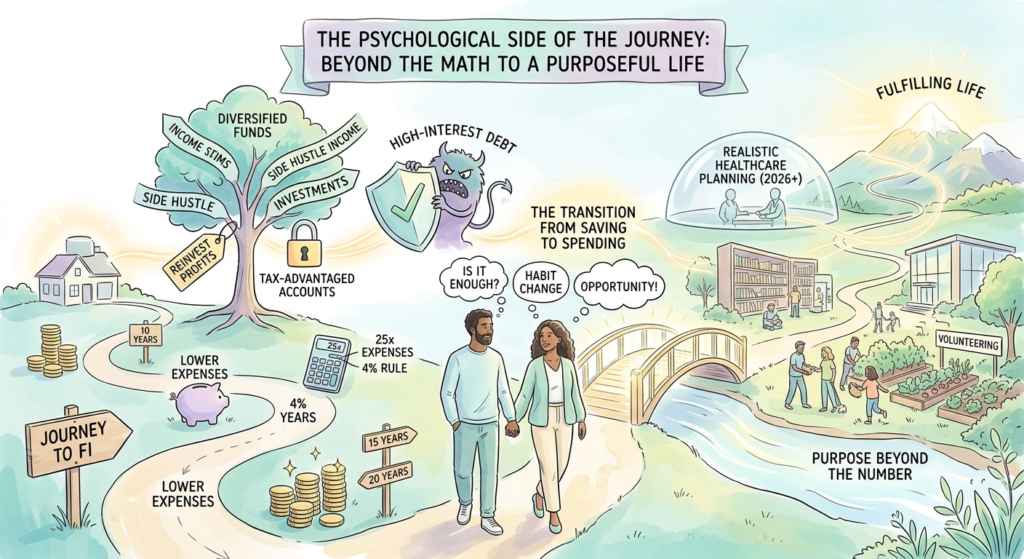
The math is the easy part. Staying consistent for 10, 15, or 20 years is the hard part, and it’s worth naming honestly. Research on people who reach an early exit from full-time work consistently shows that the transition from saving to spending is psychologically demanding after decades of the opposite habit, and that maintaining a sense of purpose – not just a large account balance – is strongly linked to better outcomes after work becomes optional. Financial independence solves a math problem. It doesn’t automatically solve the question of what you’ll do with your time once you have it. Start thinking about that answer well before you reach your number, not after.
Key Takeaways
- Financial independence means your investments can cover your living expenses without requiring a paycheck – it doesn’t require an extreme lifestyle or an early retirement date.
- Your target number is your annual expenses multiplied by 25, based on a 4 percent withdrawal rate; those planning 40-plus years of early retirement often use a more conservative 3 to 3.5 percent instead.
- Your savings percentage matters more than your income. Moving from 25 percent to 50 percent can cut your timeline nearly in half.
- Build income from more than one source, and reinvest new income rather than letting it raise your spending.
- Invest consistently in low-cost, diversified funds and prioritize tax-advantaged accounts before a standard taxable brokerage.
- Clear high-interest debt and build a cash reserve before accelerating aggressive investing.
- Price healthcare realistically if your plan involves leaving full-time work before Medicare eligibility – this is the biggest new variable in 2026 planning.
Conclusion
Financial independence isn’t a secret reserved for people with unusual luck or unusual income. It’s a formula – spend less than you earn, invest the difference consistently, protect the plan from disruption, and give it time. The households who reach this goal aren’t the ones who found a shortcut. They’re the ones who understood the math early, automated the boring parts, and stayed the course longer than everyone around them. Start with your number. Then start closing the gap.
Frequently Asked Questions
How much money do I actually need to become financially independent? Multiply your expected annual expenses by 25. If you plan to spend $50,000 a year, your target is roughly $1.25 million invested, assuming a standard 4 percent withdrawal approach.
Can I pursue this goal without saving 50 percent of my income? Yes. The aggressive pace of saving associated with early exits from full-time work is one approach, not a requirement. A 15 to 20 percent saving-to-income ratio, sustained consistently over a full career, still builds substantial financial independence by a traditional retirement age.
Is index fund investing enough, or do I need real estate too? Broad market funds alone are sufficient for most people and require far less active management than rental property. Real estate can accelerate the timeline for people willing to take on the added complexity, but it isn’t a requirement.
What’s the biggest risk to an early-retirement plan right now? Healthcare costs before Medicare eligibility. Marketplace premiums have risen substantially in 2026, and this cost is frequently underestimated in early planning.
Should I pay off my mortgage before investing? It depends on your interest rate. A mortgage under roughly 5 to 6 percent is often better left in place while you invest the difference, since long-term market returns have historically outpaced that cost. Higher-rate debt should generally be cleared first.
How long does it realistically take to reach financial independence? It depends almost entirely on how much of your income you save. At a 25 percent savings pace, expect roughly 30-plus years. At 50 percent, closer to 15 to 17 years. At 70 percent, under 10 years. Income, starting age, and investment returns all shift this, but how consistently you save is the dominant factor.