

Most people think building wealth requires a huge salary, a lucky break, or a family fortune to start with. That belief keeps a lot of capable, hardworking people stuck.
Here is what the data actually says. According to Northwestern Mutual’s 2025 Planning & Progress Study, 79 percent of American millionaires describe their wealth as self-made, not inherited. Separate research cited by The World Data puts that figure even higher, at roughly 88 percent. Either way, the pattern is the same: most people with real money built it themselves, through ordinary decisions repeated over a long period of time.
I have spent years building and running property management and short-term rental businesses, and I have watched the same thing happen up close. The people who end up financially secure are rarely the ones with the flashiest idea. They are the ones who treat money like a system, not a mystery.
This guide walks through exactly what that system looks like in 2026. We will cover the financial foundation you need before you invest a single dollar, how to use tax-advantaged accounts properly, where the stock market and real estate still fit, how to build income outside a single paycheck, and the mistakes that quietly derail people who are otherwise doing everything right.
None of this is about get-rich-quick thinking. It is about the wealth building strategies that hold up over ten, twenty, and thirty years, even when the economy gets uncomfortable.
What Wealth Building Really Means (Beyond Just Saving Money)
Saving money and building wealth are related, but they are not the same thing.
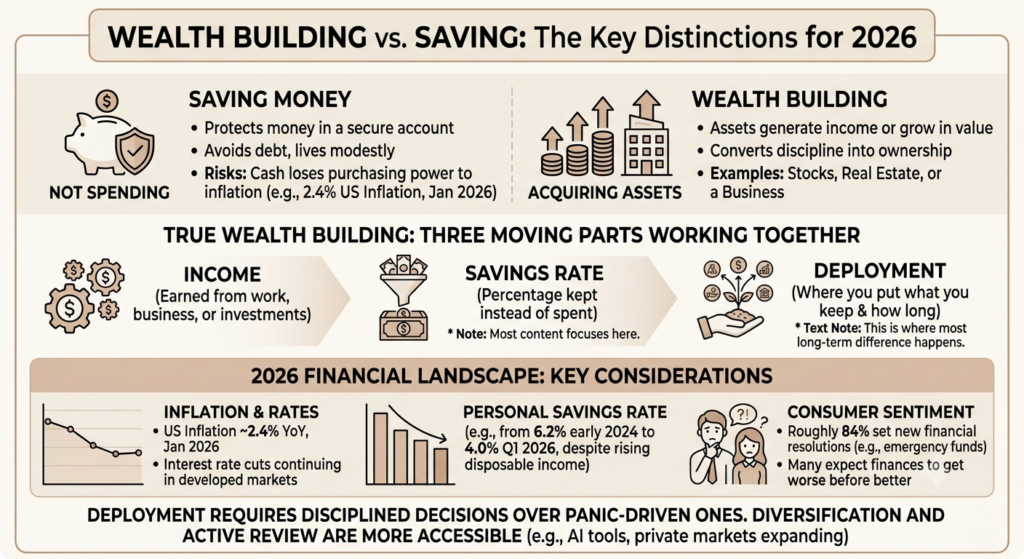
Saving is about not spending. Wealth building is about acquiring assets that generate income or grow in value while you are doing other things with your time. A savings account protects money. An asset class like stocks, real estate, or a business builds it.
This distinction matters because a lot of financially disciplined people still stay poor on paper. They save diligently, avoid debt, and live modestly, but they never convert that discipline into ownership of anything that grows. Their money sits in cash, slowly losing purchasing power to inflation.
True wealth building has three moving parts working together:
- Income – what you earn from work, a business, or investments
- Savings rate – the percentage of that income you keep instead of spend
- Deployment – where you put what you keep, and how long you leave it there
Most personal finance content focuses almost entirely on the second part. It is the third part, deployment, where most of the long-term difference actually happens.
Why 2026 Is a Different Financial Landscape
Every generation believes it is investing during unusually difficult times, and in some ways, that is always a little bit true.
A few specifics are worth knowing right now. U.S. inflation was running around 2.4 percent year-over-year as of January 2026, according to wealth industry research referenced by Abhyash Suchi’s 2026 wealth management report, with interest rate cuts continuing across developed markets. At the same time, the personal savings rate for individuals slipped from 6.2 percent in early 2024 to 4.0 percent by the first quarter of 2026, even as disposable income per person rose over the same period, based on figures cited in Northwestern Mutual’s research coverage.
Consumer sentiment has also been running low. A Vanguard survey found that roughly 84 percent of Americans set new financial resolutions heading into 2026, from building emergency funds to opening high-yield savings accounts, yet a large share of respondents still expected their personal finances to get worse before they got better.
What does this mean practically? People are worried, but they are also motivated. That combination usually produces one of two outcomes: panic-driven decisions, or disciplined ones. The wealth building strategies in this guide are built for the second path.
On the investment side, wealth managers are also shifting how they build portfolios. Industry research from MSCI’s 2026 Wealth Trends report points to advisers expanding into private markets, accelerating the use of AI tools in advice and analysis, and treating personalization as a baseline expectation rather than a premium feature. You do not need institutional access to benefit from the underlying lesson here: diversification and active portfolio review are becoming more accessible, not less.
The Millionaire Mindset: What the Data Actually Shows
Self-Made Wealth Is the Norm, Not the Exception
It is worth repeating because it undoes so much bad thinking about money: the large majority of millionaires built their own wealth. They were not handed it.
Northwestern Mutual’s study also found that 74 percent of millionaires work with a financial advisor, more than double the 34 percent rate among the general population, and 93 percent had received financial advice at some point in their lives. This is not a story about isolated genius. It is a story about people who sought out expertise and used it consistently.
Education plays a role too, though maybe not the one people assume. Research referenced by The World Data shows that while 84 to 88 percent of millionaires hold a college degree, 62 percent attended public universities rather than expensive private ones. The path to financial security does not require an elite pedigree. It requires consistent execution over time.
The Daily Habits That Separate Wealth Builders from Everyone Else
Tom Corley, a CPA and financial planner, spent five years studying the daily habits of 233 wealthy individuals, 177 of whom were self-made millionaires, alongside 128 people living in poverty. His research, published through his Rich Habits project, is one of the more detailed behavioral studies on this topic.
A few findings stand out. About 88 percent of self-made millionaires in his study spent at least 30 minutes a day on self-education, whether that meant reading, listening to industry content, or studying a skill relevant to their field. By contrast, 77 percent of the low-income individuals in the same study spent over an hour a day on television, social media, or other passive entertainment.
Corley also found that roughly 80 percent of self-made millionaires set specific, long-term goals and reviewed them daily, rather than relying on vague intentions like “I want to be rich someday.” The goals were concrete, written down, and revisited often enough to actually shape decisions.
None of this is glamorous. It looks more like a spreadsheet than a highlight reel. But that is exactly the point. Financial discipline, applied quietly and repeatedly, outperforms intensity applied occasionally.
Step 1: Build Your Financial Foundation First
Before any conversation about investing, there is groundwork that has to happen. Skipping it is the single most common reason people’s wealth building strategies stall out.
Get Rid of High-Interest Debt
Credit card debt sitting at 20 percent or higher annual interest is actively working against every other financial decision you make. No diversified portfolio reliably outperforms that kind of interest rate over time, which means paying it down is, in effect, one of the highest-return moves available to you.
A practical approach: list every debt by interest rate, not balance. Direct extra payments at the highest-rate debt first while making minimum payments on the rest. Once that one is gone, roll the payment amount into the next highest-rate debt. This is sometimes called the avalanche method, and it minimizes total interest paid over the life of your debt.
Build an Emergency Fund Before You Invest
An emergency fund is not glamorous, but it is what keeps a temporary setback from becoming a long-term financial disaster. Without one, a job loss or unexpected medical bill often forces people to sell investments at the worst possible time, or take on high-interest debt to cover the gap.
A reasonable target is three to six months of essential living expenses, held in a high-yield savings account rather than a regular checking account. Current high-yield accounts have been paying around 4 percent APY, according to reporting compiled by financial news outlets covering 2026 money-saving strategies. That is a meaningful return for money that needs to stay liquid and safe.
Once debt is under control and your emergency fund is funded, you are actually ready to build wealth, not just protect what you already have.
Step 2: Maximize Tax-Advantaged Retirement Accounts
This is the least exciting step in the entire guide, and also one of the most important.
401(k) Contributions and Employer Match
The IRS raised the 2026 individual 401(k) contribution limit to 24,500 dollars, up from 23,500 dollars in 2025. Combined employee and employer contributions can go as high as 72,000 dollars for the year. If you are 50 or older, catch-up contributions add another 8,000 dollars, and workers between 60 and 63 can contribute an enhanced catch-up amount of 11,250 dollars under the SECURE 2.0 Act.
The single most important number in this section, though, is your employer match. If your company matches a percentage of what you contribute, that match is an immediate, guaranteed return on your money before it has even been invested. Not contributing enough to capture the full match is one of the most common ways people leave free money on the table.
IRAs and Roth Accounts
For 2026, the IRA contribution limit rose to 7,500 dollars, with an increased catch-up contribution of 1,100 dollars for those 50 and older, according to IRS guidance issued in late 2025.
Roth accounts are worth understanding well, because the tax treatment is the opposite of a traditional 401(k). You contribute after-tax dollars now, but qualified withdrawals in retirement are completely tax-free, including all the growth. For younger earners in a lower tax bracket today than they expect to be in later, this can be a significant long-term advantage.
The broader long-run return most people can expect from a diversified stock allocation inside these accounts sits around 10 percent nominal annually, based on long-term S&P 500 performance data, or roughly 7 percent after adjusting for inflation.
Step 3: Invest Consistently in the Stock Market
Why Index Funds Still Win
Picking individual stocks that consistently beat the market is extraordinarily difficult, even for professionals who do it full time. Broad index funds solve this problem by giving you ownership across hundreds of companies at once, at a very low cost.
The long-run track record backs this up. Over multi-decade periods, the S&P 500 has delivered high single-digit to low double-digit annualized nominal returns, depending on the exact start and end dates measured. That consistency, more than any single year’s performance, is what makes index investing such a durable foundation for a long-term portfolio.
The Power of Compounding Over Time
Compound interest is often called the eighth wonder of the world, and the math backs up the reputation. At a 10 percent average annual return, invested money doubles roughly every seven years, following the simple rule of dividing 72 by your annual return rate.
Consider a concrete example. Investing 500 dollars a month at a 10 percent average annual return grows to more than 1 million dollars over 25 years. The starting amount barely matters compared to two other variables: how early you start, and how consistently you keep contributing, especially through market downturns rather than pulling out during them.
This is where behavior matters more than strategy. The investors who underperform the index over time are usually not making a bad selection. They are buying high out of excitement and selling low out of fear, which erodes returns far more than any fee or fund choice.
Step 4: Diversify Into Real Estate
Rental Property as a Wealth-Building Vehicle
Real estate remains one of the most proven wealth building strategies available, largely because it combines multiple return sources at once: monthly cash flow, property appreciation, mortgage paydown funded by tenants, and tax advantages like depreciation.
Having spent years in property management, I can say the biggest misconception people have about rental real estate is that it is passive from day one. It is not. It requires systems, whether that means screening tenants carefully, budgeting for maintenance and vacancy, or hiring the right management partner. Done well, though, it can become one of the more stable, income-producing assets in a portfolio, precisely because it does not move in lockstep with the stock market.
REITs for Passive Real Estate Exposure
If direct property ownership is not realistic right now, real estate investment trusts offer a way to gain exposure to the asset class without buying and managing property directly. REITs trade like stocks, pay regular dividends from rental income, and can be purchased through a standard brokerage account, which makes them a reasonable entry point for people building a diversified portfolio on a smaller budget.
Step 5: Build Multiple Income Streams
Relying on a single paycheck is one of the more fragile financial positions a person can be in, even with a strong salary. If that one income source disappears, everything built on top of it is at risk.
Side Businesses and Freelancing
Entrepreneurship remains one of the fastest ways to accelerate wealth building, largely because profits can be reinvested directly into growth rather than waiting on a slow salary increase cycle. High-margin service businesses, consulting, and freelance work in skills like marketing, design, or technical services have relatively low startup costs and can be built alongside a full-time job before eventually becoming the main income source.
Digital Assets and Passive Income Projects
Beyond active side businesses, digital assets like online courses, template libraries, or content platforms can generate income well after the initial work is done. These are not truly passive at the start. They require significant upfront effort. But once built, they can continue producing revenue with far less ongoing time investment than a traditional service business, which is part of why they have become such a popular addition to modern income strategies.
Step 6: Increase Your Earning Power
Cutting expenses has a floor. You can only reduce spending so far before quality of life suffers. Increasing income does not have the same ceiling, which is why growing your earning capacity deserves at least as much attention as budgeting does.
Negotiate Your Salary
A successful salary negotiation typically yields somewhere between 5,000 and 15,000 dollars more per year, based on data compiled across career and compensation research. Multiplied over a career, and compounded through higher retirement contributions and raises calculated as a percentage of that higher base, this single conversation can be worth a substantial amount of long-term wealth.
Invest in High-Income Skills
Skills in areas like sales, software development, digital marketing, and applied AI tools currently command salaries in the range of 100,000 to 300,000 dollars annually in many markets, according to data referenced in recent wealth-building research. Investing time and money into developing these skills, whether through formal education, certifications, or simply hands-on project work, tends to pay for itself many times over across a career.
Step 7: Protect What You Build
Wealth building strategies often focus entirely on growth and skip protection, which is a mistake. A single uninsured event, lawsuit, or poorly planned estate can undo years of disciplined saving and investing.
Insurance and Risk Management
Adequate health insurance, liability coverage, and, for business owners, appropriate business insurance are not optional extras. They are the guardrails that keep a temporary setback from becoming a permanent one. This matters even more for entrepreneurs and property owners, where a single liability claim can be financially significant without the right coverage in place.
Estate Planning and Legacy Structures
As net worth grows, the financial conversation shifts from purely building wealth to also preserving and transferring it efficiently. Trust structures, updated wills, and clear beneficiary designations are central to this stage, according to current wealth management research. You do not need significant assets to start this process. A basic will and updated beneficiary designations are appropriate at almost any income level, and the complexity can grow as your net worth does.
Common Wealth-Building Mistakes to Avoid
A few patterns show up again and again in people who work hard financially but never quite gain traction.
- Waiting for the perfect time to invest. Time in the market consistently outperforms attempts to time the market, based on decades of return data.
- Treating a single income source as permanent. Diversifying income, even modestly, reduces risk significantly.
- Ignoring employer retirement matches. This is effectively free money left unclaimed.
- Letting lifestyle inflation absorb every raise. Income growth without a rising savings rate rarely translates into real wealth.
- Skipping insurance and estate basics. Growth without protection is fragile growth.
- Avoiding professional advice. Given that a strong majority of millionaires work with financial advisors, doing this alone is not a badge of honor. It is often just a missed opportunity to avoid costly errors.
Building Wealth as an Entrepreneur: Lessons from Running a Business
Running property management and short-term rental operations has taught me that wealth building and business building are the same discipline applied to different assets.
In both cases, the people who succeed are the ones who build systems instead of relying on constant personal effort. A well-run rental property does not need you micromanaging it every day if the processes, from tenant screening to maintenance response, are documented and repeatable. The same is true of a stock portfolio on autopilot through automated contributions, or a service business with clear operating procedures.
The other lesson is patience under pressure. Every property owner and investor experiences downturns, whether that is a slow rental season, a market correction, or a client who churns. The operators and investors who come out ahead are rarely the ones who avoided every downturn. They are the ones who had a plan going into it and stuck to that plan when things got uncomfortable.
If there is one takeaway from years of building businesses in real estate, it is this: wealth is built in the unremarkable, repeated decisions, not in a single dramatic breakthrough.
Key Takeaways
- Most millionaires are self-made, and the underlying habits, daily learning, clear goal-setting, and financial discipline, are learnable and repeatable.
- Get high-interest debt under control and build a fully funded emergency fund before focusing heavily on investing.
- Maximize retirement account contributions, especially any employer 401(k) match, since that is close to guaranteed free money.
- Consistent, long-term investing in diversified index funds remains one of the most reliable wealth building strategies available, largely because of compound interest.
- Real estate, through direct ownership or REITs, adds a valuable, less correlated asset class to a portfolio.
- Building multiple income streams and increasing your earning power through high-income skills accelerates wealth building far more than cutting expenses alone.
- Protecting wealth through insurance and basic estate planning is just as important as growing it.
Conclusion
Wealth building is not about a single decision. It is about a series of ordinary ones, made consistently, over a long period of time.
Get your financial foundation in order. Use tax-advantaged accounts fully. Invest consistently, even when the headlines make that feel uncomfortable. Build more than one source of income. Protect what you build along the way. None of it is complicated in theory. What separates the people who actually build wealth from the people who only talk about it is whether they keep doing these things when it stops feeling exciting.
Start with one step from this guide today, whether that is opening a high-yield savings account, increasing your 401(k) contribution, or finally paying off that highest-interest debt. The system compounds. So does the discipline it takes to run it.
Frequently Asked Questions
How much money do I need to start building wealth?
You do not need a large lump sum. Consistent contributions matter far more than the starting amount. Investing even a modest amount monthly into a diversified index fund, combined with time and compounding, can grow into a significant sum over one to three decades.
Is real estate still a good wealth-building strategy in 2026?
Yes, though it requires more active management than many people expect. Rental property offers cash flow, appreciation, and tax advantages, while REITs offer a more passive way to gain real estate exposure without direct property ownership.
Should I pay off debt or invest first?
Generally, pay off high-interest debt, especially anything above 15 to 20 percent interest, before investing aggressively. For lower-interest debt, such as some mortgages, it can make sense to invest in parallel while still making regular payments.
How important is a financial advisor for building wealth?
Research shows a strong majority of millionaires work with a financial advisor at some point, more than double the rate of the general population. An advisor is not required, but professional guidance often helps people avoid costly mistakes and stay disciplined during market volatility.
What is the fastest way to build wealth?
There is no reliable shortcut, but the fastest sustainable path tends to combine three things: increasing income through skills or entrepreneurship, maintaining a high and consistent savings rate, and investing that savings into diversified, long-term assets rather than letting it sit in cash.
Do I need a business to build significant wealth?
No. Many people build substantial wealth through consistent saving, employer retirement plans, and long-term stock market investing alone. A business can accelerate the process by increasing income and offering additional tax advantages, but it is one path among several, not a requirement.