

Two founders start with the same capital, the same market, and roughly the same skill set. Three years later, one has built something that works. The other has folded twice and is back at a day job. Same intelligence. Same opportunity. Different result.
It’s tempting to explain that gap with luck, or connections, or “grit.” But if you look closely at how each person actually thought and made decisions along the way, a clearer pattern shows up. It’s not about who worked harder in any single week. It’s about how each of them interpreted setbacks, made calls under pressure, and kept going after the fifth thing went wrong instead of the third.
That pattern has a name in psychology: mindset. Not in the vague, poster-on-the-wall sense. In the specific, researched sense – the beliefs a person holds about their own ability to grow, and how those beliefs quietly shape every decision that follows.
This article looks at what a success mindset actually is, what the current research does and doesn’t support, and what you can realistically do about it – whether you’re running a business, leading a team, or just trying to get better at your work.
What a Success Mindset Really Means
At its core, a success mindset is the set of beliefs you hold about whether your abilities, intelligence, and circumstances can change through effort. That’s it. It’s not optimism. It’s not confidence for its own sake. It’s a belief about malleability – can I get better at this, or is my current level roughly fixed?
That belief matters because it changes what you do next. If you believe a skill is fixed, a bad outcome reads as proof you’re not cut out for it. If you believe it’s trainable, the same outcome reads as information – data you can use to adjust.
This is worth being honest about upfront: a lot of business content treats mindset as something close to magic. Believe hard enough, and success follows. That’s not what the psychology says, and it’s not what this article is going to claim. Belief changes behavior. Behavior, applied consistently and combined with the right strategy, changes outcomes. Skip the strategy step, and belief alone won’t get you very far. We’ll come back to that distinction more than once, because it’s where most “success mindset” advice quietly overpromises.
The mechanism itself is simple: thoughts shape how you interpret events, interpretation shapes emotion, emotion shapes the action you take next, and repeated actions become habits. Habits, compounded over months and years, become results. Mindset isn’t the finish line. It’s the first domino.
Growth Mindset vs. Fixed Mindset – And What the Newer Research Actually Shows
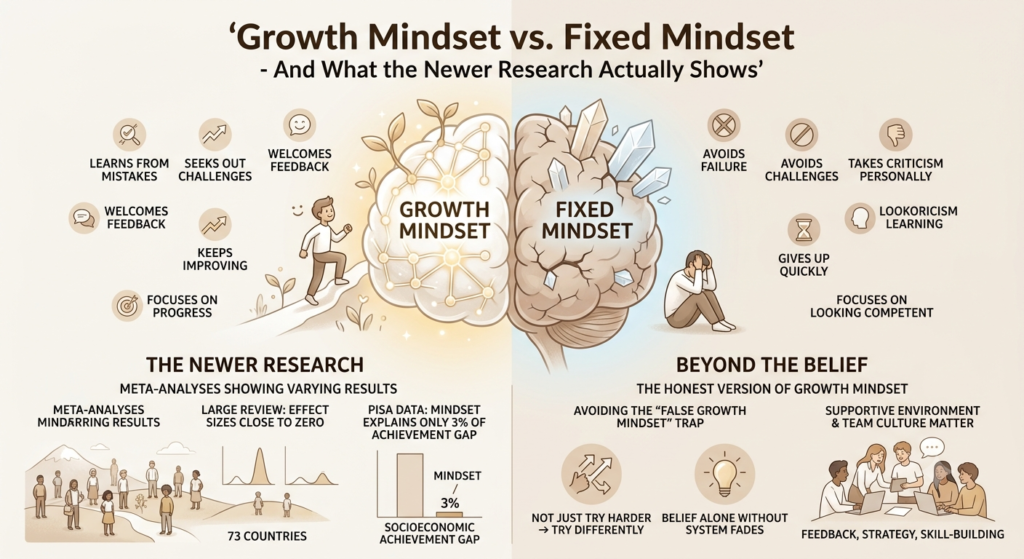
The growth mindset concept, developed by psychologist Carol Dweck, is probably the most widely cited idea in this space. The distinction is straightforward:
| Growth Mindset | Fixed Mindset |
| Learns from mistakes | Avoids failure |
| Seeks out challenges | Avoids challenges |
| Welcomes feedback | Takes criticism personally |
| Keeps improving | Gives up quickly |
| Focuses on progress | Focuses on looking competent |
That table has been repeated in thousands of articles, and it holds up reasonably well as a description of two different ways people respond to difficulty. Where things get more interesting – and more honest – is in what happens when researchers actually test whether changing someone’s mindset changes their results.
The picture is mixed. A large meta-analysis covering more than fifty separate mindset-intervention studies found a real but small positive effect on academic performance, with results varying a lot from study to study – some showed almost nothing, others showed a modest lift. A more recent structured review of the strongest-designed trials, the ones with the largest samples and cleanest data, found effect sizes close to zero. And a 2025 study looking at growth mindset across 73 countries using PISA data found that mindset explained only a small fraction – around 3 percent – of the gap in achievement linked to socioeconomic background.
None of that means mindset doesn’t matter. It means mindset alone, without anything else changing, isn’t a reliable lever for big outcomes. The interventions that work best are the ones where a shift in belief is paired with actual skill-building, better feedback, and a supportive environment. Belief without a system attached to it tends to fade.
The “False Growth Mindset” Trap
This is where a lot of well-meaning advice goes wrong. Telling someone to “just work harder” or “believe you can improve” isn’t the same as giving them a growth mindset. Researchers have started calling this the false growth mindset – praising effort without giving people the tools, feedback, or strategy to make that effort productive. A team member who’s told to “have a growth mindset” but never gets specific, actionable feedback on what to change will burn out just as fast as one who’s told they’re simply not talented enough.
The honest version of growth mindset isn’t “try harder.” It’s “try differently, based on what you just learned.”
There’s a second layer worth understanding here too: mindset doesn’t operate in isolation from the people around you. Some of the more interesting recent findings show that mindset has a social dimension – people surrounded by others who model a growth-oriented approach tend to sustain that approach more easily themselves. This matters for anyone building a team. A single person deciding to “have a growth mindset” inside a culture that punishes visible mistakes is fighting an uphill battle. The environment either reinforces the belief or quietly erodes it, regardless of how motivated that one person is.
The Cognitive Mechanics Behind Success
Underneath the mindset conversation is a set of well-established psychological mechanisms worth understanding on their own.
Self-efficacy is your belief in your own capability to execute a specific task – not a general sense of confidence, but a task-specific one. Someone can have high self-efficacy as a negotiator and low self-efficacy as a public speaker. This distinction matters in practice: self-efficacy tends to build through direct experience of small wins, not through pep talks. If you want to build it in yourself or your team, the fastest route is a string of achievable, slightly stretching tasks – not a single big leap.
Confirmation bias is the brain’s tendency to notice and remember information that supports what it already believes, while quietly discounting anything that contradicts it. This is one of the more dangerous mechanisms for anyone making decisions under pressure, because it means a belief – good or bad – tends to become self-reinforcing. If you believe you’re bad at sales, you’ll remember every rejected pitch vividly and barely register the ones that landed. Left unchecked, this turns limiting beliefs into something close to a self-fulfilling prophecy, not because the belief was ever true, but because the evidence got filtered before it reached you.
Decision-making under uncertainty is where mindset shows up most visibly in business. People with a more fixed view of their abilities tend to avoid decisions that could expose a weakness, even when avoiding the decision is the more costly move. People with a more flexible view are more willing to make a call, watch it play out, and adjust – because a wrong decision reads as information rather than as an indictment of their competence.
Emotional regulation ties all of this together. It’s not about suppressing frustration or staying artificially calm. It’s about creating enough space between a triggering event and your response that you can choose the response instead of reacting to it. That gap – even just a few seconds – is often the entire difference between a good decision and a costly one made in the heat of the moment.
Picture a client canceling a contract by email on a Friday afternoon. The fixed-mindset reaction is often immediate and defensive – a sharp reply, a rushed attempt to salvage the relationship through pressure, or quietly writing the client off as unreasonable. The regulated response looks almost boring by comparison: read the email, close the laptop, come back to it Monday with a clear head, and respond to the actual reason behind the cancellation rather than to the sting of losing the account. Nothing about that second approach requires more talent. It just requires enough emotional distance to see the situation accurately instead of through the lens of the moment.
How Neuroplasticity Fits In (Without Overselling It)
Neuroplasticity is the brain’s capacity to form new neural connections and strengthen existing ones through repeated use – essentially, the biological basis for the phrase “practice makes progress.” Repetition strengthens the pathways associated with a skill or a way of thinking, the same way a footpath becomes clearer the more it’s walked.
It’s a real and useful concept, but it’s also one of the most oversold ideas in popular psychology content. Neuroplasticity explains how change is biologically possible. It doesn’t guarantee that any specific mindset intervention will produce a specific result – which lines up with the mixed findings on mindset interventions mentioned above. The brain can change. Whether it changes in the direction you want depends heavily on what you actually practice, how consistently, and whether you’re getting accurate feedback along the way. Repetition without correction just grooves in the same mistakes more deeply.
Seven Traits Backed by Current Research
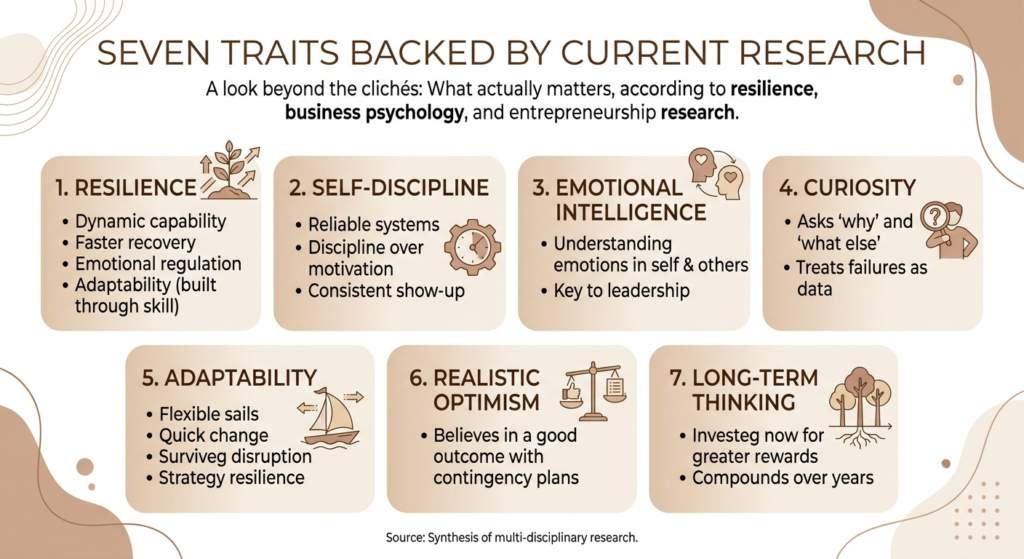
Set aside the poster-quote version of “successful people traits” for a moment. Here’s what actually shows up across resilience, business psychology, and entrepreneurship research.
1. Resilience. Not the absence of setbacks, but a faster recovery from them. Recent research on entrepreneurial resilience frames it as a dynamic capability – something built through emotional regulation and adaptability rather than a fixed personality trait you either have or don’t. That’s good news: it means resilience can be trained the same way a skill can.
2. Self-Discipline. Motivation is unreliable. It shows up strong on day one and fades by week three. Discipline is what carries you through the stretch where motivation has already left. The people who keep showing up aren’t more inspired than everyone else – they’ve just built systems that don’t depend on feeling inspired.
3. Emotional Intelligence. The ability to read your own emotional state and other people’s, and to manage both under pressure. In leadership research, emotional intelligence consistently shows up as a stronger predictor of long-term success than raw technical skill, particularly in roles that involve managing people or negotiating outcomes.
4. Curiosity. A consistent willingness to ask “why” and “what else” rather than settling for the first explanation. This shows up practically as a habit of treating every failed approach as a data point instead of a dead end.
5. Adaptability. Especially visible in how businesses responded to pandemic-era disruption – the ventures that survived weren’t necessarily the most resourced ones, but the ones that changed their model fastest when the original plan stopped working. Adaptability is resilience applied to strategy rather than emotion.
6. Realistic Optimism. This is worth distinguishing carefully from blind positivity. Realistic optimism means believing a good outcome is possible while still planning honestly for what could go wrong. It’s the opposite of denial – it’s optimism with a contingency plan attached.
7. Long-Term Thinking. The willingness to accept a smaller result now in exchange for a larger one later. In business terms, this looks like reinvesting profit instead of extracting it early, or choosing the harder client relationship that compounds over years instead of the quick win that doesn’t repeat.
Mental Barriers That Quietly Undermine a Success Mindset
Most people don’t fail to develop a success mindset because they lack motivation. They fail because a handful of specific mental patterns are working against them under the surface.
Fear of failure shows up as avoidance – not pursuing the opportunity at all rather than risking a visible loss. Fear of judgment is a close cousin: the concern isn’t the failure itself, but what other people will think of it.
Perfectionism feels like high standards but often functions as procrastination in disguise – nothing ships because nothing is ever quite ready. Imposter syndrome is the persistent sense that your success is due to luck or timing rather than ability, which quietly pushes people to over-prepare, over-explain, or avoid visibility altogether.
Negative self-talk compounds all of the above – an internal narrator that treats every mistake as confirmation of inadequacy rather than as one data point among many. The comparison trap does similar damage from the outside in, measuring your unfinished chapter three against someone else’s finished chapter twenty.
Comfort zone addiction is the quietest of the group. It doesn’t feel like fear. It feels like being busy, reasonable, and reasonably successful – just never quite pushing past the point where real growth happens.
None of these are character flaws. They’re patterns, and patterns can be noticed and interrupted, which is a lot more useful than trying to will yourself into confidence.
The practical difficulty with all seven of these barriers is that they rarely announce themselves. Perfectionism doesn’t feel like fear – it feels like diligence. Comfort zone addiction doesn’t feel like avoidance – it feels like being sensible. That’s precisely what makes them durable. The fastest way to spot one operating in your own thinking is to notice where you’ve been “about to” do something for a long stretch of time without actually doing it – the launch that’s always one more revision away, the conversation you keep meaning to have, the market you keep researching instead of entering. That gap between intention and action is usually where one of these seven patterns is quietly doing its work.
Daily Habits That Build a Success Mindset
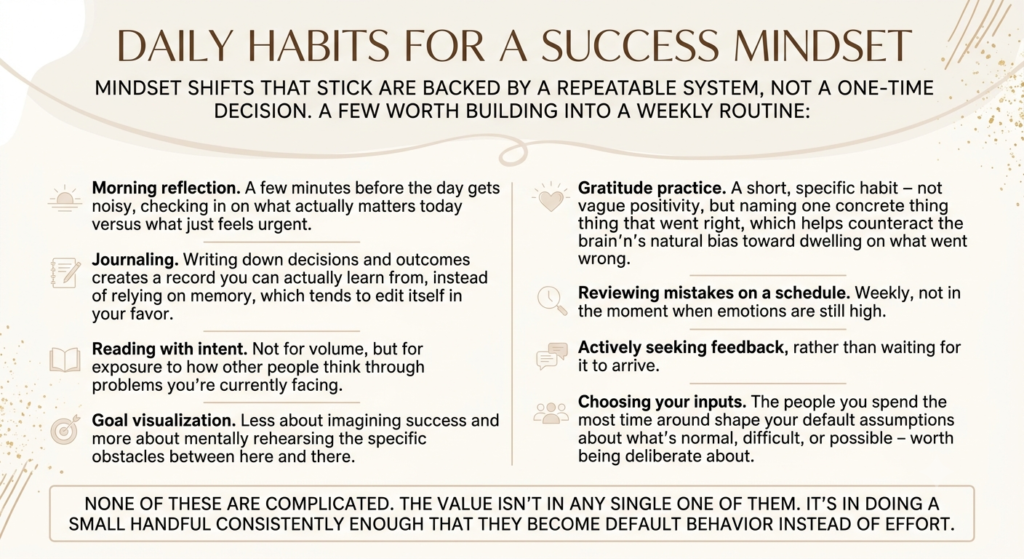
Mindset shifts that stick tend to be the ones backed by a repeatable system, not a one-time decision. A few worth building into a weekly routine:
- Morning reflection. A few minutes before the day gets noisy, checking in on what actually matters today versus what just feels urgent.
- Journaling. Writing down decisions and outcomes creates a record you can actually learn from, instead of relying on memory, which tends to edit itself in your favor.
- Reading with intent. Not for volume, but for exposure to how other people think through problems you’re currently facing.
- Goal visualization. Less about imagining success and more about mentally rehearsing the specific obstacles between here and there.
- Gratitude practice. A short, specific habit – not vague positivity, but naming one concrete thing that went right, which helps counteract the brain’s natural bias toward dwelling on what went wrong.
- Reviewing mistakes on a schedule. Weekly, not in the moment when emotions are still high.
- Actively seeking feedback, rather than waiting for it to arrive.
- Choosing your inputs. The people you spend the most time around shape your default assumptions about what’s normal, difficult, or possible – worth being deliberate about.
None of these are complicated. The value isn’t in any single one of them. It’s in doing a small handful consistently enough that they become default behavior instead of effort.
What the Evidence Says for Entrepreneurs Specifically
Founders and business owners face a particular version of this challenge, because the stakes and the ambiguity are both higher than in most employed roles. Recent research on entrepreneurial resilience points to a specific combination worth paying attention to: emotional intelligence to sustain team morale through disruption, cultural or contextual awareness to read shifting market conditions accurately, and a proactive rather than reactive posture toward change.
Separate research on psychological capital – a combination of self-efficacy, hope, resilience, and optimism – has found it plays a meaningful role in how well entrepreneurs transfer knowledge and grow their businesses, particularly in resource-constrained environments. In plain terms: founders who believe in their own capability to figure things out, while staying honest about what they don’t yet know, tend to build knowledge and adapt faster than those operating from either overconfidence or self-doubt.
The practical translation for anyone running a business: don’t just work on believing in yourself. Work on building the specific capabilities – reading a room, adjusting a plan quickly, staying emotionally steady when a deal falls through – that make that belief actually justified. Confidence without competence is fragile. Confidence built on demonstrated competence is durable.
This shows up in a very ordinary way day to day. Two business owners hit the same cash-flow crunch. One spends the week anxious, avoiding the numbers, hoping the situation resolves itself. The other opens the books immediately, identifies the three levers that actually move the needle – collections, a temporary spending freeze, a short-term financing option – and works through them in order. The difference isn’t that the second owner feels less stressed. It’s that their mindset treats the problem as solvable through specific action, which changes what they do with the stress instead of being paralyzed by it. That’s psychological capital in practice: not the absence of doubt, but the presence of a default next step even when doubt is loud.
It’s also worth noting what the research doesn’t support: the idea that resilience means pushing through everything alone. The stronger entrepreneurial resilience models explicitly build in support – mentors, peer networks, teams that can absorb some of the load. Treating resilience as a solo trait tends to produce burnout rather than durability. The founders who sustain a success mindset over years, not just months, are usually the ones who built a support structure into the plan from the start, not the ones who simply gritted their teeth harder than everyone else.
Real Examples of Mindset Under Pressure
The examples that get cited most often in this space are cited often for a reason – they hold up.
Thomas Edison treated thousands of failed experiments as elimination rather than defeat, narrowing the field with each attempt instead of reading it as proof he should quit. Oprah Winfrey was let go from an early television role and later built a media company from that setback rather than around it. Michael Jordan was famously cut from his high school varsity team and used the specific gap in his game, not vague motivation, to close the distance. J.K. Rowling faced repeated rejection before Harry Potter was picked up, and continued revising the manuscript rather than shelving the idea.
What connects all four isn’t talent or luck. It’s that each setback got treated as specific, correctable information rather than a verdict on their overall worth. That distinction – information versus verdict – is the whole mechanism in miniature.
Practical Exercises to Rewire Your Mindset
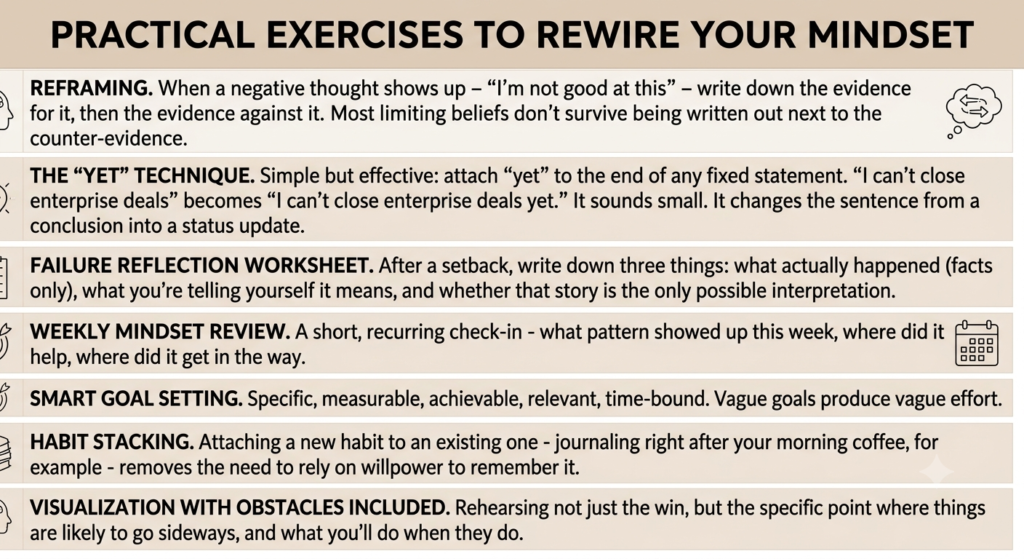
A few structured exercises, worth trying over a few weeks rather than once:
Reframing. When a negative thought shows up – “I’m not good at this” – write down the evidence for it, then the evidence against it. Most limiting beliefs don’t survive being written out next to the counter-evidence.
The “yet” technique. Simple but effective: attach “yet” to the end of any fixed statement. “I can’t close enterprise deals” becomes “I can’t close enterprise deals yet.” It sounds small. It changes the sentence from a conclusion into a status update.
Failure reflection worksheet. After a setback, write down three things: what actually happened (facts only), what you’re telling yourself it means, and whether that story is the only possible interpretation.
Weekly mindset review. A short, recurring check-in – what pattern showed up this week, where did it help, where did it get in the way.
SMART goal setting. Specific, measurable, achievable, relevant, time-bound. Vague goals produce vague effort.
Habit stacking. Attaching a new habit to an existing one – journaling right after your morning coffee, for example – removes the need to rely on willpower to remember it.
Visualization with obstacles included. Rehearsing not just the win, but the specific point where things are likely to go sideways, and what you’ll do when they do.
Can Anyone Develop a Success Mindset?
This is worth answering honestly rather than with the usual unconditional “yes.”
The evidence on nature versus nurture suggests both play a role. Some people are temperamentally more resilient or more comfortable with uncertainty. That’s real. But the research on mindset malleability also shows that beliefs about ability are more changeable than personality traits – which is encouraging, with a caveat attached.
The caveat is the one this article has repeated a few times already: mindset shifts that aren’t paired with actual skill-building, honest feedback, and a supportive environment tend to fade. The studies with the weakest results are almost always the ones testing belief change in isolation – a single workshop, a single pep talk, nothing structural changed around the person afterward. The studies with the strongest, most durable results pair belief change with an actual system: better feedback loops, real skill practice, an environment that reinforces the new pattern.
So yes, anyone can develop a stronger success mindset. But it takes more than deciding to. It takes deciding to, and then building the habits and feedback loops that make the decision stick.
Key Takeaways
- A success mindset is a belief about whether your abilities can grow – not a personality trait and not blind optimism.
- Growth mindset research shows real but modest effects; belief without a system to support it tends to fade.
- Self-efficacy, confirmation bias, and emotional regulation are the specific mechanisms worth understanding and managing.
- Resilience, discipline, and emotional intelligence outperform raw motivation over the long run.
- For entrepreneurs, the strongest results come from pairing self-belief with actual demonstrated capability – not confidence alone.
- Small, consistent habits – reflection, feedback-seeking, honest failure review – do more than any single mindset “shift.”
Conclusion
A success mindset was never meant to be a switch you flip. It’s closer to an operating system – a default way of interpreting setbacks, making decisions, and staying in motion when the outcome is uncertain. The research is clear that belief alone isn’t enough, and it’s just as clear that belief, paired with the right habits and honest feedback, changes what people are willing to attempt and how long they stick with it.
You don’t need to overhaul how you think this week. Pick one habit from this article – a weekly failure review, a single reframe of a limiting belief, one piece of feedback you’ve been avoiding asking for – and apply it consistently for the next month. Momentum builds from repetition, not from a single decision made once and never revisited.
The research is unlikely to ever produce a clean, universal formula for success – people, markets, and circumstances vary too much for that. What it does offer is a reliable set of levers: how you interpret setbacks, how you regulate your response under pressure, and how consistently you turn belief into a repeatable system. Those are learnable. Start with one.
Frequently Asked Questions
What is the psychology of success?
It’s the study of how beliefs, emotional regulation, and decision-making patterns shape the actions that lead to achievement over time – less about a single trait and more about a repeated pattern of interpreting and responding to setbacks.
How does mindset affect success?
Mindset shapes how you interpret setbacks and opportunities, which shapes the actions you take next. Repeated over months and years, those actions become the habits and decisions that produce results.
Can you train yourself to develop a growth mindset?
To some degree, yes – but research shows belief change alone has a modest effect. It works best combined with real feedback, skill-building, and a supportive environment, not as a standalone shift in thinking.
What is the difference between a growth mindset and a fixed mindset?
A growth mindset treats ability as trainable and setbacks as information. A fixed mindset treats ability as largely set and setbacks as a verdict on capability.
Is mindset more important than talent?
Neither operates alone. Talent without a willingness to adjust after failure tends to plateau. Mindset without underlying skill-building produces confidence that isn’t backed by capability. The strongest outcomes come from both together.
What daily habits help build a success mindset?
Consistent reflection, honest failure review, active feedback-seeking, and deliberate exposure to people and ideas that challenge your current assumptions.