

Everyone starts a new goal with motivation. You feel it in the first week of a new gym membership, the first few mornings of an early wake-up routine, the first days of a new business idea.
Then, almost without warning, it disappears.
This is not a personal failure. It is not proof that you are lazy or lack willpower. It is simply how motivation behaves. It is an emotional state, and emotional states are, by design, temporary.
The people who succeed over the long run are rarely the most motivated people in the room. They are the ones who kept showing up after the motivation left. That difference has a name: self-discipline.
This guide will not hand you another motivational quote to stick on your wall. Instead, it will walk through what the research actually says about why motivation fades, what is happening in your brain when a habit forms, and which specific systems replace the need for motivation altogether. By the end, you will have a practical framework you can start using today, not a feeling you have to chase.
One thing worth clearing up before going further: self-discipline is not about being harder on yourself, punishing failure, or grinding through everything on sheer force of will. That version of discipline burns people out and rarely lasts. The version covered in this guide is quieter and far more sustainable. It is built on small, repeatable actions, a supportive environment, and a realistic understanding of how your brain actually forms habits. That is what separates people who stay consistent for years from people who restart the same goal every few months.
Why Motivation Always Fades (And Why That’s Completely Normal)
The Psychology of Motivation
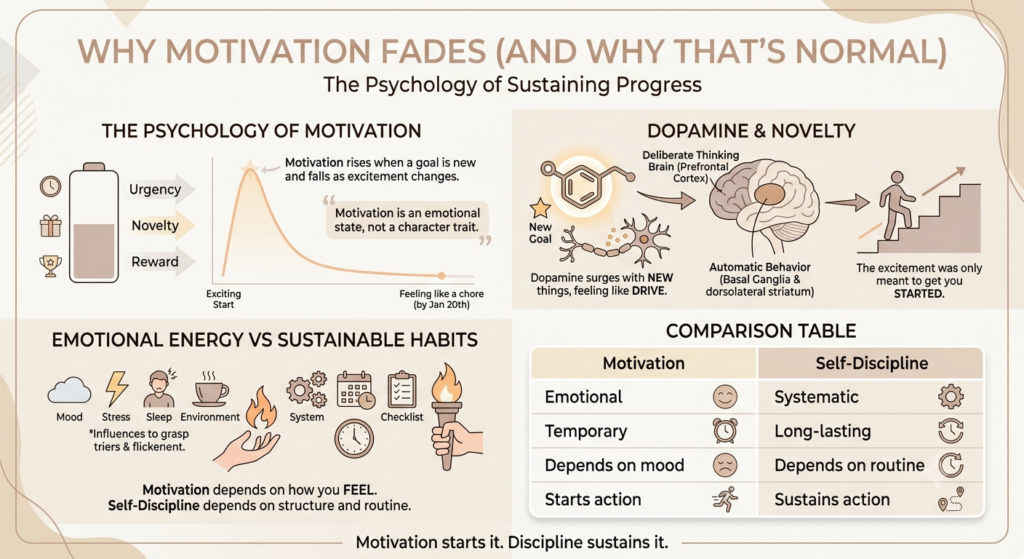
Motivation is an emotional and physiological state, not a character trait. It rises when a goal feels new, urgent, or rewarding, and it falls as soon as any of those three conditions changes. That is why a goal that felt exciting on January 1st can feel like a chore by January 20th. Nothing about the goal changed. The emotional charge around it did.
Dopamine and Novelty
A large part of what we experience as motivation is driven by dopamine, the brain chemical associated with anticipation and reward. Dopamine spikes strongly in response to something new. A new habit, a new goal, a new identity you are trying on, all of these trigger a dopamine surge that feels like drive and excitement.
The problem is that dopamine response weakens with repetition. Neuroscience research on habit formation shows that as behaviors are repeated, control shifts from the prefrontal cortex, the deliberate “thinking brain,” to the basal ganglia and the dorsolateral striatum, deeper brain structures responsible for automatic behavior. Once a behavior becomes routine, it stops needing the emotional charge that got it started in the first place.
In plain terms: the excitement was never meant to last. It was only ever meant to get you started.
Emotional Energy vs Sustainable Habits
Because motivation is emotional, it is directly affected by your mood, your stress levels, your sleep, and your environment. A bad night’s sleep, an argument with a colleague, or a stressful week at work can wipe out motivation instantly, even if your goal has not changed at all.
Self-discipline works differently. It is not a feeling you summon. It is a structure you follow regardless of how you feel that day. This is the core distinction that separates people who make progress for a few weeks from people who make progress for years.
Why Relying on Feelings Creates Inconsistency
If your actions depend on how motivated you feel, your consistency will always be as unstable as your emotions. Some days you will feel unstoppable. Other days you will feel nothing at all. A system built entirely on feeling motivated is, by definition, a system with built-in gaps.
Self-discipline closes those gaps. It does not ask “do I feel like doing this today?” It asks “is this what I do at this time, on this day, regardless of mood?”
| Motivation | Self-Discipline |
| Emotional | Systematic |
| Temporary | Long-lasting |
| Depends on mood | Depends on routine |
| Starts action | Sustains action |
Motivation is useful. It is what gets a new goal off the ground. But it was never designed to carry that goal for months or years. That job belongs to discipline.
The Science Behind Self-Discipline
Habit Loops: Cue, Routine, Reward
Much of modern habit science traces back to a simple three-part loop popularized by journalist Charles Duhigg and widely studied since: cue, routine, reward.
A cue is a trigger, something in your environment or internal state that signals a behavior should begin. It could be the smell of coffee, a specific time of day, or a feeling of boredom. The routine is the behavior itself. The reward is the payoff that reinforces the loop, making your brain more likely to repeat the same routine the next time it encounters that cue.
Over time, and with enough repetition, your brain begins to associate the cue directly with the reward. This is what makes a behavior feel automatic. According to research from Duke University, habits account for about 40% of our daily behaviors, automatic responses programmed into the basal ganglia, the part of the brain responsible for pattern recognition and automatic behavior. That is a significant share of your day already running on autopilot. Self-discipline is the practice of deliberately designing what fills that autopilot, instead of leaving it to chance.
Decision Fatigue
Every decision you make throughout the day draws on the same limited pool of mental energy. Researchers studying self-control describe this as a resource that becomes harder to exert the more it is used. One well-known field study of parole board judges found that the rate of favorable rulings drops gradually across each session of decisions and returns abruptly to a higher rate after a break, a pattern researchers attribute to the mental cost of repeated decision-making wearing down judgment over the course of the day.
This matters for self-discipline because willpower spent on small, unnecessary decisions, what to wear, what to eat, when to start working, is willpower unavailable later for the decisions that actually matter. The fewer trivial decisions you have to make, the more discipline you have left for the things that count.
It is worth noting that the underlying science here is still debated. Some researchers who study self-control have questioned whether willpower behaves exactly like a depletable physical resource, or whether the effect has more to do with shifting motivation and attention as a task drags on. Either way, the practical takeaway holds up: reducing the number of trivial decisions in your day consistently correlates with better follow-through later on, regardless of the exact mechanism behind it.
Neuroplasticity: Why Repetition Rewires the Brain
Neuroplasticity is your brain’s ability to physically change in response to repeated experience. Every time you repeat a behavior, the neural pathway associated with it strengthens, and the behavior requires less conscious effort the next time. This is the biological basis of the old saying “it gets easier with practice.” It is not a metaphor. Your brain is literally restructuring itself around what you repeat.
This is also good news. It means self-discipline is not a fixed trait you either have or lack. It is a skill built through repetition, the same way a muscle is built through consistent use.
Visual diagram idea: A simple looping flowchart showing Cue → Routine → Reward, with a second layer beneath it showing “Repetition” feeding back into the loop and gradually thickening the arrow between Cue and Routine, visually representing the behavior becoming more automatic over time.
10 Proven Ways to Build Self-Discipline When Motivation Disappears
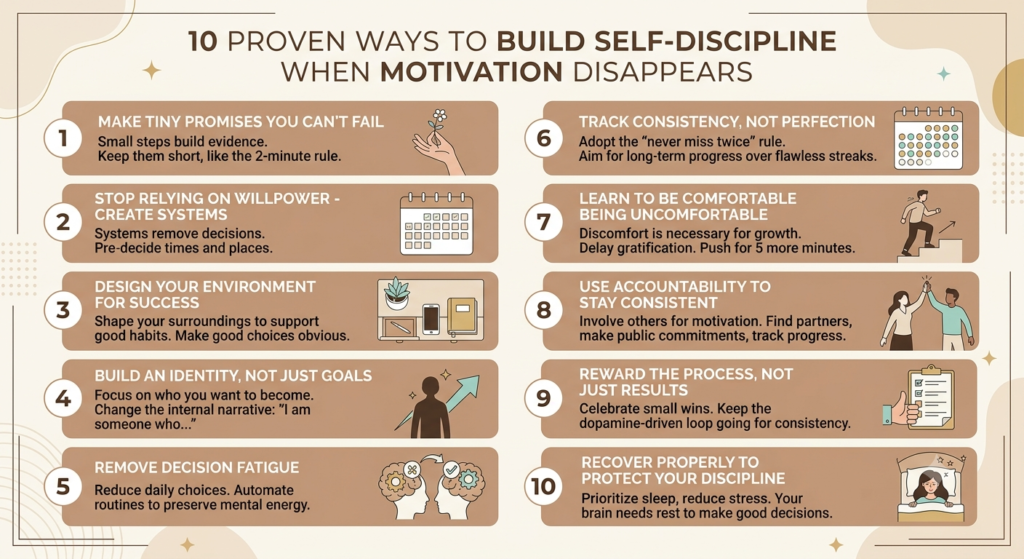
1. Make Tiny Promises You Can’t Fail
Why it works: Self-discipline is built through evidence, not intention. Every time you keep a promise to yourself, even a small one, you build proof that you are someone who follows through. Every time you break one, you build the opposite. Starting small protects that evidence.
Practical example: Instead of committing to a one-hour workout, commit to two minutes of movement. Instead of “write for an hour,” commit to opening the document and writing one sentence.
Quick Action Tip: Use the 2-minute rule. Shrink any new habit down to something that takes two minutes or less to begin. Most of the time, starting is the only real barrier, and once you start, continuing becomes far easier.
2. Stop Relying on Willpower – Create Systems Instead
Why it works: Willpower is a limited daily resource. Systems remove the need to summon it repeatedly, because the decision has already been made in advance.
Practical example: A fixed workout time at 6:30am removes the daily negotiation of “should I go today?” Meal prepping on Sunday removes the daily decision of “what should I eat?” Calendar blocking removes the question of “when will I get to this?”
Quick Action Tip: Pick one recurring decision in your week and pre-decide it permanently. Set a fixed time, a fixed place, or a fixed process, so the decision only has to be made once.
3. Design Your Environment for Success
Why it works: Discipline is far easier to maintain when your environment supports the behavior you want, and far harder when it works against you. Willpower is finite; environment design works around the clock without draining it.
Practical example: Keep distractions physically out of sight, such as leaving your phone in another room while working. Prepare tomorrow’s essentials tonight, whether that is laying out gym clothes or setting out your notebook. Make the good habit the most obvious, easiest option in the room.
Quick Action Tip: Choose one habit you want to build and physically stage your environment for it before you go to bed tonight.
4. Build an Identity, Not Just Goals
Why it works: Goals are about what you want to achieve. Identity is about who you decide you are. When a habit is tied to identity, it survives long after the original goal has been forgotten, because you are no longer doing it to hit a target, you are doing it because it is who you are.
Practical example: Instead of “I want to exercise,” the shift is “I am someone who never skips movement.” Instead of “I want to write more,” the shift is “I am a writer.” Identity-based habits consistently outperform outcome-based habits over time, because they change the internal narrative rather than just the external checklist.
Quick Action Tip: Finish this sentence and say it out loud: “I am someone who ___.” Then take one small action today that proves it true.
5. Remove Decision Fatigue
Why it works: As covered in the science section above, every decision drains a shared mental resource. Reducing the number of decisions you make about routine matters preserves that resource for decisions that genuinely require judgment.
Practical example: A fixed morning routine removes the daily question of “what should I do first?” A repeating weekly workout schedule removes “what workout should I do today?” Time-blocking removes “what should I work on next?” Automating recurring bills or grocery orders removes financial micro-decisions entirely.
Quick Action Tip: List three decisions you make every single day that do not need to be re-decided. Automate or pre-decide them this week.
6. Track Consistency, Not Perfection
Why it works: Perfection is fragile. One missed day can feel like proof that the whole effort has failed, which often leads people to quit entirely. Consistency, tracked honestly, tells a more accurate and more forgiving story.
Practical example: Adopt the “never miss twice” rule. Missing one day is human. Missing two in a row is the start of a new pattern, so treat the second day as non-negotiable. Combine this with a short weekly review, five minutes to check in on what worked and what didn’t.
Quick Action Tip: At the end of each week, ask one question: “Did I average consistency, even if I wasn’t perfect?” Progress over perfection is the standard, not flawless streaks.
7. Learn to Be Comfortable Being Uncomfortable
Why it works: Discomfort is the price of nearly every meaningful gain, whether physical, professional, or personal. People with strong self-discipline are not people who feel less discomfort. They have simply practiced tolerating it without immediately reacting.
Practical example: Delayed gratification, choosing a longer-term reward over an immediate one, is a skill that strengthens with practice, much like a muscle. Emotional resilience is built the same way, through repeated small exposures to discomfort rather than avoidance of it.
Quick Action Tip: The next time you feel the urge to quit something early because it feels hard, commit to five more minutes before deciding. Growth tends to happen just past the point where most people stop.
8. Use Accountability to Stay Consistent
Why it works: Discipline is easier to maintain when someone or something outside of you is tracking your follow-through. Accountability adds a layer of consistency that willpower alone often cannot sustain.
Practical example: An accountability partner who checks in weekly. A public commitment, such as telling your team or community about a goal. A habit-tracking app that visually shows your streak. A simple weekly check-in, even a five-minute call, can be enough.
Quick Action Tip: Tell one person about the habit you are building this week, and ask them to check in with you in seven days.
9. Reward the Process, Not Just Results
Why it works: Waiting until you hit a big outcome to feel rewarded means going long stretches with no reinforcement at all. Recognizing small wins along the way keeps the dopamine-driven reward loop active, which keeps the habit going.
Practical example: The cycle looks like this: small wins lead to more dopamine, more dopamine leads to more consistency, more consistency leads to more discipline. Celebrating a completed workout, not just a fitness goal reached months later, keeps this cycle running.
Quick Action Tip: After completing a habit today, take ten seconds to consciously acknowledge it. A short mental “that counted” is enough to reinforce the loop.
10. Recover Properly to Protect Your Discipline
Why it works: Discipline is not purely a mental or moral quality. It is closely tied to physical state. Sleep-deprived, poorly nourished, or chronically stressed people show measurably reduced self-control. Research reviewed in Frontiers in Human Neuroscience found that sleep-deprived individuals are more likely to give in to impulses, have less focus, and make other questionable or risky choices, largely because sleep loss reduces activity in the prefrontal cortex, the brain region responsible for exercising self-control.
Practical example: Prioritizing consistent sleep, managing stress through simple daily practices, staying physically active, eating in a way that stabilizes energy, and building in deliberate recovery days all directly protect your capacity for discipline.
Quick Action Tip: Protect one specific bedtime this week, and treat it with the same seriousness you would treat an important meeting.
Many people believe they lose discipline because they are lazy. Far more often, they lose it because they are exhausted, under-slept, or running on depleted physical reserves. Recovery is not a reward for discipline. It is a requirement for it.
Common Mistakes That Destroy Self-Discipline
Most people don’t lose their discipline in one dramatic moment. It erodes gradually, through a handful of small, repeatable mistakes that feel harmless in isolation but compound over weeks and months. Recognizing these patterns is often the fastest way to stop them.
Waiting to feel motivated. If action is only taken when motivation shows up, long gaps of inaction are guaranteed, because motivation is unreliable by nature.
Setting unrealistic goals. Goals that are too large too soon set up an early failure that can derail the entire effort before momentum has a chance to build.
Trying to change everything overnight. Attempting to overhaul diet, exercise, sleep, and work habits simultaneously spreads willpower too thin to sustain any single change.
Depending on willpower alone. Without systems and environment design to support it, willpower eventually runs out, usually at the worst possible moment.
Quitting after one bad day. A single missed day is not a failure. Treating it as one, and quitting entirely, turns a minor setback into a permanent one.
A 7-Day Self-Discipline Challenge
This challenge is designed to build momentum through small, achievable actions rather than a dramatic overhaul.
- Day 1: Make your bed immediately after waking up.
- Day 2: Complete one task before checking social media.
- Day 3: Walk for 15 minutes, no phone.
- Day 4: Write down three priorities before starting work.
- Day 5: Prepare tomorrow’s essentials the night before.
- Day 6: Do one uncomfortable task you’ve been avoiding.
- Day 7: Review the week honestly. Note what felt easier by Day 7 than it did on Day 1.
By Day 7, most people notice that the same actions that felt effortful at the start now require noticeably less resistance. That shift is the beginning of momentum, and momentum is what carries a system from a one-week experiment into a lasting habit.
Signs Your Self-Discipline Is Improving
Progress with self-discipline is often gradual enough that it is easy to miss while it is happening. These are the signs worth watching for, especially in the first few weeks of building a new system:
- Less procrastination on tasks you used to avoid
- More consistency, even on low-motivation days
- Better focus during work sessions
- Improved confidence in your own follow-through
- Habits start to feel automatic rather than forced
- Fewer excuses show up before starting a task
- Better emotional control under stress or setbacks
Conclusion: Stop Waiting for Motivation
Motivation is the spark. It is real, it is useful, and it deserves credit for getting people to start. But a spark was never designed to burn for months or years on its own.
Discipline is the engine. It runs on structure, not feeling. It does not ask how you feel today, it asks what you do today.
Systems beat willpower because they remove the daily negotiation altogether. Small daily actions, repeated without needing to feel inspired, are what eventually become the identity and the results people originally set out to achieve.
You do not need to wait for motivation to return. You need one small system you can start today, and the discipline to repeat it tomorrow, whether you feel like it or not.
Frequently Asked Questions
Can self-discipline be learned?
Yes. Self-discipline is a trainable skill, not a fixed personality trait. Research on neuroplasticity shows the brain physically strengthens the pathways associated with repeated behaviors, meaning consistent practice genuinely makes discipline easier over time.
Why does motivation disappear so quickly?
Motivation is tied to novelty and dopamine response, both of which naturally decline as a behavior becomes familiar. This is a normal, expected part of any new habit, not a sign that something is wrong.
How long does it take to build self-discipline?
Habit formation research suggests it takes an average of 59 to 66 days for a new behavior to start feeling automatic, though the full range spans from about 18 days to nearly a year depending on the complexity of the habit and the individual. There is no fixed universal number, but consistent daily repetition is the biggest factor in how quickly a behavior sticks.
Is discipline stronger than motivation?
Discipline is more reliable than motivation because it does not depend on mood or emotional state. Motivation is useful for starting something new, but discipline is what sustains it once the initial excitement fades.
What’s the fastest way to become more disciplined?
Start with the smallest possible version of the habit you want to build, remove decisions and friction through systems and environment design, and track consistency rather than aiming for perfection.