

A few years ago, I met a founder who had built a genuinely good product. His retention numbers were strong, his margins were healthy, and his team loved working for him. Yet every time he pitched an investor or tried to hire senior talent, he got the same polite pass. Nobody could find him online. No talks, no articles, no opinions worth quoting. To the outside world, he simply didn’t exist.
That founder isn’t rare. I’ve seen the same story play out with property managers, agency owners, and consultants who spend years perfecting their craft and almost no time letting anyone know it. In 2026, that gap is more expensive than ever. Buyers, investors, and future employees don’t just evaluate your business anymore – they evaluate you.
This guide walks through what personal branding for entrepreneurs actually means today, why it has become a business asset rather than a vanity project, and how to build one without turning into another generic voice in a crowded feed. Everything here is grounded in current research and real practice, not recycled advice from a decade ago.
Whether you’re running a property management company, a service business, or a small agency, the underlying principle is the same: the market increasingly chooses people it can see and evaluate over businesses it can’t. Building that visibility deliberately, rather than hoping it accumulates on its own, is what separates founders who stay known from ones who stay invisible no matter how good their work is.
What Personal Branding Really Means in 2026
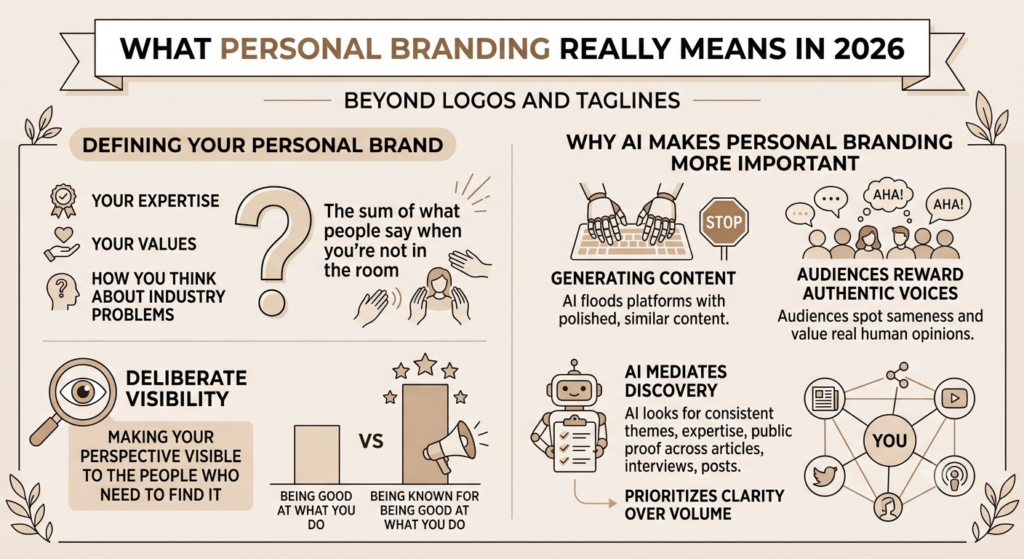
Beyond Logos and Taglines
Personal branding gets confused with self-promotion, and that confusion is exactly why so many entrepreneurs avoid it. A personal brand isn’t a slogan or a polished headshot. It’s the sum of what people already say about you when you’re not in the room – your expertise, your values, and the specific way you think about the problems your industry cares about.
Put simply, personal branding is the deliberate act of making your perspective visible to the people who need to find it. It’s the difference between being good at what you do and being known for being good at what you do. Plenty of excellent operators never get the second part right, and it quietly caps everything they build.
Why AI Has Made Personal Branding More Important, Not Less
There’s a common assumption that AI tools would flatten the need for individual voices, since anyone can now generate polished content in seconds. The opposite has happened. As AI-written material floods every platform, audiences have become sharper at spotting sameness, and they reward the accounts that still sound like an actual person with actual opinions.
AI is also starting to mediate discovery itself. When someone asks an AI assistant to recommend an expert in property management or a specialist in Airbnb operations, that assistant is looking for consistent themes, repeated expertise, and public proof scattered across articles, interviews, and posts. It prioritizes clarity over volume. If you haven’t built a recognizable footprint, the system simply fills the gap with someone who has.
Why Personal Branding for Entrepreneurs Matters More Than Ever
The Trust Gap Between People and Institutions
People trust people far more than they trust companies, and that gap has only widened. <cite index=”11-1″>One analysis found that 76 percent of people trust content shared by individuals more than content coming directly from brands.</cite> That single statistic explains why so many founders are shifting marketing budgets away from polished corporate messaging and toward the voices of the people actually running the business.
The same pattern shows up in B2B buying decisions. <cite index=”9-1″>Financial readers trust leaders who maintain a visible personal brand on social media over those who don’t by a ratio of six to one.</cite> If you’re an entrepreneur trying to close deals, raise capital, or attract partners, that trust differential isn’t a marketing nicety – it’s a direct input into whether people choose you.
What the Data Says About Personal Brand ROI
The numbers behind personal branding for entrepreneurs are no longer soft or anecdotal. Employee and founder-driven content consistently outperforms brand-only channels across nearly every measure that matters to a growing business.
- <cite index=”9-1″>Leads generated through an individual’s social media convert seven times more frequently than other leads.</cite>
- <cite index=”9-1″>Branded messages shared by individuals get reshared 24 times more often than the same messages posted by a company account.</cite>
- <cite index=”9-1″>An individual typically has around ten times more connections than their company page has followers</cite>, which means your personal reach often dwarfs your business’s official reach before you’ve even tried.
- <cite index=”8-1″>44 percent of employers say they’ve hired someone specifically because of their personal brand, while 54 percent have rejected a candidate over a weak online presence.</cite>
None of this means you need a huge following. It means the audience you already have access to – through your own name – is more valuable than most founders realize.
The Cost of Staying Invisible
The flip side of that trust and conversion data is a real cost to staying quiet. <cite index=”15-1″>Personal branding is no longer optional for business leaders and entrepreneurs; it used to be something only celebrities and keynote speakers worried about, but in a market where buyers have endless options and AI can replicate almost any product or service, you are the one thing that can’t be commoditized.</cite> If your competitor is visible and you aren’t, prospects default to the person they can actually evaluate.
The Four Forces Reshaping Personal Branding in 2026
Personal branding trends don’t appear out of nowhere. <cite index=”2-1″>Four major forces are rewriting the rules this year: AI has transformed how people create and communicate, hybrid work has changed where professional visibility actually happens, five generations are now working side by side with different expectations of leadership, and professionals and employers increasingly expect authenticity and clarity over artificial perfection.</cite> Understanding these forces helps explain why the old playbook – a stiff bio, a corporate photo, and the occasional press release – no longer moves the needle.
AI-Mediated Discovery
As mentioned above, more discovery now happens through AI summarization and recommendation rather than direct search. Consumers are placing real trust in these summaries too – <cite index=”11-1″>one study found that over 40 percent of consumers trust AI-generated summaries without ever clicking through to the original source.</cite> That means how you’re described across the internet matters as much as what you actually publish. Interviews, guest articles, and even how other people reference you in their own content all feed into that picture, which is one more reason a personal brand can no longer live on a single platform in isolation.
Hybrid Work and Shifting Visibility
With fewer people in a shared office, the moments that used to build a reputation – hallway conversations, conference presence, being seen “in the room” – happen far less often. Visibility now has to be built deliberately online, because it no longer accumulates automatically through physical proximity.
Five Generations, Five Expectations
Entrepreneurs are now marketing, hiring, and selling to a workforce and customer base spanning five generations at once, each with a different definition of credible leadership. A brand built only around one generation’s platform preferences or tone will underperform with the other four.
The Demand for Real Over Polished
<cite index=”3-1″>Personal brands that show doubt, mistakes, and unfinished thinking now feel more trustworthy, and imperfection has become part of credibility rather than something to hide.</cite> Audiences flooded with AI-generated polish are actively seeking out the opposite.
The Core Pillars of a Strong Entrepreneurial Personal Brand
Clarity: Say What Only You Can Say
<cite index=”3-1″>The strongest personal brands are built on lived experience and a specific point of view – generic messaging simply loses impact.</cite> Before you write a single post, get honest about what you’ve actually lived through that most people in your space haven’t. That’s your raw material, not a list of industry buzzwords.
Consistency Across Every Touchpoint
A personal brand isn’t one great LinkedIn post. It’s the accumulation of dozens of smaller signals – how you show up in an email, what your website bio says, how you answer questions on a podcast, what your team says about you when you’re not around. Consistency compounds; a single strong post rarely does.
Credibility Built on Real Experience
Nothing damages a personal brand faster than claims that don’t hold up under scrutiny. Every piece of content you put out should be traceable back to something you actually did, decided, or learned the hard way. This is especially true for founders in property management and operations-heavy businesses, where readers can quickly tell the difference between theory and practice.
Connection Through Emotional Storytelling
Facts convince people; stories move them. The founders who stand out in 2026 aren’t the ones who post the most statistics – they’re the ones willing to describe what a hard decision actually felt like, not just what the outcome was.
Generosity: Teaching What You Know
The founders who build the most durable brand authority tend to give away more than feels comfortable at first – the actual process behind a decision, the numbers behind a claim, the template they use internally. Withholding the useful details to “protect” your expertise almost always backfires; it just makes your content forgettable. People remember and return to the person who genuinely taught them something.
Personal Branding Across Different Stages of Your Business
Not every founder needs the same approach. What works for someone launching their first company looks very different from what works for someone running an established operation with a team already in place.
Early-Stage: Trading Credentials for Candor
When you don’t have a long track record to point to, lean into honesty instead. Early-stage founders often assume they need case studies and polished results before they’re “allowed” to post. In practice, audiences respond well to watching someone figure things out in real time – the wins, the wrong turns, and the reasoning behind each decision. That transparency becomes your credibility before revenue numbers can.
Growth-Stage: Turning Operational Lessons Into Authority
Once a business has some traction, the richest content usually comes from operations, not inspiration. A property manager scaling from ten units to fifty has dozens of specific lessons about vendor management, tenant communication, or systemizing maintenance requests. These operational details, explained plainly, tend to outperform generic motivational posts because they’re useful to someone facing the exact same problem right now. Keeping a running list of small operational decisions as they happen – rather than trying to recall them weeks later – makes this kind of content far easier to produce consistently.
Established: Shifting From Visibility to Stewardship
For founders who already have a recognizable name, the goal shifts from getting noticed to using that visibility responsibly. This often means mentoring newer voices, co-signing others’ work, and being more selective about what gets said publicly, since an established brand carries more weight with every post – for better or worse.
How to Build Your Personal Brand as an Entrepreneur: A Step-by-Step Framework
This is where most guides get vague. Here’s a practical sequence you can actually follow.
Step 1 – Define Your Niche and Point of View
Pick a lane narrower than feels comfortable. “Business advice” is not a niche. “How independent property managers scale past their first ten units without losing quality control” is. The narrower the focus, the easier it becomes for the right people – and increasingly, the right AI systems – to associate your name with that specific expertise.
A useful test: write down the exact sentence you’d want a stranger to say when someone asks them who you are. If that sentence is vague enough to describe a dozen other people in your industry, the niche isn’t sharp enough yet. Keep narrowing until the sentence could only describe you.
Step 2 – Audit Your Current Digital Footprint
Search your own name. Read your LinkedIn “About” section as a stranger would. Look at your last twenty posts across every platform you use. Most entrepreneurs discover the same problem: their online presence says almost nothing specific about what they actually do well. Fix the profile before you fix the content calendar.
Step 3 – Choose the Right Platforms (Not All of Them)
<cite index=”3-1″>Traditional platforms like LinkedIn and Instagram are already seeing declining organic reach</cite>, so spreading yourself across five platforms rarely beats doing one platform properly. Pick the single channel where your actual buyers, partners, or hires spend time, and commit there before expanding.
Step 4 – Build a Signature Content System
Rather than starting from a blank page every week, build two or three recurring formats: a weekly lesson from something that happened in your business, a monthly deep-dive article, and an occasional behind-the-scenes look at a decision in progress. A repeatable system beats sporadic inspiration.
Step 5 – Use AI as an Assistant, Not an Author
<cite index=”5-1″>AI is an excellent aid for research, organization, and idea development, but the actual thinking and writing has to remain a human effort – audiences can tell the difference, and the founders who treat AI as an assistant rather than the author will stand out precisely because most people won’t.</cite> Use it to summarize your notes or tighten a draft. Don’t let it decide what you think.
Step 6 – Show Up in Other People’s Rooms
<cite index=”5-1″>Guest appearances on podcasts and shows are quickly overtaking hosting your own show or chasing speaking slots – a single well-matched interview takes about an hour but earns visibility across multiple platforms including podcast apps, YouTube, and the host’s own audience, while also generating raw material for articles and posts afterward.</cite> This is one of the highest-leverage moves available to a busy founder.
Step 7 – Track What Actually Matters
Vanity metrics feel good but rarely predict revenue. Track inbound conversations, warm introductions, and deals that mention a specific post or article as the reason someone reached out. That’s the signal that your brand authority is translating into business.
Personal Branding for Entrepreneurs on LinkedIn
LinkedIn remains the default home base for most B2B founders, but the tactics that worked three years ago have shifted.
Posting Frequency and Timing That Works
<cite index=”8-1″>Roughly 91 percent of active LinkedIn creators post at least once every three days to sustain a strong presence</cite>, and the platform’s own data points to late morning – around 8 a.m. Pacific or 11 a.m. Eastern – as a consistently strong window to publish.
Formats That Outperform in 2026
<cite index=”1-1″>Shared media – co-authored articles, co-created courses, or a video interview series with a peer – is becoming one of the most effective formats, because it signals generosity, range, and real-world credibility that a solo post can’t match on its own.</cite> If you’ve been posting alone for months with flat results, a collaboration is often the fastest way to reach a new pocket of trust.
Why Follower Count Isn’t the Metric You Think It Is
<cite index=”8-1″>Engagement tends to drop as follower count grows, which is why regularly reposting and revisiting your best ideas matters more than chasing a bigger audience number.</cite> A smaller, genuinely engaged audience of the right buyers outperforms a large, indifferent one every time.
Common Personal Branding Mistakes Entrepreneurs Make
Trying to Sound Like Everyone Else
<cite index=”7-1″>The real problem in personal branding isn’t being polished – it’s being a carbon copy of every other founder, coach, or consultant already saying the same thing.</cite> If your posts could be published under a competitor’s name with no one noticing, the brand isn’t working yet.
Confusing Visibility With Value
Posting often isn’t the same as posting usefully. Founders sometimes chase frequency for its own sake and end up with a feed full of noise instead of a smaller number of ideas people actually remember.
Letting AI Write Your Voice
It’s tempting to hand the entire process to an AI tool, especially when time is scarce. But readers and platforms alike are getting better at detecting generic, over-polished writing, and it erodes exactly the trust a personal brand is supposed to build.
Disappearing After the First Few Posts
Most personal brands fail from abandonment, not from a bad strategy. The founders who see results are the ones who kept showing up for a full year, not the ones who posted daily for three weeks and quit.
Waiting for the “Right Time” to Start
Plenty of entrepreneurs delay building a personal brand until after the next milestone – a funding round, a bigger team, a rebrand. There’s rarely a moment that feels obviously right, and the founders who wait for one usually end up starting years later than the ones who simply began with what they had.
Building a Personal Brand Without an Existing Audience
One of the most common objections is some version of “I don’t have a following, so why bother posting.” This gets the sequence backwards. Almost every visible founder today started from zero, and the accounts that eventually built real reach did so by publishing consistently before anyone was watching, not after.
The practical starting point is simple: write for the one person you’re trying to reach, not for an imagined crowd. A single detailed post that genuinely helps one type of reader will do more for your brand authority than ten broad posts trying to appeal to everyone. Reach follows relevance, not the other way around.
It also helps to borrow existing audiences early on. Commenting thoughtfully on other people’s posts, contributing to a partner’s newsletter, or appearing as a guest on a small podcast all put your name in front of people who already trust the host – long before your own following can do that work for you.
Best Practices from Founders and CEOs Building Strong Brands in 2026
Co-Creation Over Solo Broadcasting
<cite index=”4-1″>In 2026, the personal brands earning attention are the ones showing partnerships, co-creation, and genuine community thinking, rather than founders broadcasting alone into the void.</cite> Look for peers, clients, or even competitors you respect and find a legitimate reason to create something together.
Guest Appearances Over Hosting
As covered above, appearing as a guest is proving more efficient than hosting an entire show, particularly for time-strapped operators running an actual business alongside their content efforts.
Embracing Imperfection as Credibility
<cite index=”3-1″>Because so much of the internet is now flooded with AI-generated content, personal brands that openly show doubt, mistakes, and unfinished thinking feel more human and trustworthy than the ones striving for constant polish.</cite> Don’t sand every rough edge off your story before sharing it.
Measuring the Impact of Your Personal Brand
Leading Indicators to Watch
Early signals include direct messages from people you don’t know, comments that show someone actually read the full post, and requests to speak, guest, or collaborate. These show up long before revenue does, and they’re worth tracking from week one.
Lagging Indicators That Prove ROI
Further downstream, watch for warm inbound leads that reference specific content, candidates who apply because of something you posted, and partnership offers that wouldn’t have found you through cold outreach. These are the indicators that ultimately justify the time investment to a skeptical operator.
Building a Simple Tracking Habit
You don’t need complex analytics software to measure any of this. A single running note – where you log every inbound message, introduction, or opportunity along with a quick mention of what prompted it – is usually enough to see the pattern emerge after a few months. Most founders are surprised how often the same handful of posts keep resurfacing as the reason someone reached out, sometimes months after publishing.
How Long-Term Personal Branding Compounds Over Time
The hardest part of personal branding for entrepreneurs isn’t any single tactic – it’s staying patient while the compounding effect builds. The first three months rarely feel like they’re working. Engagement is inconsistent, the audience is small, and it’s tempting to conclude the strategy isn’t right for your industry.
What actually happens is closer to interest accumulating in a savings account. Each piece of content adds a small amount of recognition, and none of it disappears once published. A well-written article from a year ago can still be the exact thing someone finds when they search your name today, long after the initial post has stopped getting new engagement. This is why the founders who treat personal branding as a long-term asset, rather than a short campaign, consistently outperform those chasing quick results.
Key Takeaways
- Personal branding for entrepreneurs is no longer optional – it’s a measurable driver of trust, leads, hiring outcomes, and deal flow.
- AI hasn’t reduced the value of a human voice; it has made a clear, consistent one more valuable, since AI systems themselves reward recognizable expertise.
- Focus on a narrow niche and a specific point of view rather than broad, generic advice.
- Use AI to support research and editing, never to replace your own thinking or voice.
- Consistency over a year beats intensity over a month – most brands fail from abandonment, not from bad strategy.
- Co-creation, guest appearances, and showing genuine imperfection now outperform polished, solo broadcasting.
Conclusion
Building a business and building a personal brand used to feel like two separate jobs. In 2026, they’re the same job. The founder who shows up with a clear point of view, real stories, and consistent effort will keep winning trust that no amount of ad spend can buy – and the one who stays invisible will keep watching that trust go to someone else. You don’t need a huge audience or a perfect content calendar. You need one clear idea about what only you can say, and the discipline to keep saying it.
Start smaller than feels impressive. Pick one platform, one recurring format, and one honest story from this week in your business. Publish it. Then do it again next week, and the week after that, until showing up stops feeling like an event and simply becomes part of how you run your business.
Frequently Asked Questions
1. What is personal branding for entrepreneurs, in simple terms?
It’s the deliberate, ongoing effort to make your expertise, values, and perspective visible to the people who need to find you – so that your reputation, not just your business, does some of the selling for you.
2. How long does it take to build a personal brand?
Most founders start seeing meaningful traction after six to twelve months of consistent posting, since trust builds through repeated exposure rather than a single viral moment.
3. Do I need to be on every social media platform?
No. Choosing one platform where your actual audience spends time and showing up consistently outperforms a thin presence spread across several channels.
4. Is it okay to use AI tools when building a personal brand?
Yes, for research, organization, and editing – but the core thinking and writing should stay yours, since audiences and platforms increasingly notice when a voice sounds generic or machine-written.
5. What’s the biggest mistake entrepreneurs make with personal branding?
Stopping too soon. Most people abandon their efforts within the first few weeks, right before consistency would have started paying off. The compounding benefits of a personal brand only show up after sustained effort, which is exactly the point where most founders give up.
6. Does personal branding actually affect revenue?
Yes. Leads that originate from an individual’s personal content convert significantly more often than leads from company-only channels, and a visible founder consistently earns more trust from buyers than a business with no recognizable human presence. Over time, this shows up not just in direct sales but in referrals, partnership offers, and stronger candidates applying for open roles.
7. Should I outsource my personal branding entirely to a ghostwriter or agency?
It’s fine to get help with editing, structure, or research, but the underlying stories and opinions need to come from you. Audiences and AI systems alike are increasingly able to detect content that doesn’t sound like a real, consistent person behind it, which undermines the trust a personal brand is meant to build in the first place.