

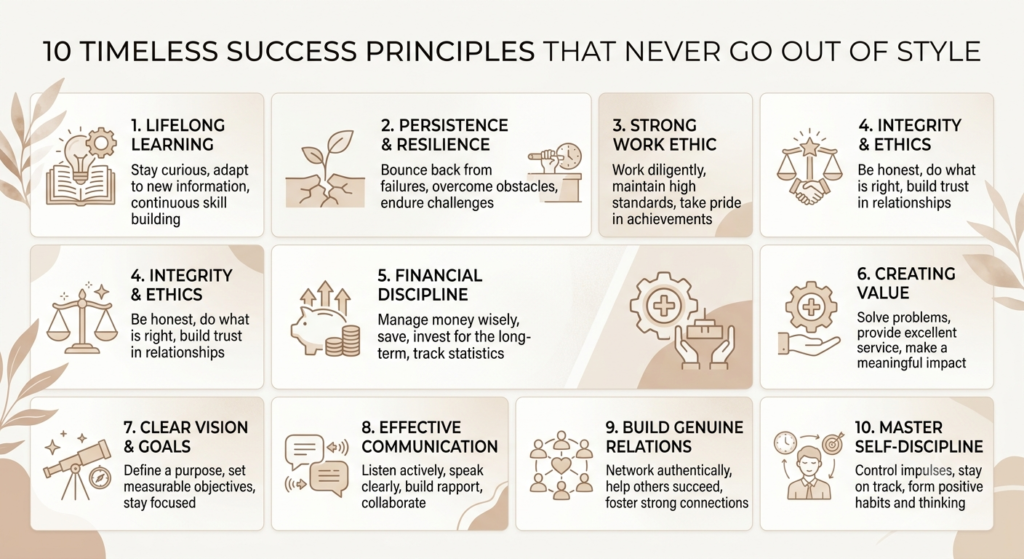
Every year brings a fresh wave of business trends, productivity apps, and “hacks” that promise to shortcut your way to success. Most of them fade within a few seasons. Yet underneath all that noise, a small set of principles keeps showing up in the lives of people who build lasting businesses, careers, and reputations.
I have spent years building and running businesses in property management and short-term rentals, and I can tell you honestly: the tactics I used five years ago are mostly obsolete. The principles behind them are not. That is the real value of timeless success principles – they do not expire when the market shifts, when a new app launches, or when an algorithm changes overnight.
This article walks through ten of those principles, grounded in current research and real-world data rather than generic motivation. You will find recent statistics on financial behavior, workplace skills gaps, business survival rates, and networking outcomes, along with practical steps you can apply this week. Nothing here is about chasing a trend. It is about building habits and thinking patterns that hold up no matter what 2026, or any year after it, throws at you.
What makes a principle genuinely timeless rather than just currently popular is simple to test: ask whether it would have been true advice fifty years ago, and whether it will still be true fifty years from now, regardless of which platforms, tools, or industries dominate at the time. Every principle in this list passes that test. That is also why you will not find advice here about a specific app, algorithm, or growth hack. Those change too fast to be worth building a foundation on.
Why Timeless Success Principles Still Matter in a Fast-Changing World
It is tempting to believe that in an era of artificial intelligence, automation, and constant disruption, old-fashioned principles like discipline and patience have lost their relevance. The data says otherwise.
The World Economic Forum’s Future of Jobs research shows that roughly 59 out of every 100 workers globally will need reskilling or upskilling before 2030, and a meaningful share of them are unlikely to receive that training in time. Technical skills are changing faster than ever. But the underlying human capabilities that determine who adapts well – discipline, resilience, sound decision-making, and the willingness to keep learning – are the same ones that mattered a generation ago.
That is the core idea behind this article. Tools change. Platforms change. The principles that let a person use those tools well do not.
1. Self-Discipline Beats Motivation Every Time
Motivation is a feeling. Feelings are unreliable. Self-discipline is a system, and systems do not care whether you feel like showing up.
Anyone who has run a business for more than a few months knows this truth firsthand. The days you do not feel inspired vastly outnumber the days you do. What separates people who build something lasting from those who stall out is not a deeper well of motivation. It is a smaller dependence on it.
Build Discipline Through Structure, Not Willpower
Willpower is a limited resource that gets depleted as the day goes on, which is why relying on it alone tends to fail by the afternoon. Structure removes the need for constant willpower:
- Fixed work blocks tied to specific outcomes, not vague “productivity”
- Environmental design that removes friction from good habits and adds friction to bad ones
- Pre-decided routines so daily choices do not have to be renegotiated each morning
Why This Still Applies in an AI-Driven Economy
Automation can execute a task once you tell it what to do, but it cannot decide what matters, hold a standard when no one is watching, or push through the unglamorous middle of a long project. That gap is exactly where self-discipline lives, and it is precisely the gap that keeps growing more valuable as more routine tasks get automated away.
2. Delayed Gratification Still Predicts Long-Term Outcomes
Delayed gratification, the ability to pass up a smaller reward now for a larger one later, has been studied for decades. A large cross-national analysis covering more than 200,000 people across 22 countries found that traits linked to delayed gratification, including self-control and willpower, are associated with better long-term outcomes such as lower mortality risk and reduced likelihood of harmful behaviors.
It is worth being honest about the nuance here, because oversimplified claims do not hold up to scrutiny. A widely cited follow-up study on the original “marshmallow test” found that early childhood performance on the test was a weaker predictor of adult outcomes than earlier research suggested, once researchers controlled for family background and other variables. In other words, the ability to delay gratification matters, but it is not destiny, and it interacts heavily with environment, trust, and opportunity.
Practical Delayed Gratification in Business
- Reinvesting early profits instead of drawing them out immediately
- Choosing a slower, sustainable growth rate over an unsustainable sprint
- Saying no to short-term revenue that would damage a long-term relationship or reputation
A Trust-Based View of Patience
Research on children’s willingness to wait for rewards has repeatedly shown that people delay gratification more readily when they trust the person or system promising the future payoff. That insight applies directly to business: your team, your customers, and your partners will delay their own gratification for you only if your track record has earned that trust.
3. A Growth Mindset Compounds Over Time, When Applied Honestly
The idea of a growth mindset, popularized by psychologist Carol Dweck, holds that abilities can be developed through effort and strategy rather than being fixed traits. It became one of the most quoted concepts in business and education over the past decade.
The current research picture is more mixed than the popular version of the idea suggests, and that nuance is worth sharing rather than glossing over. A 2025 meta-analysis of employees found that a growth mindset was positively associated with well-being and job performance, while other rigorous reviews of academic interventions have found smaller or inconsistent effects once study quality is accounted for.
What This Means Practically
A growth mindset is not a magic switch you flip that instantly improves outcomes. It works best when it is paired with:
- Deliberate practice, not just a belief that improvement is possible
- Honest feedback loops that show whether effort is actually producing results
- Effort applied to the right skills, not effort for its own sake
Applying It to Leadership
Leaders who treat mistakes as data rather than verdicts create teams that experiment more and hide less. That single shift, treating setbacks as information instead of judgment, is where a growth mindset earns its keep in a real organization.
The opposite pattern is easy to spot from the inside of a team, even if it is harder to spot in yourself. When a leader punishes honest mistakes the same way they punish carelessness, people quietly stop taking the kinds of risks that lead to real improvement. They optimize for looking competent instead of getting better, which is the exact opposite of what a growth mindset is supposed to produce. Protecting the space for people to be visibly wrong on the way to being right is, in practice, most of what applying this principle actually looks like day to day.
4. Financial Discipline Is the Safety Net Almost No One Builds
Of everything in this list, financial discipline is the principle most people acknowledge and least people practice. The current numbers make that gap impossible to ignore.
According to Bankrate’s 2026 Annual Emergency Savings Report, only around 47 percent of Americans have enough accessible savings to cover a $1,000 emergency expense, and roughly 27 percent report having no emergency savings at all, the highest level recorded since the survey began. Separate research from Empower found that more than one in five Americans have zero emergency savings set aside for a job loss, medical bill, or major repair.
Why Financial Discipline Is a Success Principle, Not Just a Money Habit
A business or career without a financial cushion is a business or career that cannot afford to take a smart risk, weather a slow quarter, or walk away from a bad deal. Financial discipline is what buys you the freedom to make good decisions instead of desperate ones.
Building the Habit, One Layer at a Time
- Start with a small, specific target, such as $500, rather than an intimidating six-month goal
- Automate transfers so saving does not depend on daily willpower
- Separate emergency funds from everyday spending accounts to reduce the temptation to dip into them
Bankrate’s own analysts have pointed out that for many households, increasing income moves the needle on savings more reliably than cutting expenses further, which is a useful reminder that financial discipline is about consistent systems, not just austerity.
5. Resilience: Treat Failure as Information, Not a Verdict
Failure is not an exception in business. It is closer to the default outcome, statistically speaking. Data from the U.S. Bureau of Labor Statistics shows that roughly 20 percent of small businesses close within their first year, around 49 percent by year five, and about 65 percent by year ten.
Cash flow problems are consistently cited as one of the leading causes of business failure, alongside a lack of market need for the product or service and running out of financing. None of this is meant to discourage anyone from starting something. It is meant to reset expectations, because people who plan for the realistic likelihood of setbacks recover from them faster than people who treat every setback as proof they should quit.
Building Resilience as a Practical Skill
- Keep a written record of past setbacks and what you changed afterward, so patterns become visible over time
- Separate the failure of a specific idea from a judgment about your ability as a whole
- Build a support network before a crisis hits, not during one
The Long Game on Resilience
Founders like Henry Ford, who went through multiple failed ventures before his lasting success, are cited often for good reason. The pattern that shows up again and again is not the absence of failure. It is the refusal to let one failure become the final chapter.
6. Continuous Learning Is No Longer Optional
Few statistics make the case for continuous learning as clearly as the current labor market data. The World Economic Forum’s Future of Jobs research projects that 170 million new roles will be created globally by 2030 while roughly 92 million existing roles are displaced, a churn driven heavily by artificial intelligence and automation.
Separate reporting found that 94 percent of business leaders currently face AI-related skill shortages inside their organizations, and a third of them describe that gap as 40 percent or larger. At the same time, the rate of skills disruption has moderated slightly compared to a few years ago, partly because more organizations are investing in structured training, which is a hopeful sign for anyone willing to keep learning.
Making Continuous Learning Sustainable
- Treat learning as a recurring line item in your schedule, not something you get to eventually
- Focus on skills that compound, such as writing, data literacy, and systems thinking, rather than only chasing the newest tool
- Learn in public where possible, since teaching or explaining a new skill accelerates retention
Why This Is a Timeless Success Principle, Not a Trend
People sometimes assume continuous learning is a modern concept tied to technology cycles. It is not. Every generation has faced its own version of this pressure, whether that was the shift from manual to digital bookkeeping or the shift from print advertising to search engines. The skill of staying teachable has simply become more visible now because the pace of change is easier to measure.
7. Relationships and Professional Networks Open Doors Skill Alone Cannot
Talent gets you noticed. Relationships get you into the room in the first place. Recent workforce research backs this up clearly: roughly 70 percent of professionals globally report being hired at a company where they already knew someone, and a large share of open roles are filled through personal and professional connections rather than public job postings.
Referral-based hiring also tends to produce better outcomes for both sides. Data compiled from hiring platforms shows that referred candidates are typically hired faster than applicants who apply cold, and companies that lean on employee referrals report meaningfully lower turnover among those hires.
Networking as a Long-Term Asset, Not a Transaction
The professionals who benefit most from their networks are rarely the ones who only reach out when they need something. Quality relationships are built through consistent, low-pressure contact over time: sharing useful information, checking in without an agenda, and showing up for other people before you need anything in return.
A Practical Approach to Building a Network
- Prioritize a smaller number of genuine relationships over a large list of shallow contacts
- Give value first: an introduction, a resource, or honest feedback, before asking for anything
- Keep in touch on a schedule, not only when you have news to share
- Follow up after a connection is made, since a single conversation at an event rarely translates into a lasting relationship without deliberate follow-through
Research on hiring outcomes reinforces why this consistency matters. Data from Personnel Psychology found that companies encouraging employee referrals saw dramatically lower turnover among those hires compared to candidates sourced through traditional job postings, which suggests that relationship-based connections are not just faster, they tend to be a better long-term fit on both sides.
8. Long-Term Thinking Wins Over Short-Term Optimization
Short-term thinking optimizes for the next quarter. Long-term thinking optimizes for the next decade, and the two often point in opposite directions. A business that chases every immediate revenue opportunity without regard for reputation, quality, or team wellbeing tends to hit a ceiling, while one that builds its foundation carefully tends to compound.
Where Long-Term Thinking Shows Up in Daily Decisions
- Choosing a slightly slower hiring process that gets the right person over a fast one that fills a seat
- Investing in systems and documentation now, even though they slow you down today, because they save far more time later
- Protecting customer trust in a difficult moment, even when a shortcut would be more profitable in the short run
The Compounding Effect
Long-term thinking rarely produces a dramatic single moment of payoff. Instead, it shows up as a gradual widening of the gap between businesses that made patient decisions and those that did not, a gap that often becomes obvious only after several years have passed.
9. Ownership and Decisive Action Separate Doers From Dreamers
Plenty of people can identify a problem. Far fewer are willing to own the outcome of fixing it, especially when the fix is uncomfortable or the results are uncertain. Ownership means taking responsibility for outcomes you did not fully control and making a decision anyway, rather than waiting for perfect information that will never arrive.
Why Indecision Is Costlier Than a Wrong Decision
A decision made with 70 percent of the information, acted on quickly, and adjusted as new data arrives, usually outperforms a decision delayed for months while waiting for certainty that never comes. Markets, competitors, and customers do not pause while you deliberate.
Practicing Ownership Daily
- Default to “what can I control here” instead of dwelling on what you cannot
- Set a decision deadline for yourself before you start gathering information, so analysis does not become a form of avoidance
- Own the outcome publicly, including when it goes wrong, since that is what earns lasting trust from a team
- Separate the decision from the outcome when reviewing your own performance, since a good decision can still produce a bad result due to factors outside your control, and a bad decision can occasionally get lucky
This distinction matters more than it sounds. People who judge themselves only by outcomes tend to become either overconfident after a lucky win or unnecessarily cautious after an unlucky loss. People who judge themselves by the quality of the decision-making process, given what they knew at the time, tend to build steadier judgment over the long run, which compounds into better decisions later.
10. Consistency Compounds: Small Actions Repeated Over Time
Of all ten timeless success principles in this article, consistency might be the least glamorous and the most powerful. Nobody posts about the fortieth ordinary Tuesday of doing the same disciplined work. But that fortieth Tuesday is usually what separates the people who reach their goals from the people who only talk about them.
The Math Behind Consistency
Small, repeated improvements compound the same way interest compounds in a savings account. A one percent improvement applied consistently does not look impressive on any single day, but stacked over months and years, it produces results that a single burst of intense effort rarely matches.
Making Consistency Realistic
- Choose a frequency you can sustain for years, not just for a highly motivated first month
- Track the action itself, such as “did I show up,” rather than only the distant outcome
- Expect inconsistency in the process and build in room to recover quickly instead of treating one missed day as a failure
Common Mistakes People Make When Applying These Principles
Knowing these ten timeless success principles is only half the equation. Most people who fail to see results are not ignoring the principles entirely. They are applying them in ways that quietly undercut their own effort.
Treating Principles as One-Time Decisions Instead of Systems
Deciding once to “be more disciplined” or “think long-term” rarely survives contact with a stressful week. Principles that last are the ones translated into a repeatable system: a specific time block, a specific account, a specific weekly check-in. The decision matters far less than the structure that carries it forward once your initial resolve fades.
Chasing All Ten Principles at Once
It is tempting, especially after reading a list like this one, to try to overhaul discipline, finances, learning habits, and relationships simultaneously. In practice, this usually produces burnout within a few weeks rather than lasting change. Real, durable progress tends to come from stacking one principle at a time, giving each one long enough to become close to automatic before adding the next.
Confusing Intensity With Consistency
A single all-nighter of intense focus feels productive, but it rarely beats a smaller, sustainable habit repeated for months. Intensity is emotionally satisfying because it produces a visible burst of output. Consistency is unglamorous because most days it produces nothing you can point to. Over a long enough timeline, consistency wins by a wide margin, which is exactly why it is easy to underrate in the moment.
Ignoring the Financial Foundation Underneath Everything Else
It is difficult to think long-term, take ownership of a bold decision, or walk away from a bad deal when you are one unexpected bill away from a crisis. Several of the principles in this article, particularly resilience, decisive action, and long-term thinking, quietly depend on having at least a small financial cushion in place first. Skipping the financial discipline section and moving straight to the more exciting principles is one of the most common ordering mistakes.
How to Start Applying These Principles This Week
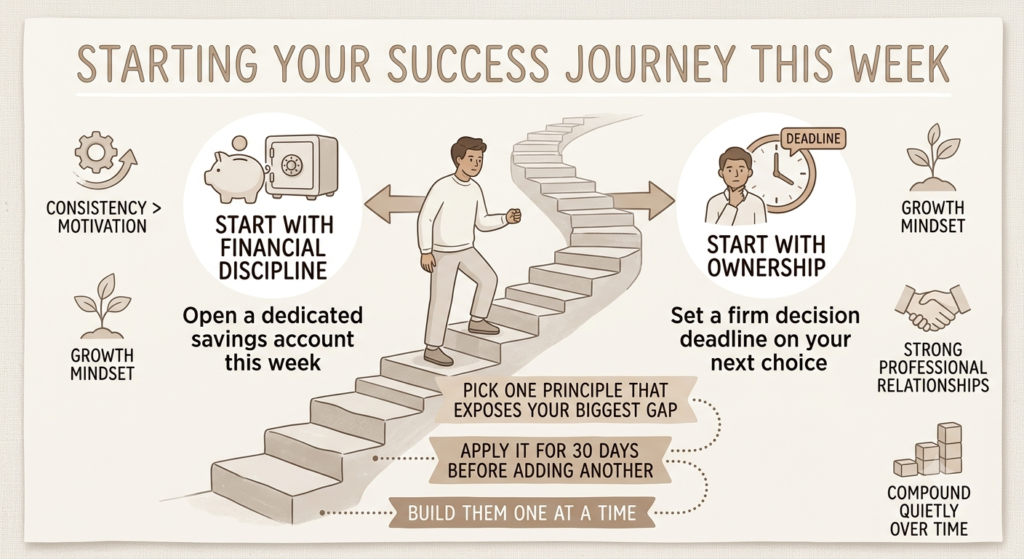
Reading about timeless success principles is easy. Building them into daily life is where most people stall. A simple way to begin is to pick just one principle from this list, the one that exposes your biggest current gap, and apply it for thirty days before adding another.
If your finances feel shaky, start with financial discipline and open a dedicated savings account this week. If your business has stalled because you keep second-guessing decisions, start with ownership and set yourself a firm decision deadline on the next choice in front of you. Stacking all ten principles at once rarely works. Building them one at a time does.
Key Takeaways
- Timeless success principles endure because they address human behavior, not specific tools or trends, which is why they stay relevant even as technology and markets shift.
- Self-discipline and consistency matter more than motivation, because systems do not depend on how you feel on a given day.
- Delayed gratification and a growth mindset both show real, if nuanced, links to better outcomes, and neither works as a one-time fix; both require ongoing practice.
- Financial discipline, particularly building even a small emergency fund, is one of the most under-practiced principles despite being one of the most protective.
- Resilience, continuous learning, and strong professional relationships are becoming more valuable, not less, as automation reshapes the job market.
- Long-term thinking, ownership, and consistency rarely produce dramatic single moments of success. They compound quietly, which is exactly why so many people underestimate them.
Conclusion
None of the ten principles in this article are new, and that is precisely the point. Self-discipline, delayed gratification, a genuine growth mindset, financial discipline, resilience, continuous learning, strong relationships, long-term thinking, ownership, and consistency have supported people through economic booms, recessions, and every technological shift in between.
The businesses and careers that hold up over time are rarely built on a single clever idea. They are built on the quiet, repeated application of principles like these, long after the initial motivation to start has faded. Pick one, start today, and let the rest compound.
Frequently Asked Questions
What are timeless success principles? Timeless success principles are habits and ways of thinking, such as self-discipline, resilience, financial discipline, and long-term thinking, that consistently support good outcomes regardless of changes in technology, industry, or economic conditions.
Why do timeless success principles matter more than trending productivity hacks? Trends and hacks tend to solve a narrow, temporary problem. Principles address the underlying behavior driving your results, which is why they continue working even after the specific tool, app, or trend that inspired them has disappeared.
How long does it take to build a habit like self-discipline or consistency? There is no fixed universal timeline, and it varies by person and habit complexity. What matters more than a specific number of days is designing your environment and routines so the habit requires less willpower over time, rather than relying on motivation to sustain it indefinitely.
Is a growth mindset backed by real research, or is it overhyped? Both, to some degree. Recent research shows real associations between a growth mindset and outcomes like workplace well-being and performance, but the effect is more modest and inconsistent than the popular version of the concept suggests, especially when it is treated as a belief alone without deliberate practice attached to it.
What is the fastest way to start building financial discipline? Start with a small, specific target, such as $500 in a separate account, and automate a fixed transfer into it. Financial professionals note that increasing income can move the needle faster than cutting expenses alone for households that are already stretched thin.
Can these principles apply outside of business, such as in personal life? Yes. Every principle covered here, from delayed gratification to consistency to resilience, applies just as directly to health, relationships, and personal goals as it does to business and career growth.