
Most people think entrepreneurship is about the idea. The pitch deck, the product, the funding round. But spend enough time around founders who last, and you notice something else. The idea rarely stays the same. What stays the same is how they think.
That way of thinking has a name: the entrepreneur mindset. It is not a personality type you are born with, and it is not a collection of motivational quotes. It is a set of habits, decisions, and mental patterns that determine whether you build something that survives contact with reality.
This matters more in 2026 than it did a few years ago. Markets are moving faster, technology is shifting monthly, and the pressure on founders has never been more visible. If you are starting a business, running one, or trying to figure out why some people seem to handle chaos better than others, this guide breaks down exactly what the entrepreneur mindset looks like in practice, what the data says about it, and how to actually build it.
You do not need to have quit a job or raised a funding round for any of this to apply. The habits that make a founder resilient are the same habits that make a freelancer sustainable, a side-hustle profitable, or a small team more effective under pressure. What changes at scale is the stakes, not the underlying pattern.
What This Way of Thinking Actually Means
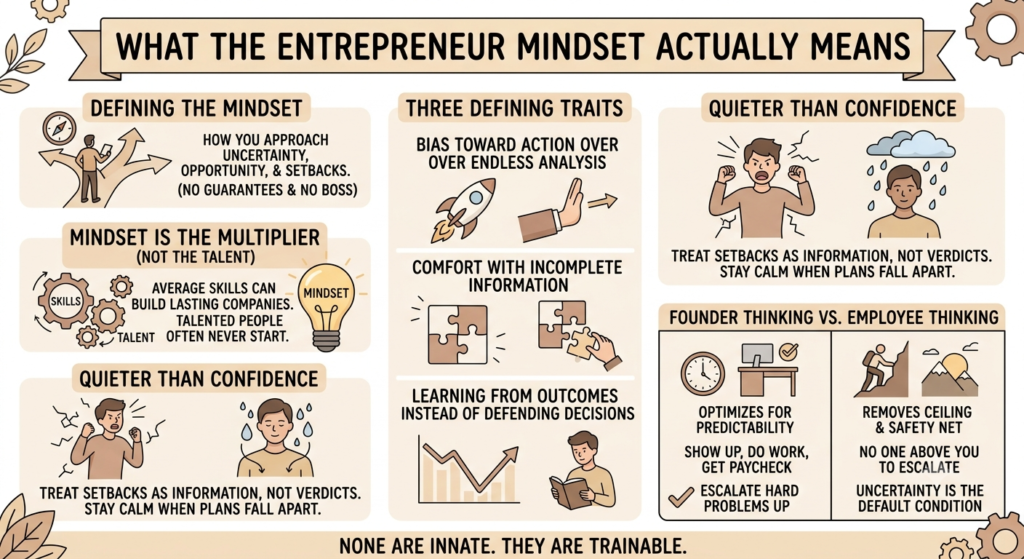
The entrepreneur mindset is the way a person approaches uncertainty, opportunity, and setbacks when there is no guaranteed outcome and no one above them to make the final call.
It shows up in how you treat a failed product launch. It shows up in how you handle a customer who churns, a co-founder who disagrees with you, or a month where revenue drops for no obvious reason. People with a strong entrepreneur mindset do not avoid these moments. They have a repeatable way of processing them without losing momentum.
This is worth separating from talent. Plenty of talented people never start anything, and plenty of average-skilled founders build lasting companies because they think differently about risk, time, and failure. Mindset is the multiplier, not the raw material.
It is also worth separating from confidence. Confidence can be loud and still be fragile. The entrepreneur mindset is quieter. It looks like someone who stays calm when a plan falls apart, not because they are unbothered, but because they have trained themselves to treat setbacks as information rather than verdicts.
Three things tend to define it consistently across founders who succeed over the long run:
- A bias toward action over endless analysis
- Comfort with incomplete information
- A habit of learning from outcomes instead of defending decisions
None of these are innate. They are trainable, and that is the most useful thing to understand before going any further.
Founder Thinking vs. Employee Thinking: What Actually Changes
It helps to be specific about what shifts when someone moves from working for a company to building their own. The skills do not disappear. The relationship to risk and reward does.
An employee mindset, by design, optimizes for predictability. Show up, do the work, get the paycheck, escalate the hard problems to someone above you. There is nothing wrong with this. Most organizations need people who think this way to function well.
The entrepreneur mindset removes that ceiling and that safety net at the same time. There is no one above you to escalate to. There is also no guaranteed paycheck at the end of the month. That combination changes how a person has to relate to uncertainty, because uncertainty is no longer something to be managed by someone else. It becomes the default operating condition.
This is why people who are excellent employees sometimes struggle badly in the first year of running their own business, and why the shift is uncomfortable even for talented, hardworking people. The skills transfer. The mindset has to be rebuilt from a different foundation, one where ambiguity is normal rather than an exception to be escalated away.
What the Data Says About Founder Success in 2026
The numbers behind entrepreneurship this year tell a more complicated story than most people expect. On one hand, participation is up. The Global Entrepreneurship Monitor’s most recent report put the Total Early-Stage Entrepreneurial Activity rate in the United States at 15 percent, meaning more people are choosing to build something of their own rather than take a fixed salary. Globally, the same research estimates close to 665 million people were engaged in some form of entrepreneurial activity.
On the other hand, the odds of any single venture surviving remain tough. U.S. Bureau of Labor Statistics data shows roughly 80 percent of new businesses make it through their first year, but survival rates fall off sharply after that, and depending on the dataset and time frame, the overall startup failure rate across the first several years lands somewhere between 70 and 90 percent.
What separates the businesses that make it from the ones that do not is rarely the idea itself. A National Business Capital and Services survey found that 38 percent of entrepreneurs named self-discipline as the single biggest factor in their success, ahead of people skills and passion. Founders who fail tend to share a different pattern: they misjudge the market, delay hard hiring decisions, or hold onto a strategy long after it has stopped working, according to 2026 research from Wilbur Labs based on interviews with 200 U.S. tech founders.
There is also a growing body of research connecting mindset directly to outcomes. A study from the Equity Accelerator, conducted with the Ewing Marion Kauffman Foundation, tracked 300 entrepreneurs and found that founders with a more growth-oriented way of thinking built more flexible, adaptable companies with cultures that were rated as more innovative and less internally competitive. In other words, how a founder thinks does not just affect their own decisions. It shapes the entire organization underneath them.
It is also worth noting who is actually starting these businesses, because the popular image is often wrong. Research from MIT and the Kauffman Foundation found the average age of a successful startup founder is closer to 45 than the twenty-something dropout of popular imagination. In a separate 2026 survey of tech founders, 58 percent had started their first company between the ages of 30 and 39, and only 20 percent took the leap before turning 30. Experience, it turns out, tends to matter more than youthful risk appetite when it comes to actually building something that lasts.
Core Traits That Define Strong Founder Thinking
Certain traits show up again and again in founders who build companies that last. None of them are mysterious, and none require a specific personality type.
Discipline Over Motivation
Motivation is unreliable. It shows up when things are going well and disappears the moment they are not. Founders with a strong entrepreneur mindset do not wait to feel motivated before doing the unglamorous work: following up with a slow-paying client, fixing a broken process, or having a hard conversation with a team member.
This is why discipline consistently outranks passion in survey data on founder success. It is not about grinding harder. It is about doing the necessary thing regardless of how you feel about it that day.
Managing Risk Like a Skill, Not a Gamble
There is a persistent myth that entrepreneurs are wild risk-takers. The reality is closer to the opposite. Experienced founders tend to be skilled at breaking a big, scary decision into smaller, testable pieces. They run a pilot before a full rollout. They validate demand before building the full product. They protect enough cash to survive a bad quarter.
This is the practical meaning of calculated risk-taking: accepting uncertainty while actively working to reduce the size of a potential mistake. It looks bold from the outside, but it is closer to disciplined experimentation than gambling.
A Growth-Oriented Way of Thinking
Founders who treat failure as data, not identity, tend to recover faster and iterate more effectively than those who treat every setback as proof they are not cut out for this. A growth mindset, in the entrepreneurial context, is the belief that skills, judgment, and even the business itself can be developed through effort and feedback rather than being fixed from day one.
This shows up in small, everyday moments. A founder with this orientation reads a harsh customer review and asks what it reveals about the product. A founder without it reads the same review and either dismisses it or spirals.
Resilience and Adaptability
The pace of change in 2026 has made rigid five-year plans close to useless. Founders who are thriving right now tend to treat their business as something closer to a living system than a fixed blueprint, testing assumptions continuously and adjusting course without treating every pivot as a failure.
Resilience here does not mean never feeling discouraged. It means having a process for getting back to work the next day anyway, and that process, repeated often enough, is what business resilience actually looks like from the inside.
Purpose and Long-Term Vision
Purpose is what keeps a founder in the game during the stretch where nothing is working and there is no applause for showing up. It is different from a mission statement on a website. It is the specific, personal reason someone is willing to tolerate years of uncertainty for a payoff that is not guaranteed.
Founders who can articulate this clearly tend to make more consistent decisions, because they have a filter for saying no to opportunities that do not serve the actual goal.
Comfort With Imperfect Decisions
The entrepreneur mindset includes a tolerance for making decisions without complete information, because complete information almost never exists in a growing business. Waiting for certainty is itself a decision, and it is usually the wrong one.
Founders who build this skill get faster at spotting the difference between decisions that are reversible, where speed matters more than precision, and decisions that are not, where it is worth slowing down.
Emotional Regulation Under Pressure
There is a specific skill that rarely gets named directly in entrepreneurship advice: the ability to feel a strong emotion, a bad sales call, a missed payroll, an investor who says no, without letting that emotion dictate the next decision.
This is not the same as suppressing feelings or pretending everything is fine. It is the gap between the moment something goes wrong and the moment you respond to it. Founders who train this gap tend to send calmer emails, run better team meetings during a crisis, and avoid the kind of reactive decisions that feel satisfying in the moment and cost far more later.
It is also one of the more trainable traits on this list. Simple practices, waiting a few hours before replying to bad news, talking it through with someone outside the business before acting, build this capacity faster than most people expect.
The Hidden Cost: Burnout and the Limits of Hustle
None of the traits above hold up under chronic exhaustion, and this is the part of the entrepreneur mindset conversation that gets skipped too often.
The numbers here are hard to ignore. Research from Wilbur Labs found that 90 percent of founders in their 2026 survey reported stress or burnout severe enough that it made them consider quitting. Separate research published through UCSF and reported by Fortune found that 87 percent of founders experience anxiety, depression, or burnout at some point. A 2026 survey of California tech founders found that 73 percent reported what researchers called shadow burnout: persistent exhaustion and cynicism hidden behind continued high performance, which is arguably more dangerous than obvious burnout because it goes unnoticed for longer.
Founder burnout is not just a personal wellness issue. It has measurable business consequences. Founders operating in a state of chronic overload report avoiding decisions rather than making bad ones, over-researching instead of shipping, and demanding unnecessary perfection as a way of stalling. This pattern often gets mistaken for high standards when it is closer to a stress response.
Part of what drives this is the sheer volume of choices founders face daily. Research from Columbia University estimates the average CEO makes around 35,000 decisions per day, and for solo founders without an executive team to delegate to, that number climbs even higher. This is where decision fatigue becomes a real operational risk rather than an abstract concept: judgment quality degrades measurably as the number of choices a person has already made that day increases.
The lesson here is not that founders should push through discomfort as a badge of honor. It is that protecting mental bandwidth is part of the job, not separate from it. The strongest entrepreneur mindset includes knowing when to rest, delegate, or simplify, because a depleted founder makes worse decisions regardless of how disciplined they normally are.
How AI Is Reshaping Entrepreneurial Decision-Making in 2026
One of the biggest shifts in how founders operate this year is how much decision-support work has moved from paid advisors to tools founders run themselves.
According to U.S. Bank’s 2026 Small Business Perspective Survey, 75 percent of small businesses now use generative AI, most heavily for marketing, content, and research tasks that used to be outsourced. The Small Business & Entrepreneurship Council’s 2026 Tech Use Survey found that 82 percent of small business employers have invested in AI tools, with the average business now running a stack of about five different tools across research, content, automation, and financial management.
This shift is not just about saving time. Leaders at LinkedIn’s economic research team have pointed out that adopting AI tools is helping small businesses accelerate decision-making and free up space for the relationship-building and strategic thinking that software cannot do. That distinction matters. The entrepreneur mindset is not being replaced by these tools. It is being tested by them, because the founders getting real value are the ones who still apply judgment to what the tool produces rather than accepting the first output.
There is a gap worth noting here too. Goldman Sachs’ 2026 research on small businesses found that while a large majority now use AI in some form, only a small fraction have fully integrated it into their core operations. The founders pulling ahead are not the ones using the most tools. They are the ones who have figured out which decisions still need a human, and which ones do not.
This creates a new kind of judgment call that did not really exist a few years ago. It is no longer just about whether to trust your gut or the spreadsheet. It is about deciding which tasks are safe to hand to a tool and which ones still require the specific, personal context only a founder has. Getting that split wrong in either direction, over-trusting automation or refusing to use it at all, is becoming its own competitive disadvantage.
The IEEE’s 2026 global technology survey found that the large majority of technologists expect this shift toward autonomous, task-completing AI to keep accelerating through the rest of the year, moving well beyond simple content generation into scheduling, research, and operational decision support. Founders who build the habit of reviewing AI output critically, rather than treating it as a finished answer, are the ones best positioned to benefit as these tools keep expanding into more of the day-to-day running of a business.
Five Practical Ways to Build This Way of Thinking
Mindset is not something you either have or lack. It is built through repeated, specific habits. Here are five that consistently show up in founders who develop it deliberately.
1. Define Your Reason Before You Need It
Write down, in one or two sentences, why this business matters enough to you to tolerate a hard year. Do this before things get difficult, not during. When you are exhausted and second-guessing everything, you will not have the clarity to write it well. You will need to read it instead.
2. Build Systems, Not Willpower
Relying on willpower alone is a losing strategy over a long timeline. Instead, build small systems that make the right behavior automatic: a weekly review of your numbers, a standing check-in with a mentor, a rule that you sleep on any decision above a certain dollar amount. Systems remove the need to be disciplined in the moment because the discipline is already built into the routine.
3. Practice Making Reversible Decisions Fast
Get in the habit of asking one question before any decision: can this be undone if it turns out to be wrong? If yes, decide quickly and move on. If no, take the time it deserves. This single habit does more to fix decision paralysis than almost anything else, and it frees up mental energy for the decisions that actually require it.
4. Actively Seek Disconfirming Feedback
It is easy to surround yourself with people who agree with you. Deliberately ask a customer who churned why they left. Ask an employee what they would change about how you lead. This is uncomfortable, and that discomfort is exactly why most founders skip it, which is also why the ones who do not skip it improve faster than their peers.
5. Protect Recovery Like It Is Part of the Job
Block time that has nothing to do with the business, and treat it as non-negotiable rather than optional. This is not indulgence. Founders who build in real recovery time consistently report clearer thinking and fewer of the avoidance patterns that come with chronic overload. A business built on a founder running on empty is not actually stable, no matter how the numbers look this quarter.
Common Mindset Mistakes That Derail Entrepreneurs
Even capable founders fall into predictable traps. Watching for these early can save years of wasted effort.
Confusing busyness with progress. Long hours feel productive, but working sixty or seventy hours a week on the wrong priorities is worse than working fewer hours on the right ones. Activity is not the same as movement toward the goal.
Treating every piece of criticism as either total truth or complete noise. The skill is filtering feedback for the useful signal inside it, not accepting or rejecting it wholesale based on how it makes you feel.
Refusing to delegate until it is too late. Many founders hold onto tasks that drain them because delegating feels like losing control. By the time they let go, they are already deep into overload, and the business has usually plateaued as a result.
Chasing certainty before acting. Waiting for a perfect plan before launching, hiring, or pricing a product is a way of avoiding risk that quietly costs more time than an imperfect action taken early.
Ignoring the compounding value of patience. Founders chasing quick wins often skip the unglamorous groundwork, like building repeat customer relationships or refining a process, that pays off later. Delayed gratification is unfashionable advice, but it remains one of the clearest predictors of who is still standing five years in.
Isolating instead of building a support network. Founders who try to carry everything alone report higher loneliness and worse mental health outcomes than those who maintain a peer group, a mentor, or a coach they can be honest with.
None of these mistakes are signs of a bad founder. They are common precisely because the pressures that create them, uncertainty, exhaustion, fear of losing control, are built into the job itself. Recognizing the pattern early is what makes the difference between a temporary rough patch and a habit that quietly erodes the business over several years.
How to Tell If You Are Actually Building This Mindset
It is easy to read a list like this and feel like you already agree with all of it, without anything changing in how you actually operate. A few honest checkpoints help separate real progress from familiarity with the concept.
Notice how you respond the next time something goes wrong that is genuinely out of your control. Do you spend the next hour venting, or the next ten minutes figuring out the next move? Neither reaction is shameful, but the ratio between them tends to shift as the mindset develops.
Look at your last five significant decisions. Were any of them delayed purely because you wanted more certainty rather than more information? That gap, between wanting certainty and needing information, is one of the clearest signs of where a founder still has work to do.
Ask someone close to the business, a co-founder, an early employee, a mentor, whether they have noticed you handling setbacks differently over the last six months. Outside perspective catches changes that are hard to see from inside your own head.
None of these checkpoints require dramatic proof. Small, consistent shifts in how you respond to pressure are the actual signal, not a single defining moment of resilience.
Key Takeaways
- The entrepreneur mindset is a trainable set of habits around risk, failure, and decision-making, not a fixed personality trait.
- Discipline consistently outranks passion and people skills as the top predictor of founder success in recent survey data.
- Burnout affects the large majority of entrepreneurs and directly damages decision quality, not just wellbeing.
- AI tools are reshaping how founders make decisions in 2026, but judgment and human relationships remain the deciding factor in outcomes.
- Small, specific habits, not motivation, are what actually build a durable entrepreneur mindset over time.
Frequently Asked Questions
Is the entrepreneur mindset something you are born with, or can it be learned? It can be learned. Research on growth-oriented thinking among founders shows that the underlying beliefs and habits behind entrepreneurial success can be developed through deliberate practice, feedback, and repetition, regardless of natural temperament.
What is the biggest factor separating successful entrepreneurs from those who fail? Survey data points to discipline as the single largest factor, ahead of passion, funding, or even the strength of the original idea. Founders who fail tend to share patterns like misjudging the market or delaying hard decisions rather than lacking motivation.
How common is burnout among entrepreneurs? Very common. Multiple 2026 studies put the share of founders reporting significant stress, anxiety, or burnout well above 70 percent, with some research putting it closer to 90 percent. It is one of the most underdiscussed risks in entrepreneurship.
Does having an entrepreneur mindset mean taking big risks? No. Founders who last tend to take calculated, testable risks rather than large, irreversible bets. The mindset is about managing uncertainty carefully, not embracing recklessness.
How is AI changing what the entrepreneur mindset looks like today? AI has shifted a lot of research, content, and administrative decision-making onto tools founders run themselves. This has not replaced judgment. It has made the ability to evaluate AI output critically a core part of modern entrepreneurial thinking.
Can an entrepreneur mindset help outside of running a business? Yes. The core habits, tolerating uncertainty, learning from setbacks, making decisions with incomplete information, transfer directly to careers, leadership roles, and personal goals outside of business ownership.
Conclusion
The entrepreneur mindset is not about being fearless, and it is not about working yourself into the ground. It is a set of habits around how you handle uncertainty, how you recover from setbacks, and how honestly you evaluate your own decisions.
The founders who last are not the ones who never struggle. They are the ones who have built a repeatable way of moving forward anyway, and who have learned, often the hard way, that protecting their own capacity to think clearly is not separate from building the business. It is the business.
If you are early in that process, start smaller than you think you need to. Pick one habit from this guide. Build it into your week. The mindset follows the practice, not the other way around.
There is no finish line where the entrepreneur mindset is fully built and never needs attention again. Markets shift, teams grow, and the challenges that tested you last year will look different next year. What stays consistent is the discipline of returning to the same core habits, protecting your capacity to think clearly, learning from what goes wrong instead of defending it, and making decisions without waiting for certainty that will never fully arrive.
That consistency, more than any single insight in this guide, is what separates founders who are still building five years from now from those who quietly stopped.
SEO & Publishing Package
SEO Title: The Entrepreneur Mindset: How Founders Really Think
URL Slug: entrepreneur-mindset-how-founders-think
Meta Description: Discover what the entrepreneur mindset really means in 2026, the traits behind lasting success, and practical steps to build resilience and clarity.
Focus Keyword: entrepreneur mindset
Secondary Keywords: growth mindset, founder burnout, decision fatigue, calculated risk-taking, self-discipline, business resilience, startup failure rate, delayed gratification
Internal Linking Suggestions
- Link “self-discipline” or “discipline” mentions to a related article on daily habits or consistency, if one exists on PrajwalShah.com.
- Link the burnout section to a dedicated article on managing founder stress or work-life balance, if available.
- Link the AI section to any existing content on business automation or productivity tools.
- Link the decision-making section to an article on business decision-making frameworks, if published.
Image Suggestions & Alt Text
- A founder reviewing notes or a whiteboard alone in a quiet office. Alt text: “Entrepreneur reviewing business decisions and building a strong entrepreneur mindset”
- A small team in a focused planning meeting. Alt text: “Founding team practicing calculated risk-taking during a strategy session”
- A person taking a break outdoors, away from a laptop. Alt text: “Entrepreneur protecting recovery time to avoid founder burnout”
- A simple chart or graphic representing decision-making under uncertainty. Alt text: “Visual representing decision fatigue and entrepreneurial decision-making”
Social Media Excerpt (100 words)
Most people think entrepreneurship is about the idea. It is not. It is about how you think when the idea stops working the way you planned. The entrepreneur mindset, self-discipline, calculated risk-taking, resilience under pressure, is not something you are born with. It is built through repeatable habits, and the data backs this up: founders who develop it consistently outperform those relying on motivation alone. This guide breaks down what the research says about founder success in 2026, the hidden cost of burnout most people ignore, and five practical habits you can start building this week.
LinkedIn Post
Most people think entrepreneurship is about the idea.
It is not. It is about how you think when the idea stops working the way you planned.
Survey data consistently shows self-discipline, not passion, not funding, not even the strength of the original idea, is what separates founders who last from those who do not.
But there is a piece of this conversation that gets skipped too often: the hidden cost. Recent research puts founder burnout well above 70 percent, and it directly damages decision quality, not just wellbeing.
I broke down what the entrepreneur mindset actually looks like in practice: the traits behind lasting success, what the 2026 data says about founder resilience, how AI is reshaping day-to-day decision-making, and five specific habits you can start building this week.
Link in comments.
Five Tweet/X Ideas
- Motivation is unreliable. It shows up when things are easy and disappears when they are not. Discipline is what fills the gap. That is the entrepreneur mindset in one sentence.
- 90% of founders in a 2026 survey said they experienced burnout severe enough to consider quitting. Protecting your mental bandwidth is not separate from the job. It is the job.
- Founders who last are not the biggest risk-takers. They are the best at breaking big, scary decisions into small, testable ones.
- The average founder is closer to 45 than 25. Experience beats youthful risk appetite more often than the startup myth admits.
- If a decision is reversible, decide fast. If it is not, take the time it deserves. This one habit fixes most decision paralysis.
Call-to-Action
If you are building something right now and want a thinking partner who has been through the same uncertainty, reach out to Prajwal Shah directly, or subscribe for more practical, no-hype breakdowns of what actually drives long-term business success.