
Most entrepreneurs don’t fail because they lack ambition. They fail because their days run them instead of the other way around. By the time email, Slack, and back-to-back calls take over, the hours that actually move a business forward are already gone.
That’s the real story behind the morning routines of successful entrepreneurs. It isn’t about waking up at 4 a.m. or copying a billionaire’s exact schedule. It’s about deciding, before the world starts pulling at your attention, what actually matters today – and protecting the time to act on it.
I’ve built and run businesses long enough to know that motivation is unreliable. Some days you feel driven. Most days you don’t. What separates entrepreneurs who build lasting businesses from those who burn out isn’t a personality trait. It’s a repeatable structure that removes the need for motivation altogether.
This guide breaks down twelve morning habits for success that show up again and again in the daily lives of high-performing founders and business owners. None of them require you to become a different person. They just require you to start your day on purpose instead of by accident. What follows is a close look at the morning routines of successful entrepreneurs, backed by current research rather than borrowed folklore.
Why Morning Routines Matter More Than Motivation
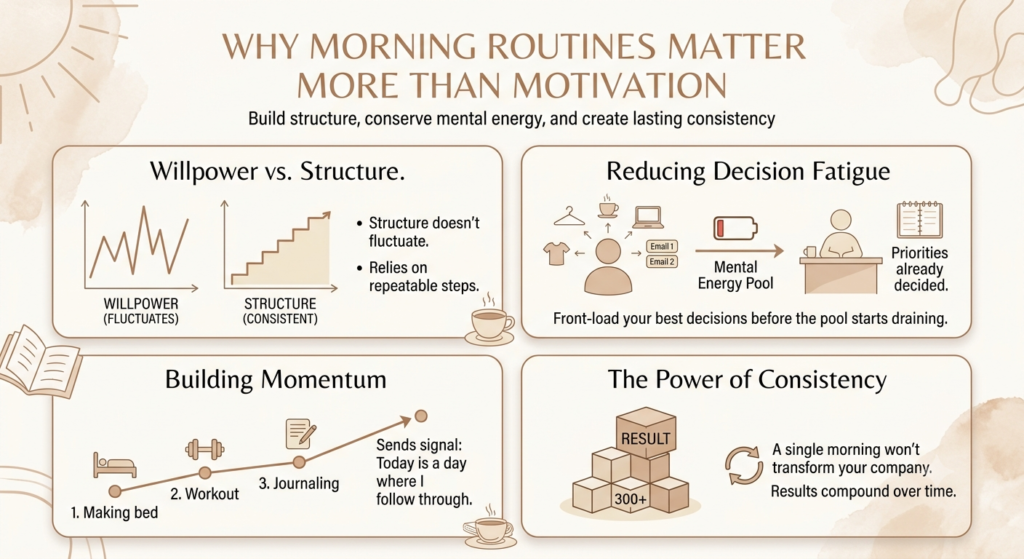
Willpower fluctuates. Structure doesn’t. That’s the core reason a strong morning routine outperforms relying on motivation alone, especially when you’re running a business where the to-do list never actually ends.
Reducing Decision Fatigue Before It Starts
Every choice you make draws on the same limited pool of mental energy – what to wear, what to eat, which email to answer first, which fire to put out. Psychologist Roy Baumeister’s early research on self-regulation popularized the idea that this pool can run dry over the course of a day, and while later large-scale replications have found the specific “willpower as fuel” mechanism weaker than first believed, the broader pattern holds up: sustained decision-making is mentally costly, and the cost shows up as worse, slower, or more avoidant choices later in the day.
A 2025 systematic review in Health Psychology Review looked at decision fatigue among healthcare professionals – a group working in one of the most structured, protocol-driven environments there is – and still found meaningful evidence of fatigue effects across diagnostic and prescribing decisions. If decision fatigue can reach professionals working inside tight clinical guardrails, it’s reasonable to expect it hits harder in the far less structured world of running a business, where founders make dozens of unstructured calls before lunch.
A morning routine works because it front-loads your best decisions – your priorities, your focus, your intentions – before the pool starts draining. You’re not deciding what matters at 2 p.m. when you’re tired. You already decided at 7 a.m. when you were sharp.
This is also why so many experienced founders describe their morning as the only part of the day they truly control. Once the first call starts, the day belongs partly to clients, partly to the team, and partly to whatever unplanned problem shows up. The morning, before any of that begins, is the one stretch of time an entrepreneur can shape entirely on their own terms.
Building Momentum Through Small Wins
Every completed step in a morning routine is a small, low-stakes win. Making the bed, finishing a workout, closing a journal entry – none of these single-handedly build a business. But stacked together, they send your brain a consistent signal: today is a day where I follow through. That signal carries into bigger decisions later.
How Routines Improve Consistency and Long-Term Performance
Business results compound. A single great morning won’t transform your company, but three hundred of them in a row will. This is the actual argument for consistency over intensity – a theme that shows up throughout entrepreneur habits research and one worth keeping in mind as you read the rest of this list. The goal was never a perfect morning. It’s a repeatable one.
Habit #1 – Wake Up with a Purpose, Not Just Earlier
The “wake up at 4 a.m. or you’re not serious about success” advice has become almost a meme in entrepreneurship content, and it does more harm than good for most people.
Quality Sleep Over Extreme Wake-Up Times
What the research on morning performance actually supports is consistency, not extremity. A 2026 review on how morning routines shape cognitive performance, mood, and circadian rhythm, published in Medical Hypotheses, points to sleep timing and sleep consistency – not an arbitrarily early alarm – as the stronger predictor of next-day mental sharpness. A 2025 randomized crossover study published in the journal Life found that a single night of extended sleep meaningfully improved both physical and cognitive performance the next morning across different times of day, reinforcing that rested brains outperform merely early ones.
Business owner productivity depends far more on sleep quality than on how many hours before sunrise you’re at your desk. If 5:30 a.m. genuinely works with your biology and your household, use it. If it means you’re running on five hours of broken sleep, you’re not gaining an edge – you’re borrowing against tomorrow’s focus.
Creating Uninterrupted Planning Time
What actually matters is carving out a window – 30, 60, or 90 minutes – before your day fills up with other people’s requests. Some founders get that window at 5:30 a.m. Others, especially those with young kids or non-standard schedules, find it at 6:45 a.m. or even later. The point of waking early isn’t the hour on the clock. It’s the uninterrupted stretch it buys you.
Why Consistency Beats Waking Up at 4 A.M.
A regular wake-up time – even one that varies by only 15 to 20 minutes day to day – helps regulate your circadian rhythm, which in turn stabilizes energy, mood, and focus. A wake-up routine built around a time you can actually sustain for years will outperform a heroic 4 a.m. schedule you abandon after eleven days.
Habit #2 – Avoid Your Phone for the First 30 Minutes
This is one of the hardest habits on this list and also one of the most consequential.
Protecting Focus from Notifications
Recent survey data paints a stark picture of how automatic this behavior has become. One 2026 industry survey found that roughly 80 percent of people check their phone within ten minutes of waking. Separate research from Reviews.org has put the figure even earlier, with a large share of users reaching for their device within the first five minutes of opening their eyes. Once you check your phone, you’ve handed the first decision of your day – and your attention – to whoever sent the most urgent-looking notification overnight.
Preventing Reactive Thinking
Opening email or Slack before you’ve decided what matters puts you in reactive mode before you’ve had the chance to set your own agenda. You’re now responding to someone else’s priorities instead of executing your own. For entrepreneurs, whose job is fundamentally about setting direction rather than just processing inputs, this is a costly trade to make before 7 a.m.
Starting the Day Intentionally
A simple rule works well here: no phone until your first task, your workout, or your planning session is done – whichever comes first in your routine. It doesn’t need to be a full digital detox. It just needs to delay the moment your attention gets hijacked.
Habit #3 – Move Your Body
Movement is one of the most consistently cited habits across successful entrepreneur habits research, and it earns its place for reasons that go beyond general health.
Walking, Stretching, or Exercising
You don’t need a 90-minute gym session. Andrea Heuston, founder and CEO of Artitudes Design, has described starting nearly every day with an hour-long walk or treadmill session specifically because it clears her head before creative work. Other founders favor a 15-minute walk paired with morning coffee, or a short bodyweight routine before showering. The form matters less than the consistency.
Benefits for Energy, Mood, and Cognitive Performance
The science backs this up directly. Research summarized by Technology Networks and drawing on work from University College London has shown that older adults who engage in more moderate-to-vigorous physical activity on a given day perform measurably better on memory tests the following day – evidence that exercise’s cognitive benefits can persist well beyond the workout itself. A 2025 study on morning-trained individuals published in Clocks & Sleep found that moderate-intensity exercise enhances cognitive function, and that this effect interacts with a person’s circadian rhythm and chronotype.
Separately, a 2025 school-based study on adolescents found that physical activity performed in the morning produced significantly stronger improvements in attention, working memory, and processing speed than the same activity performed at midday or in the afternoon – suggesting timing itself, not just movement, plays a real role in the payoff.
Why Entrepreneurs Prioritize Movement
For a founder, the return on 20 minutes of morning movement isn’t abstract wellness – it’s sharper attention during the two or three decisions that day that actually matter. Exercise physiologist and public health researcher Professor Andrew Steptoe has noted that identifying modifiable daily factors that support cognitive function matters because maintaining that function is directly tied to quality of life and independence over time – a principle that applies just as much to a 35-year-old founder managing decision-heavy days as it does to the older adults his research more commonly focuses on.
There’s also a practical, business-level reason movement earns a permanent spot in a founder’s daily lineup: it’s one of the few habits on this list that pays off almost immediately. You don’t need weeks of consistency to feel the difference a brisk walk makes to your focus an hour later. That fast feedback loop is part of why it tends to be the habit founders keep even when everything else in their schedule falls apart during a chaotic launch week or a hiring crunch.
Habit #4 – Spend Time in Silence
Quiet, unstructured time is rare for anyone running a business, which is exactly why the entrepreneurs who protect it tend to stand out.
Meditation
Meditation doesn’t need to be an hour on a cushion. Ten minutes of focused breathing is enough to shift your nervous system out of the reactive state most people wake up in, especially after checking a phone full of overnight messages.
Deep Breathing
Even outside formal meditation, a few minutes of slow, deliberate breathing lowers physiological arousal – heart rate, blood pressure, cortisol – and creates a calmer starting point for the rest of the day.
Prayer or Mindfulness
For many founders, this time takes the shape of prayer, quiet reflection, or simply sitting with a cup of coffee before the noise starts. A 2025 study published in the International Journal of Environmental Research and Public Health, looking at healthcare workers, found a measurable link between morning meditation practices, sleep quality, and better affective – emotional – health outcomes.
Improving Emotional Control Before Work
Running a business means absorbing bad news, difficult conversations, and unexpected setbacks on a near-daily basis. Entrepreneurs who build in quiet time before the day starts tend to handle those moments with more composure, simply because they aren’t starting the day already at a heightened stress baseline.
Habit #5 – Review Your Vision and Goals
It’s easy to spend an entire quarter reacting to operational fires without ever touching the reason you started the business in the first place.
Reconnecting with Long-Term Purpose
A short daily glance at your written goals – even 60 seconds – keeps your day’s tasks tethered to your actual direction. Without this check-in, it’s dangerously easy to stay busy while drifting away from what you set out to build.
Daily Visualization
Some entrepreneurs spend a few minutes each morning picturing a specific outcome they’re working toward – a product launch, a revenue milestone, a team hire. This isn’t magical thinking. It’s a simple mental rehearsal technique that keeps the goal top of mind when you’re deciding how to spend your next hour.
Keeping Priorities Aligned with Business Goals
If your calendar for the day doesn’t reflect your stated priorities, that mismatch is worth noticing before 9 a.m., not after a wasted week. This is one of the simplest morning routine tips available, and one of the most frequently skipped.
Habit #6 – Journal or Plan the Day
This is where most productive mornings actually earn their return – turning intention into a concrete plan.
Top Three Priorities
Rather than working from an endless task list, identify the three outcomes that would make today a genuine success. If you accomplish nothing else, these three should still get done.
Brain Dump Technique
Before planning, some founders spend five minutes writing down everything currently occupying mental space – half-finished thoughts, nagging worries, random ideas. Getting it onto paper frees up working memory for the actual planning that follows.
Time Blocking
Assigning specific blocks of time to specific tasks – rather than leaving the day open to whatever demands the loudest attention – is one of the most cited daily routine for entrepreneurs strategies for a reason. It turns a vague intention (“I’ll work on the proposal today”) into a scheduled commitment (“9 to 10:30, proposal, no interruptions”).
Eliminating Unnecessary Decisions
Once the day is planned, you no longer have to decide what to do next every 20 minutes. That decision has already been made, which preserves mental energy for the decisions that actually require judgment.
Habit #7 – Learn Something Every Morning
Founders who stay useful over a ten-year horizon tend to share one habit: they never stop taking in new information.
Reading Books
Warren Buffett has long described spending the majority of his working day reading, framing knowledge as something that compounds the way interest does – read consistently enough, and the advantage builds on itself over years. You don’t need 80 percent of your day. Even 15 to 20 focused minutes each morning adds up to dozens of books a year.
Listening to Podcasts
For founders whose mornings involve a commute, a workout, or meal prep, podcasts fill dead time productively. Industry-specific shows are especially valuable – they keep you current on competitor moves and shifting customer expectations without requiring dedicated reading time.
Industry News
A quick, focused scan of industry news – not a doom-scroll through general news – keeps you aware of shifts that could affect pricing, supply, or customer behavior before they blindside you.
Continuous Learning as a Competitive Advantage
In fast-moving markets, the founder who’s still learning after year five usually outlasts the one who stopped updating their thinking after year one. This is a quiet but real form of success habits that rarely gets credited publicly, because it doesn’t produce a dramatic before-and-after story – just steady, compounding advantage.
Habit #8 – Create Before You Consume
This is one of the more counterintuitive habits, and also one of the most protective of your best hours.
Work on Your Own Goals First
Before you open email, before you check what anyone else needs from you, spend your sharpest hour on the task that actually moves your business forward – writing, building, planning, deciding. This is when your mind is least cluttered and least reactive.
Delay Emails and Social Media
Email and social platforms are, by design, other people’s agendas delivered to you. Checking them first thing means your first hour of the day is spent on someone else’s priorities instead of yours. Craig Ballantyne, host of Early to Rise Radio, has built his entire framework for high-performing mornings around this exact idea: protecting a “magic time” window before reactivity takes over, arguing that planning – not willpower – is what actually makes the difference.
Protect Deep Work Hours
Whatever single task would most move your business forward if you finished it today – that’s what belongs in your first working hour, before the inbox opens.
Habit #9 – Fuel Your Brain
The physical inputs of your morning matter just as much as the mental ones.
Hydration
Many founders’ first act after waking is a full glass of water – a small habit, but a meaningful one after six to eight hours without fluids. Kat Cole, known for her leadership at brands including Cinnabon and Auntie Anne’s, has spoken about treating this as close to a non-negotiable ritual.
Nutritious Breakfast
Interestingly, a 2025 systematic review in BMC Psychology examining the combined effects of exercise and breakfast on cognitive performance found no strong evidence that breakfast timing or macronutrient content changes the cognitive benefits of morning exercise in healthy adults. In other words, don’t stress over the “perfect” breakfast – consistency and adequate nutrition matter more than any specific formula.
Morning Caffeine Strategy
Caffeine works best when it’s not the first thing your body reaches for. Having water first, and timing caffeine roughly 60 to 90 minutes after waking, tends to produce steadier energy than an immediate large coffee on an empty stomach.
Supporting Sustained Energy and Focus
None of this needs to be complicated. The goal is simply giving your body what it needs to sustain focus through your most demanding hours, rather than running on fumes and hoping willpower fills the gap.
Habit #10 – Practice Gratitude
Of all twelve habits, this is the one most easily dismissed as soft – and the one with some of the strongest research behind it.
Positive Mindset
A study published in the Journal of Personality and Social Psychology found that participants who kept gratitude journals over several weeks reported lower stress levels and a more optimistic outlook than those who didn’t. Neuroimaging research has also shown that expressing gratitude activates brain regions tied to reward, releasing neurochemicals that dampen the body’s stress response.
Lower Stress
A brief gratitude workplace program studied in 2025 and published in the journal Work found that employees who took part reported higher psychological well-being and stronger engagement than a control group – and managers observed a noticeable shift in team climate as a result. If a few minutes of structured gratitude can shift team dynamics, it’s reasonable that a personal daily practice shifts an individual founder’s baseline stress.
Better Resilience During Business Challenges
Running a business involves regular setbacks – a lost client, a missed deadline, a failed launch. Founders who practice gratitude regularly tend to recover from these setbacks faster, not because the setbacks hurt less, but because their baseline emotional state gives them more room to absorb the hit. Even writing down three specific things that went well the previous day, before diving into today’s priorities, is enough to build this habit.
Habit #11 – Protect Deep Work Hours
If Habit #8 is about what you do first, this one is about defending it once you’ve started.
Tackling the Most Important Task First
Complete your single highest-leverage task before checking a single message. This sounds simple and is genuinely difficult, because nearly every tool and notification in modern work is designed to interrupt you.
Avoiding Meetings Early
Founders who protect their mornings for deep work generally push meetings to the afternoon, when energy for high-stakes creative or strategic thinking has naturally declined anyway, but the energy needed for conversation and collaboration hasn’t.
Maximizing Peak Cognitive Performance
Circadian research consistently shows that alertness and executive function follow a predictable daily curve, typically peaking a few hours after waking for most chronotypes. Scheduling your highest-stakes thinking during that window – instead of burning it on email triage – is one of the highest-leverage productivity habits available to any founder, and it costs nothing to implement.
Habit #12 – Build a Routine You Can Actually Sustain
This final habit is really a meta-habit: the discipline to build something that fits your actual life.
Avoid Copying Someone Else’s Schedule
A routine built around a tech founder’s household, team, and time zone won’t necessarily fit a solo consultant, a parent of three, or someone running a business with a physical storefront. Borrow ideas, not entire schedules.
Start with Two or Three Habits
Trying to implement all twelve habits described in this article on Monday morning is a reliable way to abandon all of them by Thursday. Pick two or three that address your biggest current gap – phone use, movement, planning – and build from there.
Focus on Consistency Over Perfection
A routine you follow imperfectly for a year will outperform a “perfect” routine you follow for eleven days and then quit. This single mindset shift, more than any individual habit on this list, is what actually separates people who stick with a new routine from people who don’t.
Common Morning Routine Mistakes Entrepreneurs Should Avoid
Even well-intentioned founders sabotage their own mornings in a few predictable ways.
Checking emails immediately. This hands control of your first hour to whoever emailed you overnight, before you’ve decided anything for yourself.
Hitting snooze repeatedly. Fragmented extra sleep in ten-minute bursts is generally lower quality than simply getting up at the first alarm, and it starts the day with a small, repeated act of self-negotiation that tends to bleed into other decisions.
Trying to follow unrealistic “5 a.m. millionaire” routines. Copying a routine that doesn’t fit your sleep needs, household, or working style is a common reason ambitious founders abandon morning routines altogether within the first two weeks.
Overloading mornings with too many habits. A 90-minute routine with eight sequential steps sounds impressive in a productivity article and often collapses the first time a founder oversleeps by 20 minutes. Build in slack.
Treating the routine as all-or-nothing. One missed morning doesn’t erase months of consistency, but plenty of founders treat it that way and quit entirely after a single bad week. A resilient routine has a built-in fallback – a five-minute version you can do even on your worst day – so a rough morning doesn’t turn into a rough month.
Measuring the routine by someone else’s results. Comparing your six-month-old habit to a founder’s decade-old routine, reported in a polished interview, sets an unfair bar. The realistic timeline for a new habit to feel automatic rather than effortful is closer to two to three months of steady repetition, not two to three days.
Sample 60-Minute Entrepreneur Morning Routine
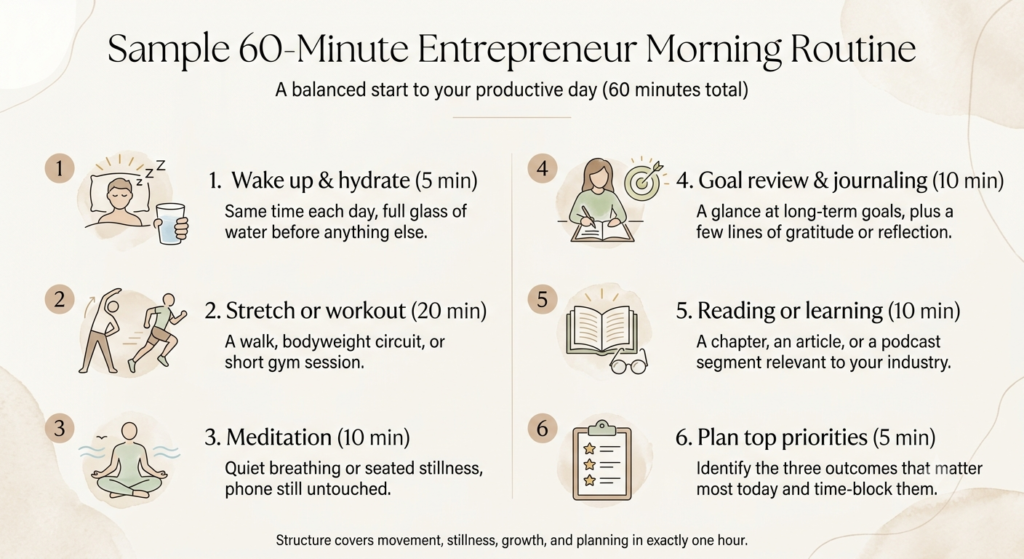
For founders who want a concrete starting point rather than a menu of options, here’s a simple structure worth testing for two weeks before adjusting it:
- Wake up & hydrate (5 min) – Same time each day, full glass of water before anything else.
- Stretch or workout (20 min) – A walk, bodyweight circuit, or short gym session.
- Meditation (10 min) – Quiet breathing or seated stillness, phone still untouched.
- Goal review & journaling (10 min) – A glance at long-term goals, plus a few lines of gratitude or reflection.
- Reading or learning (10 min) – A chapter, an article, or a podcast segment relevant to your industry.
- Plan top priorities (5 min) – Identify the three outcomes that matter most today and time-block them.
This structure covers movement, stillness, growth, and planning in exactly one hour – proof that a genuinely effective entrepreneur morning routine doesn’t require waking up before sunrise or blocking off half your morning.
Final Thoughts
Success doesn’t start when you open your laptop. It starts in the hour before that – in whether you spend it reacting to other people’s demands or executing your own plan.
None of the twelve habits in this guide are complicated, and none require rare discipline or a radically different lifestyle. What they require is repetition. Small, unremarkable actions, done consistently, compound into results that look impressive from the outside but were built quietly, one ordinary morning at a time.
You don’t need someone else’s 4 a.m. routine. You need a routine that fits your actual life, that you can still be doing a year from now, and that gives you back control of the first hour of your day – because that’s the hour, more than any other, that sets the tone for everything that follows. Study the morning routines of successful entrepreneurs for ideas, but build the version that’s actually yours.