
Ask any entrepreneur how they’re doing, and you’ll hear the same word almost every time: busy. It has become the default answer, a badge people wear without thinking twice about it. Say you’re busy, and people nod with something close to respect. Say you have free time, and you almost feel the need to explain yourself.
That reflex says a lot about how we’ve come to measure worth. Somewhere along the way, being in constant motion started to look like the same thing as making progress. Full calendars became proof of importance. Late nights became proof of commitment. Answering messages within minutes became proof that you cared about your business.
None of that is actually proof of anything. It’s just proof that you were active.
This is the trap at the center of hustle culture, and it catches serious, hardworking people just as often as it catches people who are genuinely avoiding real work. You can spend an entire day moving from task to task, clearing your inbox, sitting in meetings, and responding to every notification the moment it arrives, and still end that day no closer to the goals that actually matter to your business. The feeling of progress and the fact of progress are not the same thing, and mistaking one for the other is one of the most expensive habits an entrepreneur can develop.
This article is about the difference between busy vs productive, and why that difference decides whether your effort compounds into something meaningful or simply keeps you tired. You’ll learn what busyness actually looks like once you strip away the illusion, what genuine productivity looks like in practice, why your brain is wired to prefer the former, and how high performers build systems that consistently choose the latter. By the end, you’ll have a practical framework for measuring your days by outcomes instead of hours.
What Does Being Busy Really Mean?
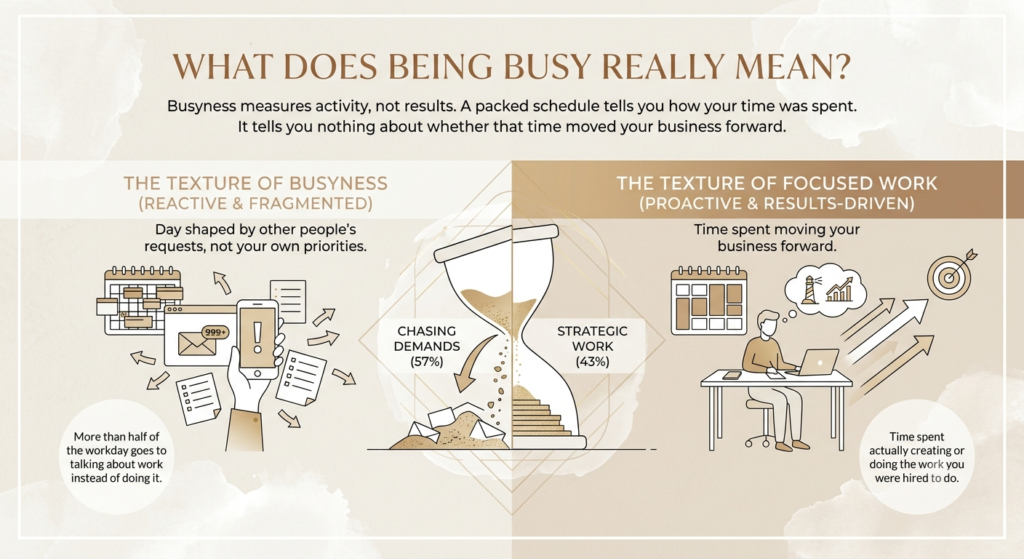
Busyness is easy to spot once you know what to look for, because it has a very specific texture. It’s reactive. It’s fragmented. And most importantly, it’s measured by activity rather than results.
A busy day typically includes some combination of the following:
- Back-to-back meetings that fill the calendar but produce few decisions
- An inbox that never reaches zero, no matter how many hours you spend on it
- A phone that interrupts your train of thought every few minutes
- Switching between four or five tasks without finishing any of them
- A to-do list that grows faster than you can clear it
- Reacting to whatever demands your attention loudest, instead of working from a plan
None of these things are inherently bad. Meetings, emails, and notifications are part of running a business. The problem starts when they become the entire job, when your day is shaped entirely by other people’s requests rather than your own priorities.
Recent workplace data backs this up in a way that should concern any founder or team leader. Analysis of workplace behavior shows that <cite index=”1-1″>knowledge workers spend 57% of their time communicating through meetings, email, and chat, and only 43% of their time actually creating or doing the work they were hired to do</cite>. Put another way, more than half of the average workday now goes to talking about work instead of doing it.
It gets more specific than that. Separate research found that <cite index=”1-1″>53% of workers’ time is spent on busywork such as communicating about tasks, searching for information, and chasing status updates, leaving less than half of their time for the strategic work they were actually hired to do</cite>. That is not a productivity gap caused by laziness. It’s a structural problem, and it’s one that shows up in businesses of every size, including the ones you and I run.
Key takeaway: Busyness measures activity, not results. A packed schedule tells you how your time was spent. It tells you nothing about whether that time moved your business forward.
What Does Being Productive Actually Look Like?
If busyness is about motion, productivity is about direction. It means working with intention toward outcomes that matter, rather than simply staying occupied until the day ends. This is the core of a genuine productivity mindset: choosing your work instead of letting your work choose you.
A genuinely productive day tends to share a few traits:
- The work was chosen deliberately, based on what matters most right now, not just what arrived first
- Time went toward high-impact tasks rather than low-value ones that happened to feel urgent
- The output is measurable. A decision got made. A client problem got solved. A project moved to the next stage.
- The work connects to a longer-term goal, not just today’s fire
- Quality took priority over sheer volume of tasks completed
This is easiest to see in how experienced entrepreneurs actually structure their weeks. Founders who consistently grow their businesses tend to protect blocks of uninterrupted time for the two or three tasks that will genuinely move the needle, and they treat everything else, including email, as work that fits around those blocks rather than the other way around. They ask a simple question before adding anything to their calendar: does this get me closer to the outcome I’m actually trying to create? If the answer is no, it gets delegated, delayed, or dropped.
That question is the entire difference between busy vs productive in one sentence. Busyness asks “what can I get through today.” Productivity asks “what actually needs to happen today.” Those two questions can lead to completely different days, even when the number of hours worked is identical.
Picture two business owners on the same Monday. The first spends the day clearing 80 emails, sitting in four meetings, and updating a project tracker that nobody else reads. By evening, the inbox is empty and the calendar is closed, but nothing about the business is meaningfully different from Sunday night. The second spends the morning in one uninterrupted block finalizing a proposal that closes a major client, batches the remaining emails into a single 30-minute window in the afternoon, and skips two of the four meetings entirely because they didn’t require her input. Both owners worked roughly the same number of hours. Only one of them moved the business forward.
That contrast is the practical test worth applying to any given day: not how full it felt, but what it actually produced.
7 Signs You’re Busy But Not Productive
Some of these will feel uncomfortably familiar. That’s the point. Recognizing the pattern is the first step to breaking it.
1. You answer emails all day, every day. Your inbox never stops, and clearing it feels like an accomplishment even though nothing on your actual priority list moved forward.
2. You constantly multitask. You’re writing a proposal while half-listening to a call while glancing at Slack. It feels efficient. It isn’t.
3. You rarely finish important projects. Big initiatives stall in the “80% done” zone for weeks because smaller, louder tasks keep cutting the line.
4. Your calendar is full, but results are limited. You could show someone your schedule as proof of how hard you work, but you’d struggle to point to what it actually produced this month.
5. Every notification interrupts your focus. A message, an email alert, or a call pulls your attention away, and you never quite get back to the depth of focus you had before the interruption.
6. You confuse urgency with importance. The loudest request wins your attention, even when it has little to do with your actual goals.
7. You end the day exhausted but unfulfilled. You were moving the entire time, yet if someone asked what you actually achieved, you’d have to think hard to answer.
If three or more of these sound like your average week, you’re not alone. But recognizing them is what makes change possible.
Why Our Brain Loves Staying Busy
Understanding why we default to busyness matters just as much as recognizing it, because this isn’t a willpower problem. It’s a wiring problem.
Small, easy tasks give the brain a quick hit of satisfaction the moment they’re checked off. Answering an email feels like progress in a way that three uninterrupted hours on a strategic project doesn’t, because the email has a visible, immediate endpoint. The strategic project doesn’t reward you until much later, so the brain naturally gravitates toward the tasks that pay out fastest, even when they matter least.
Notifications work the same way. Every ping, like, or message carries the possibility of something interesting, and that unpredictability is exactly what keeps people checking. This is one reason task-switching has become so habitual. Data on modern work patterns shows the average knowledge worker switches between roughly ten different apps up to twenty-five times a day, and each of those switches carries a measurable cost to accuracy and speed.
There’s also a social layer to this. In many industries and social circles, being busy has become shorthand for being important. Saying “I have a quiet week” can feel like admitting your business isn’t in demand, even when a quiet week is exactly what allows for the kind of deep thinking that grows a business. That social pressure, combined with hustle culture’s tendency to treat rest as a moral failing, creates what a lot of founders describe as productivity guilt: the sense that if you’re not visibly grinding, you’re falling behind.
There’s a physiological reason this pattern is so hard to break under pressure. Studies of workplace attention have found that people are far more likely to switch to an easy, interrupting task during periods of lower mental demand than during periods of high demand, which suggests the brain actively protects itself from overload by reaching for something simple whenever it can. The trouble is that modern work rarely gives it the chance to rest in that low-demand state on its own terms. Instead, a notification arrives, offers an easy hit of novelty, and the brain takes the exit every time.
Layer decision fatigue on top of that, and the pull toward busyness gets even stronger. Founders without a full leadership team behind them are often making thousands of decisions a day, and as that mental load builds, the easiest path is to default to whatever task feels most urgent rather than whatever task actually matters most. This is not a character flaw. It’s a predictable outcome of how attention and decision-making work under sustained pressure.
None of these forces are going away on their own. But once you can name them, they lose a lot of their grip.
Busy vs Productive: The Key Differences
Laid out side by side, the distinction becomes easier to apply in real time.
Activity vs impact. Busyness counts how many things you did. Productivity asks what changed because you did them.
Reaction vs intention. Busyness responds to whatever shows up. Productivity starts from a plan and works that plan, adjusting only when something genuinely warrants it.
Quantity vs quality. Busyness prizes a long list of completed tasks. Productivity prizes the few tasks that actually mattered, done well.
Urgent vs important. Busyness chases deadlines and loud requests. Productivity protects time for what’s genuinely important, even when nobody is demanding it right now.
Motion vs progress. Busyness feels like movement. Productivity is movement toward something specific, measurable, and worth reaching.
This is the mindset shift that separates founders who scale their businesses from founders who stay exhausted at the same revenue level year after year. It isn’t about working less. Many productive people still work hard hours. The difference is that their hours are pointed at something.
How High Performers Stay Productive Instead of Busy
Knowing the difference between busy vs productive is one thing. Building a routine around it is another. This is where the old advice to work smarter not harder actually earns its place, not as a slogan, but as a set of specific, repeatable habits. Here’s what that actually looks like in practice.
Prioritize the vital few tasks. Most results come from a small number of high-leverage activities, not from clearing every item on a list. Before the day starts, identify the one to three tasks that would make the day a genuine success if nothing else got done, and protect time for those first. Learning to focus on priorities instead of on volume is the single biggest shift most founders can make.
Time block for deep work. Deep, focused work produces outcomes that fragmented attention never will. Recent data on focus patterns found that <cite index=”1-1″>employees get an average of 2.9 focused sessions per week, but say they need 4.2 sessions to actually feel productive</cite>, a gap of more than 30%. Closing that gap starts with blocking uninterrupted time on the calendar and treating it as non-negotiable, the same way you’d treat a client meeting.
Limit meetings, and question every one you keep. Meetings have quietly become one of the biggest drains on business time. Research on workplace meetings found that unproductive meetings cost <cite index=”27-1″>U.S. businesses up to $375 billion per year, and 71% of senior executives describe meetings as unproductive and inefficient</cite>. Before scheduling one, ask whether the same outcome could be reached with a short message instead.
Turn off unnecessary notifications. Every interruption carries a hidden cost. Studies on workplace distraction have found it takes an average of over 23 minutes to fully regain deep focus after a single interruption. Muting non-urgent alerts during focus blocks protects far more time than the interruption itself ever seemed to cost.
Learn to say no, and mean it. Every yes to a low-value request is a quiet no to something that actually matters. Protecting your priorities requires turning down requests that don’t serve them, even when saying no feels uncomfortable in the moment.
Delegate repetitive work. If a task doesn’t require your specific judgment or expertise, it doesn’t need to be on your plate. Delegation isn’t about doing less. It’s about making sure your time goes toward the work only you can do.
Measure outcomes instead of hours worked. Hours are an input, not an output. Track what actually got produced, decided, shipped, or closed, and use that as your real measure of a good week.
Simple Daily Habits That Increase Real Productivity
Big systems matter, but daily habits are what make those systems stick. Good time management isn’t about squeezing more into each hour. It’s about consistently protecting the hours that matter most.
Plan tomorrow before ending today. Closing out each day by identifying tomorrow’s top priorities means you start the morning already knowing what matters, instead of spending the first hour figuring it out.
Follow the 80/20 rule. A small share of your activities typically drives the majority of your results. Identify which tasks fall into that category and give them priority over everything else competing for your attention.
Work in focused sessions. Rather than leaving the day open-ended, work in defined blocks with a clear start and stop time. This creates urgency and reduces the temptation to let one task sprawl across the entire afternoon.
Schedule recovery breaks. Sustained focus isn’t sustainable without rest built in. Short, deliberate breaks between focused sessions actually protect your ability to concentrate later in the day.
Review your progress weekly. A short weekly review, even fifteen minutes, is enough to ask what worked, what didn’t, and what needs to change before the next week starts.
Protect your peak energy hours. Most people have a window in the day when their focus and decision-making are sharpest. Reserve that window for your most important work, and push lower-value tasks to the hours when your energy naturally dips.
What the Latest Data Says About Busyness at Work
The gap between activity and results isn’t just a feeling. It shows up clearly in current workplace research, and the numbers are worth sitting with, especially for anyone trying to build a sustainable approach to entrepreneur productivity rather than a temporary burst of effort.
Focus itself has become harder to protect. Recent data on workplace attention found that <cite index=”8-1″>79% of workers get distracted within the first hour of starting a task, and 59% can’t sustain focus for even 30 minutes without an interruption</cite>. Across a typical workday, employees now face an interruption roughly every two minutes. Each of those interruptions carries a real cost, since regaining full focus after a single disruption takes an average of around 23 minutes.
Meetings tell a similar story. Employees now spend over 11 hours a week in meetings, and by some estimates, that adds up to nearly 400 hours a year, the equivalent of ten full workweeks spent in a conference room or on a video call. A large share of senior leaders admit those hours aren’t producing much. Ineffective meetings are estimated to cost the U.S. economy hundreds of billions of dollars a year in lost productivity, and organizations that cut their meeting load meaningfully have reported sharp gains in output once the extra hours went back to focused work.
Remote and hybrid arrangements have added a layer of nuance to this picture rather than resolving it. Workers given genuine location flexibility report far higher perceived productivity than those working exclusively from an office, and hybrid arrangements have been linked to lower turnover with no measurable drop in output. Flexibility alone doesn’t fix the underlying problem, though. The habits that create busyness, constant task-switching, notification overload, and calendars built around other people’s requests, follow workers home just as easily as they show up in an office.
Burnout is the clearest signal that this pattern has real costs. Recent survey data found that <cite index=”19-1″>roughly 88% of entrepreneurs struggle with at least one mental health issue, and just over a third report experiencing burnout directly</cite>. Founders operating in a near-constant state of busyness aren’t just tired. They’re often making worse decisions, missing opportunities, and quietly damaging the businesses they’re working so hard to build. Learning to avoid burnout isn’t a wellness extra bolted onto the business. It’s a direct input into whether the business survives.
Common Productivity Mistakes Entrepreneurs Make
Even founders who understand the theory behind busy vs productive still fall into predictable traps. Here are the ones worth watching for.
Mistaking motion for momentum. Staying busy can feel like progress even when nothing measurable has changed. It’s worth periodically stepping back and asking honestly whether the last week actually moved the business forward.
Constantly switching tasks. Jumping between projects throughout the day feels efficient in the moment, but the cognitive cost of each switch adds up. Research on task switching has consistently found that people who multitask heavily perform worse, not better, on the very tasks they’re trying to juggle.
Chasing perfection. Endlessly refining something that’s already good enough delays the results that actually matter. Done and shipped usually beats flawless and stalled.
Overplanning instead of executing. Planning is valuable, but it can quietly become a form of procrastination when it replaces action instead of guiding it.
Saying yes to everything. Every commitment, no matter how small, takes a slice of your limited time and attention. Founders who protect their priorities are deliberate about what they agree to take on.
This pattern shows up clearly in burnout research among business owners. Recent survey data found that founders experiencing burnout saw <cite index=”17-1″>a 23% drop in their own productivity metrics, alongside a 35% higher rate of startup failure</cite> compared to their non-burned-out peers. Busyness without a strategy doesn’t just fail to produce results. Over time, it actively works against the business it was meant to serve.
How to Measure Productivity the Right Way
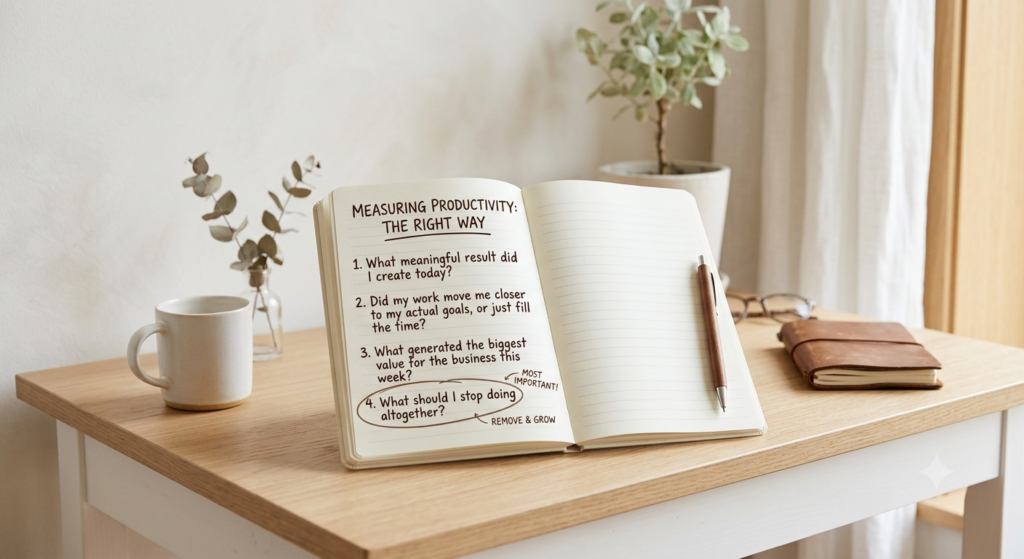
If hours worked and tasks completed aren’t reliable measures, what should you actually track? A short set of honest questions, asked consistently, works better than any complicated system.
- What meaningful result did I create today?
- Did my work move me closer to my actual goals, or just fill the time?
- What generated the biggest value for the business this week?
- What should I stop doing altogether?
That last question is often the most important, and the one entrepreneurs skip most often. Growth isn’t only about adding new habits and systems. It’s also about identifying the tasks, meetings, and commitments that no longer earn their place on your calendar, and removing them.
Answering these questions honestly, even once a week, will tell you more about your real productivity than any tracking app or task counter ever could.
Conclusion: Focus on Results, Not Busyness
Being busy might impress the people around you. It might even feel good in the moment, because motion is easier to notice than progress. But busyness alone rarely changes anything. It keeps you occupied without necessarily moving you forward.
Real productivity is quieter, and often less visible from the outside. It doesn’t always look impressive on a calendar. But it’s the thing that actually compounds, quarter after quarter, into a business and a life that genuinely move forward.
Success isn’t measured by how full your calendar is. It’s measured by the value you create and the progress you make, one deliberate day at a time. The entrepreneurs who build lasting businesses aren’t the ones who do the most. They’re the ones who consistently do what matters.
None of this requires a complete overhaul of how you work. It usually starts small: one protected block of focused time, one meeting declined, one honest look at where last week’s hours actually went. Those small corrections, repeated consistently, are what eventually separate a business that’s merely active from one that’s genuinely moving forward.
Key Takeaways
- Busyness measures activity. Productivity measures outcomes. They are not the same thing, and confusing them is costly.
- Constant meetings, notifications, and multitasking create the feeling of progress without necessarily producing it.
- Your brain is naturally drawn to busyness because small, easy tasks deliver faster rewards than deep, meaningful work.
- High performers protect time for their highest-leverage tasks, limit meetings, and measure results instead of hours.
- Burnout and busyness are closely linked, and both carry a real cost to business performance over time.
- The most useful productivity question isn’t “what can I get done today.” It’s “what actually needs to happen today.”
Frequently Asked Questions
What is the difference between being busy and being productive?
Being busy means your time is filled with activity, regardless of whether that activity produces meaningful results. Being productive means your time is directed toward outcomes that genuinely matter, such as completed projects, solved problems, or progress toward a specific goal. You can stay occupied all day without moving anything forward, but it’s much harder to create real results without some level of focused activity.
Why do people confuse busyness with productivity?
Busyness is visible and easy to measure. A full calendar, a cleared inbox, or a long list of completed small tasks all feel like proof of hard work. Productivity is often quieter and harder to see from the outside, since it’s measured by outcomes rather than activity. Social pressure to appear busy, combined with the brain’s preference for quick, easy wins, reinforces this confusion.
How can entrepreneurs become more productive?
Start by identifying the small number of tasks that actually drive results in your business, and protect time for those first. Limit meetings, reduce notifications during focused work, delegate repetitive tasks, and review your progress weekly using outcomes rather than hours worked as your measure of success.
Is multitasking making you less productive?
Yes. Research consistently shows that switching between tasks carries a measurable cognitive cost, slowing you down and increasing errors compared to focusing on one task at a time. What feels like efficient multitasking is usually just rapid task-switching, and it tends to reduce both speed and accuracy.
What are the best daily productivity habits?
Planning the next day before ending the current one, working in focused sessions with clear start and stop times, protecting your peak energy hours for your most important work, and reviewing your progress weekly are among the most consistently effective habits. None of them require special tools, just consistency.