

Most people think a business is built with money. A business plan, some funding, maybe a loan from the bank, and you’re off. But talk to anyone who has actually built something that lasted, and they’ll tell you a different story. Capital didn’t make the difference. Mindset did.
An entrepreneurial mindset is the real starting point of every business that survives past year one. It shapes how you handle a slow month, how you respond when a client says no, and whether you quit the first time something breaks. Funding can run out. Experience can be built on the job. But without the right way of thinking, neither of those things will save a business from its owner’s own hesitation, fear, or fixed beliefs about what’s possible.
Here’s something worth sitting with: recent research on small business survival shows that roughly 20 percent of new businesses fail within their first year, and about half are gone within five years. That is not a funding problem alone. Cash flow issues get blamed most often, but underneath poor cash flow decisions is usually a founder who avoided a hard conversation, delayed a pricing change, or refused to adapt when the market told them to. Mindset drives the decisions that show up later as financial statements.
And here’s the part that surprises people: an entrepreneurial mindset isn’t just for people who own a company. A marketing manager who spots an inefficient process and fixes it without being asked is thinking like an entrepreneur. A teacher who builds a side project to reach more students is thinking like an entrepreneur. A freelancer negotiating a better contract is thinking like an entrepreneur. This mindset is a way of engaging with problems and opportunities, and it applies whether you’re running a seven-figure company or trying to get a promotion.
This is arguably more relevant right now than it has been in years. Surveys on entrepreneurial intent show a sharp jump in the number of people planning to start a business or side hustle in the near future, with many citing a sense of urgency to act even when economic conditions feel uncertain. At the same time, AI tools have lowered the practical cost of starting something, letting one person do work that used to require a small team. That combination, more people wanting to start something and lower barriers to actually doing it, means the gap between people who succeed and people who stall is increasingly a mindset gap rather than a resource gap. The tools and the opportunity are more available than ever. What separates outcomes now is how people think about risk, feedback, and consistency.
In this guide, you’ll learn what an entrepreneurial mindset actually is, why so many people never develop it even though they want to, the ten habits that separate people who think this way from people who don’t, and a practical 30-day challenge you can start today. By the end, you won’t just understand the entrepreneurial mindset intellectually. You’ll have a system for building it.
What Is an Entrepreneurial Mindset?
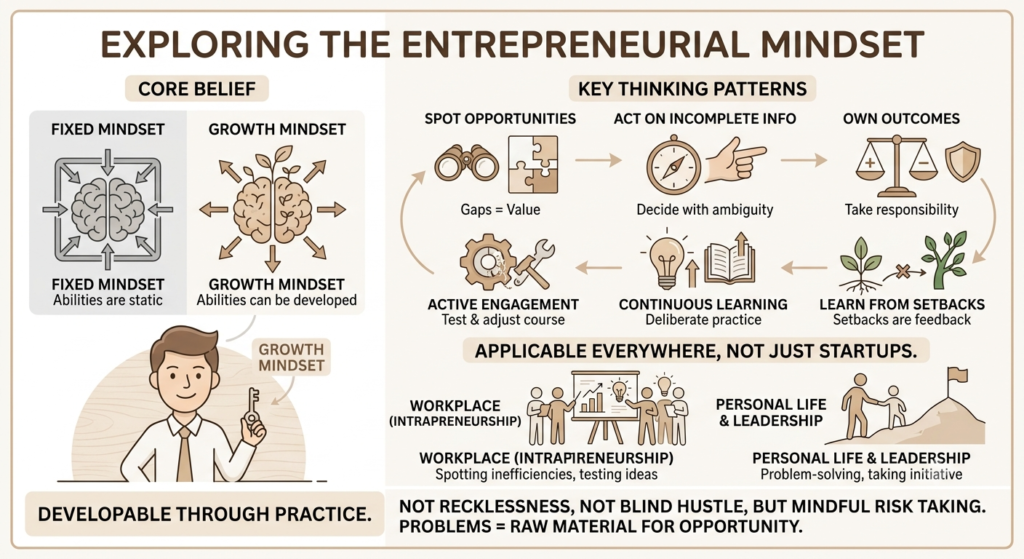
An entrepreneurial mindset is a way of thinking that treats problems as raw material for opportunity, rather than as reasons to stop. It’s not a personality trait you’re born with. It’s not reserved for people who’ve started a company. It’s a set of thinking patterns and habits that can be learned, practiced, and strengthened over time, the same way you’d build a muscle.
At its core, this mindset involves a handful of specific things:
- Seeing gaps in the market, in a workplace, or in your own life as opportunities to create value, not just annoyances to complain about.
- Making decisions with incomplete information instead of waiting for certainty that never arrives.
- Taking ownership of outcomes, good or bad, rather than assigning blame elsewhere.
- Treating setbacks as information you can use, not as a verdict on your worth or ability.
This is where the connection to psychology becomes important. Stanford psychologist Carol Dweck spent decades researching why some people improve dramatically over time while others plateau, and her research on growth mindset versus fixed mindset explains a lot of what separates entrepreneurial thinkers from everyone else. People with a fixed mindset believe their abilities and intelligence are essentially set in stone. People with a growth mindset believe abilities can be developed through effort, strategy, and feedback. Entrepreneurs, almost without exception, operate from the growth end of that spectrum. They don’t assume they already have what it takes. They assume they can build it.
The other misconception worth clearing up is the idea that this mindset is only useful if you’re planning to quit your job and launch a startup. It isn’t. Corporate researchers and business schools have started referring to this as an entrepreneurial mindset that applies inside organizations too, sometimes called intrapreneurship. Universities and training bodies increasingly frame it as a core competency for navigating uncertainty in any role, not a niche skill for founders. The ability to spot an opportunity, test a small experiment, gather feedback, and adjust course applies whether you’re managing a team, running a nonprofit, or building your first product.
And critically, anyone can develop it through deliberate practice. This isn’t about having a natural gift for risk-taking or being born extroverted and charismatic. It’s about repeatedly choosing to engage with uncertainty instead of avoiding it, then reflecting on what you learn. Do that enough times, and the mindset becomes automatic.
Consider two people who both notice the same inefficiency at work: a reporting process that eats up hours every week. One person complains about it in the break room and moves on. The other spends an evening building a simple template that cuts the process in half, then shares it with the team. Neither person has started a business. But one of them is practicing the exact thinking pattern that, applied consistently over years, produces founders, promotions, and industry reputations. The other is practicing a pattern that, applied consistently, produces frustration without change. Same starting conditions, completely different mindset.
It’s also worth being clear about what an entrepreneurial mindset is not. It is not recklessness, and it is not the belief that hustle alone guarantees success. It is not about ignoring risk or pretending every idea is a good one. Some of the most entrepreneurial people you’ll meet are also some of the most careful thinkers, precisely because they know how much is riding on getting the fundamentals right. The mindset is about active engagement with uncertainty, not disregard for it.
Why Most People Never Develop It
If an entrepreneurial mindset can be learned, why do so few people actually build it? The honest answer is that most of the barriers aren’t about ability. They’re about deeply human, deeply understandable patterns that quietly keep people stuck.
Fear of failure. This is the big one. Nobody wants to be the person whose business closed, whose idea flopped publicly, or whose big bet didn’t pay off. But fear of failure does something sneaky: it doesn’t just stop people from failing, it stops people from trying in the first place. The irony is that failure is baked into the numbers. Roughly one in five small businesses closes in year one, and the causes are rarely a single catastrophic event. Most closures come from a series of avoidable decisions compounding over time. Fear of that outcome keeps far more people out of the arena than it protects.
Comfort zone addiction. Predictability feels safe. A steady paycheck, a familiar routine, a known set of problems — these things are genuinely comforting, and there’s nothing wrong with wanting stability. But comfort can quietly become a trap when it’s chosen out of avoidance rather than intention. People stay in situations that no longer serve them because change feels riskier than staying, even when staying has its own hidden costs.
Waiting for perfect timing. There is no such thing as a perfect time to start anything. The market will never be fully predictable, the funding will never feel like quite enough, and there will always be one more course, one more certification, one more piece of research that seems necessary before taking action. Waiting for perfect conditions is often just fear wearing a more socially acceptable costume.
Seeking security over growth. This isn’t a character flaw. Security is a legitimate need, and pretending otherwise does nobody any favors. But when security becomes the only priority, growth stalls completely. This often shows up as someone turning down a genuinely good opportunity because it comes with uncertainty attached, even when the underlying risk is manageable. Entrepreneurial thinkers don’t ignore security entirely, they just refuse to let the pursuit of it override every other decision they make.
Fixed mindset vs. growth mindset. This ties everything above together. If you believe your intelligence, talent, and ability to succeed are fixed traits, every setback feels like proof that you don’t have what it takes. If you believe those things can be developed, every setback becomes data you can use to improve. The gap between these two beliefs explains why some people bounce back from a failed product launch within weeks, while others quit an entire industry after one bad quarter.
Understanding these five barriers matters because you can’t fix a problem you can’t name. Most people don’t lack the capability to think entrepreneurially. They’ve simply never examined which of these patterns is quietly running the show.
10 Habits of People With an Entrepreneurial Mindset
Reading about mindset is useful, but habits are where mindset actually becomes visible. Here are ten specific behaviors that show up again and again in people who think and act entrepreneurially, regardless of their industry or job title.
1. They Solve Problems Before They Chase Money
Entrepreneurial thinkers start with a problem, not a paycheck. They ask “what’s broken here, and what would fixing it be worth to someone?” before they ask “how do I make money.” This ordering matters more than it sounds. Businesses built around genuinely solving a problem tend to last, because the value is real and repeatable. Businesses built purely around chasing a trend or an income target tend to collapse the moment the trend fades, because there was never a durable problem underneath the offer. Research on why startups fail consistently points to “no market need” as one of the single biggest causes of business failure — in other words, businesses that were built to make money rather than to solve something people actually needed.
This habit also changes how people evaluate ideas. Instead of asking “how much could this make,” the first question becomes “who is genuinely stuck right now, and what would actually help them.” That single shift in ordering tends to produce better businesses, because the customer’s problem, not the founder’s income target, becomes the design constraint everything else is built around.
2. They Take Calculated Risks Instead of Avoiding Risk
There’s a persistent myth that entrepreneurs are wild risk-takers who bet everything on a hunch. The reality is closer to the opposite. People with an entrepreneurial mindset take calculated risks: they gather what information is reasonably available, weigh the downside against the potential upside, and then commit, understanding that some risks are worth taking even with incomplete data. The difference between a calculated risk and reckless behavior is preparation. A calculated risk has a plan for what happens if it doesn’t work. Recklessness doesn’t.
3. They View Failure as Feedback
This habit is where the growth mindset research becomes practical. Instead of treating a failed product launch, a lost client, or a missed deadline as a verdict on their competence, entrepreneurial thinkers treat it as a data point. What did this failure reveal about the market, the pricing, the messaging, or the process? Answering that question honestly is uncomfortable, but it’s also the fastest route to improvement. People who skip this step and instead spiral into self-blame tend to repeat the same mistakes, because they never actually extracted the lesson.
4. They Stay Curious and Keep Learning
The pace of change in business, especially with the speed at which new tools and technologies are reshaping entire industries, means that what worked two years ago may already be outdated. Entrepreneurial thinkers treat learning as a permanent, ongoing practice rather than something that ends after school or a certification. They read outside their industry, ask questions in rooms where they’re the least experienced person, and stay genuinely interested in how things work, not just in what benefits them directly.
5. They Focus on Creating Value
Value creation is the throughline of almost every sustainable business. Entrepreneurial thinkers ask what they can give before they ask what they can extract. This shows up in small ways: answering a stranger’s question generously online, giving away useful information for free, or over-delivering on a small project to build trust. Over time, this habit compounds. People and businesses known for creating disproportionate value attract opportunities that never had to be chased.
6. They Make Decisions Quickly and Learn Faster
Slow decision-making isn’t caution, it’s often just fear disguised as diligence. Entrepreneurial thinkers make decisions with the information available, knowing that gathering more data has diminishing returns past a certain point. The advantage isn’t that they’re always right. It’s that they get feedback faster, which means they correct course faster than someone still stuck weighing options. Speed of decision-making, followed by speed of learning from the outcome, beats slow perfectionism almost every time.
7. They Take Ownership of Every Outcome
When something goes wrong, entrepreneurial thinkers ask “what could I have done differently” before they ask “who’s responsible.” This isn’t about self-blame. It’s about maintaining control over the parts of a situation they can actually influence. Blaming the economy, the algorithm, or a client’s bad decision might be technically accurate sometimes, but it doesn’t move anything forward. Ownership does.
8. They Build Strong Networks
Business rarely happens in isolation. Research on entrepreneurial networking consistently finds that strong professional relationships open doors that cold outreach and job boards simply can’t. Weaker, more distant connections are often more valuable than tight inner circles for discovering new opportunities, because they expose you to information and networks you don’t already have access to. Entrepreneurial thinkers treat networking as an ongoing practice of building genuine relationships, not a transactional activity they do only when they need something.
This shows up in small, unglamorous ways more often than in big conference-room moments. It’s replying thoughtfully to someone’s post, following up after a helpful conversation, or introducing two people who could benefit from knowing each other without expecting anything in return. Over years, this kind of consistent, low-pressure relationship building tends to produce far more opportunities than any single well-timed pitch ever could.
9. They Adapt Faster Than Others
Markets shift, customer needs evolve, and tools that felt cutting-edge become standard within a year or two. Entrepreneurial thinkers watch for these shifts early and adjust their approach before it becomes obvious to everyone else. This doesn’t mean chasing every new trend. It means staying close enough to the market and the tools available that you can tell the difference between a passing fad and a genuine shift worth responding to.
10. They Think Long-Term Instead of Chasing Instant Results
The entrepreneurial mindset is fundamentally a long game. People who think this way are willing to accept a slower, less flashy start if it means building something durable. They resist the pressure to look successful quickly, and instead measure progress in months and years rather than days and weeks. This patience isn’t passive waiting. It’s active, consistent effort applied toward a goal that won’t pay off immediately.
Daily Habits That Strengthen an Entrepreneurial Mindset
Big shifts in thinking rarely come from one dramatic decision. They come from small, repeated actions that compound quietly over months, long before the results become visible to anyone else. Here are daily and weekly habits that build an entrepreneurial mindset over time.
- Read every day. Even fifteen minutes of reading outside your immediate field exposes you to new frameworks and ideas you wouldn’t encounter otherwise, and cross-pollination between fields is often where the most original ideas come from.
- Journal ideas. Keep a running list of problems you notice and possible solutions, even half-formed ones. Most good ideas don’t arrive fully formed. They get refined over multiple entries, often weeks or months apart.
- Analyze successful businesses. Pick one company you admire each month and study what they actually did differently, not just what made headlines. Look at their pricing, their customer service, and their early decisions, not just their current size.
- Learn one new skill every month. This doesn’t need to be dramatic. A new tool, a new negotiation tactic, or a new way of structuring a proposal all count, and small skill gains stack up faster than most people expect.
- Build side projects. Small, low-stakes projects are where you practice the muscle of taking action without the pressure of it being your only income source. Many meaningful ventures start as an evening or weekend experiment.
- Practice decision-making. Set a personal rule to make small, low-risk decisions faster than feels comfortable, and observe what actually happens as a result. Most people discover the consequences were smaller than they feared.
- Review failures weekly. Set aside time each week to look back at what didn’t work and extract one specific, actionable lesson, rather than letting setbacks blur together unexamined and unresolved.
Common Mindset Mistakes That Kill Entrepreneurial Growth
Even people actively trying to build an entrepreneurial mindset can undermine themselves in predictable ways. These mistakes tend to show up quietly, disguised as reasonable caution, which is exactly what makes them so easy to fall into. Watch for these patterns.
- Waiting until you’re “ready.” Readiness is a feeling, not a fact, and it rarely arrives on schedule. Most people who look ready from the outside started before they felt ready on the inside, and built the confidence through the doing rather than before it.
- Fear of criticism. Avoiding feedback to protect your ego also means avoiding the information that would help you improve fastest. The people whose opinions sting the most are often the ones offering the most useful correction.
- Chasing too many opportunities. Spreading effort across too many ideas at once usually means none of them get the depth of attention needed to actually work, and switching costs quietly eat away at progress on all of them.
- Comparing your beginning to someone else’s success. You’re comparing your rough draft to someone else’s finished, edited version, and that comparison will always feel unfair because it is. Most public success stories skip over years of invisible groundwork.
- Giving up after the first setback. Given that around half of small businesses don’t survive five years, some setbacks are simply part of the standard timeline, not a sign that you picked the wrong path entirely.
How Successful Entrepreneurs Think Differently
There’s a specific shift in thinking that separates entrepreneurs who build lasting success from those who burn out or stall after an early win. It’s less about any single decision and more about a handful of default settings that quietly shape every choice. It shows up in five recurring patterns.
Opportunity-focused thinking. Where most people see a complaint, entrepreneurial thinkers see an unmet need. The same frustration that makes someone grumble to a friend makes someone else start sketching a solution on a napkin that night.
Systems over motivation. Motivation is unreliable. It shows up strong some days and disappears entirely on others, often without warning. Entrepreneurial thinkers build systems and routines that keep them productive even on low-motivation days, rather than depending on inspiration to show up on schedule.
Action over perfection. A workable version released today beats a perfect version that never ships. Entrepreneurial thinkers default to shipping something, gathering feedback, and refining it, rather than polishing endlessly in private where no real feedback can reach it.
Learning over ego. Being wrong in front of other people is uncomfortable for everyone, no exceptions. Entrepreneurial thinkers have simply decided that the discomfort of being publicly wrong is worth less than the value of learning quickly from people who know more than they do.
Consistency over intensity. A short, intense burst of effort followed by burnout accomplishes less than steady, unglamorous effort sustained over months. Entrepreneurial thinkers are usually less impressive to watch day-to-day and far more impressive to look back on after a year of quiet, compounding progress.
Recent industry commentary on entrepreneurship in 2026 has reinforced this same point: mindset is increasingly treated as a strategic asset rather than a soft skill, with founders who manage their thinking as deliberately as their business plans consistently outperforming those who don’t.
A 30-Day Entrepreneurial Mindset Challenge
Reading about mindset shifts is one thing. Practicing them is another. This 30-day structure breaks the work into four manageable stages, each building on the last, so the shift in thinking has time to settle into something more permanent than a temporary burst of motivation.
Week 1: Build awareness and identify limiting beliefs. Spend this week simply noticing. Write down every time you catch yourself avoiding a decision, waiting for perfect conditions, or assuming something isn’t possible for you. Don’t try to fix anything yet. The goal is to see your own patterns clearly before trying to change them. Most people are surprised by how often these patterns show up once they’re actually paying attention, since they usually operate quietly in the background of everyday decisions.
Week 2: Take one small calculated risk every day. This doesn’t need to be dramatic. Send the email you’ve been avoiding. Pitch the idea you’ve been sitting on. Ask for the rate you actually want instead of the safe one. The goal is to build a track record, in your own mind, of taking action under uncertainty and surviving it. By the end of the week, most people notice the anticipation of these moments was worse than the actual experience of going through with them.
Week 3: Create value by solving one real problem. Pick something specific, whether it’s a friend’s business challenge, a gap in your own workplace, or a frustration you’ve noticed among people you talk to. Spend the week building even a small solution: a resource, a piece of advice, a simple tool. The point is practicing the habit of creating value rather than waiting for value to come to you. This week tends to feel the most rewarding, because the effort produces something tangible you can point to.
Week 4: Reflect, optimize, and build systems for consistency. Look back over the past three weeks. What worked? What didn’t? Turn whatever worked into a repeatable system, whether that’s a morning routine, a decision-making rule, or a weekly review process. This is the week where a month of experimentation becomes a sustainable habit, and where you decide which of the practices from the first three weeks deserve a permanent place in how you operate going forward.
Key Lessons to Remember
- Mindset shapes every business decision, often long before the decision is even made consciously.
- Failure is data, not defeat, and treating it that way is what allows people to improve instead of quit.
- Opportunities belong to action-takers, not to the people who are simply waiting for the right moment.
- Learning never stops, and the moment you assume you’ve arrived is usually the moment growth quietly stops.
- Entrepreneurship begins with how you think, not with your business registration, your funding, or your job title.
Conclusion
Entrepreneurship is a way of thinking before it’s ever a career. The habits covered here, from solving problems before chasing money to taking ownership of every outcome, aren’t reserved for people who’ve already started a company. They’re available to anyone willing to practice them consistently, starting today, in whatever role or situation they’re currently in.
You don’t need funding to start thinking this way. You don’t need permission, a perfect plan, or years of experience. You need one small entrepreneurial habit, practiced today, and then again tomorrow. Small, consistent actions, repeated over time, are what create extraordinary long-term results. Pick one habit from this guide and start it right now.