

Most people don’t stay broke because they lack intelligence. Some of the most financially stuck people you know are sharp, hardworking, and genuinely good at their jobs. What keeps them stuck isn’t a lack of brainpower. It’s a set of repeated financial behaviors that quietly work against them, month after month, year after year.
Wealth isn’t built by income alone. A surgeon earning $400,000 a year can be one bad year away from bankruptcy, while a warehouse supervisor earning $55,000 a year can retire with a seven-figure portfolio. The difference almost never comes down to how much money passed through their hands. It comes down to decisions, systems, and consistency.
This is the part nobody wants to hear: financial freedom is more psychological than mathematical. The math of saving and investing is simple enough that a twelve-year-old can understand it. What’s hard is the behavior. What’s hard is resisting the next upgrade, the next impulse purchase, the next “I’ll start saving next month.”
In this article, we’re going to walk through exactly why most people stay financially stuck, and then break down nine habits that consistently separate people who build wealth from people who spend their entire lives chasing it. Some of these ideas will feel obvious. Others might challenge how you’ve been thinking about money for years. Either way, by the end, you’ll have a clear, practical roadmap for building your own financial freedom.
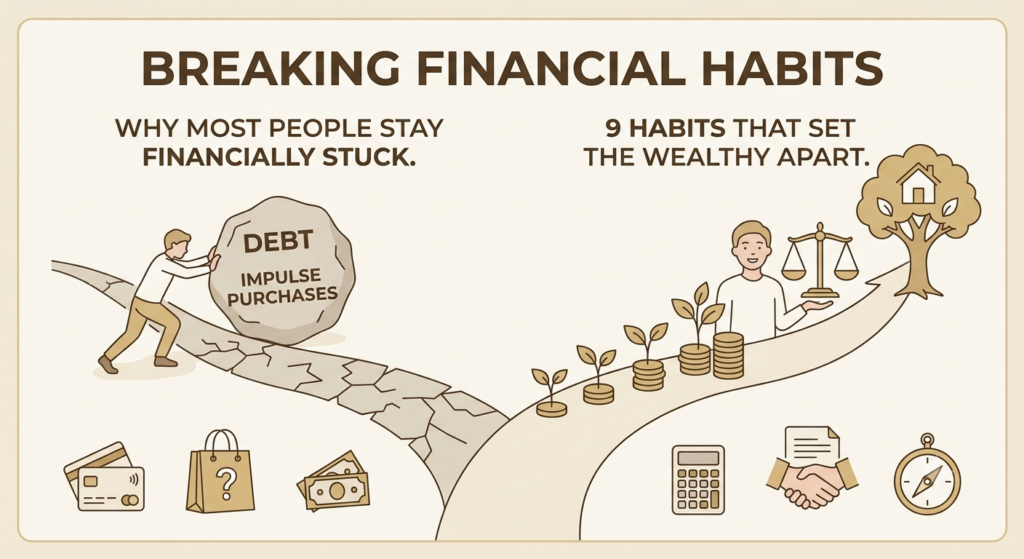
Habit 1: Financial Freedom Starts With Your Mindset
Before you touch a single spreadsheet or investment account, there’s a mental shift that has to happen first. How you think about money determines almost everything you do with it.
Scarcity Mindset vs Abundance Mindset
People with a scarcity mindset see money as a fixed, shrinking resource. Every dollar spent feels like a dollar gone forever. This mindset often triggers two opposite but equally damaging reactions: extreme hoarding out of fear, or reckless spending because “what’s the point of saving anyway.”
People with an abundance mindset see money as something that can be created, multiplied, and redirected. They don’t ignore risk, but they don’t freeze in front of it either. They ask, “How do I create more?” instead of “How do I protect the little I have?”
This isn’t about toxic positivity or pretending debt doesn’t exist. It’s about the lens you use to make decisions.
Why Fear Leads to Poor Money Decisions
Fear is one of the most expensive emotions in personal finance. Fear of missing out drives impulsive investments. Fear of judgment drives overspending on status items. Fear of scarcity drives people to avoid looking at their bank balance altogether, which almost always makes the problem worse.
When decisions are made from fear, they tend to be short-term and reactive. When decisions are made from clarity, they tend to be long-term and strategic. That single shift, from reacting to planning, is often the real starting point of building wealth.
How Wealthy People Think Differently About Money
Wealthy people generally view money as a tool, not an identity. They don’t spend to prove something. They ask a simple, repeated question before almost every purchase: does this bring me closer to my goals, or further away from them?
They also tend to separate emotions from decisions. A wealthy investor doesn’t panic-sell during a market dip because the decision was made in advance, based on a plan, not a mood.
Actionable Mindset Shift
Start by tracking your emotional reaction to money for one week. Every time you spend, pause and ask: was that decision driven by fear, boredom, pressure, or a genuine plan? You don’t need to change anything yet. Just notice the pattern. Awareness is the first step toward control, and control is the foundation every other habit on this list is built on.
Habit 2: Living Paycheck to Paycheck Is a Habit, Not Just an Income Problem
Here’s an uncomfortable truth: living paycheck to paycheck is far more common among higher earners than most people assume. Recent survey data shows that even among six-figure earners, roughly four in ten still describe themselves as living paycheck to paycheck. Income alone clearly isn’t the deciding factor.
Lifestyle Inflation
Lifestyle inflation is the quiet wealth killer. It happens when spending rises in direct proportion to income, so the gap between what you earn and what you spend never actually widens. A promotion brings a bigger apartment. A raise brings a nicer car. A bonus disappears into a vacation that “you deserve.”
None of these choices are wrong in isolation. The problem is when they happen automatically, without a plan, every single time income increases.
Spending Every Raise
This is lifestyle inflation’s closest cousin. Many people mentally “spend” a raise before it even hits their account. The rent increases. The subscriptions multiply. The dining-out budget quietly doubles. A year later, they’re earning more than ever and somehow still living paycheck to paycheck.
Emotional Spending
Stress, boredom, celebration, and even grief all trigger spending. Retail therapy is a real, well-documented pattern, and it’s one of the hardest habits to break because it’s rarely about the item being purchased. It’s about the feeling the purchase temporarily fixes.
Why Earning More Doesn’t Always Create Wealth
Wealth isn’t created by income. It’s created by the gap between income and expenses, and by what you do with that gap. Someone earning $70,000 who saves and invests 20% of it will, over time, almost always outperform someone earning $150,000 who saves nothing. The paycheck-to-paycheck cycle isn’t about the size of the paycheck. It’s about the absence of a system that protects the gap.
This gap is exactly where credit card debt tends to creep in. When spending consistently outpaces income, even by a small margin each month, the shortfall usually gets covered with a swipe rather than a conversation about the budget. That small shortfall, repeated monthly, is how modest balances quietly turn into years of revolving debt at double-digit interest rates, debt that then competes directly with saving and investing for every future dollar earned.
Habit 3: The Cost of Delayed Financial Decisions
Procrastination is one of the most expensive habits in personal finance, and most people never see the bill because it’s invisible until decades later.
Waiting to Invest
The single biggest advantage any investor has is time, not money. Historical data on the S&P 500 shows an average annualized return of roughly 10% over the past century, even accounting for crashes, recessions, and recoveries along the way. That means someone who invests consistently starting at age 25 will typically end up with dramatically more money at retirement than someone who starts at 35, even if the older starter contributes more money overall each month.
Here’s what that looks like in real numbers. A one-time $10,000 investment left untouched for twenty years, growing at that same historical 10% average, would realistically be worth somewhere in the neighborhood of $65,000 to $67,000 by the end of that period, without a single additional dollar being added. Wait an extra decade before making that same investment, and you don’t just lose ten years of growth. You lose ten years of growth on top of growth, which is the part most people underestimate until they see the actual numbers laid out in front of them.
Waiting to Start a Business
Every year spent waiting for “the right time” to start a side business or venture is a year of lost learning, lost customer relationships, and lost compounding experience. The right time rarely announces itself. Most successful entrepreneurs started before they felt ready.
Waiting to Learn
Financial literacy in the United States has actually declined in recent years, with national surveys showing adults answering fewer than half of basic personal finance questions correctly. Waiting to learn about budgeting, investing, taxes, or debt doesn’t make those topics simpler. It just delays the moment you start making informed decisions instead of guesses.
The Hidden Cost of Procrastination
Every month of delay is a month where money isn’t working for you. It’s easy to underestimate how much this adds up, because the damage is silent. Nobody sends you a bill for the wealth you didn’t build. You simply arrive at 45 or 55 with far less than you could have had.
Compound Interest Works Against Procrastinators
Compound interest is often called the eighth wonder of the world, and for good reason. It rewards early starters disproportionately and punishes latecomers just as disproportionately. A dollar invested at 25 has decades to double, redouble, and double again. That same dollar invested at 45 has far less runway to do the same work. The math doesn’t care about your excuses. It only cares about time.
Habit 4: Why Most People Never Build Assets
To understand why some people build wealth and others don’t, you need to understand four simple categories: income, expenses, assets, and liabilities.
Income is money coming in, whether from a job, a business, or investments.
Expenses are money going out, covering everything from rent to groceries to entertainment.
Assets are things that put money into your pocket over time, such as dividend-paying stocks, rental properties, or a profitable business.
Liabilities are things that take money out of your pocket over time, such as car loans, credit card balances, or a mortgage on a home that isn’t generating income.
Most people spend their entire working life focused only on the first two categories. They earn income, they cover expenses, and whatever is left over (if anything) gets spent on more liabilities: a bigger car, a bigger house, more subscriptions.
Wealthy people flip the order. They buy assets first. Before upgrading a car or a wardrobe, they ask whether their money could instead be buying something that generates future income. Over years, this single shift in ordering, assets before liabilities, is one of the clearest dividing lines between people who build wealth and people who simply spend what they earn.
Picture two people who each receive a $5,000 bonus in the same month. One puts it toward a down payment on a newer car, which starts losing value the moment it leaves the lot. The other puts it into an index fund or a small rental property down payment. Five years later, the first person is still making car payments on a depreciating asset. The second person is holding something that has grown in value and, in many cases, generated income along the way. Same bonus, same starting point, completely different financial direction.
Habit 5: The Trap of Looking Rich Instead of Becoming Rich
Social media has turned lifestyle comparison into a full-time, unpaid job for millions of people. And it’s quietly bankrupting a lot of them.
Social Media Pressure
Curated highlight reels create a false baseline for what “normal” spending looks like. Vacations, renovations, designer items, and luxury cars all get presented as the standard, when in reality, many of these purchases are financed, borrowed, or simply unsustainable.
Expensive Cars, Brand Obsession, and Status Spending
There’s a specific and well-documented trap here: spending money you don’t have, to buy things you don’t need, to impress people who often don’t actually care. Expensive cars depreciate. Brand-name items rarely hold their value. Status spending creates a short burst of validation followed by a long stretch of financial pressure.
Invisible Wealth vs Visible Wealth
Research on self-made millionaires consistently shows a pattern that surprises most people: genuinely wealthy individuals tend to live well below their means. Many drive ordinary cars, live in modest homes relative to their net worth, and rarely broadcast their financial status. Meanwhile, people carrying the outward signs of wealth, expensive cars, designer wardrobes, are often carrying significant debt behind the scenes.
Visible wealth is what you show. Invisible wealth is what you keep, grow, and eventually pass on. The two are frequently inversely related.
Habit 6: They Budget Their Time but Ignore Their Money
Most professionals are disciplined about their calendars. Meetings are scheduled. Deadlines are tracked. Yet many of those same people have no idea what their money did last month.
Tracking Expenses
You cannot manage what you don’t measure. Tracking every expense, even the small ones, reveals spending patterns that are invisible when you’re not paying attention. Coffee, subscriptions, delivery fees, and impulse buys often add up to hundreds of dollars a month that nobody consciously decided to spend.
Monthly Reviews
A short, recurring monthly review, even just 20 minutes, keeps your financial picture current. It catches problems early, before a small leak becomes a flood.
Financial Goals
Vague goals like “save more” rarely work. Specific goals like “save $500 a month toward a six-month emergency fund by December” create a target your brain can actually work toward.
Emergency Fund
An emergency fund isn’t just a safety net. It’s what breaks the cycle of relying on credit cards during unexpected expenses. Recent survey data paints a fairly sobering picture here: a significant share of adults, often cited at somewhere between 40% and 60% depending on the survey, say they couldn’t cover a $1,000 emergency expense using savings alone. Many of that group have no emergency savings at all, while others have a small cushion that would only cover a few days or weeks, not months, of expenses. That gap is exactly the situation an emergency fund exists to close, and it’s also exactly the gap that pushes so many households toward credit cards the moment a car repair or medical bill shows up unannounced.
Automation
Automating savings and investments removes willpower from the equation entirely. When a portion of every paycheck moves automatically into savings or investment accounts before you ever see it, discipline stops being a daily battle and becomes a background process.
The bigger idea here is simple: build financial systems instead of relying on motivation. Motivation fades. Systems don’t.
Habit 7: Wealth Is Built Through Diversified Income
Relying on a single paycheck is one of the riskiest financial positions a person can be in, even if that paycheck is generous.
Studies on wealthy, self-made entrepreneurs have found that a majority built at least three separate income streams before reaching their first million, with a meaningful share reaching five or more. These streams typically fall into a few broad categories:
- Business income from owning or operating a company
- Investment income from stocks, index funds, or retirement accounts
- Freelancing or consulting income using an existing skill set
- Digital products, such as courses, templates, or e-books
- Real estate, whether through rental income or appreciation
- Dividend income paid out regularly by certain stocks
The logic behind diversified income is the same logic behind a diversified investment portfolio: don’t put all your financial security in one place. Relying on a single paycheck means a single layoff, a single company restructuring, or a single industry downturn can wipe out your entire income overnight. Multiple income streams create a buffer, and over time, they often compound into something bigger than the original paycheck ever was.
This doesn’t mean everyone needs to become an entrepreneur overnight. It might start small: a freelance project on the weekend, a modest investment account, a side hustle built around an existing skill. The goal isn’t perfection. The goal is starting to reduce dependence on any single source of income.
The Growing Role of Extra Income
This pattern has only become more visible in recent years. Roughly a third to nearly half of American workers now report earning some form of extra income outside their main job, depending on how the survey defines it, and a growing share say that income has shifted from a nice-to-have to a genuine necessity as everyday costs have climbed. The specific numbers move from year to year, but the underlying trend doesn’t: fewer and fewer people are comfortable depending on a single income source, and more of them are actively building a second or third one, whether through freelancing, creative projects, or small-scale investing.
Habit 8: Small Daily Decisions Create Massive Financial Results
Wealth is rarely built through a single dramatic decision. It’s built through hundreds of small, unremarkable decisions repeated consistently over years.
Daily Spending Habits
A $6 daily coffee purchase seems harmless in isolation. Over a year, it adds up to more than $2,000. Over a decade, invested instead of spent, that same habit could realistically grow into tens of thousands of dollars, thanks to consistent contributions and market growth.
Saving Automatically
The people who save the most consistently are rarely the ones with the most willpower. They’re the ones who removed the decision entirely by automating it.
Investing Consistently
Consistency beats timing. Trying to predict the “perfect” moment to invest almost always underperforms simply investing on a regular schedule, month after month, regardless of what the market is doing.
Learning New Skills
Every new skill is a potential future income stream or a raise waiting to happen. Wealthy people rarely stop learning once they finish formal education. They treat skill development as an ongoing, lifelong investment in themselves.
Long-Term Compounding
Here’s a simple illustration. Imagine two people, both starting at age 25. One invests $300 a month until age 65. The other waits until 35 to start and invests $450 a month, more money each month, for the same end date. Assuming a long-term average annual return in the historical range of the broader stock market, the person who started ten years earlier will almost always end up with significantly more money, despite contributing less overall. Time, not the size of the contribution, is the deciding factor.
Habit 9: Your Environment Shapes Your Financial Future
You are financially, in large part, a product of your environment. The people around you, the content you consume, and the beliefs you were raised with all quietly shape your financial decisions.
Friends’ Influence
If your social circle treats debt-financed spending as normal, it becomes your baseline too. If your social circle treats saving and investing as normal, that becomes your baseline instead. Peer influence on spending is well documented and often stronger than people realize. It’s also one of the quiet drivers of lifestyle creep, since it’s much harder to resist upgrading your own spending when everyone around you is doing the same thing.
Family Beliefs
Many people carry financial beliefs into adulthood that were formed in childhood, long before they had the context to question them. Beliefs like “money is the root of all problems” or “people like us don’t get rich” can quietly steer decisions for decades unless they’re consciously examined.
Social Media
As covered earlier, social media often presents an inflated, unsustainable version of normal spending. Curating your feed to include financially responsible voices instead of purely aspirational lifestyle content can shift your baseline over time.
Financial Mentors
Having even one person in your life who models healthy financial behavior, someone who budgets, invests, and makes deliberate decisions, provides a real-world example that’s often more powerful than any book or course.
Books and Podcasts
Deliberately consuming financial education content, even for 20 minutes a day, gradually reshapes how you think about money. Over months and years, this steady input compounds just like the money itself does.
The core idea here is straightforward: surround yourself with financially responsible people and content, because your environment will shape your decisions whether you consciously choose it or not.
7 Practical Steps to Break Free Financially
Understanding these habits matters, but action is what actually changes your financial trajectory. Here are seven concrete steps to start applying what you’ve just read.
- Track every expense. For at least one month, write down or log every dollar you spend. You cannot fix a pattern you can’t see.
- Build a six-month emergency fund. Start small if you need to, even $25 a week adds up, but build toward covering six months of essential expenses.
- Eliminate high-interest debt. With average credit card interest rates sitting well above 20%, high-interest debt actively works against every other financial goal you have. Prioritize paying it down aggressively.
- Invest before spending. Flip the traditional order. Instead of saving what’s left after spending, invest first and let spending happen with what remains.
- Increase your earning potential. Invest in skills, certifications, or experience that make you more valuable in your field or open doors to new income opportunities.
- Create at least one additional income stream. Whether it’s freelancing, a small side business, or a modest investment portfolio, start building a second source of income.
- Review your financial goals every month. A brief, recurring check-in keeps your goals current and catches problems before they grow.
Key Takeaways
- Financial struggle is driven far more by repeated behavior than by income level.
- Lifestyle inflation and emotional spending quietly erase the benefit of raises and bonuses.
- Time is the single biggest advantage in investing, which makes delay extremely costly.
- Buying assets before liabilities is one of the clearest habits separating the wealthy from everyone else.
- Looking rich and being rich are often opposites, not synonyms.
- Financial systems, budgets, automation, monthly reviews, consistently outperform relying on motivation alone.
- Diversified income streams reduce risk and accelerate wealth building.
- Small, consistent daily decisions compound into significant long-term results.
- Your environment, people, content, and beliefs, shapes your financial decisions more than most people realize.
Conclusion: Wealth Is Built, Not Found
Financial success is rarely about luck, a lucky stock pick, a surprise inheritance, or a single lucky break. For the overwhelming majority of people who build lasting wealth, it grows through consistent habits, disciplined decisions, and long-term thinking, repeated quietly over years that nobody else is watching.
Every one of the nine habits covered here starts small. A mindset shift. A tracked expense. A delayed gratification here and there. An automated transfer. None of them feel dramatic in the moment, and that’s exactly the point. Wealth isn’t built through dramatic moments. It’s built through boring, repeated, unglamorous consistency.
Every small financial improvement today creates greater opportunities tomorrow. You don’t need to overhaul your entire financial life this week. Pick one habit from this list. Start there. Then build the next one on top of it.
The people who eventually break free financially aren’t the ones who found some secret shortcut. They’re the ones who simply started, stayed consistent, and let time do the rest.
Frequently Asked Questions
1. Why do some people stay financially stuck even with a good income?
High income doesn’t automatically create wealth. Without intentional habits around saving, investing, and controlling lifestyle inflation, spending tends to rise right alongside income, leaving little or nothing left over regardless of how much is earned.
2. What’s the fastest way to start building wealth from zero?
Start by tracking your expenses and building a small emergency fund. From there, focus on eliminating high-interest debt and automating a consistent, even modest, investment habit. Speed matters less than consistency here.
3. How many income streams do I actually need?
There’s no universal number, but research on wealthy, self-made entrepreneurs often points to three or more as a common pattern before reaching significant net worth. The goal isn’t a specific count. It’s reducing dependence on any single source of income.
4. Does lifestyle inflation always mean overspending?
Not necessarily. Some lifestyle upgrades are reasonable and even healthy. The problem arises when every single increase in income is automatically absorbed by higher spending, leaving no widening gap between income and expenses over time.
5. Is it too late to start building wealth in your 30s or 40s?
No. While starting earlier gives compound interest more time to work, consistent saving and investing still produce meaningful results starting at any age. The best time to start is simply now.
6. How much should I keep in an emergency fund?
A common guideline is three to six months of essential living expenses, though the right number depends on your job stability, dependents, and overall financial situation.