

Most people look at a billionaire’s bank account and stop there. They see the private jet, the headlines, the nine-figure exit, and they assume the story ends with money. It doesn’t. Behind almost every extraordinary fortune is a much less glamorous story: years of unglamorous decisions, repeated failures, and habits practiced so consistently that they eventually compounded into something extraordinary.
That distinction matters, because copying a billionaire’s lifestyle will not make you successful. Copying their thinking might.
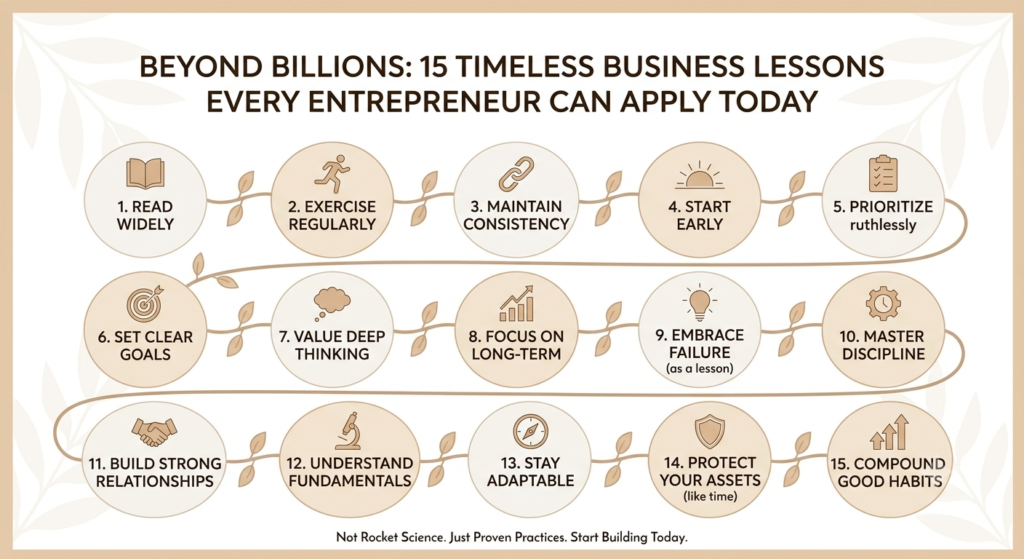
You don’t need a rocket company or a trillion-dollar market cap to benefit from how the most successful entrepreneurs in the world actually operate. A JPMorgan survey of more than 100 billionaires with a combined net worth exceeding $500 billion found that their success rested on a surprisingly ordinary set of practices: reading, exercise, consistency, early mornings, prioritization, goal-setting, and protected time for deep thinking. None of those require billions to start. They require discipline.
This guide breaks down 15 timeless business lessons drawn from how billionaire entrepreneurs actually think, decide, and build. These are not motivational one-liners. They are practical principles you can start applying in your business this week, whether you are running a property management company, a growing agency, or a business you are building on the side.
By the end of this article, you will understand what separates businesses that compound in value over decades from businesses that simply survive quarter to quarter, and you will have a clear starting point for applying that thinking yourself.
Lesson 1: Solve Big Problems, Not Small Opportunities
Every business generates revenue by solving a problem, but not every problem is worth solving. The entrepreneurs who build lasting wealth tend to fixate on problems large enough to matter to thousands, or millions, of people.
This is one of the timeless business lessons that shows up again and again in how great companies get started. Amazon didn’t begin by trying to squeeze more margin out of a niche bookstore. Jeff Bezos identified a much bigger problem: physical retail could never offer the selection, convenience, or pricing that the internet eventually could. He built toward that gap for years before it paid off.
The lesson here is not “think bigger for the sake of it.” It’s that wealth follows value creation, and value creation scales with the size of the problem you solve. A business that saves a handful of customers a small amount of time will always be a small business. A business that removes a real, widespread friction point has room to grow into something much larger.
For smaller and growing businesses, this doesn’t mean chasing an unrealistic, world-changing idea on day one. It means constantly asking who is affected by the problem you solve, how many of them there are, and how painful that problem actually is for them. The bigger and more painful the problem, the more room your business has to grow.
Lesson 2: Think in Decades, Not Quarters
Short-term thinking is the default setting for most businesses, because short-term results are what get measured, reported, and rewarded. But the entrepreneurs who build enduring companies operate on a different clock entirely.
Bezos has talked openly about this discipline for over two decades. He has said that when people congratulate Amazon on a strong quarter, the results being praised were actually decided roughly three years earlier, because the real work of building a business happens long before the numbers show it. He has pushed his teams to think in five-to-seven-year horizons rather than two-to-three-year cycles, arguing that this shift changes how you spend your time, how you plan, and how well you can anticipate what’s coming.
This kind of patience is not natural. It has to be built deliberately, because every incentive in modern business pulls toward the next sale, the next month, the next quarterly report. But sustainable businesses are built by people willing to invest in outcomes they won’t see for years.
In practice, this means asking a different question before every major decision: does this move make sense only this quarter, or does it still make sense five years from now? If a decision only holds up under short-term pressure, it’s usually not one worth building your business around.
Lesson 3: Obsess Over Customers
Nearly every enduring business has one thing in common: an almost irrational focus on the customer, not just as a source of revenue, but as the actual reason the business exists.
This obsession shows up as a refusal to settle. Businesses that last don’t ask “what can we get away with?” They ask “what would make this genuinely better for the people we serve?” That mindset builds trust, and trust is one of the few competitive advantages that cannot be copied overnight by a competitor with more funding.
Customer obsession also changes how a business grows. Instead of chasing one-off sales, customer-obsessed businesses build loyalty, because loyal customers return, refer others, and forgive occasional mistakes. Loyalty compounds in a way that transactional sales never do.
For any entrepreneur, the practical version of this lesson is simple: build feedback loops that actually reach decision-makers, resist the temptation to prioritize short-term profit over long-term trust, and treat every interaction as an opportunity to prove the business deserves the customer’s confidence again.
Lesson 4: Make Decisions with Data, Not Emotion
Confidence and instinct matter in business, but the entrepreneurs who scale successfully tend to separate how they feel about a decision from what the evidence actually shows.
This doesn’t mean ignoring intuition entirely. Experienced founders often have well-developed instincts built from years of pattern recognition. But instinct works best when it’s checked against real numbers: conversion rates, retention data, unit economics, customer feedback, and market signals. Emotion-driven decisions tend to chase excitement or avoid discomfort. Data-driven decisions tend to chase what actually works.
Warren Buffett has built an entire investment philosophy around this kind of discipline, famously noting that he only needs to make a handful of genuinely good decisions each year. That approach only works because those decisions are grounded in careful analysis rather than momentum or emotion.
Building this habit in your own business starts with something small: before making a major call, write down the data that supports it and the data that contradicts it. If you can’t point to evidence either way, that’s a sign you need more information before committing.
Lesson 5: Learn Faster Than Your Competitors
In a fast-moving market, the business that learns fastest usually wins, regardless of who started with more resources. This is one of the clearest and most consistent traits among high-net-worth entrepreneurs.
Reading remains one of the most common habits tied to business success. Surveys of self-made millionaires have found that the vast majority read daily to build knowledge relevant to their industry, and a large share read multiple books a month. This isn’t a coincidence. Reading, listening to podcasts, and studying other industries all expose entrepreneurs to patterns and ideas they wouldn’t encounter by staying heads-down in daily operations alone.
Elon Musk has credited reading extensively as part of how he built the technical knowledge behind his rocket company, despite not coming from an aerospace background. That kind of self-directed learning is available to anyone, regardless of starting capital.
The practical takeaway is to treat learning as a business input, not a personal hobby. Set aside dedicated time each week to study your industry, your competitors, and adjacent fields that might reshape your market. The businesses that stagnate are usually the ones that stopped learning once they found something that worked.
Lesson 6: Build Systems Instead of Depending on Hustle
Hustle gets a business started. Systems are what let it survive without the founder personally holding everything together.
Many entrepreneurs plateau because their business depends entirely on their own hours and attention. Every additional dollar of revenue requires a proportional increase in personal effort, which means growth is capped by how much one person can physically do. Businesses that scale past this point almost always do it by replacing effort with process.
A system, in this context, is simply a repeatable way of getting a result without reinventing it each time. That could be a documented onboarding process, a standardized way of handling customer complaints, or a clear decision-making framework for hiring. Systems reduce dependency on any one person, including the founder, and they make quality more consistent.
If you’re not sure where to start, look at whatever task in your business currently eats the most of your time. Ask whether it could be documented, delegated, or automated. That single question, applied consistently, is often the difference between a business that requires constant hustle and one that can actually scale.
This matters even more in service businesses, where quality can feel too personal or too situational to document. In reality, the opposite is usually true. A written checklist for how client issues get resolved, a standard template for onboarding new customers, or a clear escalation process for problems all reduce the chances that quality depends on which employee happens to be handling a task that day. Systems don’t make a business feel less personal to the customer. Done well, they make the experience more consistent, which is often what customers value most.
Lesson 7: Hire People Smarter Than You
No entrepreneur builds a large, durable business alone. At some point, growth depends entirely on the quality of the team around the founder, not just the founder’s individual skill.
The strongest leaders actively look for people whose expertise exceeds their own in specific areas, rather than hiring people who simply agree with them. This requires a degree of humility that not every founder has naturally, because it means admitting there are things you are not the best person in the room to handle.
Delegation is the practical extension of this lesson. Hiring smart people and then refusing to hand them real authority defeats the purpose. Growth-stage businesses are usually held back not by a lack of talent, but by founders who can’t let go of decisions that no longer need to run through them.
In your own business, this starts with an honest audit: which decisions absolutely require your judgment, and which ones are you holding onto out of habit or discomfort rather than necessity? Every decision you can responsibly hand off frees up capacity for the decisions that genuinely need you.
Lesson 8: Embrace Failure as Business Intelligence
Failure is treated very differently by entrepreneurs who build lasting companies compared to those who don’t. Instead of avoiding it, they treat it as a source of information.
Bezos has described failure and invention as inseparable, arguing that if you know in advance an experiment will work, it isn’t really an experiment at all. He has also drawn a distinction between what he calls “good failure,” the kind that comes from genuine experimentation, and “bad failure,” which comes from mishandling things you should already know how to execute well. That distinction matters, because it means not all failure is equally valuable.
The businesses that improve fastest tend to run small, low-cost experiments constantly, rather than making a small number of large, high-stakes bets. Each failed experiment narrows down what doesn’t work, which makes the next attempt more likely to succeed.
For most entrepreneurs, applying this lesson means building a culture, even in a small team, where mistakes are analyzed for lessons rather than punished. If your team hides problems out of fear, you lose access to the exact information you need to improve.
Lesson 9: Protect Your Time Relentlessly
Time is the one resource every entrepreneur has in equal supply, regardless of how much capital they’ve raised or how large their business has grown. The way successful entrepreneurs guard their time reflects how seriously they take that constraint.
One recurring theme among high-net-worth families, according to research cited by JPMorgan, is a deep intentionality about how time gets spent, treating an hour with the same care most people reserve for spending money. That mindset shows up in calendars built around high-value activities, rather than reactive schedules dictated by whoever asks for attention first.
Warren Buffett has been direct about this trade-off, noting that the gap between successful people and extremely successful people often comes down to the ability to say no to almost everything that doesn’t matter.
Protecting your time doesn’t require ruthlessness for its own sake. It requires clarity about which activities in your business actually move the needle, and the discipline to say no, delegate, or delay everything else. A calendar full of busyness is not the same as a calendar full of progress.
Lesson 10: Take Calculated Risks
Risk-taking is often misunderstood as recklessness, but the entrepreneurs who succeed repeatedly tend to take risks that are carefully bounded, not blind bets on chance.
Academic research on entrepreneurial traits, including work associated with Oxford University, has consistently found that risk tolerance is a real predictor of entrepreneurial success, alongside traits like conscientious execution and a strong internal sense of control over outcomes. But risk tolerance is not the same as gambling. It means being willing to act under uncertainty while still doing the preparation to understand what could go wrong.
The difference between gambling and strategic risk-taking usually comes down to downside protection. A calculated risk is structured so that if it fails, the business survives to try again. A gamble bets the entire business on a single outcome with no fallback.
Before taking a major risk in your business, ask what the worst realistic outcome looks like, and whether your business can absorb it. If the answer is no, the move needs to be resized or restructured before you take it, not avoided altogether.
Lesson 11: Focus on Compounding, Not Instant Results
Compounding is one of the most powerful and most underappreciated forces in business, precisely because it looks unimpressive in the short term and extraordinary over a long one.
Warren Buffett has built his entire career around this principle, both financially and personally, deliberately keeping his lifestyle modest so that his capital could keep compounding rather than being spent. The same logic applies well beyond investing. Small, consistent improvements to a product, a sales process, or a customer relationship rarely feel significant in the moment, but stacked over months and years, they separate market leaders from businesses that stall out.
This is one of the timeless business lessons that is easiest to understand intellectually and hardest to practice, because compounding requires patience during a period when the results are genuinely invisible.
Applying this lesson means resisting the urge to abandon a sound strategy just because early results feel slow. It also means looking for compounding opportunities beyond revenue, like knowledge, reputation, and relationships, all of which grow more valuable the longer they’re maintained consistently.
Lesson 12: Build Multiple Sources of Value
Businesses that depend entirely on a single revenue stream, a single client, or a single product are inherently fragile, even if that one source is currently performing well.
The most resilient entrepreneurs diversify what actually generates value in their business, not just their income. That can include building intellectual property, developing strategic partnerships, or creating assets that continue to produce value even when the founder isn’t actively working. A property management business, for example, becomes more resilient when it develops systems and reputation that hold value independent of any single property owner relationship.
This diversification isn’t about spreading a business too thin across unrelated ventures. It’s about identifying multiple, related ways the core business creates value, so that a disruption in one area doesn’t threaten the entire operation.
A useful exercise is mapping out every source of value in your business right now, revenue, relationships, intellectual property, reputation, and data, and asking which of those would survive if your single largest client left tomorrow. Wherever the answer is “not much,” that’s where to focus on building more resilience.
Lesson 13: Stay Adaptable in Changing Markets
Markets change, sometimes gradually and sometimes overnight, and the businesses that survive long-term are rarely the ones that resisted change the longest. They’re the ones that adapted without abandoning what made them valuable in the first place.
Innovation, in this context, isn’t limited to inventing new technology. It includes recognizing when a market shift, a new competitor, or a changing customer expectation requires a genuine strategic pivot rather than a minor adjustment. Businesses that treat their original model as untouchable often get outpaced by more flexible competitors, even when their original idea was sound.
The skill here is distinguishing between the core value your business provides and the specific method you currently use to deliver it. The method should be flexible. The underlying value you provide to customers is usually what should stay consistent.
Practically, this means building in regular checkpoints to reassess whether your current approach still fits the market, rather than waiting for a crisis to force the question. Businesses that pivot early, from a position of strength, almost always have more options than businesses that wait until they’re forced to.
A useful discipline here is scheduling a recurring review, quarterly or twice a year, dedicated specifically to asking what has changed in your market, your customers, and your competitors since the last review. Most businesses only ask these questions reactively, after revenue has already started to slip. By that point, the range of available options has narrowed considerably. Asking the question early, while the business is still healthy, preserves far more flexibility.
Lesson 14: Develop a Strong Personal Brand
In a market where customers increasingly research who they’re doing business with before they buy, an entrepreneur’s personal reputation has become a genuine business asset, not just a personal one.
A strong personal brand builds trust faster than a company logo alone, particularly for service-based businesses where customers are essentially betting on the judgment and reliability of the people behind the business. That trust translates directly into referrals, partnership opportunities, and long-term client relationships that are harder for competitors to disrupt.
This doesn’t require constant self-promotion. It requires consistency: showing up with the same values, expertise, and reliability across every interaction, whether that’s a client meeting, a piece of content, or a public statement. Reputation is built slowly and can be damaged quickly, which is exactly why the entrepreneurs who protect it most carefully tend to benefit from it the longest.
For most business owners, the starting point is simple: define the two or three things you want to be known for professionally, and make sure every public interaction reinforces them rather than contradicts them.
Lesson 15: Success Is a Habit, Not a Single Achievement
The final lesson ties every other one together. None of the previous 14 lessons work as isolated actions. They work because they’re practiced consistently, long after the initial motivation to try them has faded.
Research into millionaire habits consistently finds that daily discipline, not sporadic bursts of effort, distinguishes long-term success from short-lived wins. Waking up early, prioritizing tasks, setting clear goals, and protecting time for deep thinking only matter if they’re repeated often enough to become automatic.
Motivation is unreliable by nature. It comes and goes based on mood, energy, and circumstance. Discipline is what carries a business through the periods when motivation disappears entirely, which happens to every entrepreneur eventually.
The practical version of this lesson is to build systems that don’t depend on how you feel on a given day. A consistent morning routine, a recurring weekly review of your numbers, or a standing habit of reading in your industry all work precisely because they don’t require fresh motivation each time. Consistency, applied long enough, is what eventually looks like overnight success to everyone watching from the outside.
Common Traits Shared by Billionaire Entrepreneurs
Looking across all 15 lessons, a few underlying traits show up repeatedly:
- Vision – the ability to see where a market is heading before it becomes obvious to everyone else.
- Discipline – consistent daily habits that don’t depend on motivation.
- Curiosity – a genuine drive to keep learning, long after formal success has been achieved.
- Resilience – the capacity to treat failure as information rather than a verdict.
- Strategic thinking – decisions grounded in evidence and long-term consequences, not short-term emotion.
- Continuous improvement – small, compounding adjustments rather than occasional dramatic overhauls.
None of these traits require billions of dollars to develop. They require intentional practice, which is exactly why they’re accessible to entrepreneurs at any stage.
How to Apply These Lessons Starting Today
Reading about these principles is only useful if it leads to action. Here’s a practical starting point:
- Identify one problem to solve. Choose a real, painful problem affecting a meaningful number of people, not just a small convenience improvement.
- Build one new system. Pick the task that currently consumes the most of your time and document a repeatable process for it.
- Learn something every day. Commit to a fixed amount of daily reading or research relevant to your industry.
- Protect your time. Audit your calendar this week and eliminate one recurring activity that doesn’t move your business forward.
- Think long term. Before your next major decision, ask whether it still makes sense five years from now.
- Measure progress consistently. Set up a simple weekly review of the numbers that actually reflect your business’s health.
You don’t need to apply all 15 lessons at once. Choose one or two that address your business’s current weakest point, and build the habit before moving to the next.
Key Takeaways
- Wealth follows value creation, so focus on solving problems large enough to matter to thousands of people, not just a small niche.
- Long-term thinking is a discipline, not a natural instinct, and it has to be built deliberately against short-term pressure.
- Customer trust and loyalty compound over time in ways that one-off sales never do.
- Systems, not personal hustle, are what allow a business to scale past its founder’s personal capacity.
- Failure treated as information, rather than avoided entirely, accelerates business improvement.
- Consistency and daily discipline, not motivation, are what separate lasting success from short bursts of progress.
Conclusion
Billionaire success leaves clues, not shortcuts. There is no single decision, product, or lucky break that explains how the world’s most successful entrepreneurs built what they did. What explains it is a consistent pattern of thinking in decades rather than quarters, obsessing over customers rather than competitors, treating failure as data, and showing up with the same discipline on the days that feel unremarkable as on the days that feel significant.
You don’t need billions to adopt billionaire thinking. You need the willingness to apply these principles consistently, starting with wherever your business currently struggles most. The habits and principles behind extraordinary businesses are not reserved for a select few. They are available to anyone willing to practice them, one decision at a time, for long enough that consistency starts to look like success.
Frequently Asked Questions
What is the most important lesson entrepreneurs can learn from billionaires?
There isn’t a single most important lesson, but long-term thinking tends to influence every other principle on this list. Entrepreneurs who make decisions based on five-to-seven-year outcomes, rather than the next quarter, tend to build more durable businesses overall.
Can small business owners really apply billionaire thinking without billionaire resources?
Yes. Most of the habits behind billionaire success, reading consistently, protecting time, building systems, and taking calculated risks, require discipline rather than capital. They are accessible to any entrepreneur willing to practice them consistently.
How do I know if I’m taking a calculated risk or just gambling on my business?
A calculated risk is one your business can survive even if it fails. If a decision would threaten the entire business on a single bad outcome, it needs to be resized or restructured before you take it.
Why do systems matter more than hard work as a business grows?
Personal effort has a hard ceiling, because one person only has so many hours. Systems remove that ceiling by making results repeatable without requiring the founder’s direct involvement in every task.
How long does it typically take to build a truly successful, long-term business?
There’s no fixed timeline, but most lasting businesses take years of consistent effort before their results become visible from the outside. The idea of “overnight success” is usually the visible tip of years of unseen groundwork.
Is a strong personal brand really necessary for business success?
It’s not strictly necessary, but it has become increasingly valuable, particularly in service-based businesses where customers research the people behind a company before committing to work with them. A consistent, trustworthy reputation makes referrals and long-term relationships easier to build.