

Most people don’t lose sleep over their income until the moment it disappears. A layoff notice. A client who suddenly goes quiet. An algorithm change that cuts your reach in half overnight. That’s usually when the idea of building multiple income streams stops feeling like a nice-to-have and starts feeling like common sense.
For years, the advice was simple: get a good job, work hard, wait for the raise. That formula still works for some people. But for a growing number of entrepreneurs, freelancers, and even traditional employees, one paycheck no longer feels like enough of a safety net. Job markets shift faster than they used to. Costs rise faster than salaries. And the tools available to build something on the side have never been more accessible.
This has fueled a real shift toward portfolio careers, where a single person earns from several sources at once instead of one employer. It’s part of why the creator economy, digital businesses, and freelance platforms have grown so quickly in the past few years. People aren’t just chasing extra cash. They’re building resilience into their financial lives.
Here’s the part most guides skip, though. Multiple income streams are supposed to buy you freedom, not steal it. Yet a lot of entrepreneurs end up working more hours, feeling more scattered, and earning barely more than they did with one solid stream. That’s not diversification. That’s just more work wearing a different name.
In this guide, you’ll learn how to think about multiple income streams the way a strategist would, not the way hustle culture tells you to. We’ll cover why one income source is riskier than it used to be, the most common mistakes people make when adding new income, how to build income streams that reinforce each other instead of competing for your attention, and the systems and time management habits that let you scale without wrecking your health. By the end, you’ll have a practical, month-by-month path to follow instead of a vague list of “side hustle ideas.”
Why One Income Stream Is No Longer Enough
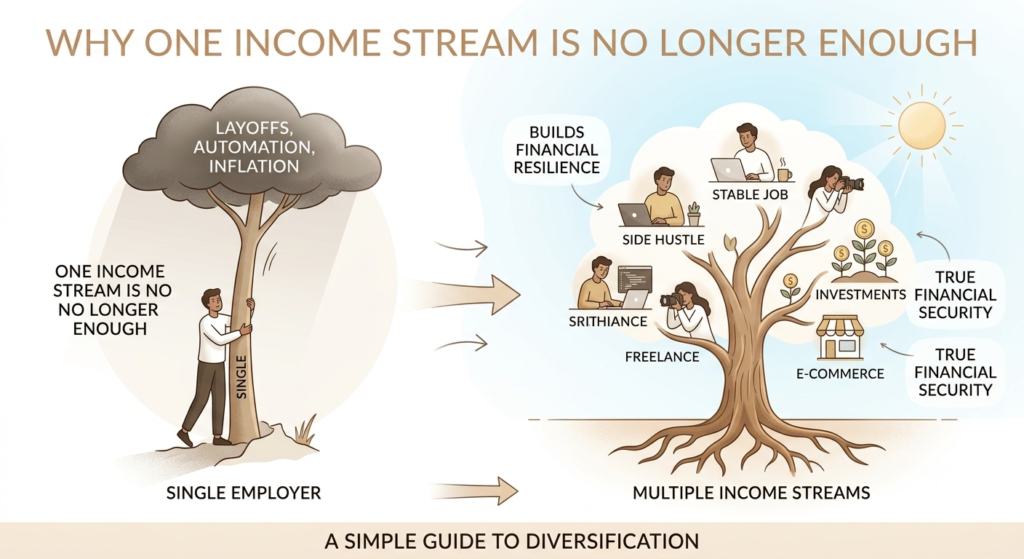
There was a time when a stable job at one company was considered the safest financial decision a person could make. That logic has been quietly falling apart for over a decade, and recent years have only sped up the process.
Economic Uncertainty and Changing Job Markets
Layoffs no longer happen only during recessions. Entire departments get restructured because of a shift in strategy, a merger, or a decision to automate certain roles. Automation and artificial intelligence are reshaping entire job categories, and while new roles are emerging alongside them, the transition isn’t always smooth for the person whose job disappeared first. A single employer, no matter how stable it seems, is still a single point of failure.
Inflation and Financial Resilience
Rising costs have pushed a large share of workers to look for income outside their primary job just to keep up with everyday expenses. Multiple recent surveys point to the same conclusion: a meaningful percentage of side hustlers say they started earning extra income specifically because their regular paycheck stopped stretching far enough. It’s not about greed. It’s about keeping pace with grocery bills, rent, and interest rates that don’t care how comfortable your salary felt three years ago.
When your income only comes from one source, inflation eats into your buying power with nothing to offset it. Multiple income streams give you more paths to grow your earnings faster than the cost of living rises.
The Concept of Income Diversification
Income diversification borrows a simple idea from investing: don’t put all your money in one place, because if that one place fails, you lose everything. The same logic applies to how you earn. If your only income depends on one job, one client, or one platform, your financial life is only as strong as that single relationship.
Diversifying doesn’t mean collecting a dozen random side gigs. It means intentionally building two, three, or four income sources that don’t all rise and fall together. If your freelance clients slow down in the summer, maybe your digital product sales pick up. If one platform changes its algorithm, your email list and personal brand still work in your favor.
Difference Between Security and Dependence
Here’s a distinction worth sitting with: a single income stream can feel secure while you’re inside it, but it often creates dependence rather than real security. You’re depending on one employer’s decisions, one industry’s health, one client’s budget.
True financial security comes from having multiple, resilient income streams working together, so that no single disruption can take you back to zero. That’s the entire argument for diversifying your income in the first place, and it’s the foundation this whole guide is built on.
The Biggest Mistake People Make When Building Extra Income
Ask ten entrepreneurs how their first attempt at multiple income streams went, and at least seven will describe some version of burnout, confusion, or quietly abandoning three half-finished projects.
Starting Five Side Hustles at Once
The most common mistake is enthusiasm without sequencing. Someone reads an article about income diversification, gets excited, and launches an online store, a freelance profile, a YouTube channel, and a coaching offer in the same month. Each one needs content, marketing, customer service, and follow-through. None of them get enough attention to actually work.
Recent industry data on side hustlers backs this up. A large share of people who start extra income projects never get past the early, unprofitable stage, and one of the most common reasons is spreading effort across too many unrelated ideas instead of committing to one until it gains traction.
Chasing Trends Instead of Solving Problems
Trendy income ideas are everywhere: a course on the latest AI tool, a print-on-demand niche someone saw go viral, a crypto strategy from a stranger online. The problem isn’t that these ideas can’t work. It’s that trend-chasing usually means solving a temporary curiosity instead of a real, ongoing problem someone will pay to solve for years.
Sustainable income streams are built around a specific person’s specific pain point. Trend-driven income streams are built around whatever is popular this month, which means they usually stop working the month after that.
Confusing Busy with Productive
There’s a particular kind of exhaustion that comes from being busy all day without moving your income forward. Answering emails, tweaking a logo for the fifth time, researching ten different platforms without picking one. It feels like work. It rarely builds a second income stream.
Productive work toward multiple income streams looks less exciting from the outside: writing the same email sequence twice to get it right, publishing consistently even when engagement is low, following up with the same handful of potential clients. It’s less stimulating than jumping between shiny new ideas, and it’s the only version that actually compounds.
Why Burnout Destroys Long-Term Wealth
This is the part hustle culture conveniently leaves out. Recent research on entrepreneurs paints a sobering picture: a large majority report dealing with at least one mental health challenge tied to their work, and burnout specifically affects a significant share of business owners at any given time. Founders experiencing burnout also report lower decision quality and a higher chance of their venture struggling, which directly undermines the very wealth-building goal that pushed them to start multiple income streams in the first place.
Burnout doesn’t just feel bad. It actively works against the outcome you’re trying to create. A tired, scattered entrepreneur makes worse pricing decisions, neglects existing clients, and eventually quits the exact income stream that was closest to paying off. If your strategy for building wealth requires sacrificing your health, it isn’t a strategy. It’s a countdown.
Start with One Strong Foundation Before Adding More
The entrepreneurs who build sustainable multiple income streams almost always follow a layered approach, even if they never call it that. They build in a specific order, and the order matters more than the number of streams.
Build a Stable Primary Income
Before you diversify, you need something solid to diversify from. This might be your full-time job, your main freelance client base, or your core business. Whatever it is, it should reliably cover your essential expenses. Trying to build a second income stream while your primary one is shaky usually means both suffer, because financial stress pulls your attention toward whichever fire is burning hottest that week.
Add One Complementary Income Stream
Once your foundation is stable, add exactly one new income stream. Not three. One. Choose something that uses skills, audience, or resources you already have, so you’re not starting completely from zero. This might mean a consultant starting to sell a template based on their process, or an employee starting freelance work in their existing field during evenings.
Optimize and Automate It
Before you even think about a third income stream, get the second one running efficiently. This means refining your offer based on real feedback, streamlining your delivery process, and automating the repetitive parts, whether that’s scheduling, invoicing, or client onboarding. A stream that still requires constant hands-on effort isn’t ready to share your attention with something new.
Only Then Build the Next Stream
Once your second income stream runs with less manual effort, you’ve earned the right to add a third. This layered, one-at-a-time approach feels slower than the “launch everything now” method. It’s also the version that actually survives past month three, because each new stream builds on a stable base instead of competing with three other half-finished projects for your limited time and energy.
Choose Income Streams That Work Together
The entrepreneurs who scale multiple income streams without losing their minds rarely build unrelated businesses. Instead, they build an ecosystem where each stream feeds the others.
Picture five potential streams:
- Consulting
- Personal brand
- Digital products
- Affiliate marketing
- Speaking engagements
On their own, these look like five separate jobs. Connected properly, they become one reinforcing system. Consulting work gives you real case studies and credibility. Your personal brand shares those lessons publicly, which builds an audience. That audience becomes the customer base for your digital products. Recommending tools you already use inside that content creates affiliate income with almost no extra work. And the visibility from your personal brand eventually leads to speaking invitations, which brings you in front of new audiences who then discover your consulting services, completing the loop.
This is the same principle observed among creators who deliberately connect their income sources: a blog feeding traffic into digital product sales, a community building an email list, short-form content driving new audience discovery, and a membership adding recurring revenue, all reinforcing one another rather than operating as disconnected side projects.
The lesson here matters more than any individual example. Before adding a new income stream, ask whether it strengthens something you’re already building or simply adds another unrelated task to your week. An ecosystem approach means every hour you invest pays off in more than one place.
Understand Active, Passive, and Scalable Income
Not all income streams behave the same way, and confusing the categories is one of the fastest ways to end up overworked. It helps to think in three buckets.
Active Income
Active income requires ongoing, direct effort in exchange for pay. If you stop working, it stops paying.
- Job
- Freelancing
- Consulting
This is usually your foundation, and there’s nothing wrong with that. Active income tends to be the most immediately reliable, which is exactly why it belongs at the base of your income structure.
Semi-Passive Income
Semi-passive income requires real upfront work but doesn’t demand your constant, hands-on attention once it’s built. It still needs maintenance, updates, and occasional customer support.
- Online courses
- Memberships
- Digital templates
These streams reward the work you already did once, rather than requiring you to redo it every time someone pays you.
Passive Income
Passive income requires minimal ongoing effort after the initial setup, though almost nothing is ever fully hands-off.
- Investments
- Dividends
- Royalties
- Rental income
Why Most “Passive Income” Still Requires Effort Initially
This is worth being honest about, because so much online content oversells passivity. Financial guidance from established sources is consistent on this point: passive income streams still demand real upfront work, whether that’s the capital required to invest, the time spent building a course, or the maintenance a rental property still needs. The IRS itself defines passive income narrowly, as earnings from activities you don’t materially participate in, which is a legal distinction, not a promise of zero effort.
The realistic version of passive income looks like this: heavy effort up front, followed by a long tail of lighter, ongoing maintenance. Anyone promising truly effortless income is usually selling something, not describing reality.
Build Around Your Existing Skills
Instead of learning five entirely new businesses from scratch, the fastest and most sustainable path to multiple income streams usually starts with what you already know how to do.
Teach What You Know
If you’ve solved a problem professionally, someone else is currently stuck on that same problem and would pay for a shortcut. This is the entire foundation of the knowledge economy, and it doesn’t require you to become a completely different kind of professional.
Package Your Expertise
A consultant who has refined a process over dozens of client engagements can turn that process into a template, checklist, or mini-course. This turns something you’ve already built once into a product you can sell repeatedly.
Monetize Existing Knowledge
You don’t need to invent a new skill set to add income. A marketer who understands paid advertising can offer consulting, write a course, or license templates. A designer who has built dozens of brand identities can turn their workflow into a productized service or a set of design assets sold to other designers.
Repurpose Work Into Multiple Products
The same underlying expertise can show up in several different formats: a blog post becomes a video, a video becomes a series of social posts, a series of client projects becomes a case-study-driven course. Repurposing isn’t cutting corners. It’s recognizing that the hardest part, developing the expertise in the first place, is already done.
Consider how this plays out across different professions. A consultant packages their onboarding framework into a paid template. A designer builds a library of brand assets they license to freelancers. A marketer turns a proven ad framework into a self-paced course. In every case, the income stream is built on top of skills the person already had, not skills they had to learn from scratch on top of an already full schedule.
Automate Before You Expand
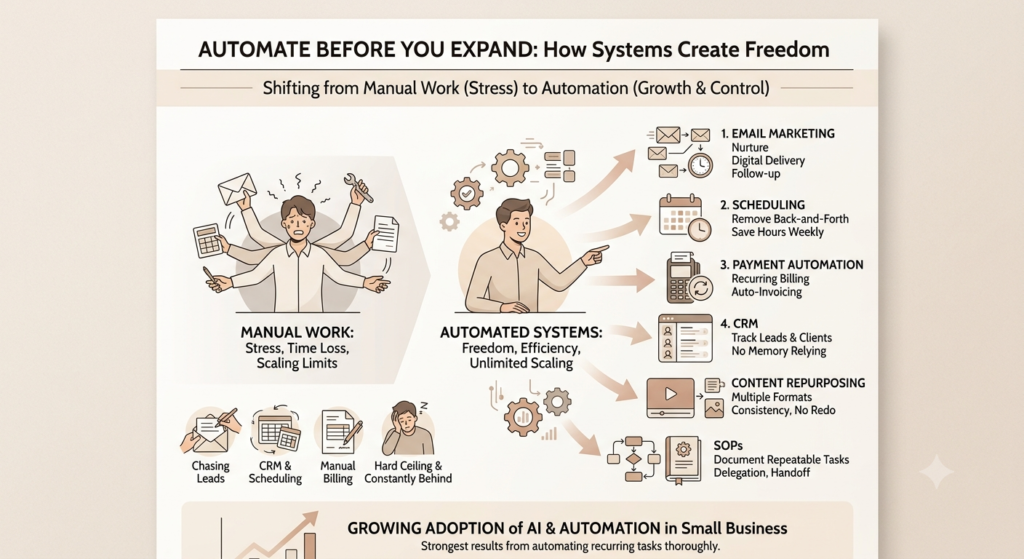
If you try to run every new income stream manually, you will eventually hit a wall, usually right around the time a second stream starts gaining real traction. This is where systems and automation stop being optional.
Email Marketing
Automated email sequences nurture new subscribers, deliver digital products, and follow up with potential clients, all without you sending a single message manually once the sequence is built.
Scheduling
Automated booking tools remove the back-and-forth of finding a meeting time, which quietly eats hours out of every week for anyone juggling more than one income stream.
Payment Automation
Recurring billing, automatic invoicing, and integrated checkout systems mean you’re not manually chasing payments or building invoices from scratch every time someone buys something.
CRM
A simple customer relationship management system keeps track of who your clients and leads are without relying on memory or a messy spreadsheet, which becomes essential the moment you have more than one type of customer to manage.
Content Repurposing
Tools and simple systems that turn one piece of content into several formats let you show up consistently across channels without creating everything from scratch every time.
SOPs (Standard Operating Procedures)
Documenting how you do repeatable tasks, whether that’s onboarding a new client or publishing a piece of content, means you can eventually hand that task to someone else instead of doing it forever yourself.
This shift toward automation isn’t a niche trend anymore. Adoption of AI and automation tools among small business owners has grown sharply in the past two years, with a large share now reporting real revenue and efficiency gains from the tools they’ve implemented. The businesses seeing the strongest results aren’t the ones with the most tools. They’re the ones who automated one specific, recurring task thoroughly before moving on to the next.
Why Systems Create Freedom While Manual Work Creates Stress
Manual work has a hard ceiling. There are only so many hours you can personally invest in following up with leads, sending invoices, or scheduling calls. Systems remove that ceiling. Once built, a system keeps performing the same task at 2 a.m. on a Sunday exactly as reliably as it does on a Tuesday afternoon.
This is the real difference between an entrepreneur who feels constantly behind and one who feels in control, even while running several income streams at once. It’s rarely about working harder. It’s about which tasks require you personally and which ones don’t.
Time Management Strategies That Prevent Burnout
Systems handle the repetitive tasks. Time management handles everything else, and it’s often the missing piece when someone tries to build multiple income streams and ends up exhausted instead.
Time Blocking
Assign specific blocks of your calendar to specific income streams instead of reacting to whatever feels urgent in the moment. This prevents one loud, demanding stream from quietly swallowing the time you meant to spend growing another.
Theme Days
Rather than switching between five different types of work every day, dedicate entire days or half-days to a single category: content creation on Mondays, client calls on Tuesdays, product development on Wednesdays. Constant context-switching is exhausting in a way that focused blocks of similar work simply aren’t.
Deep Work Sessions
Protect uninterrupted stretches of time for the work that actually moves an income stream forward, like writing a course outline or building a new offer. This is different from the shallow, reactive work of checking messages or answering routine questions, and it deserves protected time on your calendar.
Weekly Reviews
A short weekly check-in on each income stream, what worked, what didn’t, what needs attention next week, prevents you from realizing three months in that one stream has quietly been neglected.
Protecting Personal Time
Multiple income streams should expand your life, not consume it entirely. Building in non-negotiable personal time, even just a few hours a week that are fully off-limits to work, is one of the most overlooked burnout-prevention habits.
Saying No to Low-Value Opportunities
Every new income opportunity you say yes to costs you time you could have spent deepening an existing stream. The entrepreneurs who scale sustainably get comfortable turning down opportunities that don’t clearly support the ecosystem they’re already building.
Know When to Outsource
At some point, every income stream you add makes your to-do list longer unless you actively remove tasks from it. Outsourcing is how experienced entrepreneurs keep adding income streams without adding proportional hours to their week.
What Entrepreneurs Should Stop Doing
- Admin work
- Editing
- Graphic design
- Customer support
- Bookkeeping
None of these tasks require your specific expertise to be done well. They require your specific expertise to be delegated clearly, which is a very different skill.
Focus Only on High-Value Activities
High-value activities are the ones that only you can do: the strategic decisions, the relationship-building, the creative direction that shapes your brand. Everything else is a candidate for outsourcing, whether that means hiring a part-time assistant, working with a freelancer, or using an automated tool.
The math here is simple even if it feels uncomfortable at first. If bookkeeping takes you four hours a month and a bookkeeper can do it in one hour for a modest fee, keeping that task yourself isn’t frugal. It’s an expensive use of your most limited resource, which is your time and attention, not your money.
Common Myths About Multiple Income Streams
A lot of bad decisions around multiple income streams come from a handful of persistent myths. Clearing these up can save months of wasted effort.
More income streams always mean more money. Three unfocused income streams earning a little each often produce less total income than one well-optimized stream, because attention and quality get diluted across all three.
Passive income requires no work. As covered earlier, even the most passive-sounding income sources require meaningful upfront effort, capital, or ongoing light maintenance. The label “passive” describes the ongoing effort after setup, not the absence of effort altogether.
You need to quit your job first. Most successful additional income streams are built on the side, while a stable job or primary income covers living expenses. Quitting prematurely, before a new stream is validated and reliable, is one of the more common and avoidable financial mistakes entrepreneurs make.
Working 18 hours a day is the only path to success. Long hours are often treated as a badge of honor in entrepreneurship, but research on entrepreneur burnout consistently shows a connection between extreme hours, declining decision quality, and higher rates of business struggles. Sustainable systems and clear priorities outperform brute-force hours over the long run.
Every hobby should become a business. Turning something you love into a business adds deadlines, customers, and financial pressure to it. Some hobbies are genuinely better left as a source of joy and recovery rather than another income stream competing for your time.
A Practical 12-Month Roadmap
Theory is useful, but a timeline makes it actionable. Here’s a realistic 12-month progression for building multiple income streams without burning out along the way.
Months 1–3: Strengthen Primary Income and Identify Marketable Skills Focus on stabilizing whatever currently pays your bills. Alongside that, take stock of your existing skills, past work, and audience, if any. Look for the overlap between what you’re good at and what people are already willing to pay for.
Months 4–6: Launch One Side Income Stream Choose a single income stream that builds on your existing skills or audience. Launch a simple, imperfect version of it rather than waiting for a polished one. Early feedback from real customers is more valuable than months of private planning.
Months 7–9: Build Systems and Automate Repetitive Tasks Once your first side stream has some traction, shift your energy toward efficiency. Document your process, automate the repetitive parts, and remove yourself from tasks that don’t require your specific judgment.
Months 10–12: Introduce a Second Scalable Income Stream and Reinvest Profits With your first stream running more efficiently, add a second income stream that complements it, ideally one that shares an audience, skill set, or distribution channel with the first. Reinvest a portion of your profits into tools, outsourcing, or paid growth rather than spending every dollar immediately.
This roadmap isn’t rigid. Some entrepreneurs move faster, others slower, depending on their starting resources and how much time they can realistically dedicate each week. What matters is the sequence: stabilize, launch one thing, systemize it, then expand.
The Goal Isn’t More Work-It’s More Freedom
It’s worth returning to the reason any of this matters in the first place. Multiple income streams aren’t a lifestyle to aspire to for their own sake. They’re a means to a much simpler end: more control over your time, your finances, and your future.
Financial Independence
Diversified income reduces your dependence on any single employer, client, or platform. That reduced dependence is what actually creates financial independence, not the size of any one paycheck.
Lifestyle Design
When income comes from multiple, well-systemized sources, you gain more say over how and when you work. That flexibility is often the entire point for entrepreneurs who chose this path in the first place.
Flexibility
Markets shift. Industries change. A diversified income base absorbs those shifts far better than a single, rigid source of income ever could.
Sustainable Entrepreneurship
Sustainable growth means building a business and financial life you can maintain for years, not one that burns you out in eighteen months and forces you to start over.
Long-Term Wealth Over Short-Term Hustle
Short-term hustle chases quick wins and often collapses under its own exhaustion. Long-term wealth comes from consistent, systemized effort compounding over years. Multiple income streams, built the right way, are one of the most reliable paths toward that kind of lasting financial resilience.
Conclusion
Successful entrepreneurs don’t chase endless side hustles. They build a small number of complementary, scalable income streams, supported by systems, automation, and disciplined execution. The businesses and financial lives that actually last are built one stable layer at a time, not five unfinished projects launched in the same overwhelming month.
The ultimate objective isn’t to stay busy. It’s to build a business and financial life that continues to grow without sacrificing your health, your relationships, or your peace of mind. Multiple income streams, done right, should give you more of your life back, not less of it.
Key Takeaways
- Relying on a single income source has become riskier due to shifting job markets and inflation, making income diversification a practical strategy rather than a trend.
- The biggest mistake entrepreneurs make is launching several unrelated income streams at once instead of building one stable stream before adding the next.
- Income streams that support each other, feeding traffic, credibility, or audience into one another, create far more leverage than disconnected side projects.
- Not all income is equal: understanding the difference between active, semi-passive, and passive income prevents unrealistic expectations about effort required.
- Automation and outsourcing aren’t optional extras. They’re what make it possible to manage multiple income streams without burning out.
- A layered, 12-month approach, stabilize, launch, systemize, expand, outperforms trying to build everything simultaneously.
- The real goal of multiple income streams is freedom and long-term financial resilience, not simply staying busier.
Frequently Asked Questions
How many income streams should an entrepreneur have?
There’s no universal number, but most sustainable approaches settle around three to five well-connected income streams rather than a dozen scattered ones. The right number depends on how much time you can realistically dedicate to managing and growing each stream without neglecting the others.
What’s the best passive income for beginners?
For beginners, semi-passive options like digital templates, simple online courses, or affiliate marketing tend to be more realistic starting points than options like rental property, since they require less upfront capital while still demanding real initial effort to build.
Can you build multiple income streams while working full-time?
Yes, and it’s actually the more common and lower-risk path. Most successful additional income streams start as side projects built around a stable primary job, with time-blocking and prioritization making it possible to grow a second stream without quitting prematurely.
How do you avoid burnout while managing side hustles?
Avoiding burnout comes down to sequencing, systems, and boundaries: build one income stream at a time, automate and outsource repetitive tasks early, and protect dedicated personal time instead of treating every free hour as available for more work.
Which income streams are the most scalable in 2026?
Digital products, online courses, content-driven affiliate marketing, and productized consulting services tend to scale well because they separate your income from the number of hours you personally work, especially once supported by automation and clear systems.
How long does it take to build a reliable second income?
Most realistic timelines run six to twelve months from launch to a dependable, if modest, level of income, assuming consistent effort and a willingness to refine the offer based on early feedback rather than expecting it to work perfectly on the first attempt.