

Walk into any bookstore and you will find shelf after shelf dedicated to talent. Biographies of prodigies. Stories of founders who seemed to strike gold overnight. Documentaries about athletes who were “born to play.” We are conditioned, almost from childhood, to believe that natural ability is the deciding factor in who wins and who doesn’t.
It makes for a good story. It is also, in most cases, wrong.
I have spent years building and running businesses in property management and hospitality, and if there is one lesson that keeps repeating itself, it is this: the people who win long term are rarely the most gifted people in the room. They are the ones who kept showing up after everyone else stopped.
The overnight success story is a myth built on hindsight. Every founder who seems to have “come out of nowhere” actually spent years grinding in obscurity before anyone noticed. The press only shows up after the results are undeniable. What they leave out is the five years of unglamorous, repetitive work that made those results possible.
Successful entrepreneurs, athletes, creators, and leaders win because they consistently show up, not because they were handed some rare gift the rest of us don’t have. Talent might get someone a head start. It might open a door. But talent alone has never carried anyone across a finish line. That takes something else entirely.
Talent gives you a head start. Consistency gets you to the finish line.
This article breaks down exactly why that is true, what the science says about it, and how you can build the kind of consistency that compounds into real, lasting results in your business and your life.
Talent Opens the Door, But Consistency Keeps It Open
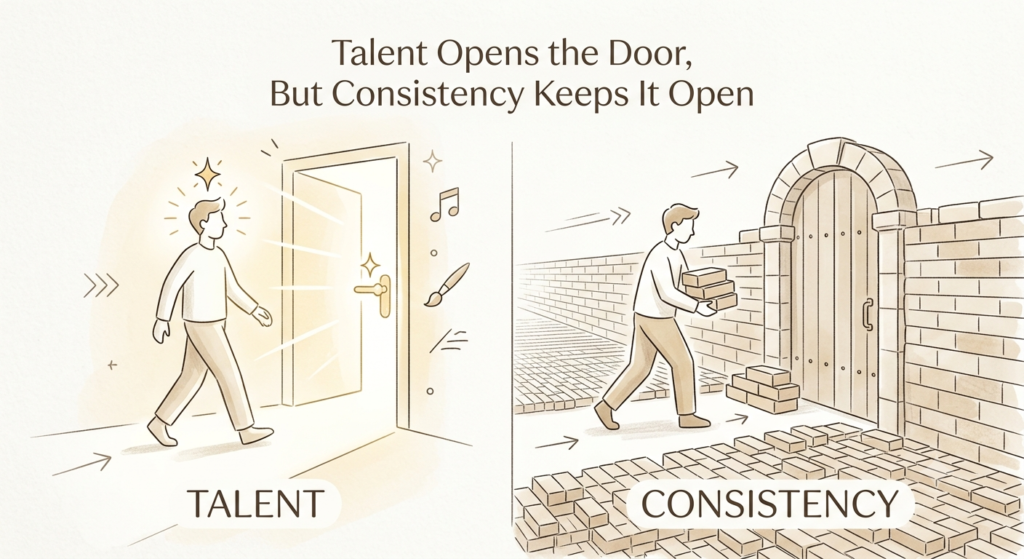
Before going further, it helps to define both terms clearly, because people often use them loosely.
Talent is a natural aptitude or ability that makes learning a skill easier at the start. It could be a quick mind for numbers, a natural way with people, or an intuitive sense for design. Talent is inherited advantage. It is potential energy.
Consistency is the repeated, disciplined application of effort over time, regardless of mood, motivation, or circumstance. Consistency is kinetic energy. It is potential put into motion, again and again, until it produces something real.
Here is the problem with talent on its own: it fades without action. A naturally gifted salesperson who never builds a follow-up system will still lose deals to a mediocre salesperson who never misses a call-back. A brilliant writer who only writes when inspired will publish less in a year than an average writer who writes five hundred words every single morning. Talent creates a ceiling of possibility, but it does nothing to guarantee the floor gets built.
Consistency, on the other hand, builds momentum. Each repetition adds a small brick. Over months and years, those bricks form a structure that talent alone could never construct, because talent doesn’t show up on the days when nobody is watching.
A simple way to see the difference:
| Talent | Consistency |
| Represents potential | Represents results |
| Present from the start | Built over time |
| Can fade without use | Strengthens with repetition |
| Gives an early advantage | Determines the long-term winner |
| Depends on natural ability | Depends on daily choices |
Notice that these two are not enemies. The entrepreneurs who go furthest are usually the ones who have some baseline ability and then layer relentless consistency on top of it. But when you have to choose which one to bet on, bet on consistency every time. It is the one variable you fully control.
The Science Behind Why Consistency Wins
This isn’t just motivational language. There is real, measurable science behind why small, repeated actions outperform sporadic bursts of brilliance.
Small Actions Compound Over Time
Compounding is usually explained through finance, where interest earns interest and a small deposit grows into a large sum over decades. The same structural principle applies to skill, business, and personal growth. Small improvements do not feel powerful because they do not produce immediate rewards, and because the feedback loop is delayed, people dismiss small improvements as insufficient. That dismissal is exactly why most people quit before compounding ever kicks in.
Compounding occurs whenever the results of previous effort become inputs for future effort, and growth accelerates not because the effort increases, but because the base upon which effort acts becomes larger. In a business, this looks like a founder who writes one piece of content a week. In month one, almost nobody reads it. By month eighteen, that same founder has a library of sixty articles, an audience that trusts them, and inbound leads that a single viral post could never replicate.
The much-repeated “1% better every day” idea illustrates the same math: tiny, consistent gains stack on top of each other rather than simply adding up. One year of applying roughly 1% daily improvement compounds into results around 37 times better than the starting point. Whether or not the exact multiplier holds in every context, the underlying pattern is well documented across skill acquisition, fitness, and learning research: consistent small inputs, repeated over a long enough period, produce outputs that look disproportionate to the effort involved.
This is also why progress feels invisible before it becomes obvious. For a long stretch, nothing seems to be happening. Revenue is flat. The audience isn’t growing. The skill still feels clumsy. Then, almost suddenly, the curve bends upward. That “sudden” breakthrough was never sudden. It was the accumulated weight of everything done quietly before it.
Your Brain Learns Through Repetition
The compound effect isn’t only a business metaphor, it is also biology. Neuroscientists call the brain’s ability to form new neural pathways throughout life neuroplasticity, and small, consistent actions strengthen these pathways until new behaviors become automatic. Repetition is not a workaround for talent. Repetition is literally how competence gets built at the neurological level.
Research on skill acquisition shows that consistent daily practice for around 30 minutes typically produces roughly two to three times better results after one year compared to the same total number of hours practiced in sporadic, multi-hour sessions. That single finding should change how every entrepreneur thinks about learning a new skill, training a new hire, or building a habit into their business. Frequency matters more than intensity.
There’s a well-known anecdote about legendary basketball coach John Wooden, whose practices were built around this exact principle: drills were kept brief, often no more than five to eight minutes each, but conducted every single day without fail, and the cumulative effect over a season was extraordinary. Short, unglamorous, repeated. That is the formula, whether you’re coaching a championship team or building a company.
Once a behavior becomes automatic, it stops requiring willpower. This is the real payoff of consistency: it eventually gets cheaper to maintain. The entrepreneur who has journaled every morning for two years doesn’t “decide” to journal anymore. It has become as automatic as brushing their teeth. That is what mastery through repetition actually looks like from the inside.
Why Most People Quit Before They Succeed
If consistency is this powerful, why doesn’t everyone use it? Because it is unglamorous, and because it collides with several very human tendencies.
Expecting instant results. Most people quietly expect that six weeks of effort should produce visible transformation. When it doesn’t, they assume the strategy is broken, when really they just haven’t given compounding enough time to work.
Lack of patience. Patience has become a rare skill in a culture engineered around instant feedback. Every app, every notification, every algorithm is designed to reward you in seconds. Business results don’t move on that timeline, and the mismatch causes people to abandon good strategies too early.
Chasing motivation. Motivation is a feeling, and feelings are unreliable. Anyone who waits to “feel like it” before doing the work will always find a day where they don’t feel like it, and that is the day the streak breaks.
Fear of failure. Some people stay inconsistent on purpose, without realizing it, because inconsistent effort provides a built-in excuse. If you never fully commit, you never have to fully find out whether you’re good enough.
Perfectionism. Waiting for the perfect plan, the perfect launch, or the perfect version of a product is one of the most effective ways to guarantee nothing ships. Perfectionism disguises itself as high standards, but it usually functions as procrastination with better branding.
Comparing themselves with others. Watching someone else’s chapter twenty while living your own chapter one is a reliable way to feel like quitting is justified. It rarely accounts for the years of invisible effort that came before the highlight reel you’re seeing.
Consistency survives all six of these traps, because it doesn’t depend on feelings, timelines, or comparisons. It only asks one question each day: did you show up and do the work you said you would do? Everything else is noise.
What Successful Entrepreneurs Do Differently
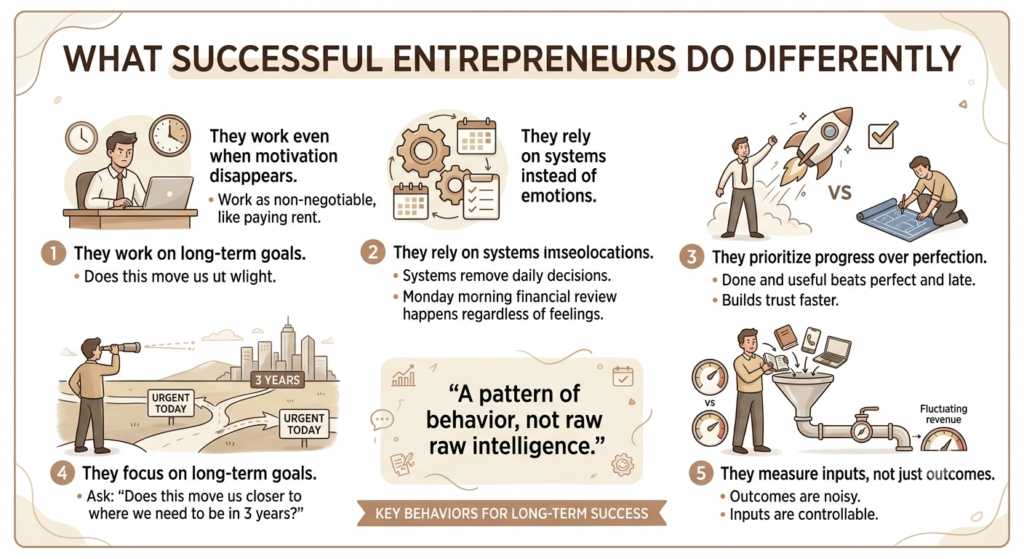
Spend enough time around founders who have built something that lasts, and a pattern becomes obvious. It has almost nothing to do with raw intelligence and almost everything to do with behavior.
They work even when motivation disappears. The founders who make it past year five are not the ones who felt inspired every day. They are the ones who treated the work as non-negotiable, the same way they’d treat paying rent.
They rely on systems instead of emotions. A system removes the daily decision of whether or not to act. If Monday mornings are blocked for financial review no matter what, that review happens whether the founder is feeling energized or exhausted. Emotion becomes irrelevant to the outcome.
They prioritize progress over perfection. A property manager who sends an imperfect but honest update to an owner today builds more trust than one who delays for a week trying to make the report flawless. Done and useful beats perfect and late, almost every time.
They focus on long-term goals. Short-term thinking chases whatever looks urgent today. Long-term thinking asks whether today’s action moves the business closer to where it needs to be in three years, and then does that action regardless of how urgent it feels.
They measure inputs, not just outcomes. Outcomes are noisy and often outside your control in the short term. Revenue can dip for reasons that have nothing to do with effort. Inputs, like calls made, content published, or properties inspected, are fully within your control and are the more honest scoreboard day to day.
A simple framework captures this whole approach:
Show Up → Improve → Repeat → Compound → Win
It is not complicated. It is just uncomfortable to sustain, which is exactly why so few people actually do it.
Real Examples Where Consistency Beat Talent
Across nearly every field, the pattern of quiet, repeated effort outlasting flashes of natural ability shows up again and again.
Business founders. Most successful companies were not built on a single brilliant idea. They were built on years of small, iterative improvements to product, pricing, and customer experience, made consistently long after the initial excitement of launch had worn off. The founders who are still standing a decade later are usually the ones who kept refining their offer quarter after quarter, not the ones who had the flashiest pitch deck on day one.
Content creators. The people who achieve the greatest success in business, health, and personal development aren’t necessarily the most talented or lucky, they’re the ones who stay disciplined and committed to small habits that accumulate into massive results. A creator who publishes consistently for two years, even with average production quality, will almost always build a larger, more loyal audience than a naturally talented creator who posts sporadically whenever inspiration strikes.
Athletes. Coach John Wooden’s daily, brief, unglamorous drills, repeated without fail across an entire season, produced results that felt extraordinary precisely because they compounded quietly over time rather than arriving in one dramatic leap. This same pattern shows up in nearly every serious athletic program: the training that wins championships rarely looks impressive on any single day.
Investors. Warren Buffett, one of the richest investors in the world, did not build his fortune through sudden windfalls; he followed the principle of compounding returns, turning small, consistent investments made over decades into billions. He started young and simply never stopped. The strategy wasn’t exotic. The consistency was the edge.
Writers. Prolific authors rarely describe their process as waiting for inspiration. They describe a fixed daily word count, hit whether the writing feels good or not. Over years, that unglamorous discipline produces a body of work that a “naturally talented” but inconsistent writer never manages to finish.
In every one of these cases, the common thread is not genius. It’s repetition applied with discipline, long enough for the compounding to become visible to everyone else.
The Hidden Superpower of Consistency
Consistency does more than produce results. It changes how you are perceived and how you make decisions.
It builds trust. Clients, partners, and employees learn who they can rely on by watching what happens over time, not by listening to what someone promises once. A property manager who responds to every maintenance request within 24 hours, every time, earns a level of trust that no marketing campaign can buy.
It creates credibility. Expertise is proven through a track record, not a claim. Consistency is what turns “I know what I’m doing” into a demonstrated fact.
It develops confidence. Confidence is not something you think your way into. It is built through evidence, and consistent action is the fastest way to generate evidence that you can rely on yourself.
It improves decision-making. When your habits and systems are consistent, you free up mental energy for the decisions that actually require judgment, instead of spending willpower re-deciding basic routines every day.
It reduces procrastination. A consistent routine removes the daily negotiation with yourself about whether now is the “right time” to start. The time was already decided in advance.
It makes success predictable. This might be the most underrated benefit. Talent produces occasional brilliance. Consistency produces a reliable floor of performance that rarely dips below a certain standard, which is exactly what businesses, teams, and clients actually need.
How to Build Consistency (Even When You Don’t Feel Like It)
Understanding why consistency wins is the easy part. Building it into daily life is where most people struggle. Here is a practical approach.
Start Small
The instinct is to go big immediately: two hours of deep work every morning, a complete overhaul of the business, a five-day-a-week gym routine starting tomorrow. Ambitious plans like this usually collapse within two weeks because they demand more willpower than most people have in reserve.
Start with something almost embarrassingly small. Ten minutes of outreach calls. One paragraph of writing. A single habit tracked in a notebook. The goal at the start is not intensity, it’s proving to yourself that you can show up tomorrow, and the day after that.
Build Systems Instead of Depending on Motivation
A system is a routine that removes decision-making from the equation. Instead of deciding each morning whether to review your numbers, you decide once that Monday at 9 a.m. is always the review, and then you simply follow the system.
Protect your focus from distractions, measure your daily practice, and leverage the compound effect of tiny gains for extraordinary long-term success. That protection has to be built structurally, through blocked time, clear routines, and defined defaults, rather than relying on daily discipline to hold the line by itself.
Track Progress
Tracking your daily habits and progress makes the compound effect visible and reinforces positive behaviors, and creating simple tracking systems for your most important habits and metrics turns measurement itself into a powerful, compounding habit. Whether it’s a simple checklist, a spreadsheet, or a habit-tracking app, the act of marking a day as “done” reinforces the identity of someone who follows through.
Celebrate consistency, not perfection. A month with twenty-six out of thirty days completed is a strong month. Treating it as a failure because it wasn’t thirty out of thirty is exactly the kind of thinking that causes people to quit.
Never Miss Twice
This single rule may be the most practical tool in the entire article. Missing a single day does not destroy the habit-formation process, and your brain’s neural pathways do not erase themselves because you missed one day. Life happens. Flights get delayed, kids get sick, deadlines collide. Missing one day is normal and does not undo months of progress.
The danger is in the second missed day. One missed day is an exception. Two in a row starts to become a new pattern, and patterns are exactly what your brain is wired to adopt through repetition. The rule is simple: whatever happens, get back on track the very next day.
Protect Your Environment
Willpower is a limited and unreliable resource, especially at the end of a long day. The people who stay consistent the longest tend to rely less on willpower and more on environment design. Remove the phone from the desk during focus hours. Keep the running shoes by the door. Put the habit tracker somewhere visible.
Create cues that support your habits and remove the ones that work against them. Consistency gets dramatically easier when the environment is quietly pulling you toward the behavior instead of away from it.
Common Mistakes That Destroy Consistency
Even well-intentioned people sabotage their own consistency in predictable ways.
- Waiting for motivation. Motivation is a byproduct of action, not a prerequisite for it. Waiting to feel ready almost always means waiting indefinitely.
- Setting unrealistic goals. A goal that requires perfect conditions to succeed is a goal designed to fail the first time life gets messy.
- Doing too much too soon. Adding five new habits at once spreads willpower too thin. Build one at a time, and let it become automatic before adding the next.
- Constantly switching strategies. Jumping to a new business model, content platform, or productivity system every few weeks resets the compounding clock back to zero. Nothing has time to build momentum.
- Comparing your chapter one to someone else’s chapter twenty. This kills more good habits than any external obstacle ever could. The only fair comparison is between where you are today and where you were a month ago.
The Entrepreneur’s Consistency Checklist
A practical way to put all of this into action is to build a short daily and weekly checklist around the habits that matter most in business. Here is a starting framework:
- Daily learning – even fifteen minutes of reading, listening, or studying your industry
- Daily planning – a short review of the top three priorities for the day
- Weekly review – an honest look at what worked, what didn’t, and what needs to change
- Consistent networking – regular, ongoing contact with peers, partners, and mentors, not just when you need something
- Content creation – sharing insights, updates, or lessons on a fixed schedule
- Customer follow-ups – never letting a client or tenant relationship go quiet without a check-in
- Health habits – protecting sleep, movement, and basic physical energy, since none of the above is sustainable without it
- Financial tracking – reviewing numbers on a set schedule instead of only when something feels wrong
None of these items are complicated. The value isn’t in the difficulty of each task, it’s in doing each one on a fixed rhythm, week after week, long after the novelty has worn off.
Conclusion: Success Belongs to Those Who Keep Showing Up
Talent may get you noticed, but consistency earns respect. Motivation comes and goes, opportunities rise and fall, and circumstances change, but the habit of showing up every day creates results that luck and talent alone never can.
Every founder, athlete, writer, and investor referenced in this article shares the same underlying story: years of unremarkable, repeated effort that eventually compounded into something remarkable. None of it happened overnight, and none of it depended on being the most gifted person in the room.
If you want lasting success in business and life, stop chasing perfection and start building consistency. The small actions you repeat today become the extraordinary results you enjoy tomorrow.
Key Takeaways
- Talent provides a head start, but consistency determines who actually finishes.
- Small, repeated actions compound over time, even when progress feels invisible in the short term.
- Repetition physically strengthens the neural pathways behind skill and habit.
- Most people quit not because the strategy fails, but because they expect faster results than compounding allows.
- Systems outperform motivation because they remove the daily decision of whether to act.
- Missing one day is normal; missing two starts to build a new, unwanted pattern.
- Tracking progress and protecting your environment make consistency easier to sustain.
Frequently Asked Questions
Is talent completely unnecessary for success?
No. Talent can provide a genuine early advantage and make certain skills easier to learn at first. The issue is relying on talent alone, without the consistent effort needed to develop it into a real, durable skill.
How long does it actually take to build a lasting habit?
Longer than the popular “21 days” claim suggests. A systematic review of 20 studies involving 2,601 participants found that health-related habits typically require two to five months to develop, with individual variability ranging from 4 to 335 days. The safest expectation is roughly two to three months of consistent repetition before a habit starts to feel automatic.
What should I do if I miss a day in my routine?
Get back to it the next day without treating the miss as a failure. Missing a single day does not destroy the habit-formation process, since the long-term trend matters far more than any single day. The real risk is missing two days in a row, which is when a lapse starts to become a new pattern.
How do I stay consistent when I don’t feel motivated?
Build systems and routines that don’t depend on how you feel. Fixed times, small starting commitments, and visible progress tracking all reduce the reliance on daily willpower or motivation.
Can consistency really outperform natural talent in business?
In most cases, yes, especially over multi-year timelines. A founder who consistently improves their product, follows up with customers, and refines their systems will typically outperform a naturally gifted but inconsistent competitor, because business results are driven by cumulative, repeated actions rather than isolated bursts of brilliance.
What’s the fastest way to start building more consistency today?
Pick one small, specific habit, something so easy it feels almost too simple, and commit to doing it at the same time every day for the next thirty days. Track it visibly, and follow the never-miss-twice rule if a day gets away from you.