

Most people who want to start a business never do, and the reason is almost always the same. They believe they need a large sum of money before they can begin. A commercial lease. A team. A polished logo. A six-figure cushion in the bank.
None of that is true, and the data backs it up. A large share of small businesses in the US launch with modest personal savings, and nearly a third of nonemployer firms start with no outside capital at all. Self-funding, not venture funding, is the norm, not the exception. Roughly 20% of small business owners finance their launch with personal savings, and close to three-quarters of entrepreneurs fund their earliest phase through savings, credit cards, or a paycheck from their day job.
I have watched this play out again and again, both in my own path and in the founders I mentor. The businesses that survive the first two years are rarely the ones with the biggest opening bank balance. They are the ones built by people who solved a real problem, found one paying customer, and reinvested what they earned instead of waiting for permission from an investor.
This guide is not a motivational pep talk. It is a practical framework for how to start a business with limited money, built around three ideas that have stood the test of time: choose a low-cost model, validate before you spend, and get a paying customer before you build anything elaborate. By the end, you will have a step-by-step path, a lean one-page plan template, and a realistic 30-day launch sequence you can start using today.
Stop Waiting for Perfect Conditions
Lack of Money Is Often an Excuse in Disguise
It is easy to tell yourself that you will start “once you have saved enough” or “once the market settles down.” In practice, that day rarely arrives. What actually happens is that the idea grows stale, the fear grows louder, and the window for testing it quietly closes.
Here is the uncomfortable truth: waiting for perfect financial conditions is often a more comfortable form of procrastination than admitting you are afraid to be told no by a customer. Money is rarely the real blocker. Clarity and action are.
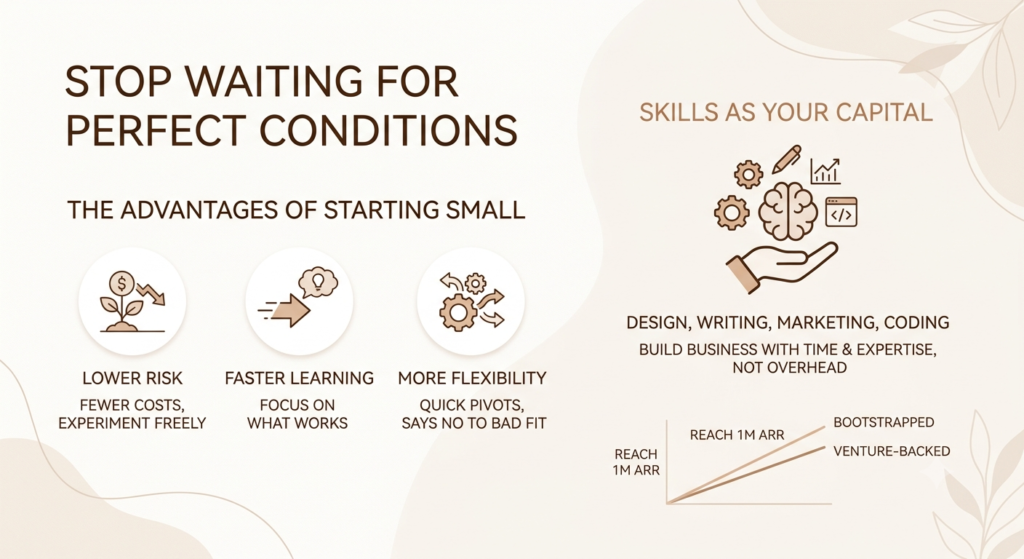
The Advantages of Starting Small
Starting lean is not a consolation prize. It is a strategic advantage that founders with large war chests do not get to enjoy.
- Lower risk. If your monthly costs are close to zero, a slow month will not sink you. You can experiment, fail cheaply, and try again without existential pressure.
- Faster learning. When every dollar is your own, you pay close attention to what actually converts into revenue. You cut what does not work far faster than a well-funded team that can afford to be inefficient for a while.
- More flexibility. Without a board, investors, or a large payroll to protect, you can pivot in a week instead of a quarter. You can say no to a bad-fit client. You can change your pricing on a Tuesday afternoon.
An analysis of SaaS company growth from ChartMogul, covering more than 2,500 companies, found that the top-performing bootstrapped companies reach one million dollars in annual recurring revenue only about four months slower than their venture-backed peers, while keeping full ownership the entire time. Capital speed is real, but it is not the decisive advantage people assume it to be.
Skills Are Often More Valuable Than Capital in the Beginning
In the earliest stage of a business, your skill set is your capital. A marketer who understands paid acquisition, a designer who can build a clean landing page, a writer who can turn expertise into content that ranks and converts – these people are running businesses with almost no overhead, because their primary input is time and expertise, not equipment or inventory.
If you are starting with limited money, your first job is to take an honest inventory of what you already know how to do well enough that someone would pay you for it today. That is your starting point, not a business plan template.
Choose a Business That Requires Minimal Investment
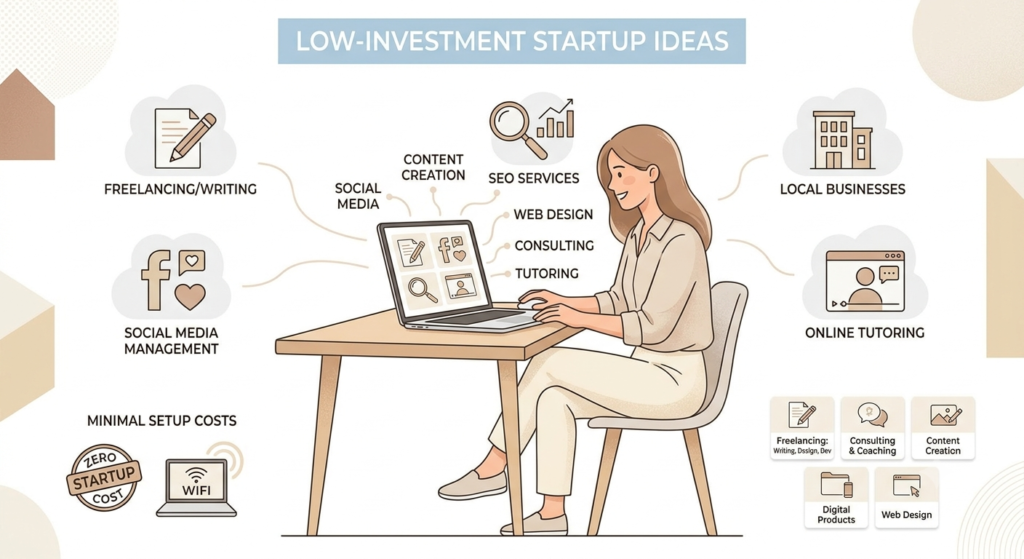
Not every business idea is equally friendly to a bootstrapped launch. Physical products, inventory-heavy retail, and anything requiring specialized equipment or a storefront typically demand real capital before you see a dollar of revenue. Service-based and knowledge-based businesses, by contrast, can often start with nothing more than a laptop and an internet connection.
The freelance and independent-work economy has grown large enough that it is no longer a fringe option – it is a mainstream starting point. Current estimates put the number of Americans doing freelance or independent work in the tens of millions, and multiple industry trackers describe freelancing as the fastest-growing segment of the US labor market. This matters for you as a founder because it means the market infrastructure – platforms, payment tools, client expectations – already exists for exactly the kind of low-cost business you are likely to start.
Consider these low-investment paths:
Freelancing
Writing, design, development, video editing, or translation work you can start selling through your existing network or a single platform profile.
Consulting or Coaching
If you have five or more years of experience in a function – operations, sales, hiring, finance – companies and individuals will pay for structured guidance, especially if you can point to concrete outcomes you have delivered before.
Social Media Management
Small businesses want a consistent online presence but rarely have the time or skill to manage it themselves. This is one of the lowest-barrier services to start, requiring only a portfolio of sample work and a handful of tools.
Content Creation
Blog writing, newsletter ghostwriting, and short-form video content are in high demand as companies compete for attention across more channels than ever.
Web Design
Small businesses and solo professionals routinely need a simple, professional website. You do not need to build custom software – a well-designed site on an existing platform solves the problem.
SEO Services
Local businesses in particular are often invisible in search results and do not know why. Basic technical and content-based SEO work can be a highly profitable low-overhead service.
Online Tutoring
Academic subjects, test preparation, and language instruction can all be delivered over video calls with no physical space required.
Digital Products
Templates, guides, courses, and toolkits let you build something once and sell it repeatedly, though these generally take longer to gain traction than direct service work.
Key point: Service-based businesses tend to carry far lower startup costs than product or inventory-based businesses, because your primary expense is your own time rather than materials, storage, and logistics. Data from Carta’s review of more than 40,000 startups found that founders typically invest around ten thousand dollars to get their business off the ground – and for service businesses, that figure is often a fraction of that, since the core costs are development tools, a website, and basic software subscriptions.
Validate the Idea Before Spending Money
The single most expensive mistake first-time founders make is building something before confirming anyone wants it. Validation is how you avoid that mistake, and it costs almost nothing.
Identify a Real Problem
Start with a problem you have personally experienced, or one you have watched a specific group of people struggle with repeatedly. Vague problems produce vague businesses. “People need better productivity tools” is not a problem. “Freelance bookkeepers spend three hours a week manually reconciling client invoices” is a problem you can solve.
Talk to Potential Customers
Before writing a line of code or designing a single graphic, have direct conversations with 10 to 20 people who fit your target customer profile. Ask about their current process, their frustrations, and what they have already tried. Resist the urge to pitch your idea in this stage – you are gathering evidence, not selling.
Create a Simple Offer
Once you understand the problem clearly, put together a basic offer: what you will deliver, for whom, and at what price. This does not need a website or branding. A single paragraph in an email or a direct message is enough to test interest.
Get Feedback and Improve
Send that offer to a small group of real prospects. Their response – or silence – tells you more than any amount of internal debate ever will. Adjust the offer based on what you learn, and test again.
The Lean Startup Concept
This entire validation process draws from the Lean Startup methodology, popularized by entrepreneur Eric Ries. The central idea is straightforward: build the smallest possible version of your idea, put it in front of real customers, measure their actual behavior, and use what you learn to decide your next move. The goal is to replace assumptions with evidence as quickly and cheaply as possible, rather than spending months building a full product based on guesses.
Applied to a limited-money launch, this means your first version of the business should be embarrassingly simple. A spreadsheet instead of custom software. A phone call instead of an app. The point is not to look impressive. The point is to learn whether people will actually pay.
Create a One-Page Lean Business Plan
Traditional 30-page business plans are built for a world where you need to convince a bank loan officer or a venture investor. If you are bootstrapping, you need something that helps you think clearly and move fast – not a document that sits in a drawer.
A lean one-page plan should cover:
- Problem – What specific pain point are you solving, and for whom?
- Solution – What is your offer, in one or two sentences?
- Target Audience – Who exactly will pay for this, and how do you reach them?
- Revenue Model – How will money come in: one-time fees, subscriptions, retainers, commissions?
- Marketing Channels – Where will your first ten customers actually come from?
- Estimated Startup Costs – What will you genuinely need to spend in the first 90 days?
- 90-Day Goals – What does meaningful progress look like by the end of the quarter?
A lean plan like this is often sufficient for early-stage decision-making, because its job is not to impress anyone. Its job is to force you to answer the questions that matter before you spend money you do not need to spend. You can rewrite it every 30 days as you learn more – treat it as a living document, not a static one.
Start With Free or Low-Cost Tools
One of the quiet advantages of starting a business today is how much operational infrastructure is available for free or near-free. There is rarely a good reason to take on fixed monthly costs in your first 90 days.
- Website builders and WordPress for a professional-looking online presence without hiring a developer.
- Canva for design work – social graphics, presentations, and simple marketing materials – without needing design software expertise.
- Free productivity and collaboration tools for documents, scheduling, and basic project tracking.
- Social media platforms as free distribution channels to reach your first audience directly.
- Free-tier CRM and invoicing tools to manage client relationships and get paid without a monthly software bill.
The goal at this stage is not to have the most sophisticated tech stack. It is to minimize fixed expenses so that nearly every dollar you bring in strengthens your cash position instead of paying down overhead you took on prematurely. You can upgrade tools later, once real revenue justifies the cost.
Get Your First Customer Before Building Everything
This is where most first-time founders get the sequence backwards. They build first, then go looking for customers. The better order is the reverse.
Practical Steps
- Reach out to your network. Your first customer is more likely to come from someone who already trusts you than from a stranger on the internet. Tell people directly what you are offering.
- Share your offer on LinkedIn and Instagram. A clear, specific post about the problem you solve will outperform a vague announcement that you are “starting a business.”
- Join relevant communities. Industry-specific forums, local business groups, and niche online communities are full of people with the exact problem you solve.
- Offer a pilot project. A discounted or limited-scope first engagement lowers the barrier for someone to say yes, while still generating real revenue and real feedback.
- Collect testimonials. The moment you deliver value, ask for a short written testimonial. This becomes the proof that convinces your next ten customers.
Core Lesson: Revenue Is the Best Validation
No amount of positive feedback, likes, or encouraging conversations replaces the signal of someone actually paying you money. Revenue tells you, unambiguously, that the problem is real and your solution is worth something. Everything else is an educated guess.
Reinvest Profits Instead of Chasing Investors Too Early
What Bootstrapping Means
Bootstrapping means funding your business through personal savings, ongoing income, and – most importantly – the revenue the business itself generates, rather than through outside investors. There is no term sheet, no equity given away, and no board to answer to.
The Benefits: Control, Ownership, and Discipline
The constraint of limited capital is not purely a disadvantage. It forces real financial discipline: pricing has to support actual margins, spending has to be justified by results, and growth has to be earned rather than purchased. Over time, that discipline compounds into a business built on genuine unit economics rather than borrowed momentum.
It is also worth being clear-eyed about the numbers. Only a very small fraction of businesses – well under one percent by most estimates – ever raise venture capital at all. The overwhelming majority of founders build their companies the way this guide describes: self-funded, revenue-first, and growing at the pace their own cash flow allows. Mailchimp is a well-known example of this path – its founders bootstrapped the company entirely on reinvested profits for two decades before an acquisition that made headlines, without ever taking outside investment.
When Outside Funding Might Become Necessary
Bootstrapping is not the right model for every business. Ventures that require significant upfront capital before any revenue is possible – hardware, biotech, capital-intensive manufacturing – often need outside funding earlier. Businesses competing in winner-take-all markets, where speed to scale determines survival, may also need to raise capital sooner than a bootstrapped timeline allows.
For most service businesses, digital products, and consulting practices, however, funding becomes a genuine option only after you have proven the model works – not a prerequisite for starting it
Common Mistakes First-Time Entrepreneurs Make
Understanding what derails other founders is often more useful than another list of things to do right.
- Building a product nobody wants. This remains the single most common cause of failure. Skipping validation to “just start building” is the fastest way to burn time and money on the wrong thing.
- Spending on branding before getting customers. A polished logo and a custom domain will not generate revenue on their own. Get paying customers first; refine your brand as the business proves itself.
- Renting an office too soon. Fixed overhead is the enemy of an early-stage business. A commercial lease before you have predictable revenue turns a manageable slow month into a crisis.
- Ignoring cash flow. Profitability on paper means little if the timing of money coming in does not match the timing of money going out. Nearly one in five small business owners cites a lack of capital or cash flow as a leading financial challenge, and inflation-driven cost increases compound that pressure further.
- Trying to do everything at once. Spreading limited time and money across five ideas at once is slower than committing fully to one and learning from it quickly.
A Simple 30-Day Action Plan
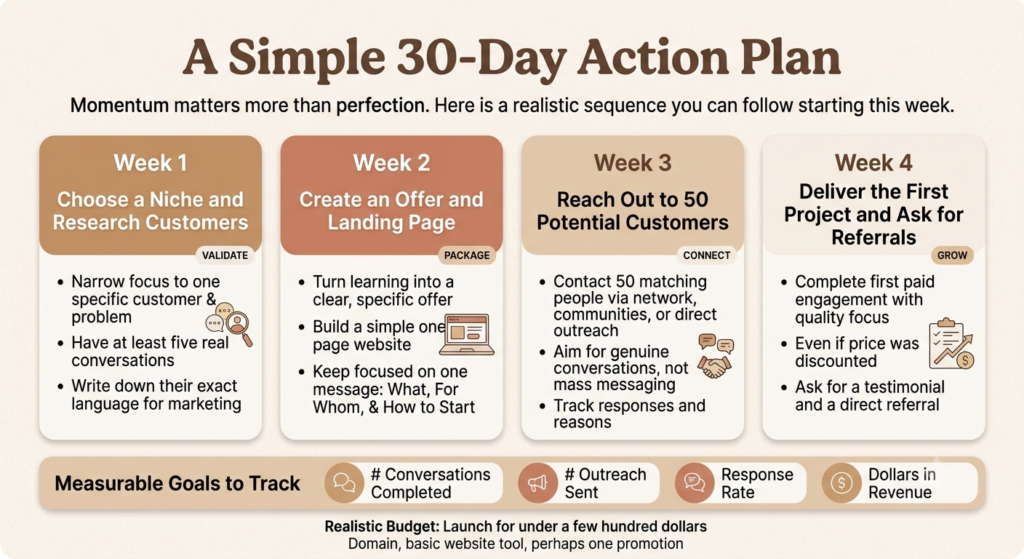
Momentum matters more than perfection. Here is a realistic sequence you can follow starting this week.
Week 1: Choose a Niche and Research Customers
Narrow your focus to one specific type of customer with one specific problem. Have at least five real conversations with people in that group. Write down their exact language when describing the problem – you will use it in your marketing later.
Week 2: Create an Offer and Landing Page
Turn what you learned into a clear, specific offer. Build a simple one-page website using a free or low-cost builder. Keep it focused on one message: what you do, for whom, and how to get started.
Week 3: Reach Out to 50 Potential Customers
Contact 50 people who match your target customer profile – through your network, relevant communities, or direct outreach. Aim for genuine conversations, not mass messaging. Track who responds and why.
Week 4: Deliver the First Project and Ask for Referrals
Complete your first paid engagement with full attention to quality, even if the price was discounted. Ask for a testimonial and, directly, for a referral to someone else who might need the same help.
Measurable goals to track: number of validation conversations completed, number of outreach messages sent, response rate, and – most importantly – dollars in revenue collected by day 30.
Realistic budget: most founders following this plan can launch for under a few hundred dollars, covering a domain, a basic website tool, and perhaps one paid promotion – well below the tens of thousands of dollars often cited as the average cost to start a business, because that average includes physical locations, inventory, and staff that a lean service business does not need in month one.
Final Thoughts: Start Before You’re Ready
You do not need a perfect plan. You do not need a large investment. You need a real problem to solve, a customer willing to pay for the solution, and the discipline to keep showing up after the first no.
Every founder who has built something lasting started exactly where you are now – with more uncertainty than resources. The businesses that make it past year one are rarely built by the people with the biggest budgets. They are built by the people who moved first, listened to their customers, and reinvested every dollar of progress back into the next step.
Start small. Start lean. Start now.
Key Takeaways
- Most entrepreneurs self-fund their launch through savings and early revenue rather than outside investment – this is the norm, not the exception.
- Service-based businesses like freelancing, consulting, and content creation typically require far less capital than product or inventory-based businesses.
- Validate your idea through direct customer conversations before spending money building anything.
- A one-page lean business plan is often more useful in the early stage than a lengthy formal document.
- Get your first paying customer before you invest in branding, tools, or infrastructure – revenue is the real validation.
- Reinvesting profits gives you control and discipline that outside funding can quietly erode.
- A focused 30-day plan can move you from idea to first paying customer with a minimal budget.
Frequently Asked Questions
1. How much money do I actually need to start a service-based business?
Many service businesses can launch for a few hundred dollars, covering a domain name, a basic website tool, and essential software subscriptions. This is significantly lower than the broader small business average, which includes costs like inventory, equipment, and physical locations that most service businesses do not need.
2. Is bootstrapping better than raising investment?
Neither approach is universally better – they solve different problems. Bootstrapping suits businesses that can reach profitability within a reasonable timeframe and where founders want to retain full ownership and control. Raising capital tends to make more sense for capital-intensive ventures or markets where speed to scale is critical to survival.
3. How do I validate a business idea without spending money?
Have direct conversations with 10 to 20 people who match your target customer profile, present a simple offer, and pay close attention to whether they would actually pay for it. This costs time, not money, and prevents you from building something nobody wants.
4. What is the biggest mistake new entrepreneurs make when starting with limited money?
Building a full product or service before confirming that real customers will pay for it. Skipping validation is the most common reason early-stage businesses fail to gain traction.
5. Do I need a formal business plan to get started?
Not in the beginning. A one-page lean plan covering your problem, solution, target audience, revenue model, marketing channels, and 90-day goals is typically sufficient to guide early decisions.
6. How long does it usually take to get a first paying customer?
With focused outreach, many founders following a structured 30-day plan can secure a first paying project within that window, particularly in service-based businesses where the sales cycle is short and personal.