

Most business owners do not fail because they lack ambition. They fail because they never turn that ambition into a working system.
Research from Harvard Business School puts a number on this problem that should stop every founder mid-scroll: somewhere between 60 and 90 percent of strategic plans never get executed the way they were designed. Another widely cited HBR estimate found that two-thirds of well-formulated strategies collapse specifically because of poor execution, not poor thinking. The plan wasn’t the problem. What happened after the plan was written – that’s where things fell apart.
If you run a small business, this should feel familiar. You’ve probably sat down at some point, maybe over a weekend, and mapped out where you want your business to go. Then Monday arrived, a client emailed with an emergency, an employee quit, and the plan quietly slid into a drawer.
This guide is not another motivational push to “think bigger.” It’s a practical walkthrough of what business strategy actually is, the frameworks that work for businesses your size, and – more importantly – how to build a system that keeps your strategy alive after the planning meeting ends. Whether you run a property management company, an Airbnb portfolio, a service business, or a small team trying to compete against bigger players, the principles here apply directly to you.
What Business Strategy Really Means (and Why Most Owners Get It Wrong)
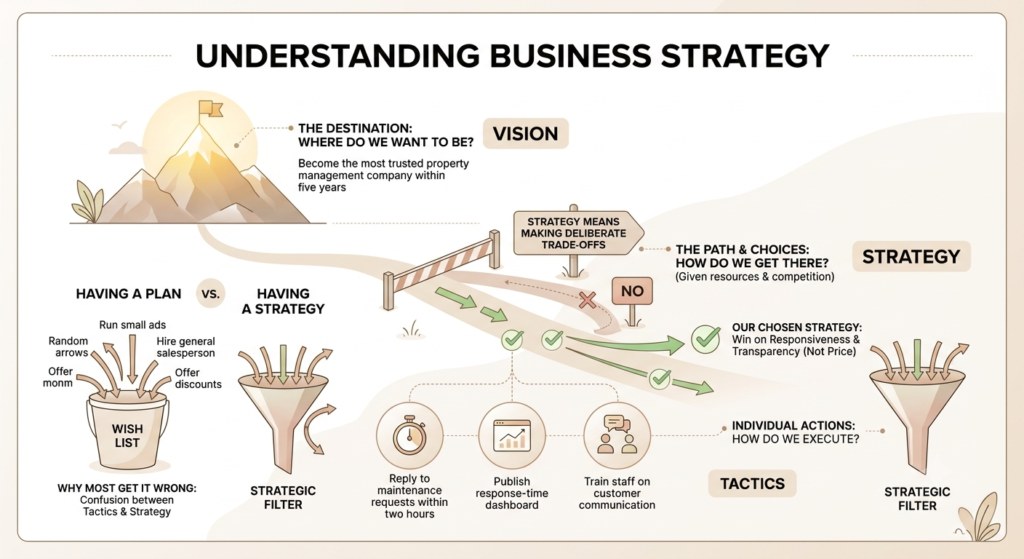
Ask ten small business owners to define “strategy” and you’ll get ten different answers. Most of them will actually be describing tactics.
Strategy vs. Tactics vs. Vision
A vision is where you want to end up. A strategy is the specific, deliberate set of choices you make to get there, given your resources and your competition. Tactics are the individual actions that carry out the strategy.
Here’s a simple way to separate the three. “Become the most trusted property management company in our region within five years” is a vision. “Win on responsiveness and transparency rather than price” is a strategy. “Reply to every maintenance request within two hours and publish a public response-time dashboard” is a tactic.
The confusion happens because tactics feel productive. Posting on social media, running a promotion, hiring a salesperson – these all feel like “doing strategy.” But without a clear strategic choice behind them, tactics are just activity. Busy is not the same as strategic.
Why “Having a Plan” Isn’t the Same as Having a Strategy
A real business strategy for small business owners has to answer an uncomfortable question: what are you choosing not to do? Strategy, at its core, is about trade-offs. If your plan lets you say yes to every opportunity that comes your way, it isn’t a strategy – it’s a wish list.
This is one of the biggest gaps between businesses that grow steadily and businesses that stall. The ones that grow have a filter. When a new opportunity shows up, they can quickly tell whether it fits the direction they’ve chosen or whether it’s a distraction dressed up as growth.
Why a Clear Business Strategy for Small Business Owners Matters More in 2026
Strategy has always mattered. But the environment small business owners are operating in right now makes the difference between a strategic business and a reactive one much sharper.
The Current Small Business Landscape: Growth Amid Pressure
There are more than 36 million small businesses in the United States today, accounting for the vast majority of all businesses and generating close to 44 percent of GDP. Heading into 2026, owner confidence is unusually high – close to 94 percent of small business owners expect growth this year, and nearly four in ten plan to increase their marketing spend. At the same time, inflation and cash flow pressure remain the two challenges owners report most often.
That combination – high optimism paired with real financial strain – is exactly the environment where strategy separates the businesses that scale from the businesses that burn out. Owners who are simply reacting to whatever’s urgent tend to chase every trend: a new AI tool here, a new marketing channel there. Owners with a defined strategy use the same tools, but they use them in service of a specific position they’re trying to own in their market.
Technology adoption is accelerating fast enough that it’s now a baseline expectation rather than an edge. Nearly half of small employer firms report using AI in some capacity, and among small businesses in general that figure is closer to the majority. The businesses pulling ahead aren’t the ones using AI the most – they’re the ones who know exactly which problems they’re using it to solve, because that decision was made strategically, not reactively.
The Execution Gap: Why Good Strategies Still Fail
Here’s the part most planning advice skips over. A detailed analysis of more than 20,000 strategic plans found that 83 percent of organizations complete less than a quarter of their planned strategic initiatives. Not “struggle to complete.” Complete less than 25 percent.
Separately, an Economist Intelligence Unit survey found that 61 percent of executives admit their companies struggle to connect the strategy they’ve formulated with the work that happens day to day. That disconnect is often called the strategy execution gap, and it’s rarely about the strategy being wrong. It’s usually about the strategy living in a document instead of living in the calendar, the meetings, and the decisions your team makes every day.
For a small business, this gap looks different than it does at a Fortune 500 company, but it’s just as real. It looks like a strategic priority getting written on a whiteboard in January and never mentioned again by March. It looks like hiring decisions, marketing spend, and daily priorities that have no visible connection to the direction you said you wanted to go.
The Building Blocks of an Effective Business Strategy
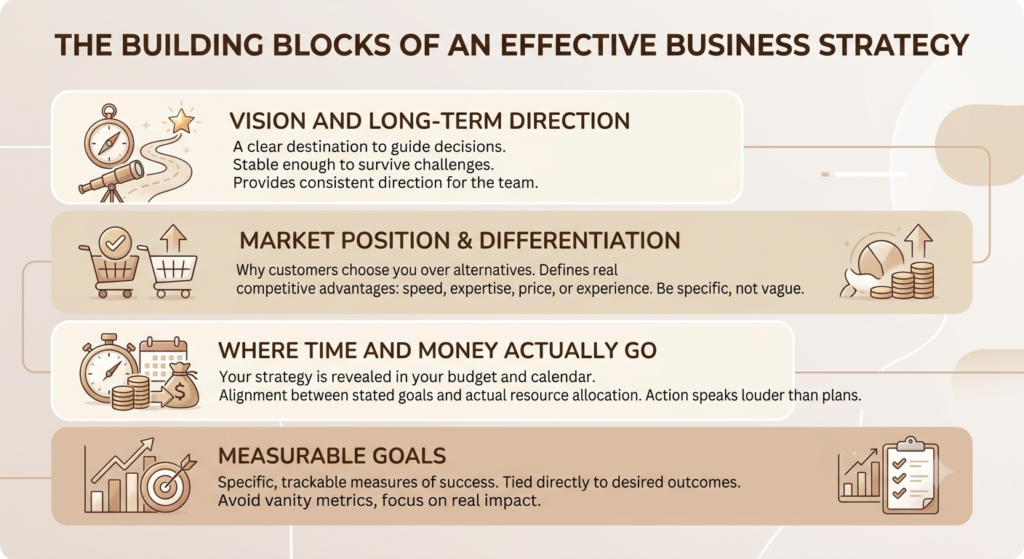
Before touching any specific framework, it helps to understand the raw ingredients every solid strategy needs, regardless of industry or company size.
Vision and Long-Term Direction
Every strategy needs a destination that’s specific enough to guide decisions but stable enough to survive a bad quarter. If your direction changes every few months, your team will stop trusting it – and stop acting on it.
Market Position and What Sets You Apart
You need a clear answer to why a customer should choose you over the alternative sitting right next to you. This is your competitive advantage, and it has to be something real: faster service, deeper expertise, better pricing discipline, a superior customer experience, or access to something competitors don’t have. Vague answers like “we care more” rarely hold up against a determined competitor. Strong market positioning comes from naming this clearly rather than leaving it implied.
Where Your Time and Money Actually Go
Strategy shows up most clearly in your budget and your calendar. Where your money and your time actually go reveals your real strategy far more accurately than any planning document does. If you say customer retention is your top priority but spend all your budget on new customer acquisition, your actual strategy and your stated strategy are two different things.
Measurable Goals
A strategy without numbers attached is an opinion. You need specific, trackable measures that tell you whether the strategy is working – not vanity metrics, but numbers tied directly to the outcome you’re trying to create.
Popular Strategy Frameworks Small Businesses Actually Use (And When to Use Each)
You don’t need to memorize dozens of frameworks. You need one strategic planning framework that actually fits a business your size, and the judgment to know when to reach for another.
SWOT Analysis for Situational Clarity
SWOT – strengths, weaknesses, opportunities, threats – remains one of the most widely used tools for a reason: it’s simple, fast, and gives you an honest snapshot of where your business stands before you commit to a direction. It’s typically the best starting point for any strategic review, especially for smaller teams that don’t have the bandwidth for a heavier process. A property manager, for instance, might find that responsiveness is a genuine strength, that owner-reporting is a weakness, that a competitor’s recent exit from the market is an opportunity, and that rising insurance costs are a threat worth planning around before they hit the budget.
OKRs for Focus and Follow-Through
Objectives and Key Results connect a big, ambitious goal to a small number of measurable outcomes, usually reviewed quarterly. OKRs are particularly effective for small teams because they force ruthless prioritization – you genuinely cannot have fifteen objectives and call it OKRs. A single OKR might read: Objective – become the fastest-responding provider in our market; Key Results – average response time under two hours, 90 percent of maintenance requests closed within 48 hours, client satisfaction score above 4.7. Most strategy consultants now recommend combining SWOT for diagnosis with OKRs for execution, since the two solve different problems.
Porter’s Five Forces for Competitive Positioning
Developed by Michael Porter, this framework examines the competitive pressure in your industry across five areas: rivalry among existing competitors, the threat of new entrants, the power of suppliers, the power of buyers, and the threat of substitute products. It’s especially useful before entering a new market or when you’re trying to understand why margins in your industry feel tighter than they used to. An Airbnb operator weighing expansion into a new city, for example, would use this framework to gauge how saturated the short-term rental market already is and how much pricing power local property owners currently hold.
Blue Ocean Strategy for Differentiation
Rather than competing head-on in a crowded market, Blue Ocean Strategy pushes you to find or create a space where you face little to no direct competition. For small businesses that can’t out-spend larger competitors, this is often more realistic than trying to win a price war. Instead of competing purely on nightly rate, a small hospitality operator might build a strategy around a specific guest experience – extended-stay comfort for remote workers, for example – that larger, more generic competitors aren’t structured to deliver.
Balanced Scorecard for Long-Term Performance Tracking
The Balanced Scorecard expands your view beyond financial results to include customer experience, internal processes, and organizational growth. It’s a heavier framework, but even a simplified version helps small business owners avoid the trap of judging strategy purely on this month’s revenue. Tracking retention alongside revenue, for example, often reveals problems months before they show up in a bank balance.
Choosing the Right Framework for Your Business Stage
As a general rule, startups and small businesses get the most value from SWOT and OKRs because both frameworks demand minimal resources while still producing real strategic clarity. Established or fast-growing businesses tend to benefit from layering in Porter’s Five Forces or the Balanced Scorecard as complexity increases. There’s no single “correct” framework – the right one is whichever helps you answer the specific question you’re currently facing.
How to Build Your Business Strategy for Small Business Growth, Step by Step
Frameworks are tools. Here’s how to actually put one to work.
Step 1: Assess Where You Stand Today
Before choosing a direction, get honest about your current position – your strengths, your real weaknesses, and the external forces shaping your market. This is where a SWOT analysis earns its keep. Resist the urge to skip this step because it feels obvious; most strategic missteps trace back to an inaccurate starting picture. Talk to a handful of current customers as part of this step. Owners are often surprised to learn that the strength customers value most isn’t the one the business has been marketing hardest.
Step 2: Define a Clear, Specific Direction
Narrow your direction down to something you could explain in one sentence to a new employee on their first day. If it takes a paragraph to explain, it’s still too vague to guide decisions. A useful test: read your direction statement back and ask whether it rules anything out. If every possible move still fits inside it, it isn’t specific enough yet.
Step 3: Identify What Sets You Apart
Write down, specifically, why a customer picks you over the next-best option. If you can’t answer this clearly, that’s your first strategic priority – not growth, not marketing, but figuring out what makes you genuinely different. Avoid claims that any rival could make with a straight face, like “good service” or “we care.” Push toward something specific enough that a customer could verify it.
Step 4: Set Measurable Objectives
Translate your direction into three to five measurable objectives for the next quarter or year. This is where OKRs are especially useful, since the format forces you to pair every ambition with a concrete way to measure progress. Keep the list short on purpose. A list of twelve priorities functions the same way as having none, because nothing gets treated as genuinely urgent.
Step 5: Allocate Resources Deliberately
Look at your current budget and your team’s calendar. Does the way time and money are being spent actually match your stated priorities? If not, something has to change – either your priorities were wrong, or your resource allocation is. This step is often the most uncomfortable one, because it usually means cutting something the business has been doing out of habit rather than strategic value.
Step 6: Build an Execution System, Not Just a Plan
This is the step that separates the businesses in the 83 percent failure statistic from the ones that actually deliver. An execution system means your strategic objectives show up in recurring meetings, in how you review progress, and in how decisions get made week to week – not just in an annual planning document that nobody reopens until next year. Even something as simple as opening every weekly team meeting with a two-minute check on strategic priorities keeps the plan visible instead of buried.
Step 7: Review and Adjust on a Fixed Cadence
Set a specific, recurring time – monthly or quarterly – to check your progress against your objectives and adjust. Businesses that track their financial and operational metrics on a consistent monthly cadence are meaningfully more likely to survive long-term than those that only check in occasionally. Treat this review as non-negotiable, the same way you’d treat payroll or a client deadline – because a strategy that only gets reviewed when there’s spare time will, in practice, never get reviewed at all.
The Role of Technology and AI in Modern Business Strategy
You cannot talk about business strategy in 2026 without addressing AI directly, because the way small businesses are adopting it has shifted noticeably over the past year.
Where AI Genuinely Helps Strategic Decision-Making
Small business owners are moving past the experimental phase of AI adoption and into targeted, practical use. Instead of testing AI for the sake of testing it, the businesses seeing real results are identifying a specific operational bottleneck – slow invoicing, inconsistent customer follow-up, manual data entry – and applying AI directly to that problem. Used this way, automation frees up time that can be redirected toward the strategic thinking and decision-making that actually requires a human.
Where AI Cannot Replace Strategic Thinking
What AI cannot do is choose what sets your business apart or decide what trade-offs your business should make. Those decisions require judgment about your specific market, your specific customers, and your specific constraints. Treat AI as an execution accelerant within a strategy you’ve already defined, not a substitute for defining one.
Business Strategy in Practice: Property Management, Hospitality, and Service Businesses
Strategy tends to feel abstract until you see it applied to a business that looks like yours. A few examples make the difference concrete.
A small property management company competing against larger regional players rarely wins by trying to match their scale. A more realistic strategy is to compete on responsiveness and transparency – faster communication, clearer reporting to owners, and fewer surprises. That single strategic choice then shapes everything downstream: which software gets purchased, how the team is trained, and which metrics get reviewed weekly.
An Airbnb host or short-term rental operator managing a handful of properties faces a similar decision. Trying to compete purely on price against larger portfolio operators is usually a losing strategy, since bigger operators can absorb thinner margins. A stronger strategic position often comes from specializing – targeting a specific guest type, offering a distinct experience, or becoming the most reliable option in a specific neighborhood – rather than trying to be everything to everyone.
Service-based businesses, from consulting firms to local trades, face a version of the same choice. Growth often looks like saying yes to every client who calls. But a business that defines exactly which clients it serves best, and says no to the rest, typically builds a stronger reputation and higher margins than one that takes on anything to keep revenue moving. In each of these cases, the strategy isn’t complicated. What matters is that the choice was made deliberately, written down, and protected against the daily pressure to chase whatever opportunity shows up next.
Common Mistakes That Undermine Business Strategy
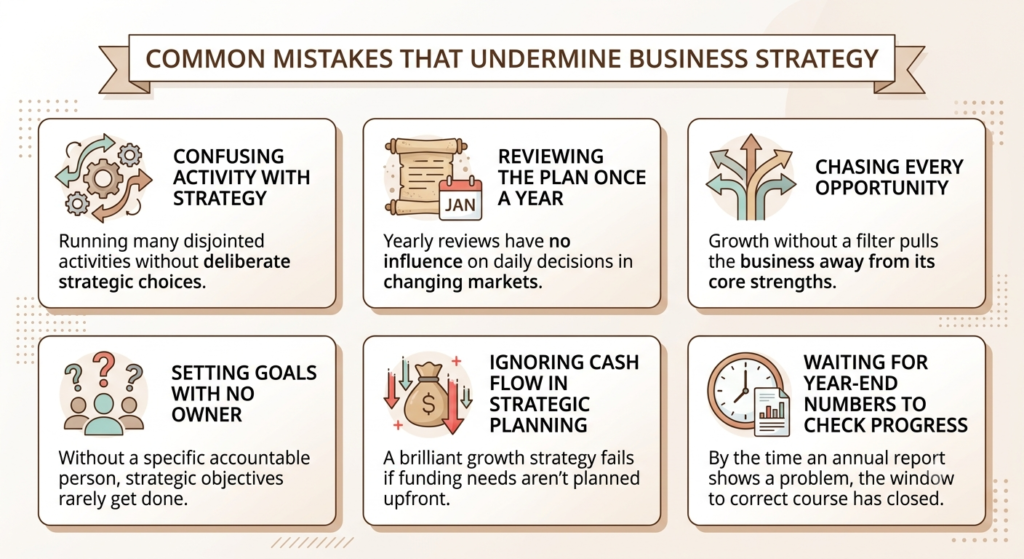
Even well-intentioned business owners fall into a handful of predictable traps:
- Confusing activity with strategy. Staying busy across every channel isn’t the same as making deliberate strategic choices. A business can look extremely active on social media, in outreach, and in new initiatives while still having no coherent direction underneath any of it.
- Reviewing the plan once a year. A strategy that’s only revisited annually has effectively no influence on daily decisions, since twelve months is more than enough time for a market, a team, or a competitor to change substantially.
- Chasing every opportunity. Without a clear filter for what fits your direction, growth can quietly pull a business away from its strengths and into markets or services it was never built to serve well.
- Setting goals with no owner. If no specific person is accountable for a strategic objective, it rarely gets done – spread across a whole team, accountability tends to belong to no one in particular.
- Ignoring cash flow in strategic planning. A brilliant growth strategy still fails if the cash needed to fund it isn’t planned for from the start, since rapid growth frequently requires upfront spending well before the revenue it generates arrives.
- Waiting for year-end numbers to check progress. By the time an annual report shows a problem, the window to correct course has usually already closed, which is why a monthly or quarterly review cadence matters so much more than an annual one.
Real-World Patterns: What Businesses That Execute Well Do Differently
Across the research on strategy execution, a few consistent patterns show up again and again in the businesses that actually follow through.
They keep the number of strategic priorities small – usually no more than three to five at a time – rather than spreading attention across a long list. They put someone with real decision-making authority in charge of each priority, rather than leaving execution to advisors or committees with no power to allocate resources. Analysis of strategy execution failures consistently points to this authority gap: a consultant or outside advisor can recommend a change, but only someone who controls budget, hiring, and compensation can actually make that change stick.
They also track leading indicators throughout the period, not just the final result, so problems surface while there’s still time to fix them. Waiting for a quarterly revenue report to reveal a problem means the damage has typically already been done. Businesses that execute well instead watch the earlier signals – response times, pipeline activity, customer engagement – that tend to move before revenue does.
Finally, these businesses treat strategy as something communicated repeatedly, not announced once. One frequently cited internal survey found that half of a company’s own middle managers couldn’t name their organization’s top strategic objectives months after they’d been introduced. In a small business, that risk is just as real – a priority mentioned once in a team meeting rarely survives contact with a busy month unless it’s repeated and reinforced.
None of these patterns require a large team or a big budget. They require discipline and a willingness to say no to distractions that don’t serve the direction you’ve chosen.
How to Know If Your Strategy Is Working
A strategy is working if you can answer three questions clearly at any point in the year: What are we prioritizing right now, and why? How do we know if it’s working? And what have we said no to in order to focus on it?
If those three questions are hard to answer on a random Tuesday, the strategy isn’t actually running your business – it’s sitting in a folder somewhere, waiting for a planning meeting that already happened.
Key Takeaways
- A business strategy for small business owners is a set of deliberate trade-offs, not a wish list of goals you’d like to hit.
- The biggest risk to your strategy isn’t a bad plan – it’s poor execution, which derails the majority of well-formulated strategies.
- SWOT and OKRs are the most practical starting frameworks for small businesses; add Porter’s Five Forces or the Balanced Scorecard as complexity grows.
- Strategy has to live in your calendar and your budget, not just in a document you revisit once a year.
- AI can accelerate execution, but it cannot make your core strategic choices for you.
- Reviewing progress on a fixed, recurring cadence is one of the strongest predictors of whether a strategy actually gets executed.
Conclusion
The businesses that grow steadily aren’t necessarily the ones with the most creative ideas. They’re the ones that turned a handful of deliberate choices into a system they actually follow – reviewed on a schedule, tied to real numbers, and protected from the daily noise that pulls most plans off course.
You don’t need forty frameworks or a 143-slide deck to get there. You need a clear direction, an honest picture of what makes you different, a small number of measurable priorities, and the discipline to revisit them before the next crisis shows up. Start there, and you’ll already be ahead of the 83 percent of businesses whose plans never make it past the planning stage.
Frequently Asked Questions
What is the difference between business strategy and a business plan?
A business plan is typically a broader document covering your business model, financials, and operations, often used for funding or launch purposes. A business strategy is narrower and ongoing – it’s the specific set of choices guiding how you compete and grow, and it should be revisited far more often than a business plan.
How often should a small business review its strategy?
Monthly or quarterly reviews work best for most small businesses. Annual-only reviews tend to let the strategy drift too far from what’s actually happening day to day.
Which strategic framework is best for a small business just starting out?
SWOT analysis paired with OKRs is usually the most practical combination for early-stage or resource-limited businesses, since both require minimal time investment while still producing real clarity and focus.
Do I need a formal strategic plan if I run a very small business?
Yes, though it doesn’t need to be elaborate. Even a one-page strategy covering your direction, what sets you apart, and three measurable objectives is far more effective than no strategy at all.
How does cash flow fit into business strategy?
Cash flow management should be treated as part of the strategy itself, not a separate financial concern. Ambitious growth strategies that don’t account for the cash needed to fund that growth are a common reason strategic plans stall.
Can AI tools replace the need for a human-defined business strategy?
No. AI can support execution – automating tasks, surfacing data, speeding up analysis – but the core strategic choices about direction, positioning, and trade-offs still require human judgment specific to your market and your business.