
Most founders spend more hours studying their market than they spend studying themselves. That imbalance catches up with almost everyone eventually.
Recent survey data on founder wellbeing found that 87% of founders report experiencing anxiety, depression, burnout, or some combination of the three, and only a small fraction said they had faced none of these issues in the past year. Numbers like that are not a footnote to entrepreneurship. They are close to the main story.
This guide is not another list of morning routines copied from a billionaire’s Instagram post. It is a practical look at what self improvement for entrepreneurs actually means in 2026, what the current research says works, and how to build a version of it that fits your business, your schedule, and your personality instead of someone else’s.
Why Self Improvement for Entrepreneurs Matters More Than Ever
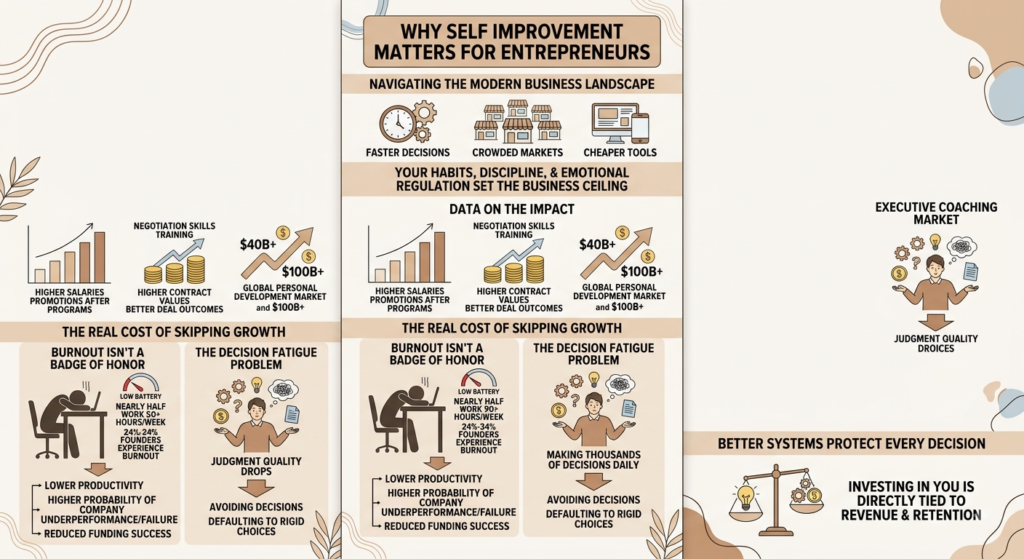
Running a business today looks different than it did even five years ago. Tools have gotten cheaper, markets have gotten more crowded, and the pace of decision-making has gotten faster. None of that changes the fact that a business is still built and operated by a person, and that person’s habits, discipline, and emotional regulation set the ceiling for everything else.
The data backs this up in a fairly direct way. Professionals who complete structured self-improvement programs in their field report earning noticeably higher salaries on average, and a majority land promotions within two years of completing that work. Entrepreneurs specifically point to negotiation skills as a top self-improvement priority, with the large majority who invest in that training reporting better deal outcomes, from higher contract values to shorter negotiation timelines.
Self improvement for entrepreneurs is not a soft, feel-good category sitting next to yoga and journaling. It is directly tied to revenue, retention, and how long you stay in the business you built.
There is also a market signal worth noting. The global personal development market was valued north of $40 billion a few years ago and continues climbing at a steady mid-single-digit annual growth rate, while the broader executive coaching and leadership development market has grown even faster, now valued well over $100 billion globally. People are not spending that kind of money on trends. They are spending it because the return, however you measure it, keeps showing up.
The Real Cost of Skipping Self-Improvement as a Founder
It is worth being honest about what happens when founders treat personal growth as optional.
Burnout Isn’t a Badge of Honor
For a long time, exhaustion was treated as proof of commitment in founder culture. The research tells a different story. Nearly half of business owners report working more than 50 hours a week, and roughly a quarter work past 60. That workload correlates directly with burnout rates: recent surveys put the share of founders currently experiencing burnout in the range of 24% to 34%, with well over two-thirds reporting some direct mental health impact from running their business.
The consequences are not just personal. Burned-out founders show measurably lower productivity, a higher probability their company underperforms or fails, and a reduced ability to close funding or major deals when it matters most. Burnout is not a private struggle that stays contained to evenings and weekends. It shows up in your P&L.
The Decision Fatigue Problem
Founders without a full executive team often make thousands of decisions in a single day, from pricing to hiring to which email gets a reply first. Research on decision fatigue shows that as this volume climbs, judgment quality drops, and people compensate by either avoiding decisions altogether or defaulting to rigid, overly cautious choices that look like high standards but are really a symptom of a depleted mind.
This is one of the clearest, most practical arguments for self improvement for entrepreneurs: better systems for managing your own energy and attention directly protect the quality of every decision you make that day.
The Mindset Shift: From Hustle to Sustainable Growth
If burnout culture got you here, it will not get you out. The founders who build durable companies tend to make a specific mental shift at some point, usually after a rough year or a health scare forces the issue.
Growth Mindset vs. Fixed Mindset for Founders
A growth mindset, in practical business terms, means treating your current skill level as a starting point rather than a ceiling. Founders who operate this way tend to seek feedback more often, recover from setbacks faster, and delegate sooner because they are not emotionally attached to being the smartest person in every meeting.
A fixed mindset shows up as defensiveness around criticism, reluctance to hire people who are better than you at a given function, and a tendency to repeat the same mistakes because admitting a mistake feels like admitting a permanent flaw rather than a temporary gap.
Neither mindset is fixed forever, which is the point. It is a habit of interpretation you can retrain.
Reframing Failure as Data
Global entrepreneurship research shows something reassuring here: across most economies surveyed, founders who exit one business usually go on to start another. Failure does not end most entrepreneurial careers. It gets folded into the next attempt as experience. Treating a failed product launch or a missed revenue target as information rather than judgment is one of the most transferable self-improvement skills a founder can build.
Core Pillars of Self Improvement for Entrepreneurs
Rather than treating personal growth as one vague category, it helps to break it into pillars you can actually work on individually.
Self-Discipline and Daily Systems
Discipline gets romanticized, but in practice it is mostly about removing friction from the behaviors you already want. Founder surveys consistently rank self-discipline among the top two or three traits people believe are essential for entrepreneurial success, right alongside communication skills. That belief holds up because discipline is what carries you through the unglamorous middle of a project, long after the initial motivation has faded.
Practical starting points:
- Decide the night before what your first task of the next day will be, so you are not making that decision on a tired brain at 7 a.m.
- Protect one block of deep-focus time daily where notifications are off and the calendar is blocked.
- Set a hard stop time for work at least four nights a week. Discipline includes stopping, not just starting.
Emotional Intelligence in Leadership
Emotional intelligence is not a soft skill bolted onto leadership. It is closely tied to team retention, conflict resolution, and how quickly a founder notices a problem before it becomes a crisis. Founders with strong self-awareness tend to catch their own stress responses early enough to manage them, rather than letting frustration leak into a team meeting or an investor call.
A simple starting practice: at the end of each day, name one moment where your emotional reaction affected a decision. Over a few weeks, you will start noticing the pattern before it happens, not just after.
Continuous Learning
The half-life of specific business knowledge keeps shrinking, especially anything related to marketing platforms, AI tools, or distribution channels. Founders who build a habit of continuous learning, whether through books, industry newsletters, or structured courses, tend to spot shifts in their market earlier than competitors who rely only on what worked last year.
This does not require hours a day. Thirty focused minutes reading something directly relevant to a current business problem beats two hours of unfocused scrolling through “thought leadership” content that has no application to your work.
Time Management and Energy Management
Time management gets most of the attention, but energy management deserves equal weight. A calendar full of open slots does you no good if you are mentally exhausted during every one of them. Founders who track their own energy patterns, and schedule demanding work like negotiations or strategy sessions during their natural high-energy windows, report getting more done in fewer hours than founders who simply work longer.
Physical and Mental Health Foundations
This pillar is the one entrepreneurs skip first and pay for last. Chronic stress in founders has been linked to higher rates of gastrointestinal issues, sleep disruption, and persistent fatigue. None of these show up on a pitch deck, but all of them quietly erode the judgment and stamina a growing company depends on.
The floor here is not complicated: consistent sleep, regular movement, and at least one person outside the business you can talk to honestly about how things are actually going. None of these need to be perfect. A founder who sleeps seven hours most nights and takes a twenty-minute walk most days will outperform, over a year, a founder who chases an optimized routine for a week and then abandons it under pressure. Consistency at a moderate standard beats intensity you cannot sustain.
Self Improvement for Entrepreneurs at Different Stages of Growth
What “growth” means for you changes depending on where your business actually is. A solo founder juggling every function and a CEO managing a 40-person team are not solving the same problem, even if both would describe themselves as working on self-improvement.
The Solo Founder Stage
In the earliest stage, the biggest risk is usually burnout from doing everything yourself with no feedback loop to catch mistakes early. Self improvement here looks less like leadership development and more like basic sustainability: protecting sleep, setting boundaries around client availability, and building the discipline to work on the business itself, not just inside it, for at least a few hours a week. Solo founders also benefit disproportionately from peer accountability, since there is no internal team to notice when something is off.
The Scaling Stage
Once you have a small team, the growth edge usually shifts from personal output to delegation and communication. Founders at this stage often struggle to let go of tasks they used to do themselves, which quietly caps how fast the business can grow. This is where emotional intelligence work pays off most directly: learning to give feedback without triggering defensiveness, and learning to trust a hire enough to actually hand over the keys to a function you used to own.
The Established Business Stage
At this stage, the biggest self-improvement risk is complacency, not burnout. Founders who have built something that works can lose the habit of continuous learning because the pressure that forced it in the early years has eased off. Deliberately scheduling learning and reflection time, rather than waiting for a crisis to reintroduce it, is what separates founders who keep growing the business from founders who plateau comfortably.
Measuring Whether Your Self-Improvement Efforts Are Working
It is easy to feel busy improving yourself without any real evidence that it is translating into better outcomes. A few concrete markers help cut through that.
Track how often you catch a bad decision before making it, rather than after. Track how many hours a week you spend on work that only you can do, versus work you are simply used to doing. Track your own energy levels at the same time each day for a month, and see whether new habits shift that baseline. None of these require expensive tools. A simple weekly note in a notebook or a spreadsheet is enough to spot a trend over eight to twelve weeks, which lines up with how long the research says habits actually take to solidify in the first place.
If a habit or a new routine has not moved any of these markers after three months, it is worth questioning whether it fits your specific business and personality, rather than assuming the problem is a lack of willpower.
Building Habits That Actually Stick
Most self-improvement advice fails not because the advice is wrong, but because the timeline attached to it is wrong.
Why the 21-Day Myth Is Wrong
The idea that a habit forms in 21 days traces back to a 1960s self-help book and was never based on rigorous research. A recent systematic review from the University of South Australia, analyzing more than 2,600 participants across 20 studies, found that habits typically begin forming within about two months, with the median landing between 59 and 66 days, and some habits taking closer to a year to become fully automatic.
That is a very different planning horizon than 21 days. Founders who expect a new habit, like a morning planning ritual or a weekly financial review, to feel automatic within three weeks often quit right before it would have stuck. Setting a realistic 8-to-12-week expectation dramatically improves follow-through.
Habit Stacking for Busy Founders
Rather than adding an entirely new block of time to an already packed schedule, attach the new habit to something you already do without fail. If you already make coffee every morning, that is the anchor point for a two-minute priority-setting ritual. If you already close your laptop at the end of the day, that is the anchor for a one-line journal entry on what worked and what didn’t.
Tracking matters too, but keep it simple. Research on habit tracking during the early formation phase found that people using basic yes-or-no tracking stuck with a new habit noticeably longer than people using more detailed, complicated tracking systems. Complexity is often the enemy of consistency, especially in the first two months.
The Role of Coaching and Mentorship
Founders often resist outside help until a crisis forces the conversation. The data suggests that is backwards.
Is Executive Coaching Worth the Investment
Executive coaching is one of the more heavily researched corners of self improvement for entrepreneurs, and the honest picture is more nuanced than the sales pages suggest. The widely circulated “788% ROI” figure traces back to a single 2001 case study and gets repeated far more than its methodology deserves. More rigorous, recent research from the ICF and PwC points to a steadier, still meaningful median return in the range of 3x to 7x the cost of coaching, with the large majority of organizations that actually tracked results reporting a positive return.
The more useful framing for a founder is downside math rather than headline multipliers. A senior leader who derails in a role can cost a company hundreds of thousands of dollars in lost productivity and replacement costs, while a structured coaching engagement typically runs a small fraction of that. Coaching does not need an inflated statistic to justify itself. The comparison against the cost of not addressing a blind spot usually does that on its own.
Peer Groups and Masterminds
Coaching is not the only structured outside input worth building into your growth plan. Founder peer groups and masterminds give you something a coach often can’t: a room full of people facing similar operational problems in real time, who can catch a bad decision before you make it because they made a similar one themselves. Isolation is a recurring theme in founder mental health research, and structured peer groups are one of the more direct countermeasures available.
Practical Daily and Weekly Routines for Entrepreneurs
Theory only matters if it turns into a routine you will actually follow on a busy Tuesday.
Morning Routines
A useful founder morning routine does not need to be elaborate. It needs three things: a clear first priority for the day, a few minutes without a screen, and something that signals to your brain that work has not started yet. That could be ten minutes of movement, a short walk, or simply drinking coffee somewhere other than your desk.
Weekly Reviews
A 20-to-30-minute weekly review, done at the same time every week, is one of the highest-leverage habits available to a founder. It should cover three questions: What moved the business forward this week? What consumed time without moving anything forward? What is the single most important thing next week? This single habit, done consistently, tends to surface priority drift long before it becomes a real problem.
Tools and Resources for Entrepreneurial Growth
The tools available for self improvement for entrepreneurs have expanded considerably. Meditation and focus apps have grown into a market worth several billion dollars, with some platforms reporting tens of millions of downloads, which reflects real demand rather than a passing trend. AI-powered planning and note-taking tools have also become common additions to a founder’s daily stack, helping compress the time spent on scheduling and information capture so more of the day goes toward decisions only a founder can make.
Books remain a reliable, low-cost input as well. Business self-help specifically remains a multi-billion-dollar publishing category, with leadership and entrepreneurship consistently ranking among its most popular subjects. The specific title matters less than the consistency of exposure to new frameworks and honest accounts of how other founders solved similar problems.
None of these tools substitute for the underlying habit, though. An app can remind you to meditate, and a note-taking assistant can organize your ideas, but neither one builds the discipline to actually open the app in the first place. Treat tools as scaffolding around a habit you have already decided to build, not as the habit itself. Founders who buy a new productivity app hoping it will create motivation from scratch are usually disappointed within a few weeks, while founders who already have a habit in motion tend to get real value from the tool that supports it.
It is also worth being selective. Adding three new apps and two new books to your routine at once is a common way to abandon all of them within a month. Pick one tool that supports the single pillar you decided to focus on, and give it the same eight-to-twelve-week runway you are giving the underlying habit.
Why Self Improvement for Entrepreneurs Looks Different From General Self-Help
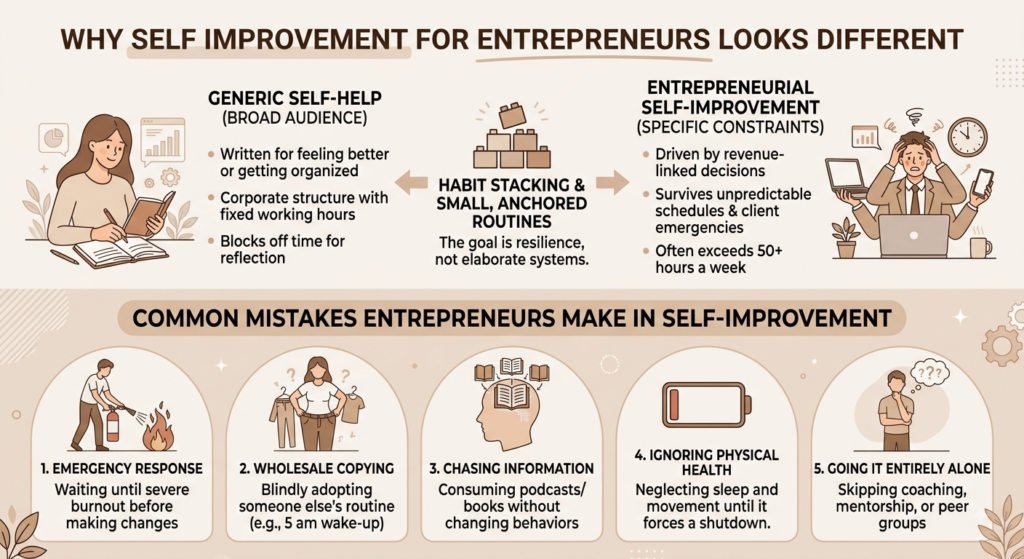
General self-help content is written for a broad audience trying to feel better or get more organized. Self improvement for entrepreneurs carries a different set of constraints that generic advice often misses entirely.
A founder cannot simply block off two hours a day for reflection the way a corporate employee with fixed working hours might. Revenue depends directly on decisions made this week, which means any self-improvement habit has to survive contact with a genuinely unpredictable schedule. It also has to compete with a workload that, per the data cited earlier, regularly exceeds 50 hours a week for a large share of business owners.
This is why habit stacking and small, anchored routines outperform elaborate systems borrowed from productivity books written for a different kind of professional. The goal is not to build the most impressive routine. It is to build the one that survives an unpredictable Tuesday when a client emergency eats your morning and a hiring decision eats your afternoon.
Common Mistakes Entrepreneurs Make in Self-Improvement
A few patterns show up again and again in founders who struggle to make personal growth stick.
- Treating self-improvement as an emergency response. Waiting until burnout is already severe before making any change, instead of building small habits before a crisis forces the issue.
- Copying someone else’s routine wholesale. A 5 a.m. wake-up and cold plunge might work for one founder and completely wreck another founder’s sleep and mood. Personal development is personal for a reason.
- Chasing information instead of applying it. Consuming another podcast or book without changing a single daily behavior is entertainment, not growth.
- Ignoring physical health until it forces a shutdown. Sleep and movement are not rewards for a slow week. They are inputs that determine how good next week’s decisions will be.
- Going it entirely alone. Skipping coaching, mentorship, or peer groups because it feels like an unnecessary expense, then paying for that isolation later in slower decisions and missed blind spots.
How to Build Your Own Self Improvement Plan
A workable plan does not need twelve categories. It needs a small number of commitments you will actually keep.
- Pick one pillar, not five. Choose the single area from the list above that is costing you the most right now, whether that’s discipline, energy management, or emotional regulation.
- Attach a new habit to an existing one. Use habit stacking so the new behavior has a built-in trigger instead of relying on willpower alone.
- Give it eight to twelve weeks before judging it. Based on the current research on habit formation, that is a realistic runway, not a failure to plan around.
- Add one outside perspective. That could be a coach, a mastermind, or simply a peer founder you check in with weekly. Isolation makes every other habit harder to sustain.
- Review and adjust monthly. Self improvement for entrepreneurs is not a one-time project. Revisit what’s working and drop what isn’t, the same way you would review a marketing channel that stopped converting.
Key Takeaways
- Self improvement for entrepreneurs is directly linked to business outcomes, not just personal wellbeing, with measurable effects on salary, promotions, and deal quality.
- Founder burnout affects a substantial share of business owners and carries real costs in productivity and company survival, not just personal wellbeing.
- A growth mindset and a habit of reframing failure as data are foundational to long-term resilience.
- The core pillars worth building are self-discipline, emotional intelligence, continuous learning, time and energy management, and physical health.
- Habits typically take roughly two to three months to solidify, not the commonly cited 21 days, so plan your expectations accordingly.
- Executive coaching shows a credible, if more modest than advertised, positive return, and peer groups offer a low-cost complement to formal coaching.
- A workable plan focuses on one pillar at a time, uses habit stacking, and includes at least one outside perspective.
Conclusion
Building a business will always demand more of you than feels comfortable. That is not a reason to treat your own growth as optional. It is the reason self improvement for entrepreneurs deserves the same intentional planning you already give your product roadmap or your sales pipeline.
Start with one pillar. Give it the two or three months the research says it actually needs. Bring in at least one outside perspective, whether that’s a coach, a mastermind, or a founder friend who will tell you the truth. The business you’re building will only grow as far as you’re willing to grow alongside it.
Frequently Asked Questions
What is self improvement for entrepreneurs? It refers to the deliberate practices a business owner uses to strengthen their mindset, discipline, emotional intelligence, and health so they can lead their company more effectively over the long term.
How long does it take to build a new habit as a founder? Research suggests most habits take somewhere between two and three months to become automatic, with a median around 59 to 66 days, though some habits take considerably longer depending on the behavior and the person.
Is executive coaching actually worth the cost for a small business owner? For many founders, yes, though the inflated ROI figures often quoted online should be treated skeptically. More conservative research points to a return in the range of three to seven times the cost of coaching, with the majority of participants reporting a positive outcome.
What is the biggest self-improvement mistake entrepreneurs make? Waiting until burnout or a major setback forces the issue, rather than building small, sustainable habits before a crisis makes change urgent.
Can self-improvement really affect revenue and business growth? Yes. Skills like negotiation training and structured leadership development show measurable links to better deal outcomes, higher retention, and stronger team performance, all of which affect the bottom line.
Do I need a coach to make progress, or can I do this alone? A coach helps, but is not required. A consistent weekly review, one or two peer relationships, and a habit-stacking approach to new behaviors can produce meaningful progress without a formal coaching engagement.