

There is a moment every founder eventually faces. The initial excitement has worn off, the to-do list keeps growing faster than the revenue, and the question that started as a whisper gets louder: “Do I still want to do this?”
If you have asked yourself that question recently, you are not broken, and you are not alone. Business motivation is not a personality trait that some entrepreneurs have and others don’t. It is a resource, one that gets built, spent, and rebuilt, often in the same week.
This article is not another collection of quotes to screenshot and forget by lunchtime. It is a practical, research-backed look at what actually drives entrepreneurs, why that drive fades, and what to do about it when it does. Along the way, we will look at the latest data on why people start businesses in the first place, what psychology tells us about sustainable motivation, and the daily habits that separate founders who last from founders who burn out.
Whether you are three months into your first venture or ten years into a company you are questioning, understanding how business motivation actually works will change how you approach the hard days.
What Business Motivation Really Means (Beyond the Quotes and Hype)
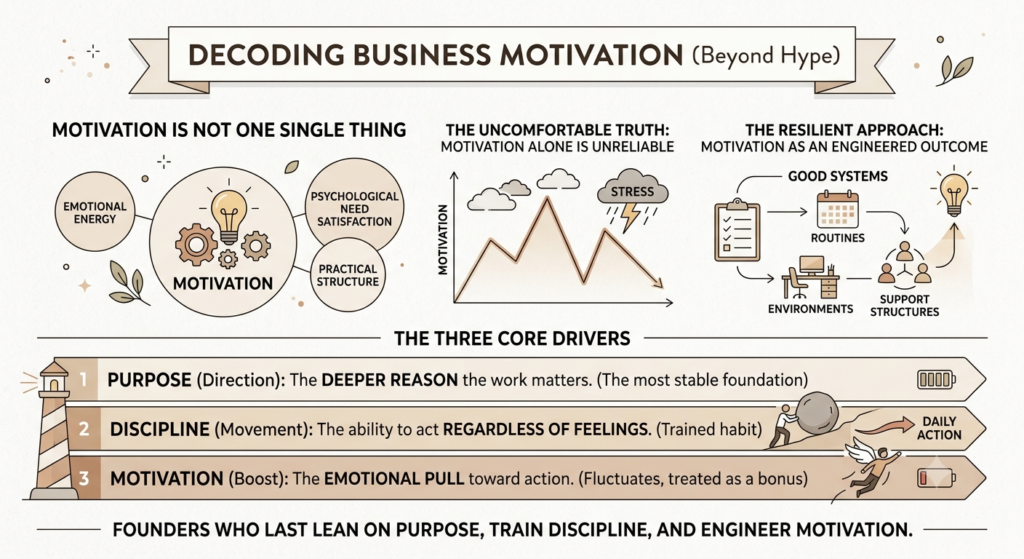
Ask ten entrepreneurs to define business motivation and you will get ten different answers. Some will describe it as the fire that gets them out of bed. Others will call it a feeling they used to have and can’t quite locate anymore. Both are right, because motivation is not one single thing. It is a mix of emotional energy, psychological need satisfaction, and practical structure working together.
Why Motivation Alone Isn’t a Strategy
Here is an uncomfortable truth: motivation, on its own, is unreliable. It rises and falls with sleep, stress, wins, losses, and even the weather. If your business depends entirely on you feeling inspired every single day, it will collapse the first week you don’t.
This is why the most resilient entrepreneurs stop treating motivation as a mood and start treating it as an outcome of good systems. They build routines, environments, and support structures that generate motivation, rather than waiting for it to arrive on its own. Business motivation, in other words, is something you engineer, not something you hope for.
The Difference Between Motivation, Discipline, and Purpose
These three words get used interchangeably, but they describe different forces:
- Motivation is the emotional pull toward action. It fluctuates daily.
- Discipline is the ability to act regardless of how you feel. It is trained, not inherited.
- Purpose is the deeper reason your work matters to you. It is the most stable of the three.
The founders who last don’t rely on motivation alone. They lean on purpose to define the direction, discipline to keep moving when motivation dips, and they treat motivation itself as a welcome bonus rather than a requirement.
Why Entrepreneurs Start Businesses in the First Place (2026 Data)
Understanding what originally sparks business motivation helps explain why it sometimes disappears. If your “why” gets lost in the daily grind, reconnecting with it is often the fastest way back to momentum. Recent research on entrepreneurship gives a clear picture of what actually drives people to start companies today.
Autonomy and “Being Your Own Boss” Still Wins
Across nearly every major survey conducted in the past year, the desire for independence tops the list. Roughly six in ten business owners cite wanting to be their own boss as a primary driver, and a similar share point to dissatisfaction with traditional corporate employment as a push factor. People are not just running toward entrepreneurship; many are running away from environments where they felt they had no control.
Financial Motivation and Building Wealth
Money remains a powerful and honest motivator. Recent survey data shows increasing income and building long-term wealth as the number one motivation for starting a business across multiple countries in 2026, with U.S. entrepreneurial intent climbing sharply compared to the prior year. For many founders, entrepreneurship has shifted from a long-term dream to something closer to a financial necessity, especially amid economic uncertainty.
Purpose-Driven Founders: Making a Difference
It is not all about the balance sheet. A significant share of entrepreneurs, sometimes cited as high as two-thirds in certain surveys, say wanting to make a difference in the world was among their top motivations. Globally, research spanning dozens of economies shows that roughly half of new entrepreneurs endorse social purpose as a core motivating factor alongside financial goals.
How Motivations Differ by Gender and Region
Motivation is not one-size-fits-all. Recent research on women-owned businesses found that flexibility and work-life balance rank as the leading motivator for the majority of women entrepreneurs, more so than for their male counterparts. Regionally, entrepreneurial intent also varies significantly. Recent survey data placed American entrepreneurial ambition well above that of Canada, the UK, and Australia, reflecting differences in economic pressure, cultural attitudes toward risk, and access to funding.
Recognizing which of these motivators is actually driving you is valuable diagnostic work. A founder chasing autonomy will burn out doing something different than a founder chasing purpose, and reconnecting with your original motivator is often the fastest route back to business motivation when things feel stale.
Entrepreneurial Intent Is Rising, Not Fading
It’s also worth noting the broader trend line. Recent survey data shows entrepreneurial intent in the United States nearly doubling year over year, with roughly one in three adults saying they plan to start a business or side hustle. That surge reflects a mix of genuine ambition and real economic necessity, as more people treat entrepreneurship as a practical response to job insecurity rather than a purely optional dream. Understanding that your own motivation may be shaped by this same mix of ambition and necessity can help you be honest with yourself about what’s really driving your decisions, rather than assuming your experience should look like the founder narratives you see online.
The Science Behind Business Motivation: What Self-Determination Theory Teaches Founders
If you want to understand why some routines and reward systems build lasting drive while others quietly destroy it, psychology already has an answer. Self-determination theory, developed by psychologists Edward Deci and Richard Ryan, remains one of the most rigorously tested frameworks for understanding human motivation, and recent workplace meta-analyses continue to confirm its relevance in 2026.
Autonomy, Competence, and Relatedness
The theory identifies three basic psychological needs that, when met, produce genuine and sustainable motivation:
- Autonomy – the sense that you are acting by choice, not obligation.
- Competence – the sense that you are capable and improving at what you do.
- Relatedness – the sense of connection to other people around your work.
When these three needs are satisfied, people experience what researchers call autonomous motivation, and it is strongly linked to higher engagement, better performance, and lower burnout. When these needs are unmet or thwarted, motivation becomes controlled, driven by external pressure, guilt, or fear, and it tends to produce short-term compliance at the cost of long-term well-being.
Why External Rewards Alone Backfire
This is where many entrepreneurs get it wrong, both for themselves and their teams. Chasing revenue milestones, follower counts, or external validation can provide a short burst of energy, but research consistently shows that when people’s sense of autonomy is stripped away by pure reward-chasing, intrinsic motivation actually declines over time. This does not mean money doesn’t matter. It means money alone, disconnected from a sense of ownership and mastery, is a fragile foundation for long-term drive.
Applying SDT to Your Own Business
You can use this framework directly. Ask yourself:
- Autonomy – Where in my business do I feel like I’m choosing versus being forced? Can I redesign my week to restore more choice?
- Competence – Am I learning and improving, or stuck repeating tasks I’ve outgrown? Where could a new skill reignite my interest?
- Relatedness – Do I have people in my professional life who understand what I’m building? Am I isolated?
Strengthening even one of these three areas measurably improves business motivation, according to decades of applied research across work settings.
Why Business Motivation Fades (The Hard Truths No One Talks About)
Motivation doesn’t usually disappear overnight. It erodes gradually, often while a founder is technically “succeeding” on paper. Understanding the real causes makes it far easier to catch the slide early.
Burnout Is the Silent Motivation Killer
The data on founder burnout is sobering. Recent surveys of entrepreneurs found that a majority report experiencing burnout symptoms within the past year, with long work hours and chronic sleep deprivation cited as leading causes. One widely cited 2026 founder mental health report found that the overwhelming majority of founders report experiencing anxiety, depression, or burnout, and nearly half say they have seriously considered quitting their company because of it.
Burnout is frequently mistaken for laziness or a personal failure of willpower. It is neither. It is a physiological and psychological response to unsustainable demand, and it directly suppresses the exact neural and emotional systems that generate motivation in the first place.
The Loneliness Factor
Entrepreneurship is often solitary, especially for solo founders and small business owners without a co-founder or leadership team. Recent research on founder well-being found a substantial share of business owners concealing their mental health struggles from investors, partners, and even close colleagues, largely out of fear it will be seen as weakness. This isolation directly undermines the “relatedness” need identified in self-determination theory, quietly draining motivation even when the business itself is performing well.
Comparison Culture and Social Media
The always-on nature of social platforms creates a constant stream of curated success stories. Recovery-focused researchers writing about founder burnout in 2026 specifically point to social media comparison as one of the compounding pressures unique to this era of entrepreneurship, alongside always-on culture and rapid AI-driven change. Comparing your unfiltered daily reality to someone else’s highlight reel is a fast track to feeling like you are falling behind, even when you are not.
When Motivation Dips Are Normal vs. When They’re a Warning Sign
Not every low-motivation day is a crisis. A rough Monday after a bad night’s sleep is normal. Warning signs that something deeper is happening include:
- Persistent exhaustion that doesn’t improve with rest
- Growing cynicism toward your customers, product, or team
- Declining output despite working longer hours
- Physical symptoms like frequent headaches, tension, or sleep disruption
If several of these show up together and persist for weeks, it is worth treating as a signal to change your approach, not just push harder.
The Financial Pressure Cycle
Financial stress deserves its own mention, because it interacts with motivation in a particularly damaging way. When cash flow is tight, many founders respond by working even longer hours, which reduces sleep and recovery, which impairs judgment, which often leads to costly mistakes that make the financial pressure worse. This cycle can quietly run for months before a founder realizes that working harder is no longer the solution, and that the real fix is a clearer financial plan, a trusted advisor, or simply permission to slow down and think strategically instead of reactively.
How to Build Business Motivation That Lasts
Once you understand what actually drives sustainable motivation, you can start building it deliberately rather than waiting for inspiration to strike.
Anchor Your Motivation to Purpose, Not Just Profit
Revenue targets are useful for planning, but they make poor emotional fuel because they are abstract and distant. Purpose, on the other hand, is immediate. It’s available to you on your worst day just as much as your best one. Spend time articulating, in writing, exactly who your work serves and why it matters to you personally. Revisit that statement when motivation dips.
Set Systems, Not Just Goals
Goals tell you where you’re going. Systems tell you what you do today regardless of how you feel. A founder with a goal to “grow revenue 30 percent this year” but no weekly system for outreach, content, or sales calls is relying entirely on motivation to fill the gap. A founder with a defined system executes even on low-motivation days, and consistent execution is what actually compounds into results.
Track Small Wins
Business motivation research consistently shows that visible progress, even in small increments, is one of the most powerful daily motivators available to knowledge workers and entrepreneurs alike. Keep a simple running log of what you accomplished each day, no matter how minor. On hard weeks, this log becomes proof that you are still moving, even when it doesn’t feel like it.
Build a Support Network
Given how strongly isolation undermines motivation, deliberately building relationships with other founders is not a nice-to-have, it is a core input. This can be a mastermind group, a mentor, a peer accountability partner, or simply a standing monthly call with another business owner who understands the specific pressures you’re under.
Reward Yourself Without Undermining Your Own Drive
Rewards can support business motivation, but only when they’re used carefully. A reward that celebrates real progress, like taking an afternoon off after closing a difficult deal, reinforces the connection between effort and outcome. A reward that becomes the entire reason you’re working, chasing a bonus or a vanity metric purely for its own sake, tends to crowd out the deeper, more durable drivers discussed earlier. Use rewards to mark milestones, not to replace purpose as your primary fuel.
Protect Your Energy Like a Business Asset
Your energy is not separate from your business, it is one of its most important assets. Treat your sleep, movement, and recovery time with the same seriousness you’d apply to cash flow. A founder running on four hours of sleep is operating with impaired judgment, and impaired judgment is expensive.
Daily and Weekly Habits That Sustain Business Motivation
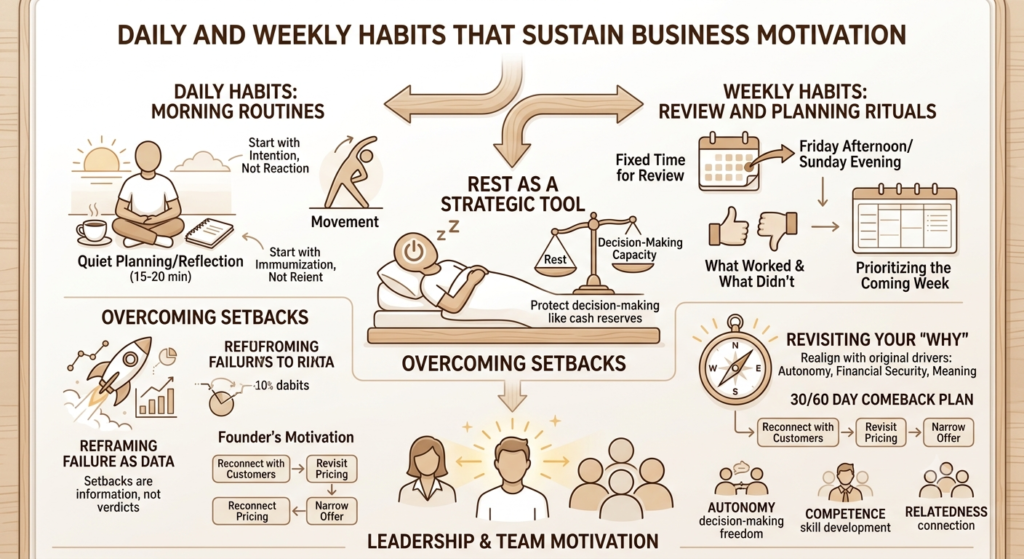
Sustainable business motivation is built through repeated, small structural choices rather than occasional bursts of willpower.
Morning Routines That Set the Tone
You don’t need an elaborate five-hour morning ritual. What matters is starting the day with intention rather than immediately reacting to notifications, messages, and other people’s priorities. Many founders find that even fifteen to twenty minutes of quiet planning, movement, or reflection before checking email meaningfully changes their focus for the rest of the day.
Weekly Review and Planning Rituals
Set aside a fixed time each week, often Friday afternoon or Sunday evening, to review what worked, what didn’t, and what matters most for the coming week. This single habit does double duty: it creates the sense of progress that fuels motivation, and it prevents the following week from being run entirely on reaction and urgency.
Rest as a Strategic Tool, Not a Reward
Many entrepreneurs treat rest as something to be earned after enough hard work, which means it rarely happens. Reframe rest as a strategic input that protects your decision-making capacity, the same way you’d protect your cash reserves. Founders operating on chronic sleep debt make measurably worse decisions, and worse decisions cost more time and money than the rest would have.
Business Motivation During Setbacks and Slow Seasons
Every business goes through slow, uncertain, or outright difficult periods. What separates founders who recover from those who quit is often not talent, but how they interpret the setback.
Reframing Failure as Data
A launch that underperforms, a client who churns, or a quarter that misses target is not proof that you should quit. It’s information. Treating setbacks as data to analyze, rather than verdicts on your worth as an entrepreneur, keeps the emotional damage contained and makes the lesson usable.
Revisiting Your “Why”
Slow seasons are exactly when it’s worth returning to the original motivators that got you started, whether that was autonomy, financial security, or a desire to build something meaningful. If your current daily reality has drifted far from that original driver, a slow season can be a useful moment to realign your business rather than abandon it.
Learning From Founders Who’ve Been There
One notable pattern from recent founder research: even among those who have experienced a failed venture, very few say the failure would stop them from trying again. The building itself, not just the outcome, tends to be what founders describe as meaningful, which is a useful reframe during any period where results feel disconnected from effort.
Building a Comeback Plan
Rather than waiting for motivation to simply return on its own during a slow season, it helps to create a short, concrete comeback plan. Identify the one or two levers most likely to move the needle, whether that’s reconnecting with past customers, revisiting your pricing, or narrowing your offer. Give yourself a defined timeframe, such as thirty or sixty days, to test those changes. Having a specific plan turns a vague feeling of stagnation into a measurable project, and measurable projects are far easier to stay motivated for than open-ended uncertainty.
Leadership and Team Motivation: Beyond Yourself
If you lead a team, your business motivation doesn’t stay contained to you. It shapes the culture around you, for better or worse.
How Your Motivation Affects Your Team
Teams are highly sensitive to a leader’s energy and tone, often more than to formal announcements or strategy documents. A founder running on empty tends to unintentionally create urgency, tension, or short-tempered communication that ripples through the whole team. Protecting your own motivation is, in this sense, a leadership responsibility, not a personal indulgence.
Creating a Culture of Autonomous Motivation
The same three needs that drive your own motivation, autonomy, competence, and relatedness, apply directly to your employees. Giving team members real decision-making latitude, opportunities to develop new skills, and genuine connection with colleagues and leadership consistently predicts higher engagement and lower turnover, according to workplace research grounded in self-determination theory. Micromanagement and rigid, reward-only incentive structures tend to produce the opposite effect over time.
Current Trends Shaping Business Motivation in 2026
The context entrepreneurs are operating in has shifted meaningfully over the past couple of years, and it’s worth understanding how these trends interact with motivation specifically.
AI Tools Lowering the Barrier to Entry
A growing share of aspiring entrepreneurs report turning to AI tools to simplify early-stage tasks, reduce costs, and navigate areas where they feel least confident, according to 2026 entrepreneurship surveys. This is changing the emotional experience of starting a business, lowering the intimidation factor for first-time founders who previously felt they lacked the skills to begin.
For business motivation specifically, this shift matters because it removes some of the friction that used to drain energy before a business even got off the ground. Tasks like drafting a website, researching a market, or setting up basic operations used to require either a steep learning curve or a costly hire. When that friction disappears, founders can spend more of their limited motivation on the parts of the business that actually require human judgment and creativity, which tends to be more sustaining over time than grinding through repetitive setup work.
The Rise of the Side Hustle and “Invisible Entrepreneurs”
Rather than leaping straight into full-time entrepreneurship, more people are starting small through side hustles, creating what researchers have termed a growing informal economy of “invisible entrepreneurs.” This lower-risk entry point can actually protect motivation, since financial pressure is reduced while the founder builds confidence and validates their idea.
Mental Health Becoming Part of the Business Conversation
Perhaps the most encouraging trend is the growing openness around founder mental health. Where burnout and anxiety were once rarely discussed publicly, an increasing number of accelerators, founder communities, and business publications are treating mental well-being as core business infrastructure rather than a personal weakness to hide. This cultural shift makes it easier for entrepreneurs to seek support before motivation collapses entirely.
Key Takeaways
- Business motivation is not a fixed trait. It’s an outcome of good systems, satisfied psychological needs, and clear purpose.
- The leading reasons people start businesses in 2026 remain autonomy, financial opportunity, and a desire to make a difference, though the weighting shifts by gender and region.
- Self-determination theory shows that autonomy, competence, and relatedness are the three psychological needs that generate lasting, intrinsic drive.
- Burnout, isolation, and social comparison are the primary forces that quietly erode motivation over time.
- Systems, small wins, purpose, and a support network are more reliable motivation generators than willpower alone.
- Rest should be treated as a strategic business input, not a reward you earn after burning out.
- A founder’s own motivation directly shapes team culture and engagement.
Conclusion
Business motivation was never meant to be a constant, unwavering flame. It rises, dips, and needs deliberate tending, just like every other resource that keeps a company running. The founders who build lasting businesses are rarely the ones who feel inspired every single day. They are the ones who understand what genuinely fuels them, build systems that don’t depend entirely on mood, and treat their own well-being as seriously as their balance sheet.
If you’re in a season where motivation feels distant right now, that does not mean you’re on the wrong path. It likely means it’s time to revisit your systems, reconnect with your original purpose, and protect the energy that got you here in the first place.
None of this requires a dramatic overhaul overnight. Pick one idea from this article, whether it’s a weekly review ritual, a support call with another founder, or simply an earlier bedtime, and put it in place this week. Sustainable business motivation is built one deliberate choice at a time, not discovered in a single burst of inspiration. The work is still worth doing. Build it in a way that lets you last.
Frequently Asked Questions
Q: Is it normal to lose motivation even when my business is doing well?
Yes. Motivation and business performance don’t always move together. Founders can hit financial milestones while running on empty emotionally, especially if the growth came at the cost of sleep, relationships, or rest.
Q: How do I get motivated when I genuinely don’t feel like working?
Start with the smallest possible version of the task rather than waiting to feel ready. Momentum tends to generate motivation, not the other way around. If the lack of motivation is persistent rather than occasional, treat it as a signal to examine burnout, purpose alignment, or workload rather than trying to push through indefinitely.
Q: What’s the difference between healthy hustle and burnout risk?
Healthy hustle includes recovery time and still leaves you feeling capable and connected to your work most days. Burnout risk shows up as chronic exhaustion, cynicism, and declining output despite increased hours, often for weeks at a stretch.
Q: Do successful entrepreneurs ever want to quit?
Frequently. Recent founder surveys show that a large majority of business owners have seriously considered quitting at some point due to stress or burnout. Wanting to quit during a hard stretch is common and does not predict long-term outcomes on its own.
Q: How often should I revisit my business’s core purpose?
A quarterly check-in works well for most founders, with a deeper review during any major setback or slow season. If your daily work has drifted noticeably from your original motivation, that’s worth addressing before it compounds.
Q: Can a team’s motivation really be affected by the founder’s mood?
Yes, consistently. Leaders set the emotional tone for a team, often more powerfully than any official policy or announcement. Protecting your own motivation and energy is part of leading a team well, not separate from it.