

Starting a company still feels like jumping off a ledge and building the parachute on the way down. That has not changed. What has changed is how much noise surrounds the process – AI tools promising instant products, accelerators promising fast tracks, and social media founders promising overnight success.
None of that noise makes the fundamentals go away. The founders who make it past year one still do the same unglamorous things: they talk to customers before they build, they watch their cash like a hawk, and they make decisions instead of avoiding them.
This guide pulls together the startup tips for first-time founders that consistently separate the businesses that survive from the ones that quietly close down. It is written for the person staring at a blank business plan, not for someone who already has a term sheet on the table.
Every section below is built around one idea: the founders who last are rarely the ones with the flashiest idea. They are the ones who validate before they build, watch their numbers honestly, and treat every early customer interaction as data worth acting on. That approach is not glamorous, but it is repeatable – and repeatable is exactly what a first-time founder needs most.
Why Most Startups Fail (And What the Data Actually Shows)
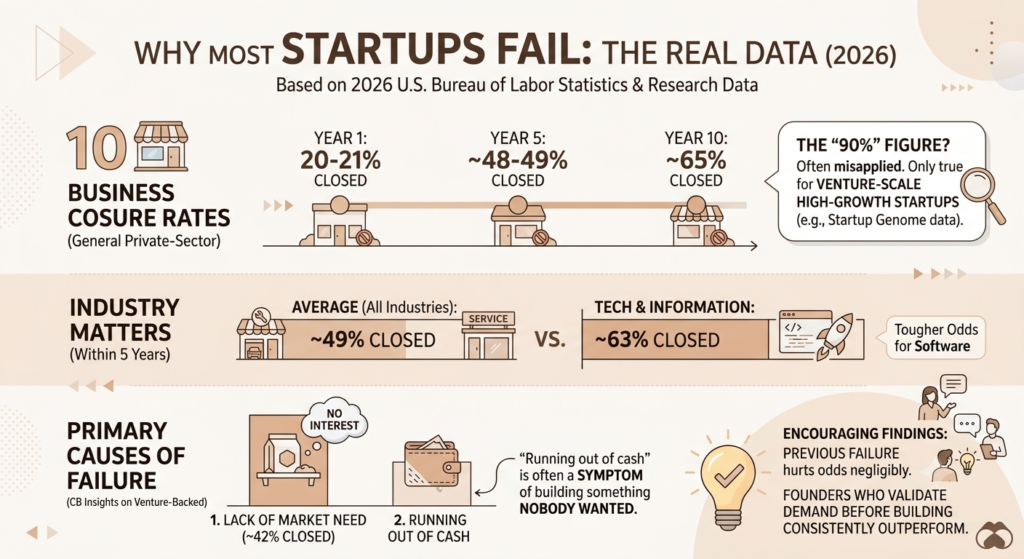
Before getting into advice, it helps to know what you are actually up against. The “90% of startups fail” line gets repeated so often that it has become background noise, but the real picture is more useful than the headline.
According to U.S. Bureau of Labor Statistics data analyzed for 2026, roughly 20 to 21 percent of new private-sector businesses close within their first year, about 48 to 49 percent are gone within five years, and around 65 percent do not make it to year ten. The 90 percent figure comes from a narrower group – venture-scale, high-growth startups tracked by Startup Genome – and it is closer to accurate for that specific category, but it is often misapplied to every new business.
Industry matters more than most founders assume. Tech and information-sector startups close faster than the average, with roughly 63 percent gone within five years compared to the broader 49 percent figure across all industries. If you are building software, your baseline odds are tougher than a founder opening a service business down the street.
The causes of failure have stayed remarkably consistent for over a decade. CB Insights research on hundreds of failed venture-backed companies points to a lack of market need as the single biggest killer, involved in roughly 42 percent of shutdowns, followed by running out of cash. “Running out of cash” is often described as a symptom rather than a root cause – teams typically ran out of money because they spent it building something nobody needed badly enough.
The encouraging part of the data: a previous failure barely hurts your odds the second time around, and founders who validate demand before writing code consistently outperform those who do not. That single habit – testing before building – is where the rest of this guide starts.
1. Validate the Problem Before You Build Anything
The single most common mistake among first-time founders is falling in love with a solution before confirming anyone actually has the problem badly enough to pay for a fix. A startup without real demand is not a startup. It is an expensive hobby with a pitch deck.
Validation does not mean asking friends and family whether they like your idea. It means talking to strangers who match your target customer and asking about their current behavior, not their future intentions.
Run real customer discovery interviews, not casual chats
Structured customer discovery interviews focus on what someone is doing right now to solve a problem, not whether they would theoretically use your product. Asking “would you use this?” tends to produce polite, socially motivated answers that tell you almost nothing. Asking “what are you doing today to deal with this?” surfaces real pain, real workarounds, and real budget.
Most experienced founders aim for six to twelve interviews per customer segment before patterns start repeating, though a sharply defined problem can produce useful signal sooner. Watch for people already cobbling together a fix using spreadsheets, WhatsApp groups, or sticky notes – that is usually a stronger signal than anything they say out loud.
Test the riskiest assumption first
Every business idea rests on a handful of assumptions, and one of them is usually the assumption that, if wrong, breaks the entire plan. Identify that assumption and design the cheapest possible experiment to test it before building anything resembling a real product. A landing page, a pre-order button, or a manual “concierge” version of your service can validate demand without a single line of production code.
A useful gut check pulled from recent founder research: rate the customer’s pain on a scale from one to ten. If it sits at a three or four, people are unlikely to change their existing habits for you. If it is an eight, nine, or ten, they are actively hunting for a better answer – and that is the kind of problem worth building a company around.
2. Build a Lean MVP That Tests One Core Belief
Once you have real evidence of demand, resist the urge to build the full product you imagined on day one. A minimum viable product exists to test whether your solution actually solves the validated problem – nothing more.
Know what to leave out
Feature creep is one of the fastest ways to burn runway before you have proof anyone wants what you are building. A disciplined MVP typically excludes advanced customization, multiple user roles unless they are core to the value proposition, deep third-party integrations, and polished visual design. None of that matters if the core workflow does not solve the problem well enough for someone to keep using it.
Founders who study successful product teams consistently notice the same pattern: strong teams spend more time deciding what not to build than deciding what to build. Product discovery – understanding the user, the business goal, and the technical constraints – comes before a single feature gets designed.
Use AI as a genuine speed advantage
If you are building in 2026, you have one structural advantage founders from five years ago did not: AI tools can compress the time between idea and working prototype dramatically. Founders are now using AI to write early code, generate first-draft designs, handle basic customer support, summarize feedback, and produce early marketing content. This does not mean every company needs to be an “AI startup” – it means AI can be woven into how you build, regardless of what you are building.
Solo founders in particular can get further than ever before without a large team, since AI tools can absorb much of the early technical and operational load. Bringing on a co-founder or hiring a team becomes necessary once demand outpaces what one person can realistically handle, not before.
3. Get Your Unit Economics Right From Day One
Nothing kills momentum faster than discovering, six months in, that your business model does not actually make financial sense. Strong cash flow management is not a “later” problem – it is a founding-stage problem.
Track a short, living plan instead of a static business plan
A formal, polished business plan is useful when you are talking to a bank or an early investor, but day-to-day execution needs something shorter and more honest: a document reviewed weekly that turns strategy into specific priorities, owners, and deadlines. Vague goals like “grow our brand” are far less useful than something measurable, such as generating a set number of qualified leads by a fixed date, with a clear percentage expected to convert to a demo or purchase.
Keep a simple decision log alongside this plan. When something does not go as expected, a decision log makes it possible to tell whether the miss came from bad judgment, weak execution, or conditions nobody could have predicted – three very different problems that require three different fixes.
Watch the early warning signs of financial strain
A handful of patterns tend to show up before a cash crisis becomes visible on a bank statement: founders personally rescuing customer accounts that should run themselves, customer acquisition costs creeping upward, support requests growing faster than revenue, delivery quality slipping as volume increases, and critical operations depending entirely on one person. Every one of these is a signal to slow down and fix the underlying system rather than push harder on growth.
Roughly 29 percent of startup shutdowns trace back to a lack of a clear monetization strategy. Knowing how you make money – specifically, not vaguely – is not optional homework. It is the foundation everything else sits on.
Avoid the financial mistakes that repeat across every cohort
A few money mistakes show up again and again among first-time founders, regardless of industry. Overexpanding before the current market is fully served is one of them – roughly 17 percent of startup failures trace back to growing operations faster than the business could actually support. Ignoring customer feedback is another quiet killer; startups that dismiss what users are telling them face a meaningfully higher failure rate than those that build feedback loops into their weekly routine.
The fix for most of these is not more spreadsheets. It is a simple weekly habit: look at cash in the bank, cash going out, and how many weeks of runway that leaves at the current burn rate. Founders who know this number cold make faster, calmer decisions than founders who only check when something feels wrong.
4. Choose the Right Funding Path for Your Stage
Not every startup needs outside capital, and not every founder should raise money just because it is available. The funding decision should follow your business model, not the other way around.
Understand what raising actually looks like right now
The funding environment in 2026 has grown more selective than it was a few years ago. Investors are no longer satisfied with a polished pitch deck full of ambitious language – they want evidence: early revenue signals, a core group of genuinely happy paying customers, and a realistic path to market. Median seed round sizes have climbed alongside valuations in several sectors, but the bar for what counts as “fundable” has risen right along with the money on the table.
Only a small fraction of startups that launch – roughly 4 percent by some estimates – ever reach a priced seed round at all. That is not meant to discourage bootstrapping; it is a reminder that most successful small companies never raise institutional money, and that is a perfectly viable path.
Round sizes have also moved. Recent tracking of seed-stage deals shows a typical seed round landing around the two-million-dollar mark, with valuations and round sizes climbing further in competitive categories like AI. That climb has not made raising easier for everyone equally – it has mostly widened the gap between startups with strong early traction and those still trying to raise on a slide deck alone. Geography still matters too: a large share of total venture capital continues to concentrate in a handful of hubs, which means founders building outside those hubs often need to work harder to get in front of the right investors, whether through remote pitching, warm introductions, or online founder communities.
Match the capital to the actual need
Venture capital fits when a business genuinely needs speed, category ownership, and enough capital to chase a large, winner-take-most outcome. If your business can grow profitably on its own revenue, non-dilutive paths – revenue-based financing, small business loans, or simply reinvested profit – often preserve more control and force healthier financial discipline. Founders who treat venture capital and self-funded growth as interchangeable options often end up pursuing the wrong kind of raise for their actual business.
5. Build a Founding Team You Can Trust
Team problems show up in a meaningful share of startup post-mortems, and co-founder conflict is one of the more preventable causes of failure. Getting this right early saves enormous pain later.
Prioritize complementary skills and shared values over friendship
A good co-founder relationship is not the same as a good friendship. Look for someone whose skills genuinely fill the gaps in your own – technical and commercial pairings are common for a reason – and have direct conversations early about equity, decision-making authority, and what happens if one person wants to leave. Avoiding these conversations because they feel awkward almost always costs more later than having them upfront.
Hire slowly for your first few roles
Your first hires shape your culture more than any values document you write. A positive early culture is strongly associated with startup survival, while a toxic one accelerates failure. Hire when the workload has clearly outpaced what your current team can handle or when you need a skill you cannot realistically learn fast enough – not simply because funding just landed in the bank account.
Resist the temptation to hire ahead of proof. A common pattern in failed startups is bringing on a sales team, a marketing hire, or additional engineers before the core product has demonstrated it works for the right customers. Every early hire should map to a specific, already-validated need, not a hope that more people will somehow produce more traction. When you do hire, be explicit about role, ownership, and equity in writing from day one – informal understandings between early team members are one of the most common sources of painful disputes later, precisely because nobody wrote anything down while the relationship was still easy.
Set expectations for how decisions get made
Small founding teams often skip a basic conversation: who has final say when people disagree, and how are disagreements resolved without stalling the business. Deciding this before a real conflict arises, rather than in the middle of one, keeps disagreements from turning into resentment. It also gives early employees clarity about how the company actually operates, which matters more to retention than most founders expect.
6. Create Business Systems Before You Need Them
Founders often treat process and documentation as something for “later, once we’re bigger.” In practice, the startups that scale smoothly are usually the ones that built lightweight business systems early, long before they felt necessary.
Document decisions as you make them
Write down why you chose a pricing model, why you picked a particular tool, why you passed on a partnership. This sounds unnecessary when your team is three people who talk constantly, but it becomes essential the moment you hire someone who was not in the room. Documentation is not bureaucracy – it is a way of preserving institutional memory so the same debates do not happen twice.
Automate the repeatable, not the important
Use automation and AI tools for scheduling, reporting, basic customer support, and repetitive administrative work. Keep a human directly involved in anything that shapes how a customer feels about your company – sales conversations, service recovery, and product decisions still benefit from a founder’s direct attention in the early days.
7. Protect Your Focus and Manage Founder Burnout
Long hours are part of the deal in the early stage of any company, but treating exhaustion as a badge of honor tends to backfire. Founder burnout does not just hurt the individual – it slows decision-making, damages team morale, and often leads to the exact premature scaling or panic-driven pivots that sink otherwise promising companies.
Build small structural habits early: a weekly review of what actually moved the business forward, clear boundaries around when work stops, and at least one person outside the company you can be honest with about how things are really going. None of this shows up on a pitch deck, but founders who burn out rarely make it to the milestones that matter.
8. Build a Distribution Channel Early, Not Later
A great product with no way to reach customers is still an idea, not a business. Your first ten customers typically come from direct outreach, your personal network, or early partnerships. Your first hundred need to come from something repeatable – and finding that one repeatable channel is arguably the central job of an early-stage founder.
Pick one channel and prove it before you diversify
Spreading thin across five acquisition channels at once usually means none of them get proven or refined. Pick the one most aligned with where your specific customers already spend attention, run it long enough to see real signal, and only add a second channel once the first is producing predictable results. A clear go-to-market strategy built around one working channel beats a scattered approach across many unproven ones.
Momentum beats secrecy
The “stealth mode” approach – building quietly for months before showing anyone – has fallen out of favor. Visible progress, even in small amounts, does two things at once: it tests real interest and it builds the kind of proof that makes the next customer, hire, or investor conversation easier. A simple landing page can test curiosity. A clickable prototype can reveal usability problems before they become expensive. A pre-order can prove people will actually pay before you build the full version.
Treat distribution as a discipline, not an afterthought
It is easy to spend months perfecting a product and only start thinking about how people will find it once launch day arrives. That order of operations rarely works. Start testing messaging and channel fit in parallel with product development – a basic landing page with a clear description of the problem you solve can start collecting interest and feedback weeks or months before the product is ready. Watching which version of your messaging gets more sign-ups, more replies, or more shares tells you something about market fit long before your product does.
Word of mouth still outperforms most paid channels for early-stage companies, largely because it comes with built-in trust a cold ad cannot replicate. The fastest way to earn it is not a clever referral program – it is building something good enough, and responding to customers well enough, that people want to talk about it without being asked.
9. Turn Early Customer Experience Into Your Growth Engine
In the earliest stage of a company, customer experience is not a department – it is whatever the founder does personally when something goes wrong. That direct, hands-on contact is actually an advantage most later-stage companies have lost, and it is worth treating as one on purpose.
Respond faster than feels reasonable
Early customers forgive a lot of rough edges if they feel heard quickly. A founder who personally replies to support requests within a couple of hours, rather than a couple of days, builds a level of trust that is difficult to manufacture once a company scales past a certain size. Track a simple metric – first response time – and treat improving it as seriously as any growth metric on your dashboard.
Let your first users shape the roadmap
Your earliest, most engaged customers are a better source of product direction than most competitive research. Pay close attention to what they use constantly versus what they ignore, and be willing to cut features that sounded good in a planning meeting but never got real usage. This is also where a positive company culture starts to compound: teams that stay close to genuine user problems tend to build stronger products than teams optimizing for internal opinions about what customers might want.
10. Use AI as a Force Multiplier, Not a Shortcut Around Judgment
AI adoption among early-stage companies has become close to universal – recent tracking of pre-seed and seed startups shows the overwhelming majority now use AI somewhere in their product or operations. That is a tool advantage worth using, but it is not a substitute for the judgment calls only a founder can make.
Use AI to move faster on execution: drafting content, analyzing customer feedback at scale, prototyping ideas, and handling routine support volume. Keep the strategic decisions – who you are building for, what problem matters most, when to pivot – firmly in human hands. The founders getting real advantage from AI in 2026 are the ones using it to compress the distance between an idea and a test, not the ones outsourcing their thinking entirely.
11. Know When to Pivot, Persevere, or Walk Away
Not every idea deserves to become a company, and recognizing that early is a strength, not a failure. After a genuine validation process – real customer conversations, a tested assumption, and an honest look at the data – you are generally facing one of three calls: keep going because the evidence supports it, adjust the model because part of it is clearly not working, or stop because the problem was not as real or as painful as you hoped.
The founders who struggle most are usually the ones who skip this decision entirely and just keep building on momentum alone. Revisiting your original assumptions every few months, with the same honesty you brought to your first customer interviews, keeps you from spending years on something the market already told you no about.
Key Takeaways
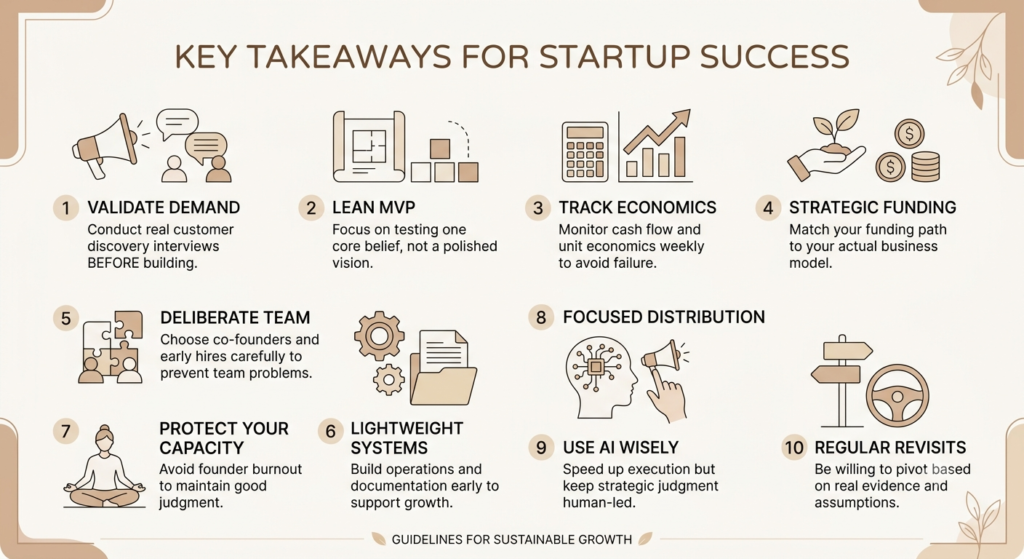
- Validate demand through real customer discovery interviews before writing a single line of code or spending meaningful money.
- Build a lean MVP focused on testing one core belief, not a polished version of your full vision.
- Track cash flow and unit economics weekly; most shutdowns trace back to a lack of market need or running out of money.
- Match your funding path to your actual business model instead of raising simply because capital is available.
- Choose co-founders and early hires deliberately – team problems are a common, preventable cause of failure.
- Build lightweight business systems and documentation early so growth does not outpace your operations.
- Protect your own capacity; founder burnout undermines the judgment your company depends on.
- Commit to one proven distribution channel before spreading effort across several unproven ones.
- Use AI to speed up execution while keeping strategic judgment in human hands.
- Revisit your core assumptions regularly and be willing to pivot or stop based on real evidence.
Conclusion
None of the startup tips for first-time founders in this guide are complicated, and that is exactly the point. Validate before you build. Watch your cash. Choose your team and your funding path deliberately. Protect your own energy enough to keep making good decisions for years, not months.
The odds are real, but they are not fixed. Founders who test their assumptions instead of defending them, who build systems before they are forced to, and who treat every setback as information rather than verdict, consistently beat the averages – not because they got lucky, but because they did the unglamorous work early, before it became urgent.
Frequently Asked Questions
What is the biggest mistake first-time founders make?
Building a full product before confirming real demand. Most failures trace back to solving a problem that was not painful or common enough for customers to pay for, rather than to a lack of technical skill.
How many customer interviews should I do before building anything?
Most experienced founders look for roughly six to twelve interviews per customer segment before clear patterns emerge, though a narrowly defined problem can surface useful signal with fewer conversations.
Do I need outside funding to start a company?
No. Many sustainable businesses grow entirely on reinvested revenue. Outside funding makes sense when your business specifically needs speed and scale that self-funded growth cannot provide, not simply because capital is available.
How long should MVP validation take?
A focused validation process, from problem discovery through a working MVP and early usage signals, typically takes several weeks to a few months depending on your access to customers and how quickly you can run experiments.
What causes most startups to fail?
Research consistently points to a lack of real market need as the leading cause, followed by running out of cash – which is often the visible symptom of building something the market did not want strongly enough.
Is the 90 percent startup failure rate accurate?
It depends on which startups you count. The figure applies most accurately to venture-scale, high-growth companies. Broader government data on all new private-sector businesses shows a lower first-year failure rate, closer to one in five.