

A few years ago, most leadership advice sounded the same. Be confident. Set a vision. Delegate. Inspire people.
That advice was not wrong. But it was incomplete.
Walk into almost any workplace today and you will find teams built from full-time employees, contractors, freelancers, and AI tools working side by side. You will find people who question authority more than they used to and expect transparency instead of just direction. You will find leaders trying to make fast decisions in a world that keeps changing the rules mid-game.
This is the environment leadership skills have to work in now. Not a slide deck environment. A real one, with real pressure.
I have spent years building and running property management and short-term rental operations, which means I have had to lead teams through slow seasons, sudden staffing gaps, unhappy guests, and plans that fell apart overnight. None of that gets fixed by charisma alone. It gets fixed by specific, learnable skills applied consistently.
This guide breaks down the leadership skills that matter most right now, backed by current research, and gives you a practical way to build each one. No fluff, no recycled motivational quotes. Just what works.
Why Leadership Skills Look Different in 2026
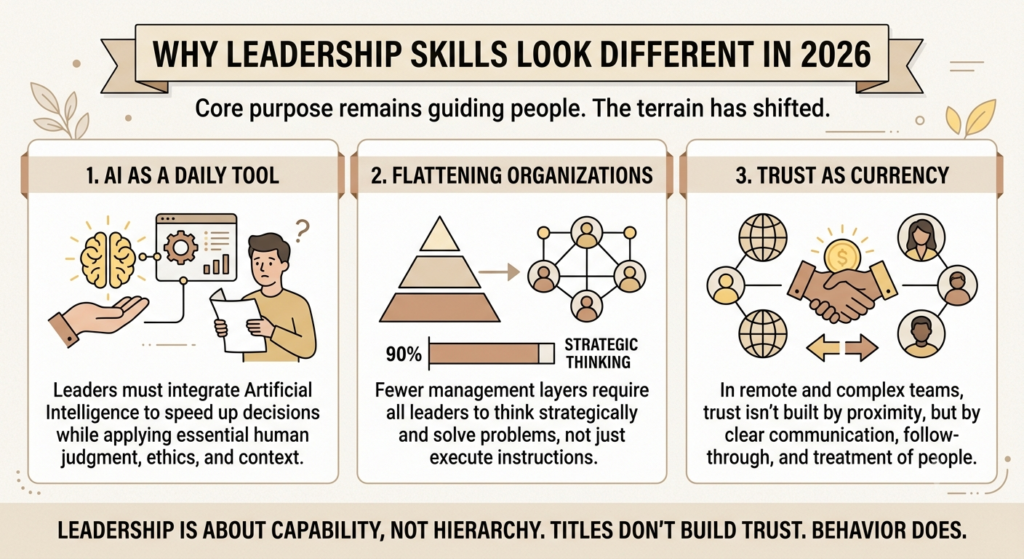
Leadership has not changed in its core purpose. It is still about guiding people toward a shared outcome. What has changed is the terrain leaders are walking on.
Three shifts stand out.
First, artificial intelligence has moved from a future concept to a daily tool. Leaders are now expected to use AI to speed up decisions while still applying human judgment, ethics, and context that a model cannot provide on its own.
Second, organizations are flattening. Fewer layers of management mean leaders at every level are expected to think strategically, not just execute instructions passed down from above. A recent industry report found that roughly 90 percent of business leaders now consider strategic thinking and problem-solving essential skills for hiring and growth, a expectation once reserved for senior executives.
Third, trust has become the currency that holds teams together. When people work across time zones, contracts, and shifting priorities, they cannot rely on hallway conversations or long tenure to build confidence in their leader. They rely on how that leader communicates, follows through, and treats them when things go wrong.
Put together, these shifts mean leadership skills today are less about hierarchy and more about capability. Titles do not build trust. Behavior does.
That is the lens for everything that follows.
Emotional Intelligence in Leadership: The Non-Negotiable Foundation
If you only develop one leadership skill this year, make it this one.
Emotional intelligence in leadership is the ability to recognize your own emotions, manage how you respond under pressure, and read what the people around you are feeling before it turns into a bigger problem. It sounds simple. In practice, it is one of the hardest skills to master because it requires you to slow down in moments when everything in you wants to react fast.
The research on this is not subtle. A Harvard Business Review study found that companies with employees scoring high on emotional intelligence had a 90 percent retention rate, compared to just 67 percent at companies with lower scores. Separate research has shown that employees working under emotionally intelligent managers are roughly four times less likely to leave their jobs.
Here is what that looks like day to day. A property manager on my team once had a guest complaint escalate quickly over a maintenance delay. The easy response would have been to get defensive or push blame onto the maintenance vendor. Instead, the manager paused, acknowledged the guest’s frustration directly, and worked out a fair resolution before offering an explanation. The guest left a five-star review anyway, not because the problem disappeared, but because they felt heard.
That is emotional intelligence doing its job. It does not eliminate problems. It changes how people experience them.
How to build it:
- Name your emotional state before you respond to a stressful situation, even silently. “I am frustrated right now” creates a half-second of distance that changes your next move.
- Ask more questions before offering solutions, especially with team members who come to you upset.
- Request honest feedback from a peer or mentor about how you come across under pressure. Most people are not aware of their own blind spots here.
Leaders often underestimate how much this one skill influences every other skill on this list. Poor emotional regulation undermines good strategy. Strong emotional intelligence makes every other leadership skill easier to apply.
There is also a performance dimension that often gets overlooked. Research on emotionally intelligent leadership has found that companies prioritizing this skill in their culture see meaningfully higher profitability compared to those that treat it as optional. Sales teams led by emotionally intelligent managers have shown measurable increases in performance as well, which suggests this is not simply about being liked. It is about creating conditions where people do their best work because they feel safe enough to try, fail, and try again.
One reason emotional intelligence is so difficult to fake is that people notice inconsistency almost immediately. A leader who is calm in a good week but volatile the moment a deadline slips is not demonstrating emotional intelligence, even if they usually seem composed. The skill is tested precisely in the moments when it is hardest to apply, not in the easy ones. That is worth remembering the next time a project goes sideways and the instinct is to react immediately instead of pausing first.
Communication Skills for Leaders
Leadership skills fail quietly and often invisibly when communication breaks down. A leader can have the right strategy and still lose the team simply because the message never landed the way it was intended.
Effective communication skills for leaders go beyond speaking clearly. They involve choosing the right channel, adjusting tone for the audience, and confirming that a message was actually understood, not just delivered.
This matters more now because so much communication happens asynchronously. A message sent in a group chat at 9 a.m. can be read at noon, misread at 3 p.m., and cause confusion by the next morning if there is no room for immediate clarification. Leaders who communicate well in this environment tend to over-communicate intentionally rather than assume silence means agreement.
A useful habit is the “say it three ways” approach. State the key point directly. Explain the reasoning behind it. Then describe what it looks like in action. This reduces the chance that people nod along without truly understanding what is being asked of them.
Transparency plays a major role here too. Research from a 2026 global workplace study found that employees are four times more likely to trust a leader when communication is transparent, and that openness about company strategy reduces the likelihood of employee anxiety by around 40 percent. People do not need every detail of every decision. They need to know they are not being kept in the dark.
Practical steps:
- Confirm understanding by asking team members to repeat back key instructions in their own words.
- Default to over-communicating during periods of change rather than waiting until you have “the full picture.”
- Separate the message from the moment. If you are frustrated, wait before writing that email.
Strategic Thinking
Strategic thinking used to sit at the top of the org chart. Not anymore.
As organizations flatten and move faster, leaders at every level are expected to see beyond their immediate task list and understand how their decisions connect to the bigger picture. This is one of the clearest leadership skills gaps organizations are trying to close right now.
Research from the Wharton School, based on a study involving more than 20,000 executives, identified six abilities that separate strategic leaders from reactive ones: the ability to anticipate, challenge assumptions, interpret ambiguous information, decide, align others, and learn from outcomes. None of these require a corner office. They require practice.
A simple way to build strategic thinking is to regularly ask “why” three levels deep. If a task exists, why does it exist? If that reason is valid, why does the broader goal behind it matter? This habit trains you to stop treating tasks as isolated to-dos and start seeing them as pieces of a larger system.
Short-term execution still matters, of course. But leaders who only manage the next task, without connecting it to a longer-term direction, tend to burn out their teams chasing urgency instead of progress. Setting clear, measurable short-term goals that visibly ladder up to a long-term vision keeps teams motivated because they can see their work mattering beyond the immediate deadline.
How to strengthen this skill:
- Block time weekly, even 30 minutes, to step back from execution and review whether current priorities still serve the larger goal.
- Study decisions after the fact. What did you anticipate correctly? What did you miss?
- Involve your team in the “why” behind decisions, not just the “what.”
Strategic thinking also benefits from deliberately seeking out information that challenges your current plan, rather than only confirming it. It is easy to build a strategy, gather supporting evidence, and stop looking once the picture feels complete. Leaders who consistently outperform their peers tend to keep asking what could prove the plan wrong, well after the plan has already been set in motion. This habit alone tends to catch blind spots that would otherwise surface as expensive surprises months later.
It also helps to separate strategic thinking from strategic planning. Planning produces a document. Thinking produces a mindset that keeps adjusting as new information arrives. A five-year plan written today will almost certainly need revision within a year, and that is not a failure of the plan. It is a sign the leader is paying attention to a world that refuses to hold still.
Decision-Making Under Uncertainty
Every leadership skill on this list eventually funnels into a single moment: the decision itself.
Leaders today rarely get to make decisions with complete information. Markets shift based on political and economic factors that are hard to predict. Supply chains, staffing, and customer expectations can change within weeks. Waiting for certainty is often not an option.
Good decision-making under these conditions is less about being right every time and more about having a repeatable process. A useful framework is to separate reversible decisions from irreversible ones. Reversible decisions, like testing a new pricing structure or trying a new vendor for a month, can be made quickly with limited information because the cost of being wrong is low and correctable. Irreversible decisions, like a major hire or a long-term contract, deserve slower, more deliberate analysis.
Leaders who struggle most with decision fatigue often treat every choice as equally weighty. Training yourself to sort decisions by reversibility frees up mental energy for the ones that truly deserve it.
It also helps to build in a short pause before high-stakes decisions, even 24 hours when possible. Emotion-driven decisions made under pressure are far more likely to be regretted later than decisions given even a small amount of distance.
Another practical habit is deciding in advance who else needs to weigh in before a decision is finalized, and who simply needs to be informed after the fact. Confusing these two groups is a common source of frustration on teams. Leaders who ask for input from everyone on every decision slow the organization down and dilute accountability. Leaders who never ask for input miss valuable context and often make avoidable mistakes. The skill lies in knowing, decision by decision, which category applies.
It is also worth acknowledging that not deciding is itself a decision, and often the more costly one. Leaders sometimes delay a choice hoping more clarity will arrive on its own. In fast-moving environments, that clarity rarely shows up before the window to act has already closed. An imperfect decision made on time frequently outperforms a perfect decision made too late.
Adaptive Leadership and Change Management
If there is one leadership skills theme that keeps surfacing across current research, it is adaptability.
The World Economic Forum’s Future of Jobs Report found that employers expect roughly 39 percent of workers’ core skills to change by 2030, driven by shifts in technology and how organizations operate. That is not a distant projection. Leaders are already feeling it in real time, as roles, tools, and expectations shift faster than formal training can keep up.
Adaptive leadership means guiding a team through change without pretending the change is not disruptive. Effective change management typically includes clear communication about what is actually changing and what remains stable, an honest read of how ready the team is for the shift, adjusted support based on where people are struggling, consistent feedback loops to catch resistance early, and visible recognition of progress to keep morale from collapsing mid-transition.
The mistake many leaders make is treating change as a single announcement instead of an ongoing process. A new system, a restructured team, or a shifted strategy does not settle in after one meeting. It settles in after weeks of reinforcement, questions answered, and small adjustments made along the way.
Learning cultures matter here too. Because the half-life of professional skills continues to shrink, leaders who build ongoing learning into daily work, rather than treating it as a separate training event, end up with teams that adapt faster and complain less.
Team Management and Delegation
Strong team management is one of the most practical leadership skills because it directly determines whether a leader’s time gets spent on high-value work or gets consumed by tasks someone else could have handled.
Delegation is not simply handing off work. It is matching the right task to the right person, giving enough context for them to succeed, and stepping back enough to let them own the outcome. Leaders who struggle with delegation often fall into one of two traps: they hold on to everything because they believe no one else can do it as well, or they delegate without clarity and then get frustrated when the result misses the mark.
A useful test before delegating a task is to ask whether the instructions given would make sense to someone with no prior context. If they would not, more clarity is needed before handing it off, not less follow-up afterward.
Team management also includes recognizing that different people need different kinds of support. Some team members thrive with independence and minimal check-ins. Others need more frequent touchpoints, especially when learning a new responsibility. Applying the same management style to everyone regardless of experience or confidence tends to either overwhelm newer team members or frustrate experienced ones who feel micromanaged.
A practical delegation checklist:
- Define the outcome you want, not just the steps to get there.
- Set a check-in point before the deadline, not only at the deadline.
- Give people room to solve problems their own way, even if it is not exactly how you would do it.
Building Trust Through Transparency
Workplace trust used to be built slowly, through years of shared history. That timeline has compressed. Teams change faster, projects rotate faster, and leaders are expected to earn trust in weeks, not years.
Transparency is the fastest, most reliable path to that trust. When leaders explain the reasoning behind decisions, even unpopular ones, people are far more likely to stay engaged than when they are simply told what to do. The earlier communication research bears this out directly: transparent communication makes employees dramatically more likely to trust their leader and meaningfully reduces workplace anxiety.
There is a two-way dimension to this as well. Many executives report concern about the accuracy of what they know about their own team’s skills and capabilities, which points to a deeper trust gap that runs in both directions. Leaders who create regular, honest conversations about strengths, growth areas, and career goals close that gap faster than annual performance reviews ever could.
Trust also shows up in smaller, daily moments. Following through on a small commitment, like getting back to someone by the time you said you would, builds more credibility over time than any single grand gesture.
AI Fluency: The New Leadership Skill
Five years ago, this section would not have existed in a leadership skills article. Today it is essential.
AI is no longer a distant tool leaders can ignore. It is embedded in daily workflows, from drafting communications to analyzing performance data to speeding up operational decisions. This creates a new leadership responsibility: knowing how to use AI well without outsourcing judgment to it.
AI fluency means being able to question AI-generated outputs, recognize where bias might creep in, and blend the speed of automation with human context that a model simply does not have. It does not mean becoming a technical expert. It means staying curious and critical at the same time.
There is a trust dimension here too, and leaders should not ignore it. Recent research found that a notable share of executives worry employees are becoming overly dependent on AI for daily tasks, which puts leaders in the position of setting clear expectations about where AI helps and where human judgment still has to lead.
Leaders who get this right treat AI as a collaborator, not a replacement for thinking. They use it to remove repetitive work from their day so they have more time for the parts of leadership that cannot be automated: listening, coaching, and making judgment calls that require context a model does not have.
Coaching and Developing Others
The best leaders I have worked alongside share one habit in common. They treat every interaction as a small coaching opportunity, not just a chance to get a task done.
Coaching is different from managing. Managing is focused on the task in front of you. Coaching is focused on building the person’s ability to handle similar situations independently in the future. A leader who coaches well spends slightly more time upfront explaining reasoning, and it pays off later in fewer repeated questions and more confident decision-making from the team.
This matters because talent development has become a retention strategy, not just a growth strategy. People increasingly choose to stay with leaders who are visibly invested in their progress, not just their output.
A simple coaching habit is to end feedback conversations with a question instead of an instruction. Rather than saying “do it this way next time,” try asking “what would you approach differently next time, knowing what you know now.” This shifts ownership of the lesson to the person who needs to apply it.
Common Leadership Mistakes That Undo Good Skills
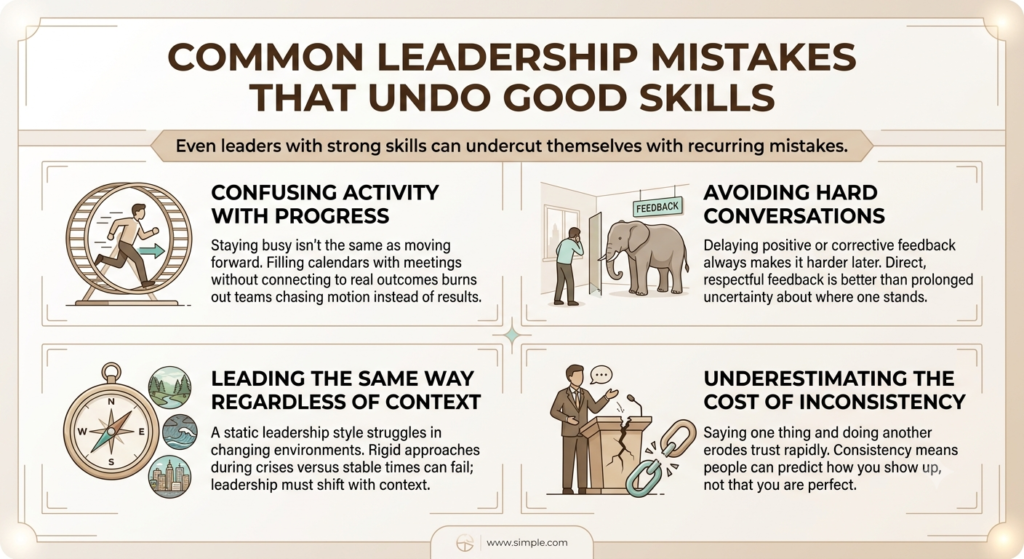
Even leaders who understand every skill above can undercut themselves with a handful of recurring mistakes.
Confusing activity with progress. Staying busy is not the same as moving the team forward. Leaders who fill their calendars without connecting each meeting to a real outcome tend to burn out their teams chasing motion instead of results.
Avoiding hard conversations. Delaying feedback, whether positive or corrective, almost always makes the conversation harder later, not easier. Most people can handle direct, respectful feedback far better than prolonged uncertainty about where they stand.
Leading the same way regardless of context. A leadership approach that worked during a stable quarter often needs to shift during a crisis, and vice versa. Rigid leadership styles struggle in environments that keep changing.
Underestimating the cost of inconsistency. Saying one thing and doing another, even occasionally, erodes trust faster than almost anything else. Consistency does not mean perfection. It means people can predict how you will show up.
How to Build These Skills, Starting This Month
Reading about leadership skills is easy. Building them takes deliberate repetition. Here is a simple way to start without overwhelming yourself.
Pick one skill from this list, not all of them at once. Trying to improve everything simultaneously usually results in improving nothing.
Set a small, specific practice for the next 30 days. If you are working on emotional intelligence, that might mean pausing before responding to any frustrating message. If you are working on delegation, that might mean handing off one task per week that you would normally keep for yourself.
Ask for feedback at the end of the month from someone who works closely with you. Self-assessment alone tends to be unreliable because most people overestimate their own consistency.
Then choose the next skill. Leadership development is not a single course or certification. It is a slow accumulation of better habits, applied consistently under real pressure.
Key Takeaways
- Leadership skills in 2026 center on adaptability, emotional intelligence, and the ability to blend AI tools with human judgment.
- Emotional intelligence remains the foundation, directly linked to higher employee retention and stronger decision-making under pressure.
- Strategic thinking is no longer reserved for senior executives; it is expected at every leadership level.
- Transparent communication builds trust faster than tenure or authority ever could.
- Delegation and coaching, done well, free up leadership capacity while developing stronger, more independent teams.
- AI fluency is now a core leadership skill, requiring judgment about when to rely on automation and when human context matters more.
- Consistency, not perfection, is what earns long-term trust from a team.
Conclusion
None of the leadership skills covered here are complicated to understand. Emotional intelligence, clear communication, strategic thinking, adaptability, trust, and now AI fluency are all fairly intuitive once explained.
The difficulty is not in understanding them. It is in applying them consistently, especially on the days when it would be easier not to.
Leadership is not a title you earn once. It is a set of decisions you make repeatedly, often in small, unremarkable moments that never make it into a case study. How you respond to a frustrated team member. Whether you follow through on a small promise. How honestly you explain a hard decision.
Build these leadership skills one at a time, apply them under real pressure, and give yourself room to get better slowly. That is how lasting leadership actually gets built.
Frequently Asked Questions
What are the most important leadership skills to develop first?
Emotional intelligence and communication skills for leaders tend to have the widest impact because they influence how every other skill, from decision-making to delegation, actually lands with a team.
Can leadership skills be learned, or are some people just born leaders?
Leadership skills can absolutely be learned. Traits like confidence or charisma may come more naturally to some people, but skills like emotional intelligence, strategic thinking, and adaptive leadership are built through deliberate practice, not innate talent.
How does AI change what leadership skills matter most?
AI has made judgment, ethics, and human context more valuable, not less. Leaders now need AI fluency alongside traditional skills, using automation to remove repetitive work while still applying human oversight to decisions that carry real consequences.
How long does it take to improve leadership skills?
There is no fixed timeline, but consistent, focused practice over 30 to 90 days on a single skill tends to produce noticeable change, especially when paired with honest feedback from people who work closely with you.
What is the difference between managing and leading?
Managing focuses on organizing tasks and processes efficiently. Leading focuses on setting direction, building trust, and developing people so they can perform well even without constant oversight. Strong leaders do both, but leadership skills specifically address the people side of that equation.
Why do some technically skilled people struggle as leaders?
Technical skill and leadership skill are different disciplines. Someone can be excellent at their craft while still lacking the communication, delegation, or emotional intelligence needed to guide a team effectively. Leadership requires its own deliberate development, separate from technical expertise.