

Most business owners don’t fail because they lack ambition. They fail because growth, when it isn’t managed on purpose, quietly breaks the very business it’s supposed to build.
I’ve watched this happen up close, both in my own ventures and in the businesses I’ve advised. A company lands a big client, doubles its bookings, or finally gets the marketing traction it’s been chasing for years, and instead of celebrating, the owner is suddenly buried. Systems that worked fine for a small operation start cracking. The team gets stretched thin. Cash gets tight even though revenue is climbing. What looked like success on paper starts to feel like chaos in practice.
This is the part nobody tells you when you’re starting out: growth is not the reward at the end of hard work. Growth is a different kind of hard work, with its own rules, and if you don’t understand those rules, more customers and more revenue can actually push your business closer to the edge, not further from it.
That’s what this guide is about. Not motivational talk about “thinking big” or “hustling harder,” but a grounded, practical look at business growth strategies that actually hold up in 2026 – a year defined by persistent inflation, rapid AI adoption, tighter lending conditions, and business owners who are more optimistic than they’ve been in years, even while margins stay thin.
By the end, you’ll have a clear framework for building growth that doesn’t collapse under its own weight, along with a 90-day action plan you can start using this week.
What Business Growth Actually Means in 2026
Ask ten business owners to define growth and you’ll probably get ten different answers. More revenue. More customers. More locations. A bigger team. A bigger exit.
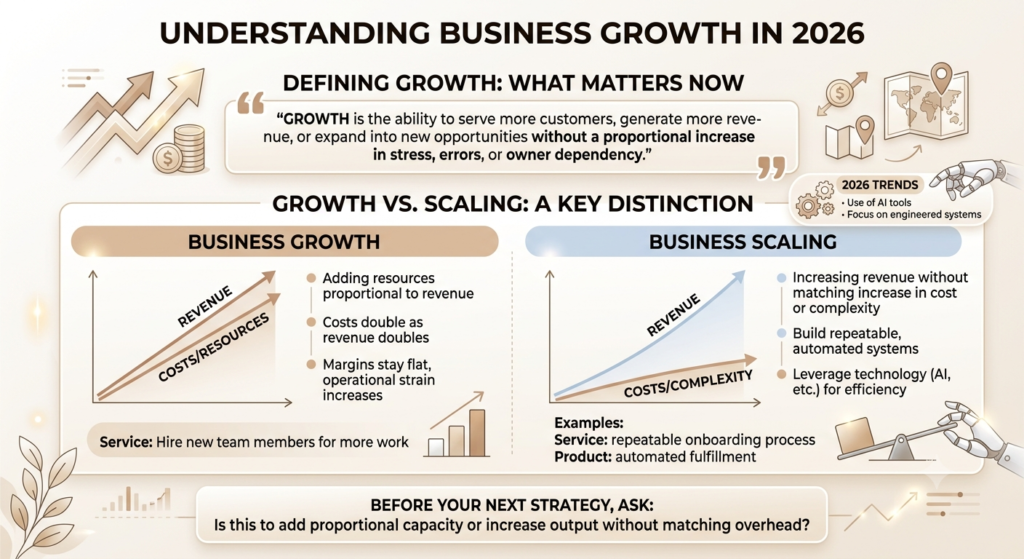
Here’s the definition I’ve come to trust after years of running and managing businesses: growth is the ability to serve more customers, generate more revenue, or expand into new opportunities without a proportional increase in stress, errors, or owner dependency.
Notice what’s missing from that definition. It doesn’t say growth means working more hours. It doesn’t say growth means you personally have to touch every part of the business. Real growth means your business gets better as it gets bigger – not just louder.
This distinction matters more in 2026 than it has in years. According to a 2026 small business report, 93% of small business owners expect growth this year, and separate research puts that figure closer to an all-time high of 94%, with more than half of owners now using AI tools in daily operations. Optimism is high. But optimism without infrastructure is exactly how businesses end up growing themselves into a crisis.
The businesses that will actually benefit from 2026’s growth wave are the ones treating growth as a system to be engineered, not a wave to be ridden.
Growth vs. Scaling: A Distinction Worth Understanding
Business owners often use “growth” and “scaling” interchangeably, but treating them as the same thing is part of why so many companies stumble. Growth means adding resources – people, inventory, marketing spend – in roughly the same proportion as revenue. If revenue doubles and costs also double, that’s growth, but it isn’t necessarily healthy, because margins stay flat and the operational strain increases right alongside the top line.
Scaling means increasing revenue without a matching increase in cost or complexity. A service business that builds a repeatable onboarding process, for example, can take on more clients without hiring a new coordinator for every ten accounts. A product business that automates its reorder and fulfillment process can handle a 30% sales increase without adding a proportional number of warehouse staff.
Neither approach is inherently wrong. Sometimes growth – hiring more people to do more of the same work – is exactly what a business needs, particularly in service industries where quality depends on human attention. But confusing the two leads owners to expect scaling-level efficiency from growth-stage decisions, which sets unrealistic expectations and often triggers premature cost-cutting when margins don’t improve as quickly as hoped.
Before choosing your next growth strategy, it’s worth asking plainly: is this initiative meant to add proportional capacity, or is it meant to increase output without a matching increase in overhead? The answer should shape how you measure success and how patient you’re willing to be with the results.
Why Most Businesses Struggle to Grow
Before talking about what works, it’s worth being honest about what doesn’t – because the data on business failure is more instructive than most growth advice.
According to Bureau of Labor Statistics figures widely cited going into 2026, roughly 20% of new businesses close within their first year, around 49% don’t make it past five years, and only about a third are still standing after a decade. Those numbers have stayed remarkably consistent across different economic cycles, which tells you something important: business failure isn’t mostly caused by bad luck or a rough economy. It’s caused by decisions made inside the business.
Research from CB Insights, referenced heavily in 2026 small business analysis, breaks down the leading causes of business failure in a way that should reshape how you think about growth:
- Running out of cash is the single biggest killer, cited in roughly 38% of failures.
- Lack of market need – building something people don’t actually want badly enough to pay for – accounts for around 35%.
- Team problems, including poor hires and founder conflict, contribute to about 23% of failures.
- Getting outcompeted by more agile or better-resourced rivals plays a role in roughly 19% of cases.
- Overexpansion – growing faster than the business’s systems and finances can support – is a recurring, specific cause on its own.
Look closely at that list. Cash flow and overexpansion aren’t problems that show up when a business is struggling. They’re problems that show up when a business is succeeding too quickly without the structure to absorb it. This is the paradox at the heart of business growth: the moment you’re winning is often the moment you’re most exposed.
That’s why the strategies below start with foundations, not tactics.
The Foundation: Build Systems Before You Scale
If there’s one lesson I’d want every entrepreneur to internalize before chasing their next growth milestone, it’s this: systems create the ceiling for how big and how well your business can grow. Hustle alone cannot substitute for structure.
Documented Processes
Every task that lives only in your head, or only in the head of one key employee, is a growth bottleneck waiting to happen. If you can’t hand off a task without a two-hour explanation, that task isn’t a process – it’s a dependency.
Start by documenting the five to ten workflows that keep your business running day to day: how a new customer is onboarded, how invoices go out, how a complaint gets resolved, how inventory gets reordered. Simple step-by-step documents, even in a shared folder, are enough to start. The goal isn’t perfection. The goal is that your business can function correctly even when you’re not the one doing the work.
Financial Systems and Cash Flow Management
Since cash flow problems are the leading cause of business failure, this deserves more than a passing mention. Growing businesses often experience something counterintuitive: revenue goes up while cash gets tighter. This happens because growth usually requires spending money before it comes in – more inventory, more payroll, more marketing – while customers may still be paying on 30, 60, or 90-day terms.
Practical steps that protect you here include reviewing financial statements monthly rather than only at tax time, maintaining a cash reserve that can cover several months of operating expenses, and securing a line of working capital before you need it rather than scrambling for financing during a cash crunch. Businesses heading into 2026 that maintain strong liquidity are the ones positioned to move quickly on opportunities – negotiating better supplier terms, taking on larger contracts, or investing in equipment – while their less-prepared competitors are stuck reacting.
The Right Team Structure
You cannot personally scale a business past a certain size. At some point, growth requires trusting other people with real decision-making authority, not just task execution. This means hiring for judgment, not just skill, in your first few key roles, and it means resisting the temptation to hire quickly under pressure – since team-related issues remain one of the more common reasons businesses stall out.
A useful gut check: if you disappeared for two weeks, would your business run the same way, worse, or would it stop? If the honest answer is “it would stop,” your growth ceiling is your own personal bandwidth, and no amount of marketing spend will fix that.
Business Growth Strategies That Work in 2026
With the foundation in place, here are the strategies actually moving the needle for businesses this year.
1. Strengthen Cash Flow Discipline as a Growth Lever, Not Just a Safety Net
Most owners think of cash flow management as defensive – something you do to avoid disaster. In 2026, with inflation still hovering near 3% and input costs like energy, insurance, and wages continuing to climb, cash flow discipline has become an offensive weapon. Businesses with strong liquidity can respond to a supplier’s early-payment discount, snap up discounted inventory, or absorb a slow month without panic. Businesses without it are always one bad quarter away from a crisis.
Build a rolling 13-week cash flow forecast, not just an annual budget. It’s short enough to stay accurate and long enough to spot problems before they become emergencies.
2. Use AI to Multiply Your Team’s Capacity – Without Replacing Judgment
Artificial intelligence has moved from novelty to necessity for small businesses. Recent research shows more than half of small businesses are now using generative AI tools in some capacity, and a large majority of those users report a measurably positive impact on their operations. This isn’t limited to large enterprises anymore; AI-powered scheduling, customer service, content creation, and data analysis tools are increasingly affordable and accessible to businesses of any size.
The businesses getting real value from AI aren’t using it to replace strategic thinking. They’re using it to eliminate the repetitive, low-judgment work – drafting first versions of customer emails, summarizing call transcripts, flagging anomalies in financial data – so that people can spend their time on decisions that actually require human judgment: relationship-building, negotiation, and strategy.
If you haven’t adopted any AI tools yet, start with one narrow, painful task rather than trying to overhaul your entire operation at once. Automating one bottleneck well beats bolting on five tools that nobody actually uses.
3. Deepen Customer Experience and Retention
It costs significantly more to acquire a new customer than to retain an existing one, yet growth-focused businesses routinely underinvest in the customers they already have. In a year where economic pressure has households and businesses being more selective with spending, the businesses winning aren’t necessarily the ones with the flashiest marketing – they’re the ones creating experiences that feel simple, reliable, and trustworthy enough to turn a first-time buyer into a repeat one.
This means auditing your customer journey for friction points: confusing onboarding, slow response times, unclear communication. Small, consistent improvements to how customers experience your business compound into loyalty, and loyal customers are both cheaper to serve and more likely to refer others.
4. Diversify Revenue Streams Deliberately
Relying on a single product, service, or client concentration is one of the more overlooked risks in business growth. If one client represents 40% of your revenue, you don’t have a growing business – you have a fragile one with good numbers.
Diversification doesn’t mean chasing every opportunity that comes your way. It means deliberately identifying one or two adjacent offerings that serve your existing customer base, or one new customer segment that values what you already do well. The goal is spreading risk without spreading your team so thin that quality suffers everywhere.
5. Build Strategic Partnerships Instead of Just Bigger Sales Teams
Partnerships have become one of the more efficient business growth strategies for smaller companies competing against larger, better-resourced rivals. Rather than trying to out-hire or out-spend a bigger competitor, forming the right partnerships gives you access to a wider audience and additional expertise without the fixed cost of expanding headcount.
The key to making partnerships work is alignment: your partner’s customers should already need what you offer, and both sides need shared visibility into pricing, promotions, and customer communication so prospects get a consistent experience regardless of who they talk to first.
4. (continued) Data-Driven Decision Making
Businesses generate a constant stream of data – sales patterns, website behavior, customer feedback, support tickets – but most of it goes unused. Treating data analysis as a core part of business growth strategies, rather than an occasional reporting exercise, helps you spot which customer segments are most profitable, which marketing channels actually convert, and where operational bottlenecks are quietly costing you money.
You don’t need an expensive analytics platform to start. A simple monthly review of your five most important numbers – revenue by segment, customer acquisition cost, retention rate, average order value, and cash on hand – will reveal more than most owners expect.
6. Invest in Employee Development
Employees are one of the most underleveraged growth assets in most small businesses. Continuous training and skill development doesn’t just improve day-to-day execution; it builds the bench strength you’ll need when you’re ready to delegate more responsibility. Businesses that invest in their people tend to adapt faster to market shifts and generate more of the small, incremental process improvements that add up to meaningful operational gains over time.
Practically, this can be as simple as setting aside a fixed monthly budget for training, creating a habit of cross-training employees across roles, and giving your best people visibility into the “why” behind business decisions, not just the “what.”
7. Expand Into New Markets – Deliberately, Not Reactively
Market or geographic expansion offers real upside: new customers, diversified revenue, and reduced dependency on a single local economy. But expansion is also where overexpansion-related failures happen most often, since it typically requires meaningful upfront investment before returns materialize.
Before expanding into a new market, validate demand on a small scale first – a pilot offering, a limited-region launch, or a soft rollout to a subset of existing customers in the new segment. Treat expansion as a hypothesis to be tested, not a decision to be made on instinct alone.
8. Optimize for How Customers Actually Search in 2026
Search behavior has shifted meaningfully with the rise of AI-powered search tools, chatbots, and voice assistants. Businesses relying purely on traditional SEO tactics from a few years ago are starting to lose visibility to competitors optimizing for how people actually ask questions today – in natural, conversational language, often expecting a direct answer rather than a list of links.
This doesn’t mean abandoning SEO fundamentals. It means writing content that answers real questions clearly, structuring information so it’s easy for both humans and AI tools to understand, and making sure your business’s core information – hours, services, location, pricing – is accurate and consistent everywhere it appears online.
Common Mistakes That Derail Growth
Even well-intentioned business owners fall into predictable traps when scaling. Watch for these:
- Growing headcount before growing systems. Adding people to a broken process just means more people doing the wrong thing faster.
- Chasing every opportunity that shows up. Saying yes to every client, market, or product idea spreads resources thin and dilutes what made the business good in the first place.
- Ignoring cash flow because revenue looks strong. Profitable on paper and solvent in practice are two different things, especially during rapid growth.
- Underestimating how much growth costs before it pays off. New hires, new inventory, and new marketing all require cash upfront, often well before the resulting revenue arrives.
- Confusing being busy with being productive. A packed calendar and a growing business are not the same thing.
- Waiting too long to delegate. Founders who insist on personally approving every decision become the bottleneck that caps their own company’s growth.
- Treating pricing as fixed. Many businesses hold onto old pricing structures well past the point where rising costs have quietly eroded their margins, only realizing the damage when a slow quarter exposes how thin the profit actually was.
- Measuring growth only by revenue. Revenue that arrives without healthy margins, manageable workload, and satisfied customers isn’t sustainable growth – it’s a temporary spike that often reverses once the strain catches up with the business.
Each of these mistakes shares a common thread: they all involve mistaking activity for progress. A business can look busier, bigger, and more successful on the surface while quietly becoming less stable underneath. Recognizing the difference early is what allows an owner to course-correct before a manageable issue turns into an existential one.
How to Know You’re Ready to Scale
Not every business is ready to grow right now, and that’s not a failure – it’s a signal to strengthen the foundation first. A few honest questions can help clarify where you actually stand:
- Do you have at least three to six months of operating expenses in reserve?
- Are your core processes documented well enough that someone new could follow them?
- Do you know your actual profit margins on your top products or services, not just your revenue?
- Can your current team absorb 20–30% more volume without everything breaking?
- Do you have a way to track whether growth initiatives are actually working, or are you flying on instinct?
If you answered “no” to two or more of these, that’s not a reason to stop pursuing growth – it’s a signal about where to focus first.
A 90-Day Growth Action Plan
Turning strategy into action requires a timeline. Here’s a simple 90-day framework to move from theory to execution.
Days 1–30: Diagnose Document your top five workflows. Build a 13-week cash flow forecast. Identify your single biggest bottleneck – the one thing that, if it broke, would stop the business.
Days 31–60: Strengthen Fix the bottleneck identified above. Introduce one AI or automation tool to reduce repetitive work. Review your customer journey for the two or three biggest friction points and fix them.
Days 61–90: Expand Pilot one new revenue stream, partnership, or market segment on a small scale. Set up a monthly review of your five key business numbers. Reassess your readiness checklist from the section above.
This sequence matters. Diagnosing before strengthening, and strengthening before expanding, is what separates growth that lasts from growth that collapses under its own weight.
Key Takeaways
- Business growth strategies that last are built on systems – documented processes, disciplined cash flow management, and a capable team – not just ambition or market timing.
- Cash flow problems and overexpansion, not bad luck, are the leading causes of business failure, which makes financial discipline a growth strategy in its own right.
- AI adoption among small businesses has become mainstream in 2026, but the businesses benefiting most use it to remove repetitive work, not to replace strategic judgment.
- Customer retention, deliberate diversification, and strategic partnerships tend to outperform aggressive, unfocused expansion.
- Readiness matters: scale the parts of your business that can already handle more volume, and strengthen the parts that can’t before pushing growth further.
Conclusion
Growth isn’t something that happens to a business. It’s something a business is built to handle. The companies that come out of 2026 stronger won’t necessarily be the ones that grew the fastest – they’ll be the ones that grew on a foundation built to hold the weight.
If there’s one shift I’d encourage every entrepreneur reading this to make, it’s this: stop asking “how do I grow faster?” and start asking “what needs to be true about my business before more growth makes it better instead of harder?” That single reframe changes which decisions you make next, and it’s usually the difference between businesses that scale sustainably and the ones that grow themselves into a crisis.
Build the systems first. The growth will hold.
Frequently Asked Questions
What are the most effective business growth strategies for a small business in 2026?
The strategies with the strongest track record combine operational discipline – cash flow management and documented systems – with customer-focused growth levers like retention, strategic partnerships, and selective use of AI tools to increase capacity without increasing overhead.
How much cash reserve should a growing business keep on hand?
Most financial advisors and lenders recommend three to six months of operating expenses as a baseline reserve, with growing businesses often needing more given the upfront costs associated with hiring, inventory, and marketing during expansion.
Is it better to focus on customer retention or new customer acquisition for growth?
Both matter, but retention typically offers a stronger return since it costs less to keep an existing customer than to acquire a new one, and loyal customers are more likely to refer others, effectively lowering your acquisition costs over time.
How do I know if my business is growing too fast?
Warning signs include cash getting tighter even as revenue rises, employees consistently missing deadlines or making more errors, customer complaints increasing, and the owner becoming the bottleneck for every decision. These usually mean systems haven’t kept pace with demand.
Should small businesses be using AI to support growth in 2026?
For most businesses, yes, in a targeted way. AI tools are increasingly accessible and, according to recent surveys, the large majority of small business users report a positive impact. The key is starting with one specific, repetitive bottleneck rather than trying to automate everything at once.
What’s the biggest mistake businesses make when trying to scale?
Adding people, locations, or products before the underlying systems – cash flow visibility, documented processes, and a capable team – can support the added complexity. Growth without infrastructure tends to expose weaknesses rather than solve them.