

There is a strange point almost every founder hits. The business is growing. Revenue looks healthy. Customers keep coming. And yet you feel more tired, more stretched, and more indispensable than ever.
That is not a sign of success. It is a warning sign.
According to the U.S. Bureau of Labor Statistics, roughly 20 percent of small businesses close within their first year, and about half do not make it past five years. The reasons behind those numbers are rarely dramatic. They are usually quiet, structural problems that build up over time: no cash flow discipline, no documented processes, and a founder who has become the operating system of the entire company.
This article is about the fix. Not motivation, not hustle, not another productivity hack. It is about building real business systems for entrepreneurs so your company can run, grow, and survive without every decision passing through you first.
If you run a service business, a property management company, a small agency, or anything in between, this applies to you. I have built and managed businesses where I was the bottleneck for far too long before I learned better. What follows is the practical version of that lesson.
What Business Systems Really Mean (Beyond Templates and Software)
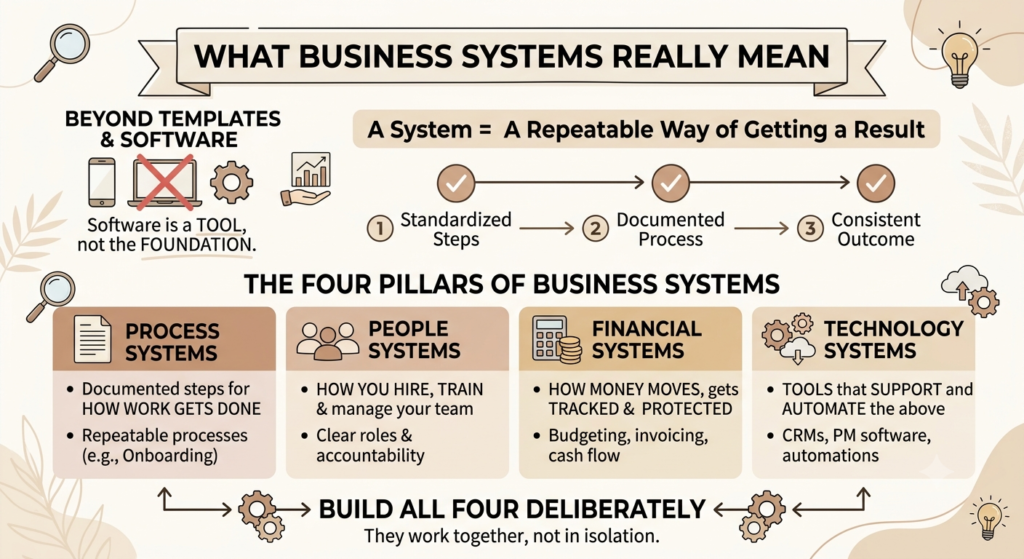
When people hear “business systems,” they often picture software. A CRM. A project management board. An automation tool that sends emails while you sleep.
Software is part of it, but it is not the foundation. A system is simply a repeatable way of getting a result, one that does not depend on you personally remembering every step or making every call.
Think about it this way. If a new employee joined your company tomorrow, could they follow a clear process to onboard a customer, resolve a complaint, or close a sale without asking you what to do at every turn? If the answer is no, you do not have a system yet. You have a habit that lives only in your head.
Business systems for entrepreneurs cover four basic categories:
- Process systems – the documented steps for how work gets done
- People systems – how you hire, train, and hold your team accountable
- Financial systems – how money moves in, gets tracked, and gets protected
- Technology systems – the tools that support and automate the above
None of these categories work well in isolation. A great CRM will not save a sales process that lives only in your memory. A documented process will not help if no one is accountable for following it. The goal is to build all four together, deliberately, instead of letting them form by accident.
Why Most Businesses Never Outgrow Their Founder
The Founder-as-Bottleneck Pattern
Early on, founder involvement in everything is not a flaw. It is often necessary. You know the customers, you understand the product, and you can move faster than anyone else because nothing has to be explained to you first.
The problem shows up later, when that same closeness becomes a ceiling. Business analysts and growth consultants have flagged this pattern repeatedly through 2026: as a company grows, every important question still routes through one person, decisions slow down, and the team learns to wait instead of act.
That waiting is not a motivation problem or a talent problem on your team’s part. It is a structural one. If your business cannot function without your daily input, you have not built a company. You have built a very demanding job that happens to have your name on the door.
The uncomfortable truth is that founder competence often causes this trap, not founder carelessness. You got good results by being involved in everything, so the market, your clients, and your own team came to expect that involvement permanently. Letting go starts to feel risky, even when it is exactly what growth requires.
What the Data Says About Failure Causes
It is worth being specific about why businesses actually fail, because the popular story (“most businesses just fail, that’s how it goes”) hides the real, fixable causes underneath it.
Cash flow problems remain the single most cited reason businesses shut down, tied to roughly 82 percent of failures according to recent U.S. Bank research on small business closures. That is not usually because the business was unprofitable on paper. It is because nobody had a system for tracking, forecasting, or protecting cash in real time.
Beyond cash, a wrong team or leadership mix has been linked to close to a quarter of startup failures, and weak or absent business planning shows up in a large share of closures as well. Pricing mistakes, poor management, and ignoring customer feedback round out the list.
Almost every one of these causes has the same underlying fix: a system that catches the problem before it becomes fatal. A weekly cash flow review catches the first cause. A documented hiring process catches the second. A pricing review built into your quarterly planning catches the third.
The Changing Face of Entrepreneurship in 2026
Before getting into the fix, it helps to understand who is actually building businesses right now, because the pressure to systemize is not the same for everyone.
There are roughly 36.2 million small businesses operating in the United States today, making up 99.9 percent of all U.S. firms and employing close to 46 percent of the private-sector workforce. Entrepreneurship is no longer a side story in the economy. It is a large share of it.
The motivations behind starting a business have also shifted. Being your own boss remains the top reason people start a company, but a meaningful share of new founders are entering entrepreneurship after a layoff or job disruption rather than choosing it purely out of ambition. That distinction matters, because founders who start a business out of necessity often have less runway for trial and error, which makes early systems even more valuable, not less.
Ownership demographics are also shifting generationally. Gen X still leads business ownership, but Millennials and a small, growing share of Gen Z founders are stepping into ownership roles, often bringing a stronger default comfort with digital tools and automation. That comfort is useful, but it can also create a trap: founders who are fluent with software sometimes reach for a new tool before they have defined the process that tool is supposed to support.
None of this changes the fundamentals. Whether you started your business by choice or by necessity, and whether you are a digital native or not, the same structural gap shows up eventually. Growth outpaces the founder’s personal capacity, and something has to give: either the business gets systems, or the founder absorbs the strain indefinitely.
The Real Cost of Running Your Business Without Systems
Cash Flow Blind Spots
When there is no financial system, cash flow becomes something you feel rather than something you track. You notice the account is low, but not why, or when it will recover.
A basic cash flow system does not need to be complicated. It needs a weekly check-in on what is coming in, what is going out, and what is due in the next 30 to 60 days. That single habit, formalized into a repeatable process, prevents the majority of the surprises that sink otherwise healthy companies.
Burnout and Decision Fatigue
Founders without systems tend to make hundreds of small decisions a day that a system should be making instead. What time should the team start. How should a refund request be handled. Which vendor gets paid first this week.
Each decision is small on its own. Together, they drain the mental energy you need for the decisions that actually require your judgment: strategy, key hires, and long-term direction. Founder burnout has become a well-documented contributor to business closures, and much of it traces back to this constant low-level decision load rather than any single catastrophic event.
Lost Valuation and Exit Readiness
Even if you never plan to sell, this point matters, because it reveals how a buyer, investor, or bank sees your business. A company that depends entirely on one person for sales, client relationships, or operational judgment is considered high risk. Buyers see it as a business that might not survive the transition, not as a business built on your reputation.
Founder-dependent companies typically receive lower offers, longer transition requirements, or earn-out structures designed to protect the buyer if the founder’s departure hurts performance. A business built on documented, transferable systems is worth more, plainly and measurably, than the same business built on one irreplaceable person.
The Five Core Systems Every Entrepreneur Needs
Building business systems for entrepreneurs does not mean overhauling your entire company overnight. It means identifying the five areas where dependency on you is costing the most, and systemizing those first.
1. Sales and Customer Acquisition System
If revenue depends on you personally closing every deal, your growth ceiling is your own calendar. A sales system defines your ideal customer, a repeatable outreach or inbound process, standard objection handling, and clear criteria for when a deal is qualified.
Once this exists on paper, someone else on your team can execute it, and you can step back into a coaching or oversight role instead of being the sole salesperson.
A practical starting point is a one-page sales playbook: who the ideal customer is, the three or four questions that qualify or disqualify a lead, the standard follow-up sequence, and the language you use to handle the two or three objections that come up most often. Most founders already know all of this intuitively. Writing it down is what makes it transferable.
2. Operations and Standard Procedures
Standard operating procedures are the backbone of consistent quality. They describe, step by step, how recurring tasks get done: onboarding a new client, handling a service request, closing out a project.
Written procedures reduce the tribal knowledge problem, where only you or one senior employee knows how something actually gets handled. New hires ramp up faster, mistakes drop, and quality stays consistent even when you are not in the room.
You do not need a polished manual to start. A simple numbered checklist, saved somewhere the whole team can access, is enough to begin. The goal is not perfect documentation. The goal is that the process no longer lives exclusively in someone’s head.
3. Financial Management System
This covers budgeting, invoicing, cash flow tracking, and basic reporting. It does not need to be elaborate. It needs to answer three questions reliably, every week: how much cash do we have, what is coming in, and what is going out.
Many founders avoid building this system because financial management feels tedious compared to sales or product work. That avoidance is exactly why cash flow issues remain the top cause of business failure.
Self-funding is still the most common way small businesses cover early costs and cash gaps, which makes disciplined cash flow tracking even more important, since there is often no outside lender asking hard questions about your numbers before a problem becomes serious.
4. Hiring and Team Development System
A hiring system defines your role requirements, your interview process, and your onboarding checklist before you need to fill a position urgently. Without it, hiring happens reactively, usually under pressure, which is how the wrong people end up on the team.
Team development matters just as much as hiring. Regular check-ins, clear performance expectations, and a simple path for growth keep good people from leaving and reduce how much day-to-day coaching depends on you personally.
Talent gaps and leadership mismatches remain one of the most common reasons businesses stumble as they grow, which makes a repeatable hiring process one of the highest-leverage systems you can build, even before the business feels big enough to need one.
5. Customer Experience System
Customer experience should not depend on which employee happens to answer the phone that day. A documented system covers how inquiries are handled, response time expectations, complaint resolution steps, and follow-up after a sale or service is complete.
Consistent customer experience is one of the fastest ways to build referral-driven growth, because customers trust a business that feels the same every time they interact with it.
How to Build Business Systems for Entrepreneurs Step by Step
Step 1: Document What You Already Do
Before building anything new, write down what currently happens, even if it is messy. For one week, keep a simple log of every recurring decision or task you personally handle. This becomes your raw material.
Step 2: Identify the Bottleneck Decisions
Look at your log and mark which items only you can do because of expertise, and which items only you do out of habit. The habit-based ones are your fastest wins. Those are the first candidates for a documented process.
Step 3: Assign Ownership, Not Just Tasks
A system without an owner will decay within a few months. For each process you document, name one person responsible for it, not a group. Shared ownership tends to mean no ownership.
Step 4: Automate the Repeatable Work
Once a process is documented and owned, look for the parts that software can handle without judgment calls: scheduling, reminders, invoicing, basic reporting, and data entry are strong candidates. Business automation should support your system, not replace the thinking behind it.
Step 5: Review and Refine Quarterly
Systems are not permanent. Set a quarterly review where you check whether each process is still being followed, still producing the right result, and still owned by the right person. Businesses that treat systems as a one-time project usually watch them quietly fall apart within a year.
Real-World Example: Systemizing a Property Management Business
Property management is a useful case study because it is operationally heavy by nature. Every property has maintenance requests, tenant communication, rent collection, vendor coordination, and inspections happening at the same time, often across multiple locations.
In the early stage, it is common for a single person to personally coordinate every maintenance call, every tenant question, and every vendor relationship. That works when you manage a handful of properties. It collapses the moment you try to scale past what one person can physically track.
The shift happens when maintenance requests get routed through a standard intake process instead of a personal phone number, when vendor relationships are documented with agreed pricing and response times instead of relying on informal favors, and when tenant communication follows a consistent template instead of being improvised each time.
None of this removes the founder’s judgment from the business. It removes the founder from tasks that never needed their judgment in the first place, freeing up time for the decisions that actually move the business forward, like which properties to take on next or how to price a new service tier.
There is also a compounding effect worth noting. Once maintenance intake, vendor coordination, and tenant communication run on documented systems, the same structure tends to make the business easier to explain to a potential partner, lender, or buyer. A property portfolio that runs on process, rather than on one person’s memory of which vendor to call for which building, is simply easier to trust and easier to value.
Common Mistakes Entrepreneurs Make When Building Systems
Building systems for problems you do not have yet. Some founders over-engineer processes for a scale they have not reached, creating bureaucracy that slows down a small team without adding real value. Build for your current size, plus a little room to grow.
Documenting once and never updating. A process written down two years ago and never revisited is often more misleading than having no documentation at all, because people follow it without questioning whether it still fits how the business actually works now.
Treating systems as a replacement for leadership. A system tells people what to do. Leadership development is still what determines whether they do it well, adapt when something unusual happens, and stay motivated to follow it in the first place. Systems and people development have to grow together.
Keeping systems entirely in the founder’s head. Ironically, many founders who complain about being the bottleneck are the ones actively preventing systems from existing, because writing things down feels slower than just doing it themselves one more time.
Ignoring the financial system until there is a crisis. Cash flow management is usually the last system founders build and the first one they wish they had built sooner.
Copying another company’s system wholesale. A process that works for a twenty-person company rarely fits a five-person team without adjustment. Use other businesses as a reference point, not a template to copy exactly. Your systems should match your current headcount, your customers, and the way your team actually communicates.
The Role of Technology and AI in Modern Business Systems
Technology adoption among small businesses has accelerated significantly, and AI tools are increasingly part of how repetitive, information-heavy work gets handled: research, reporting, first-draft content, scheduling, and data cleanup.
The important caution here is sequencing. AI and automation work best after your process and ownership are already clear. Applying automation to a process that is still undefined just produces the wrong output faster.
A useful rule: automate the repeatable, low-judgment steps inside a system you have already documented, and keep human judgment in place for anything involving nuance, relationships, or exceptions. Technology should reduce the load on your systems, not replace the thinking that built them
Signs Your Business Is Ready to Scale Beyond You
- You are the only person who can answer certain client or operational questions
- Growth opportunities get delayed because you personally do not have the bandwidth to take them on
- New hires take a long time to become productive because there is no documented process to train them on
- You feel that stepping away for a week would create real problems, not just a backlog
- Revenue is closely tied to your personal involvement in sales or delivery
If two or more of these sound familiar, it is time to prioritize business systems for entrepreneurs over adding more hours to your own week. More hustle will not fix a structural problem. Better structure will.
Key Takeaways
- Business systems are repeatable processes for people, operations, finance, and technology that let a company run without depending entirely on the founder
- Cash flow issues remain the leading cause of small business failure, and most are preventable with a basic weekly financial system
- The five core systems every entrepreneur needs are sales, operations, finance, hiring, and customer experience
- Systems should be documented, owned by a specific person, and reviewed quarterly, not built once and forgotten
- Automation and AI work best after a process is already clearly defined, not as a substitute for defining it
- A business with strong systems is more valuable, more sellable, and more sustainable than one built entirely around its founder
Conclusion
Every founder eventually reaches a point where working harder stops producing more results. That point is not a failure. It is a signal that the business has outgrown the way it was built.
Business systems for entrepreneurs are not about removing yourself from the company you built. They are about making sure the company can stand on its own, so your time goes toward the decisions that truly need you, instead of the ones that never did.
Start small. Document one process this week. Assign one owner. Review it in ninety days. That single habit, repeated consistently, is how a business stops depending on its founder and starts becoming a real, lasting asset.
Frequently Asked Questions
What are business systems in entrepreneurship?
Business systems are documented, repeatable processes that let a company operate consistently across sales, operations, finance, hiring, and customer experience, without requiring the founder to personally manage every decision.
Why do small businesses fail without systems?
Most failures trace back to preventable structural problems, especially poor cash flow tracking, weak planning, and founder dependency, rather than a single dramatic event. Systems catch these issues early instead of letting them compound.
How do I start building systems in a small business?
Start by documenting the recurring decisions and tasks you currently handle personally, then identify which ones happen out of habit rather than necessity. Those are your first candidates for a written process with a clear owner.
Do I need software to build business systems?
No. Documentation, ownership, and consistency come first. Software and automation should support an already-defined process, not replace the thinking behind it.
How often should business systems be reviewed?
A quarterly review is a reasonable baseline for most small businesses. This catches processes that have quietly stopped working before they cause real damage.
Can a solo entrepreneur benefit from business systems?
Yes. Even without employees, documented systems for client onboarding, finances, and delivery reduce decision fatigue and make it far easier to eventually bring on help without chaos.