

Most entrepreneurs will spend money on a new website, a better logo, or another round of paid ads before they ever spend a single hour on their own name. That order of priorities is backwards, and the data backs that up.
People do not trust logos. They trust people. Before someone buys from your business, joins your team, funds your idea, or agrees to a partnership, they usually look up a person first, not a company page. A recent industry review found that 70 percent of consumers say they feel a stronger connection to brands whose leaders are visible and active, and 57 percent say that visible, authentic leadership directly shapes what they choose to buy. Your name, not just your company name, has become part of your balance sheet.
For decades, branding meant building a corporate identity: a memorable logo, a tagline, a consistent color palette, a mission statement nobody outside the marketing team ever read. That approach still matters, but it no longer sits at the center of how people decide who to trust. The center has shifted to founders. Buyers, employees, journalists, and investors now research the person behind the business almost as carefully as they research the business itself. A founder with a clear, credible presence can move a deal forward faster than a polished corporate deck ever could.
This shift is sometimes called founder branding, and it shows up everywhere in how business actually gets done today. It shapes buying decisions, because people would rather purchase from someone whose thinking they already understand and trust. It shapes partnerships, because collaborators want to work with a name they recognize as reliable. It shapes hiring, because talented people want to work for a leader they find inspiring, not just a company with a good salary band. And it shapes growth, because a strong personal brand becomes free, compounding marketing that keeps working long after a single campaign ends.
This article breaks down what personal branding actually is, why it matters more now than at any point in the last decade, the measurable business benefits it creates, the myths holding entrepreneurs back, the practical steps to build one properly, the mistakes to avoid, real examples worth studying, and how to track whether your efforts are actually paying off. By the end, you will understand exactly why personal branding for entrepreneurs is one of the best business investments an entrepreneur can make, and how to start treating it like one.
What Is Personal Branding? (And What It Isn’t)
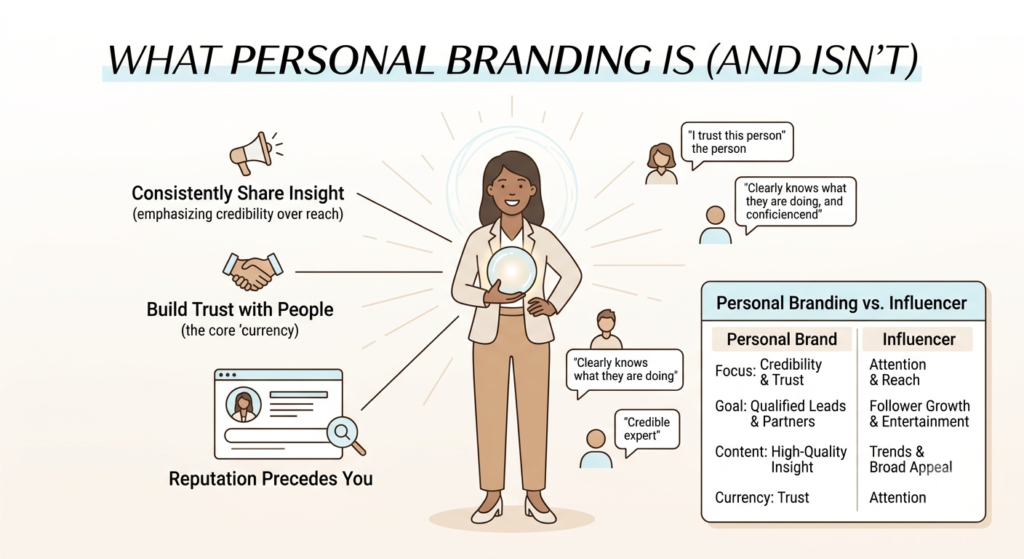
Personal branding is the deliberate, consistent way you present your expertise, values, and perspective to the people who matter to your business. It is the reputation that precedes you into a room, a sales call, or a search result. It is built through what you say publicly, how you say it, and whether your actions match your words over time.
That definition matters because personal branding gets confused with becoming an influencer almost constantly, and the two are not the same pursuit. An influencer’s currency is attention. A personal brand’s currency is trust. An influencer might optimize for reach, entertainment, and follower growth. An entrepreneur building a personal brand is optimizing for something narrower and more durable: being recognized as credible in a specific area, by the specific people who could become customers, partners, employees, or referral sources.
This distinction changes everything about how you should approach the work. If you are chasing followers, you will chase whatever trends generate views, even when they have nothing to do with your business. If you are building credibility, you will publish the kind of insight that makes a stranger think, “this person clearly knows what they are doing,” even if only a few hundred of the right people ever see it. A property manager with three thousand highly engaged local followers who understand rental markets will generate more qualified leads than one with three hundred thousand followers who mostly want entertainment.
Authenticity outperforms polish here, and this is not a soft, feel-good claim. Research into personal branding behavior shows that audiences respond more strongly to genuine, human communication than to over-produced content that feels manufactured. Perfection reads as distance. A founder who shares a real lesson from a difficult client, a mistake that cost money, or a decision they got wrong builds more trust in a single post than a dozen polished announcements ever could. People are not looking for flawless. They are looking for real, competent, and consistent.
Why Personal Branding Matters More Than Ever
Several forces have converged over the past few years to make personal branding less of a nice-to-have and more of a business necessity.
The first is the sheer abundance of information. Artificial intelligence tools can now generate polished marketing copy, professional-looking websites, and convincing product descriptions in seconds. That abundance has an unintended side effect: when anyone can produce content that looks credible, credibility itself becomes scarce and valuable. Buyers can no longer rely on how something looks to judge whether it is trustworthy. They rely on who is behind it.
The second force is that trust itself has become deeply localized. The 2026 Edelman Trust Barometer found that as global trust in national governments and major institutions has declined, trust in the people closest to us has actually increased, including trust in “my CEO” among employees, and trust in neighbors, coworkers, and friends. Edelman’s researchers describe this as an “insular trust mindset,” where people place more faith in individuals they feel close to or familiar with than in distant institutions. For entrepreneurs, this is a significant opportunity: a founder who shows up consistently and personally is far better positioned to earn that localized trust than a faceless corporate account ever will be.
The third force is that customers actively research founders before they buy, especially in higher-consideration purchases. This is not limited to consumer products. In B2B buying, the pattern is even more pronounced. A 2025 Edelman-LinkedIn study of B2B buying behavior found that <cite index=”20-1″>74 percent of B2B decision-makers ranked recognition as a leading expert in the field among the top factors that mattered most when finalizing a vendor decision</cite>. That same research found that <cite index=”20-1″>79 percent of hidden decision-makers, the finance, legal, procurement, and operations stakeholders who rarely interact with sales teams, said they were more likely to champion a vendor during the RFP process if that vendor consistently published high-quality expert content</cite>. People are not just buying a product. They are buying confidence in the person behind it.
The fourth force is that decision-makers buy confidence before they buy products. A founder who can clearly explain why their business exists, what problem it solves, and why they are the right person to solve it removes friction from every stage of the sales process. Confidence, communicated consistently over time, is what personal branding is actually built from.
8 Business Benefits of Investing in Your Personal Brand
Personal branding is not an abstract marketing exercise. It produces measurable business outcomes across trust, revenue, hiring, and resilience, and the benefits of personal branding are easiest to see when broken into specific, concrete gains rather than one vague idea of “visibility.” Here is what a well-built personal brand actually does for your business.
Builds Instant Trust
First impressions now happen online, long before a prospect ever speaks with you directly. Someone searching your name before a meeting, a sales call, or a partnership discussion will form an opinion based on what they find, whether you intended that or not.
Reputation directly influences purchasing decisions in this environment. Industry research shows that a large share of employers and buyers say a person’s visible reputation shapes how much they trust them before any direct interaction takes place. Your business reputation is now built in public, whether you manage it deliberately or not, and if your online presence is thin, inconsistent, or outdated, you are handing that first impression over to chance. If it is deliberate and current, you walk into every interaction with credibility already established.
Generates More Qualified Leads
When people already know your expertise before they reach out, the entire nature of that first conversation changes. They are not asking “can you actually do this,” they are asking “when can we start.” That shift alone dramatically improves lead quality.
This also reduces the amount of convincing required during sales calls. A prospect who has read your content, watched you explain your thinking, or heard you speak on a podcast arrives already partially sold. You spend less time overcoming objections and more time discussing scope, timeline, and fit.
Reduces Customer Acquisition Costs
A strong personal brand generates organic visibility that would otherwise require continuous ad spend to replicate. Every piece of content you publish under your own name keeps working long after you hit publish, appearing in searches, getting shared, and reaching new people without additional cost.
Word-of-mouth marketing compounds this effect. People are far more likely to recommend a business when they can personally vouch for the founder’s expertise and character. That referral costs nothing to generate and converts at a far higher rate than most paid channels.
Creates Premium Pricing Power
Experts charge more, and buyers accept it because expertise reduces perceived risk. When you are recognized as a leading voice in your field, price becomes a secondary consideration behind the confidence that you will deliver the outcome they need.
This is why thought leadership content correlates so strongly with revenue outcomes in enterprise buying. Companies with a strong, consistent publishing habit report meaningfully shorter sales cycles precisely because trust and credibility are established before pricing conversations even begin. Authority raises the ceiling on what people are willing to pay, and it lowers the resistance you face when asking for it.
Opens Partnership Opportunities
A recognizable personal brand becomes a magnet for opportunities that never show up on a cold outreach list. Podcast hosts look for guests who already have a following and a clear point of view. Conference organizers look for speakers who can draw an audience on their name alone. Journalists look for founders who can speak credibly and quotably about their industry.
These opportunities compound. A single strong podcast appearance can lead to a speaking invitation, which can lead to a media feature, which can lead to a partnership inquiry. None of this requires a large marketing budget. It requires a clear, visible point of view that people can find and reference.
Attracts Better Employees
Talented people do not just want a paycheck. They want to work for someone whose vision they believe in and whose leadership they respect. A founder with a visible, authentic presence gives prospective employees a reason to choose your company over a competitor offering similar compensation.
This matters even more in competitive hiring markets, where the best candidates typically have multiple offers to weigh. A founder who has clearly articulated what the company stands for, and who shows up as a real, credible leader rather than an anonymous name on an offer letter, has a real advantage in closing the candidates worth fighting for.
Makes Marketing Easier
Founder stories consistently outperform corporate messaging because people connect with people, not with brand voice guidelines. A post explaining why you started your business, what you learned from a failed pricing model, or how you handled a difficult client will almost always generate more genuine engagement than a polished company announcement.
This human connection drives real marketing efficiency. Instead of constantly producing new campaigns to capture attention, a founder with an established voice can share ongoing insights, lessons, and updates that naturally keep the audience engaged. Marketing stops feeling like a separate function and starts feeling like an extension of how you already communicate.
Protects Your Business During Difficult Times
Every business eventually faces a difficult stretch: a service issue, a public complaint, a market downturn, a product delay. Businesses with strong founder brands weather these moments differently than businesses without one, because a loyal, trusting audience gives you the benefit of the doubt that an anonymous company rarely receives.
Trust research consistently shows that people extend more patience to individuals and institutions they already trust, and are far quicker to walk away from ones they do not know personally. An audience that has followed your reasoning and character over time is far more likely to stay through a rough quarter than one that only knew you through a logo.
Personal Brand vs Business Brand
A business needs both a personal brand and a business brand, and treating them as competing priorities is a mistake. They serve different functions and reinforce each other when built correctly.
Your business brand is the system: your company name, visual identity, operational processes, product quality, and customer experience. It is what allows the business to scale beyond you, to be sold, franchised, or handed off to a team without collapsing. Your personal brand is the trust accelerant: the reason people give the business brand a chance in the first place, especially in its early years.
The two complement each other in practice. In the beginning, most businesses lean heavily on the founder’s personal credibility because the business brand has not yet earned trust on its own. Over time, as the business brand builds its own track record, reviews, and reputation, it can carry more of that weight independently, freeing the founder to use their personal brand for higher-level opportunities like partnerships, media, and industry positioning rather than day-to-day customer acquisition.
Founder-led companies illustrate this relationship clearly at scale. Academic research analyzing S&P 500 companies found that founder-led businesses generate 31 percent more patents than the average company in the index, and that those innovations tend to be more valuable. A separate long-term study found that S&P 500 companies where founders remained deeply involved outperformed the rest of the index by roughly 3.1 times over a 25-year period. The pattern is consistent: when a founder’s personal credibility, vision, and reputation stay attached to the business, the business tends to make bolder, more resilient decisions than one run purely by rotating professional management.
Common Myths About Personal Branding
A few persistent myths about entrepreneur branding keep capable entrepreneurs from ever starting, and each one falls apart under basic scrutiny.
Myth 1: “I need thousands of followers.” Follower count is a vanity metric, not a business one. A niche audience of a few hundred qualified prospects who trust your judgment will generate more revenue than a broad audience of strangers who scroll past your posts. Depth beats size every time in a business context.
Myth 2: “I have nothing valuable to share.” Every entrepreneur running a real business has knowledge that someone else is actively searching for: how you price a service, how you handle a difficult client, how you structured your first year of operations. What feels obvious to you because you live it daily is genuinely useful to someone earlier in the journey.
Myth 3: “It’s only for influencers.” Personal branding predates social media by decades. Consultants, doctors, lawyers, and business owners have always built reputations through referrals, speaking engagements, and word of mouth. Social platforms simply made that process faster and more visible; they did not invent the underlying need to be known and trusted.
Myth 4: “It’s all about posting selfies.” Personal branding is about demonstrating expertise and character consistently. That can happen through written insights, case studies, behind-the-scenes operational content, or public speaking. Photos of your face are optional. Clear, useful thinking is not.
Myth 5: “It takes years before seeing results.” Consistency accelerates results faster than most entrepreneurs expect. Executives who commit to regular publishing often see their first meaningful outside recognition, such as a media mention or speaking inquiry, within the first few months, not years. The delay most people experience is not a timeline problem, it is a consistency problem.
Practical Ways to Build Your Personal Brand
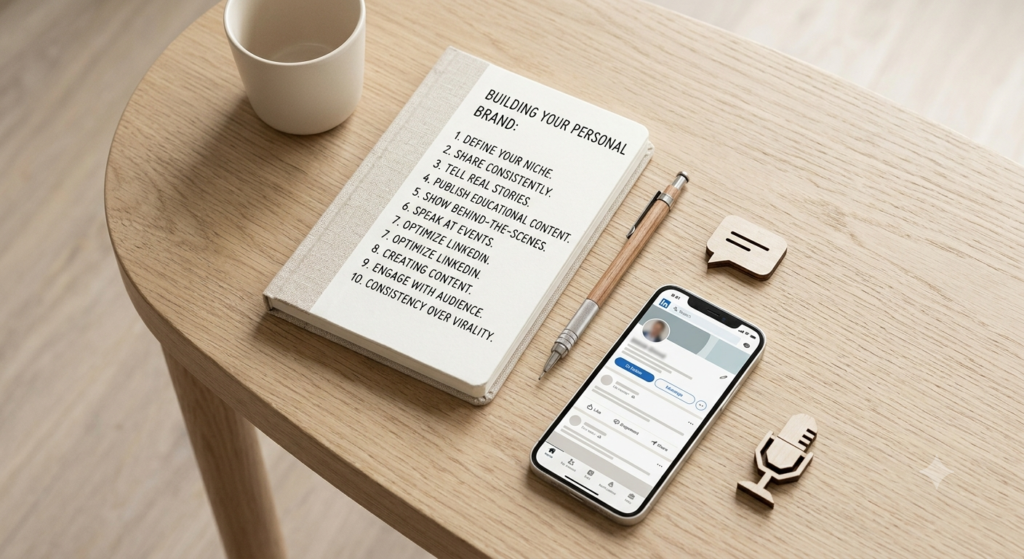
Building a personal brand is a system, not a single campaign, and a workable personal brand strategy comes down to a short list of habits repeated consistently rather than a complicated plan. The personal branding tips below are the practical building blocks that compound over time.
Define your niche. Get specific about what you want to be known for. “Business advice” is too broad to be memorable. “Helping short-term rental owners build reliable operating systems” is specific enough that the right people immediately know whether you are relevant to them.
Share your expertise consistently. Pick a rhythm you can sustain, whether that is weekly or a few times a month, and stick to it. Consistency builds recognition far more reliably than sporadic bursts of high-quality content followed by long silences.
Tell real stories. Specific, honest stories about decisions, mistakes, and outcomes are more memorable and more trusted than generic advice. A story about a lease negotiation that almost fell apart teaches more, and builds more credibility, than a list of five generic negotiation tips.
Publish educational content. Teaching what you know, freely, is one of the fastest ways to demonstrate real expertise. It also naturally attracts the kind of audience most likely to eventually become customers, because they are already engaging with your actual area of work.
Show behind-the-scenes moments. Letting people see how decisions actually get made, not just the polished outcome, builds a sense of familiarity that pure promotional content never achieves. This is part of what makes founder content outperform corporate messaging so consistently.
Speak at events. Speaking engagements put you in front of an audience that has already self-selected as interested in your topic, and they lend third-party credibility that self-published content cannot fully replicate on its own.
Build a professional LinkedIn presence. For most entrepreneurs, especially those working with other businesses, LinkedIn carries a disproportionate share of the professional audience. It remains the platform where executive content earns the highest engagement relative to corporate brand pages, making it a natural home base for building online authority through founder-led content.
Create content across multiple platforms. Not every audience lives in the same place. Repurposing your core insights across LinkedIn, a blog, a newsletter, or short video extends your reach without multiplying your workload, since the underlying thinking stays the same.
Engage with your audience. Responding to comments, answering questions, and participating in relevant conversations turns a one-way broadcast into a relationship. This is often the single most under-used lever entrepreneurs have available, and it costs nothing but attention.
Stay consistent instead of chasing viral posts. A single viral post rarely changes a business. A steady, recognizable presence over months and years does. Chasing virality often pulls entrepreneurs away from their actual area of expertise in search of broader appeal, which quietly erodes the credibility they were trying to build in the first place.
Personal Branding Mistakes Entrepreneurs Should Avoid
Just as important as knowing what to do is knowing what quietly undermines the effort.
Trying to appeal to everyone. A message built to appeal to everyone usually resonates with no one. The entrepreneurs who build the strongest personal brands are specific about who they serve and comfortable that not everyone is the right audience.
Copying other creators. Borrowing a format or structure is fine. Copying someone else’s voice, opinions, or story is not, and audiences notice the difference quickly. Authenticity, not imitation, is what earns trust.
Being inconsistent. Publishing intensely for two weeks and then disappearing for two months resets the trust-building process every time. Slow and steady genuinely outperforms sporadic and intense here.
Selling too often. An audience that feels sold to constantly disengages fast. The most effective founders spend the majority of their content teaching, sharing, and connecting, with promotional content as the minority, not the majority.
Ignoring audience engagement. A personal brand built entirely as a broadcast, with no responses to comments or messages, leaves value on the table. Some of the best leads show up in the comments section, not the inbox.
Focusing only on follower count. As covered in the myths above, chasing followers over relevance leads entrepreneurs to create content that grows numbers but not revenue.
Building an image that doesn’t reflect reality. A personal brand that overstates results, expertise, or lifestyle eventually meets reality, whether through a bad client experience or a skeptical prospect who does their own research. Trust, once broken this way, is far harder to rebuild than it was to earn.
Real Examples of Strong Personal Brands
Looking at well-known entrepreneurs makes the underlying principles concrete.
Elon Musk built Tesla and SpaceX while simultaneously building one of the most recognized personal brands among public founders. Regardless of personal opinions about him, his consistent, highly visible communication about his companies’ vision has repeatedly shown how directly a founder’s public presence can influence a company’s public perception and market attention.
Gary Vaynerchuk transformed a family wine business into a media and marketing company largely by publishing relentless, practical content across every major platform for over a decade. His brand is built almost entirely on consistency and volume, proving that showing up regularly, even with imperfect polish, can build enormous long-term authority.
Sara Blakely built Spanx from a five-thousand-dollar personal investment into a company Blackstone valued at 1.2 billion dollars when it acquired a majority stake in 2021. Her personal storytelling, including openly sharing her early rejections and unconventional path, became inseparable from the brand itself and remains central to how the company is perceived even after she stepped back from day-to-day operations as Executive Chairwoman.
Simon Sinek built his authority almost entirely through one clear, well-articulated idea about leadership and purpose, repeated and expanded consistently across books, talks, and media appearances for years. His example shows that a personal brand does not need to cover many topics. One well-developed idea, communicated with total consistency, can carry an entire career.
Across all four examples, the same threads repeat: consistency over time, demonstrated expertise, storytelling that feels personal rather than corporate, authenticity even when it means sharing failure, and active community building rather than one-way broadcasting.
Measuring the ROI of Your Personal Brand
Personal branding can feel intangible, but its impact is measurable when you track the right indicators over time.
Website traffic originating from your personal content or profile links shows whether your visibility is translating into interest in your business.
Organic inquiries that reference something you published or said publicly are one of the clearest signs that your content is doing real work, since these leads arrive already warmed up.
Speaking invitations are a strong external validation metric. If event organizers are seeking you out, your reputation has extended beyond your existing audience.
Podcast appearances function similarly, expanding your reach into audiences you did not have to build yourself.
LinkedIn profile views and connection requests from relevant industries indicate growing recognition among the professional audience most likely to matter for B2B growth.
Newsletter subscribers represent an owned audience you are not renting from a platform algorithm, and steady growth here reflects real, compounding trust.
Social engagement, when evaluated for quality of comments and shares rather than raw counts, shows whether your content is actually resonating with the right people.
Referral business that traces back to your public reputation, rather than paid acquisition, is often the most valuable metric of all, since it reflects trust extended by someone else on your behalf.
Sales influenced by personal content, tracked by asking new clients how they found you or what convinced them to reach out, closes the loop between visibility and revenue.
None of these metrics require expensive tools to track. A simple habit of asking new leads and clients “how did you hear about us” and noting patterns over a few quarters will reveal, with real clarity, whether your personal brand is doing its job.
Conclusion: Why Personal Branding Is One of the Best Business Investments You Can Make
Products evolve, and competitors will eventually match your features. Marketing trends change, and the channel that works brilliantly today may be irrelevant in two years. Algorithms shift constantly, rewriting the rules for visibility with little warning.
Your reputation, expertise, and credibility compound over time in a way none of those things can. A competitor can copy your pricing, your product, and even your marketing playbook, but they cannot copy years of consistent, honest communication that has already earned someone’s trust. That is what makes personal branding one of the best business investments an entrepreneur can make: it is the rare asset that appreciates the longer you hold it, rather than depreciating the moment a competitor catches up.
Building a personal brand is less about becoming famous and more about becoming trusted. It does not require chasing virality, mastering every platform, or manufacturing a persona that does not reflect who you actually are. It requires showing up consistently, sharing what you genuinely know, and letting your reputation build the way trust always has, one honest interaction at a time. The investment continues paying dividends long after any individual campaign ends, which is exactly why it deserves a permanent place in how you run your business, not a temporary marketing push you eventually abandon.
If building the operational backbone of your business is next on your list, our guide on creating repeatable business systems walks through how to build the structure that lets your growing reputation actually convert into consistent results. And if you are weighing how personal visibility should factor into your broader growth plan, our piece on long-term thinking for entrepreneurs breaks down how to balance short-term wins with decisions that compound for years.
Key Takeaways
- Personal branding is the deliberate, consistent demonstration of your expertise and character to the people who matter to your business, not a pursuit of follower count.
- Trust has become increasingly local and personal, making a founder’s visible reputation more influential in buying decisions than ever before.
- A strong personal brand builds trust, generates qualified leads, lowers acquisition costs, supports premium pricing, opens partnerships, attracts talent, simplifies marketing, and protects the business during difficult periods.
- Personal brands and business brands work together, not in competition, with founder credibility often carrying young businesses until the company brand can stand on its own.
- Consistency, authenticity, and specificity outperform volume, perfection, and broad appeal at every stage of building a personal brand.
- ROI can and should be tracked through concrete indicators like organic inquiries, referral business, speaking invitations, and sales that trace back to your public reputation.
Frequently Asked Questions
How long does it take to see results from personal branding?
Most entrepreneurs who publish consistently start seeing early signals, such as inbound messages or engagement from relevant people, within the first few months. Larger outcomes like speaking invitations or major partnerships typically build over a year or more of sustained, consistent effort.
Do I need to be active on every social platform to build a personal brand?
No. Choosing one or two platforms where your target audience actually spends time, and showing up there consistently, will outperform a thin, inconsistent presence spread across five platforms.
Is personal branding only useful for consumer-facing businesses?
No, it is arguably more influential in B2B contexts. Research shows a large majority of B2B decision-makers weigh a leader’s recognized expertise heavily when finalizing vendor decisions, and consistent expert content directly influences RFP outcomes.
What if I am not comfortable being highly visible online?
Personal branding does not require constant self-promotion or being on camera. Written content, case studies, and thoughtful commentary can build significant authority without requiring a highly performative public presence.
Can personal branding hurt my business if something goes wrong?
A well-built personal brand actually provides more protection during difficult moments, not less, because an audience that already trusts you is more likely to extend patience than one that only knows your company through a logo. The risk lies in inconsistency between what you say publicly and how you actually operate, not in visibility itself.
How is personal branding different from just being a good networker?
Networking builds relationships one conversation at a time. Personal branding builds recognition and trust at scale, reaching people you have never personally met but who already feel they know how you think and operate because of what you have consistently shared.