

Every entrepreneur I have ever met has doubted themselves at some point. Not occasionally. Regularly. Sometimes daily.
If you are reading this because you feel unsure of yourself right now, I want to say something clearly before we go any further: that feeling does not mean you are unqualified to run a business. It means you are paying attention to how much is actually at stake.
There is a persistent myth in business culture that confident founders simply do not feel fear. That they walk into meetings, pitch investors, or launch products without a flicker of doubt. This is not true, and believing it only makes things worse. It sets up an impossible standard, and when you inevitably fall short of it, you interpret normal human uncertainty as proof that something is wrong with you.
Confidence is not the absence of fear. It is the ability to act well despite it.
Research backs this up. Depending on which study you look at, somewhere between 72% and 84% of entrepreneurs report experiencing imposter syndrome at some point in their careers.<sup>1</sup> That is not a small, unlucky minority. That is most of the people building companies right now, including many whose businesses you would assume are thriving without a single doubt behind the scenes.
Successful founders are not the ones who never feel uncertain. They are the ones who have learned to move forward anyway, and who have built systems, habits, and mental frameworks that let them act with clarity even when their internal voice is shaky.
This guide is built around that idea. In the sections ahead, you will find:
- Why confidence matters more than having a flawless business idea
- The specific patterns that quietly erode entrepreneurial confidence
- Twelve practical, research-informed ways to build real self-belief
- Daily habits that reinforce confidence over time
- Common mistakes that keep founders stuck in self-doubt
- What psychological research actually says about how confidence is built
- The difference between confidence and overconfidence, and why that line matters
None of this is about hype or forced positivity. It is about giving you a working blueprint you can actually use, starting with the next decision you have to make today.
Why Confidence Matters More Than Having the Perfect Business Idea
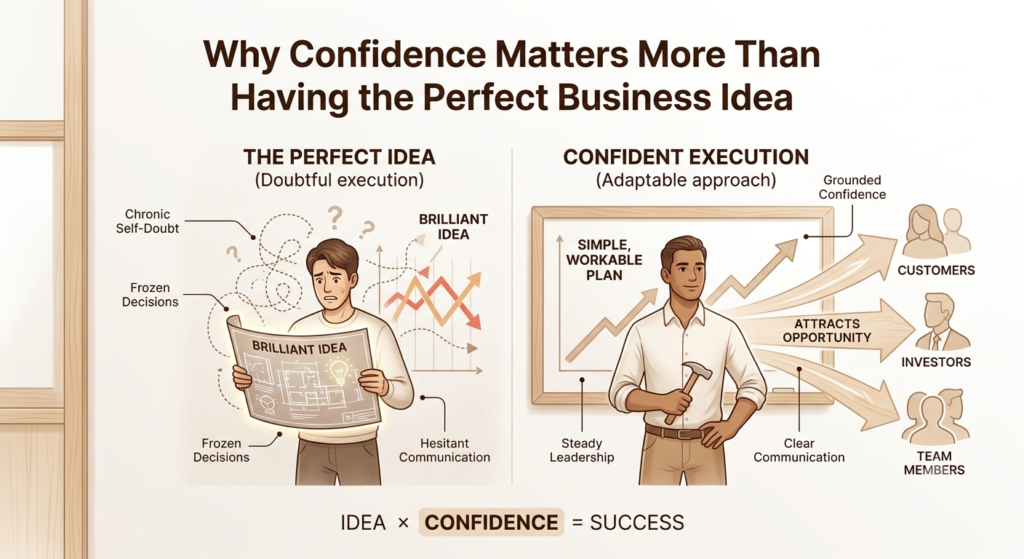
Founders spend an enormous amount of energy chasing the “right” idea, the “right” market, the “right” moment to start. Very little of that energy goes toward the thing that actually determines whether an idea survives contact with reality: the confidence of the person executing it.
Here is why that matters more than people assume.
Confidence shapes the quality of your decisions. Running a business means making dozens of judgment calls a week with incomplete information – who to hire, what to charge, when to pivot, when to hold steady. A founder operating from a place of chronic self-doubt tends to either freeze on these decisions or overcorrect, changing direction too often because every choice feels shaky. A founder with grounded confidence can make a decision, commit to it, and adjust based on real feedback instead of anxiety.
Confidence changes how you communicate. Customers, investors, and employees are reading you constantly, often without realizing it. Hesitant language, over-qualified statements, and visible nervousness communicate uncertainty about the business itself, even when the underlying product or service is solid. This is not about performing confidence you do not feel. It is about the fact that clear, steady communication tends to follow from genuine self-belief, and people respond to it.
Confidence steadies your leadership during uncertainty. Every business goes through rough stretches – a bad quarter, a failed launch, a key employee leaving. Teams take their emotional cues from leadership. A founder who can stay level-headed during a setback gives their team permission to stay focused instead of panicking. This is one of the most underrated forms of leadership confidence, and it is built, not inherited.
Confidence attracts opportunity. People are more willing to invest in, partner with, refer business to, and follow founders who seem to genuinely believe in what they are building. This does not mean faking certainty you do not have. It means the quiet, grounded self-trust that comes from doing the work tends to be visible, and it tends to open doors.
None of this means the idea does not matter. It obviously does. But a mediocre idea executed by a confident, adaptable founder will usually outperform a brilliant idea executed by someone too paralyzed by doubt to act on the feedback they are getting. Confidence is the multiplier sitting underneath everything else.
The Biggest Confidence Killers for Entrepreneurs
Before building confidence, it helps to understand what is actively working against it. Most founders are not lacking willpower. They are fighting a handful of specific, well-documented psychological patterns.
Fear of Failure
This is the most obvious one, and also the most misunderstood. Fear of failure rarely shows up as a dramatic thought like “I might lose everything.” More often, it shows up quietly – as procrastination on launching, as endless “just one more round of research” before committing, as avoiding the phone call you know you need to make.
The data on business survival is sobering enough to make this fear feel rational. According to Bureau of Labor Statistics figures, roughly 20% of small businesses close within their first year, and about 49% do not make it past year five.<sup>2</sup> Fear of joining that statistic is not irrational. But it becomes a problem when it stops you from doing the very things that improve your odds of not joining it.
Comparing Yourself to Successful Founders
Social media has made this worse, not better. You see the funding announcement, the “we just hit seven figures” post, the polished behind-the-scenes reel – and almost never the eighteen months of quiet struggle that came before it. Comparison culture creates a distorted picture where everyone else appears to be further ahead, more certain, and less afraid than you are, even when that is almost never true.
Imposter Syndrome
This deserves its own explanation because it is so widespread among entrepreneurs specifically. Imposter syndrome is the persistent feeling that your success is due to luck rather than skill, and that at some point you will be “found out” as underqualified. Research on the topic shows it disproportionately affects founders because of a specific combination of pressures: wearing too many roles at once, working in relative isolation without peers who normalize the struggle, and facing high expectations from investors, clients, or employees who assume the founder has all the answers.<sup>3</sup>
It is worth naming plainly: this feeling is common enough that experiencing it says almost nothing about your actual competence. It says something about the structure of entrepreneurship itself.
Perfectionism
Perfectionism often gets mistaken for high standards, but it functions very differently. High standards push you to improve; perfectionism keeps you from shipping anything until it meets a standard that keeps moving further away the closer you get to it. For entrepreneurs, this shows up as products that never quite launch, pitches that get rewritten endlessly, and websites that stay “almost ready” for months.
Fear of Rejection
Sales calls, investor pitches, partnership requests, and even hiring conversations all carry the risk of a “no.” Founders who have not built a healthy relationship with rejection tend to avoid the exact activities – outreach, networking, asking for the sale – that their business depends on most.
12 Practical Ways to Build Entrepreneurial Confidence
This is the core of the guide. These are not abstract mindset tips. Each one is something you can put into practice starting this week, and together they form a working approach to how to build confidence as an entrepreneur that holds up under real pressure, not just in theory.
1. Start Before You Feel Ready
Most founders wait for confidence to arrive before they act. It works the other way around. Confidence is generated by action, not the reverse.
This is not a motivational slogan – it maps directly onto how psychological research explains self-belief. Psychologist Albert Bandura’s work on self-efficacy identified “mastery experiences” – the direct experience of successfully doing something – as the single most powerful source of confidence, more influential than encouragement from others or watching someone else succeed.<sup>4</sup> You cannot think your way into confidence. You have to act your way into it, and the feeling follows the evidence, not the other way around.
Practically, this means: send the email before the pitch deck is perfect. Launch the version of the product that is good enough, not the one that is flawless. The evidence you need to feel more sure of yourself only exists on the other side of the action you are avoiding.
2. Collect Small Wins Every Day
Confidence compounds the same way savings does – through small, consistent deposits rather than one dramatic windfall. Waiting for a single massive success to finally “feel like a real entrepreneur” sets you up for a long wait and a lot of unnecessary doubt in the meantime.
Instead, build a habit of noticing and completing small, achievable goals daily: one outreach message sent, one process documented, one difficult conversation handled well. Each of these is a small mastery experience, and according to Bandura’s framework, they need to be attributed to your own effort – not luck – to actually build efficacy.<sup>5</sup> That means giving yourself credit for the win instead of brushing it off.
3. Replace Perfection With Progress
Perfectionism feels like it protects your reputation, but in practice it mostly protects you from feedback – and feedback is what your business actually needs to improve. Every week a product sits unlaunched because it is not “ready” is a week without real data about what customers actually want.
A useful reframe: think of your first version as a rough draft you are allowed to improve later, not a final exam you have one shot at passing. Done, shipped, and imperfect will teach you more than polished and unreleased ever will.
4. Learn to Separate Failure From Identity
One of the most damaging habits among founders is turning a failed launch, a lost client, or a bad quarter into a verdict on their own worth. “The campaign didn’t work” quietly becomes “I’m not cut out for this.”
These are not the same statement, and treating them as if they are is one of the fastest ways to erode confidence for good. A failed project is data. It tells you something about the market, the timing, or the execution – not about your fundamental capability. Founders who recover fastest from setbacks are the ones who can look at a failure and ask “what does this teach me” instead of “what does this say about me.”
5. Build Expertise Through Consistent Learning
A meaningful portion of entrepreneurial self-doubt is not really about confidence at all – it is about a genuine skills or knowledge gap. If you feel shaky pitching investors because you have never done it, or uncertain about your numbers because you have not learned basic financial statements, the fix is not a mindset shift. It is learning the thing.
Confidence that is built on real competence is far more durable than confidence built on hoping nobody asks a hard question. Set aside consistent time – even twenty minutes a day – for learning the specific skills your business currently demands of you.
6. Surround Yourself With Growth-Oriented People
Bandura’s research also identified “vicarious experience” as a major driver of self-efficacy – watching someone succeed at something builds your own belief that you can do it too, but only when you see that person as similar to yourself in some meaningful way.<sup>6</sup> This is a big part of why mentorship and founder communities work so well. Watching a peer at a similar stage figure something out is far more useful to your confidence than watching a billionaire founder from a stage, because you can actually see yourself in their position.
Be deliberate about who you spend time with. Mentors, accountability partners, and other founders navigating similar problems will do more for your confidence than motivational content ever will.
7. Practice Difficult Conversations
Sales calls, negotiations, networking events, and public speaking all share a common trait: they get easier almost entirely through repetition, not through waiting to feel ready for them.
Founders who avoid these conversations because they feel awkward or uncertain often stay uncertain indefinitely, because avoidance prevents the very repetition that would build comfort. Treat these as a skill to practice deliberately – role-play a hard client conversation with a colleague, rehearse your pitch out loud before the meeting, take the smaller networking event before the big one. The discomfort fades with volume, not with waiting.
8. Keep a Success Journal
This sounds simple, and it is, but it directly counters one of the most common cognitive patterns among high-achieving, self-doubting people: forgetting your wins the moment you have moved on to the next challenge.
Keep a running log – even five minutes at the end of each week – of specific things you handled well: a hard conversation you navigated, a decision that paid off, a skill you clearly improved at. When self-doubt creeps in later, this becomes concrete, personal evidence to counter it, rather than trying to argue yourself out of a feeling with abstract reassurance.
9. Improve Your Physical and Mental Health
Confidence is not purely psychological. It is also physiological. Sleep deprivation, chronic stress, and poor physical health measurably impair decision-making, emotional regulation, and the ability to think clearly under pressure – all of which directly affect how capable you feel in the moment.
Bandura’s model of self-efficacy explicitly includes emotional and physiological state as one of its four core sources of confidence.<sup>7</sup> Feeling anxious or exhausted lowers your sense of what you are capable of, independent of your actual skill level. Protecting your sleep, movement, and stress levels is not a luxury separate from building your business. It is part of the infrastructure that makes clear decision-making possible.
10. Focus on Your Customers, Not Your Competitors
Constantly monitoring competitors keeps you anchored to someone else’s scoreboard, and it is a reliable way to feel behind no matter how well you are actually doing. Comparison, more than almost anything else, is what quietly drains entrepreneurial confidence over time.
Redirect that attention toward the people you can actually serve well. Talking to customers, understanding their real problems, and improving your offer based on their feedback builds both a better business and a more grounded sense of your own value – because it replaces abstract comparison with concrete usefulness.
11. Celebrate Progress Without Becoming Complacent
There is a real difference between acknowledging progress and losing your edge. Founders sometimes avoid celebrating wins at all, worried it will make them soft or overconfident. This usually backfires, because it teaches you to associate achievement with nothing – no recognition, no reinforcement – which makes it harder to sustain motivation over the long run.
The better approach is deliberate: mark the win, take a moment to actually register it, and then return to the work with clear eyes about what still needs improvement. Confidence and humility are not opposites. The founders who last are usually running both at once.
12. Develop a Long-Term Entrepreneurial Mindset
Confidence built overnight tends to evaporate just as quickly under the first real setback. Confidence built through consistent action over months and years is far more resilient, because it is backed by an actual track record rather than a temporary mood.
This is where an entrepreneur mindset really pays off – the ability to view your business as a multi-year project rather than a series of make-or-break moments. Every skill learned, every difficult conversation survived, and every small win logged is compounding, even when it does not feel like much in the moment.
Think about the founders you consider genuinely confident. In almost every case, that confidence was not present on day one. It was built across dozens of product decisions, hundreds of customer conversations, and more than a few painful mistakes along the way. What looks like natural self-assurance from the outside is usually an accumulated track record that the founder has simply learned to trust. You are building that same track record right now, even in the parts of the journey that feel uncertain or slow.
The long-term view matters because it changes how you interpret a hard week. A single bad month does not erase a year of consistent effort, but it can feel that way if you are only measuring your confidence against the last few days instead of the larger pattern. Founders who adopt this longer time horizon tend to make steadier decisions, because they are not treating every setback as an emergency that threatens the entire venture.
Daily Habits That Build Confidence
The twelve strategies above work best when supported by a consistent daily rhythm. These are small, repeatable habits worth building into your routine:
- Morning planning routine – Start the day by identifying two or three priorities instead of reacting to whatever lands in your inbox first. This alone reduces the low-grade anxiety of feeling behind before the day has even started.
- Reading for 20 minutes – Whether it is industry news, a business book, or a case study relevant to your work, consistent reading closes knowledge gaps that quietly fuel self-doubt.
- Daily outreach or networking – One message, one call, one introduction request. Small, repeated exposure to the exact activities that feel uncomfortable is how they stop feeling uncomfortable.
- Weekly reflection – Set aside time to review what worked, what did not, and what you learned. This turns the week’s experience into usable data instead of a blur of stress.
- Learning one new business skill – Whether it is a spreadsheet function, a piece of marketing knowledge, or a legal basic, closing skill gaps deliberately builds competence-based confidence.
- Tracking personal growth – Revisit your success journal regularly, not just when you are doubting yourself, so the pattern of progress becomes visible over time rather than something you have to dig for in a hard moment.
None of these habits are dramatic on their own. Their value comes from repetition.
Common Confidence Mistakes Entrepreneurs Make
Even founders actively working on their confidence often fall into a few recurring traps:
Waiting for motivation. Motivation is unreliable and mood-dependent. Founders who wait for it before taking action end up with inconsistent output. Discipline and routine outperform motivation over any meaningful timeframe.
Seeking constant validation. Checking in repeatedly with others before making routine decisions can quietly signal, to yourself and your team, that you do not trust your own judgment. Some input is healthy. Needing it for every decision erodes your own decision-making muscle.
Avoiding difficult decisions. Delaying a hard call – a hire, a firing, a pricing change – because you are not fully certain rarely makes the decision easier later. It usually just delays the discomfort while the underlying problem continues.
Trying to know everything. No founder has full mastery of finance, marketing, operations, product, and legal simultaneously. Trying to appear that way is exhausting and unnecessary. Building the right team and knowing what to delegate is a form of confidence in itself.
Comparing chapter one to someone else’s chapter twenty. The founder you are comparing yourself to online is very likely years into their journey, showing you a highlight reel rather than the version of themselves that looked a lot like you do right now.
Mistaking overconfidence for competence. Some founders overcorrect from self-doubt straight into ignoring real warning signs. Confidence without honest self-assessment is just as dangerous as excessive doubt – more on this distinction below.
What Science Says About Building Confidence
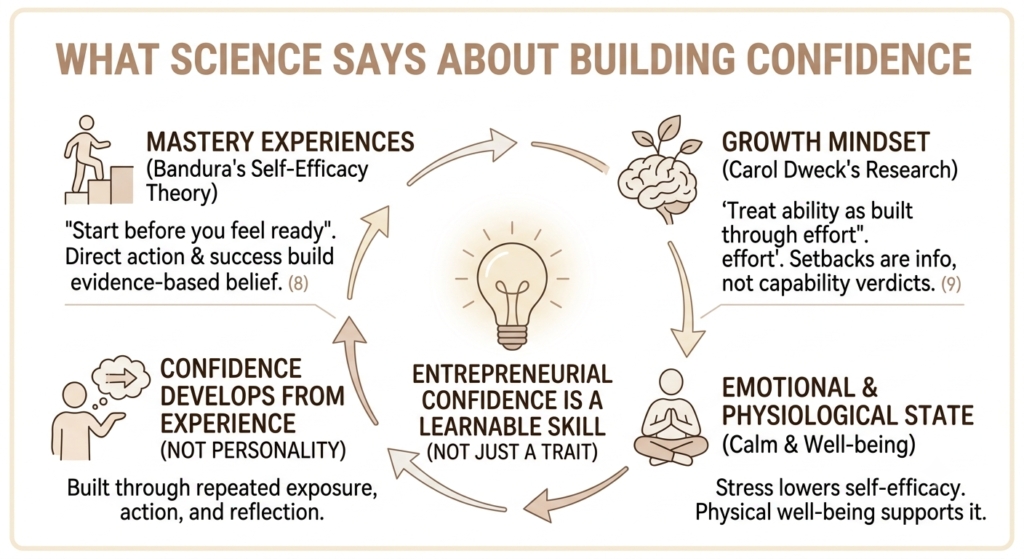
It is worth grounding this guide in the actual research, because entrepreneurial confidence is not just a personality trait some people are lucky enough to have. It is a skill with a documented mechanism behind it.
Self-efficacy through mastery experiences. Psychologist Albert Bandura’s self-efficacy theory, one of the most cited frameworks in psychology, identifies four sources of confidence: mastery experiences, vicarious experience, verbal persuasion, and emotional or physiological state.<sup>8</sup> Of these, direct mastery experience – actually doing the thing successfully – is consistently found to be the most powerful. This is the scientific backbone behind “start before you feel ready”: belief follows evidence, and evidence comes from action.
Growth mindset. Stanford psychologist Carol Dweck’s research distinguishes between a fixed mindset, which treats ability as a static trait, and a growth mindset, which treats ability as something built through effort and learning.<sup>9</sup> Founders with a growth-oriented entrepreneur mindset tend to interpret setbacks as information rather than as verdicts on their capability, which directly supports faster recovery and continued effort after failure.
Emotional and physiological state. As noted earlier, stress and exhaustion measurably lower perceived self-efficacy, while calm and physical wellbeing support it. This is a documented part of Bandura’s model, not just wellness advice loosely attached to a business topic.
Confidence developing from experience rather than personality. Across this body of research, a consistent theme emerges: confidence is not a fixed trait some entrepreneurs are simply born with. It is built through repeated exposure, action, and reflection – which means it is genuinely learnable, at any stage of your business.
This matters for a practical reason. If confidence were purely a matter of personality, founders who did not start out naturally self-assured would have a permanent disadvantage. The research says otherwise. It says the founder who is currently the most anxious about a first sales call can, through repeated practice and honest reflection on what worked, end up more confident in that specific skill than someone who started out relaxed but never deliberately worked at it. Confidence is closer to a trained skill than a fixed trait, and that reframing alone tends to relieve some of the pressure founders put on themselves to already feel a certain way before they have done the work to earn it.
Confidence vs Overconfidence
It is worth being direct about this distinction, because pushing hard on “build your confidence” without addressing its opposite failure mode can do real damage.
Confidence is grounded in an honest, current assessment of your skills, your business’s numbers, and the market you are operating in. A confident founder can say “I don’t know” and go find the answer. They adjust when the evidence tells them to. Their self-belief coexists with genuine humility about what they still need to learn.
Overconfidence ignores or dismisses evidence that contradicts a founder’s existing beliefs. It shows up as refusing to adjust a failing strategy, dismissing customer feedback, or making major financial commitments without validating the assumptions behind them. Overconfidence often looks identical to confidence from the outside – until the numbers eventually force the correction that should have happened much earlier.
The practical way to tell them apart: confidence makes decisions and stays open to being wrong about the details. Overconfidence makes decisions and treats being wrong as unthinkable.
Staying humble while making bold decisions is less about hedging every choice and more about building in regular checkpoints – reviewing your numbers honestly, asking for feedback from people who will actually disagree with you, and treating your own assumptions as things to test rather than facts to defend.
Final Thoughts
Every founder whose business you admire started exactly where you are now – uncertain, occasionally scared, and without proof that any of it would work. The difference was never the absence of doubt. It was the decision to act anyway, and to keep acting until the evidence caught up with the belief.
Confidence isn’t something you discover fully formed one day. It’s something you earn, in small increments, through the specific actions covered in this guide – starting before you’re ready, collecting small wins, learning the skills you’re missing, and surrounding yourself with people who reflect back what’s actually possible for you.
If there is one thing to take from this guide, let it be this: you do not need to feel completely ready to take the next step in your business. You need to take the step, and let the confidence follow.
What is one bold step you have been putting off until you “feel ready”? Consider taking it this week, before that feeling ever arrives.
Key Takeaways
- Confidence is not the absence of fear – it is the ability to act well despite it, and it is a skill that can be deliberately built.
- Imposter syndrome affects the large majority of entrepreneurs at some point; experiencing it is not evidence of your incompetence.
- Mastery experiences – direct evidence from taking action – are the strongest documented driver of self-belief, more powerful than encouragement or observation alone.
- Small, consistent wins compound into durable confidence far more reliably than waiting for one big breakthrough.
- A growth-oriented entrepreneur mindset helps you treat setbacks as information rather than as a verdict on your ability.
- Genuine confidence stays open to being wrong about the details; overconfidence treats being wrong as unthinkable.
Frequently Asked Questions
1. How do I build confidence as an entrepreneur if I keep failing?
Failure is data, not identity. Each setback carries specific, usable information about what to adjust. Founders who separate the outcome of a failed attempt from their personal worth recover faster and keep the confidence they have already built intact.
2. Is imposter syndrome common among successful entrepreneurs?
Yes. Multiple studies place the prevalence of imposter syndrome among entrepreneurs between roughly 72% and 84%, and it affects founders across experience levels, including highly successful ones. It is a near-universal part of the entrepreneurial experience rather than a signal of unusual weakness.
3. Can confidence really be learned, or is it just personality?
Psychological research, particularly Albert Bandura’s work on self-efficacy, supports confidence as a learnable skill built primarily through direct mastery experiences. It is not fixed at birth – it develops through repeated action, reflection, and exposure over time.
4. What is the fastest way to build confidence as a new founder?
There is no true shortcut, but the closest thing to one is taking small, achievable actions daily and consciously tracking them. Momentum from consistent small wins builds confidence faster than waiting for a single large success.
5. How do I stay confident without becoming overconfident?
Keep decision-making paired with honest feedback loops – real customer input, accurate financial numbers, and people around you willing to disagree. Confidence adjusts to new evidence; overconfidence dismisses it.
6. Does physical health actually affect entrepreneurial confidence?
Yes. Sleep, stress levels, and physical wellbeing directly influence decision-making quality and emotional regulation, both of which shape how capable you feel in high-pressure moments. This is a documented part of self-efficacy theory, not just general wellness advice.