

Running a business has never been easier-and harder-at the same time.
Today, entrepreneurs have access to AI, automation, and countless tools that promise to save time. Yet most business owners still end every day feeling overwhelmed. The problem isn’t a lack of effort. It’s a lack of structure.
Research consistently shows that small business owners work long hours every week, but more hours don’t automatically lead to more revenue. Instead, the businesses that grow consistently are usually led by owners who build repeatable processes instead of relying on hustle alone.
The productivity habits of successful business owners aren’t about squeezing more work into the day. They’re about making sure every hour actually moves the business forward.
Let’s look at the habits that separate busy entrepreneurs from truly productive ones.
Why Productivity Matters More Than Working Longer Hours
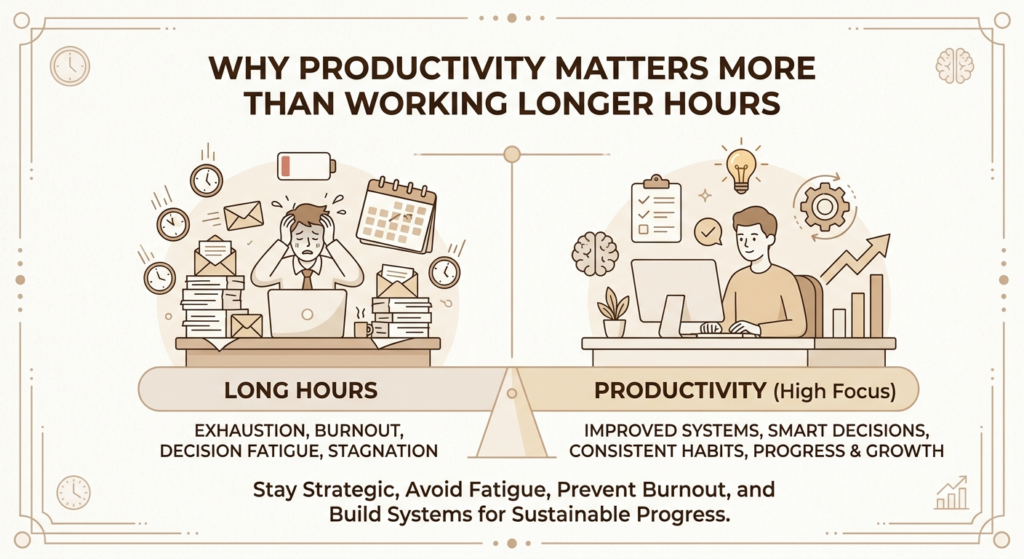
Many entrepreneurs wear long working hours like a badge of honor. But staying busy isn’t the same as making progress.
One of the biggest challenges business owners face is decision fatigue. Every email, client request, hiring decision, pricing update, or marketing campaign requires mental energy. As those decisions pile up, the quality of your thinking naturally declines, making it easier to procrastinate or choose the safest option instead of the smartest one.
At the same time, burnout has become a serious concern for founders. Working harder without improving your systems eventually leads to exhaustion-not growth.
The good news? Productivity is a skill, not a personality trait. Small habits, repeated consistently, create massive results over time.
1. Start Every Day With Three High-Impact Priorities
Highly productive business owners don’t begin the day by checking emails.
Instead, they identify the three tasks that will have the biggest impact on revenue, customers, or business growth.
Maybe it’s closing a sales call, reviewing a marketing campaign, or meeting a potential partner.
Everything else becomes secondary.
A common mistake is creating an endless to-do list with twenty small tasks. Completing those may feel productive, but they rarely move the business forward.
Every morning, ask yourself:
“If I only finished three things today, what would make today a success?”
2. Plan Your Calendar Instead of Hoping You’ll Find Time
Successful entrepreneurs don’t leave important work to chance.
Rather than relying on a simple to-do list, they use time blocking to reserve dedicated hours for important projects.
When your calendar already has space reserved for strategic thinking, sales, or content creation, you’re far more likely to finish the work.
Studies have repeatedly shown that deciding when and where you’ll complete a task dramatically increases the likelihood that you’ll actually do it.
Treat your calendar like an appointment with your biggest client-because your business deserves that level of commitment.
3. Build Repeatable Processes
Imagine answering the same customer question fifty times every month.
Now imagine having a document that answers it perfectly every single time.
That’s the power of business systems.
Whether it’s onboarding a new client, sending invoices, or publishing social media posts, documented processes save time, reduce mistakes, and make it easier to grow your team.
Instead of asking,
“How do I finish this task?”
start asking,
“How can I make sure I never have to think about this task again?”
That simple shift changes everything.
4. Stop Doing Everything Yourself
One of the hardest lessons for entrepreneurs is accepting that being capable doesn’t mean you should do everything.
Bookkeeping.
Scheduling.
Inbox management.
Research.
These are all valuable tasks-but they probably don’t require the owner’s attention.
Learning delegation allows you to spend more time on strategy, sales, and customer relationships-the activities that actually grow a business.
Your goal isn’t to be the busiest person in the company.
It’s to become the most valuable one.
5. Protect Focus Like It’s Your Most Valuable Asset
Notifications are productivity killers.
Every message, phone call, or social media alert forces your brain to restart.
Research shows the average knowledge worker spends only a small portion of the day doing meaningful focused work because constant interruptions break concentration.
That’s why many successful entrepreneurs schedule one or two uninterrupted sessions of deep work every day.
Close unnecessary tabs.
Silence your phone.
Turn off notifications.
Even one focused 90-minute session can produce better results than an entire afternoon of distracted multitasking.
6. Learn to Say “No”
Every opportunity looks exciting.
A networking event.
Another meeting.
A side project.
A new partnership.
But every “yes” is also a “no” to something more important.
Successful entrepreneurs carefully protect their time because they understand that attention is a limited resource.
If an opportunity doesn’t align with your goals, politely decline it.
Your calendar should reflect your priorities-not everyone else’s.
7. Measure Progress, Not Hours
Some business owners proudly say they worked 70 hours this week.
A better question is:
“What did those 70 hours actually produce?”
Instead of tracking how long you worked, focus on KPI tracking like sales, customer retention, lead generation, cash flow, and profit margins.
The numbers tell the real story.
Growth comes from improving outcomes-not simply increasing effort.
8. Use Technology to Eliminate Repetitive Work
Modern entrepreneurs have more opportunities than ever to save time through automation tools.
Scheduling meetings, following up with leads, organizing customer information, and sending recurring emails can often happen automatically.
Recent research also shows AI adoption continues to grow rapidly among businesses, with many firms using it to simplify routine work rather than replace strategic thinking.
Technology shouldn’t replace your judgment.
It should free you to use it where it matters most.
9. Protect Your Energy
Productivity isn’t just about managing your schedule.
It’s about managing yourself.
Poor sleep, skipped meals, and constant stress eventually reduce creativity, patience, and decision-making ability.
That’s why burnout prevention should be treated as a business strategy-not a personal luxury.
Exercise, proper rest, and regular breaks often produce better long-term results than another late night at the office.
Your business performs at the level you perform.
10. Review Your Business Every Week
Many business owners only look at their numbers when something goes wrong. Successful entrepreneurs do the opposite-they schedule a weekly review.
Spend 30 to 60 minutes every week looking at your revenue, expenses, marketing performance, customer feedback, and cash flow. This habit helps you catch small problems before they become expensive ones.
A weekly review also gives you confidence. Instead of guessing how your business is doing, you’ll know exactly where you stand and what needs your attention next.
11. Keep Learning
The best business owners never stop being students.
Whether it’s reading a book, listening to a podcast during your commute, or following industry updates, continuous learning keeps you ahead of the competition.
You don’t need to spend hours every day. Even 20 minutes of focused learning can introduce new ideas that improve your marketing, leadership, or operations over time.
More importantly, learning helps shape an entrepreneur mindset-one that sees challenges as opportunities to improve rather than obstacles to avoid.
12. Make Meetings Worth Everyone’s Time
Meetings should solve problems-not create more of them.
Before scheduling one, ask yourself:
“Could this be handled with a quick message or email?”
If a meeting is necessary, set an agenda, invite only the people who need to be there, and finish with clear action items.
Short, focused meetings leave more time for meaningful work and help your team stay productive throughout the day.
13. End Every Day With a Simple Review
Instead of shutting your laptop the moment the clock hits five, spend five minutes reflecting on your day.
Ask yourself:
- What went well today?
- What could I improve?
- What are my top three priorities for tomorrow?
This small habit creates a smoother start the next morning and reduces the mental clutter that often follows entrepreneurs home.
14. Keep Improving Your Processes
No business system is perfect forever.
The most successful owners regularly ask:
- Can this process be simplified?
- Can it be documented?
- Can it be automated?
- Can someone else handle it?
Small improvements may not seem significant in the moment, but over months and years they create a business that’s easier to run and easier to scale.
The productivity habits of successful business owners are built on this mindset of continuous improvement rather than chasing perfection.
15. Maintain a Healthy Work-Life Balance
Success shouldn’t come at the cost of your health or relationships.
Many entrepreneurs believe working longer hours automatically leads to better results, but the opposite is often true. Taking time to recharge helps you think more clearly, make better decisions, and show up with more energy for your business.
Protecting your evenings, spending time with family, and making space for hobbies aren’t distractions-they’re investments in long-term performance.
A sustainable business starts with a sustainable business owner.
Common Productivity Mistakes Business Owners Should Avoid
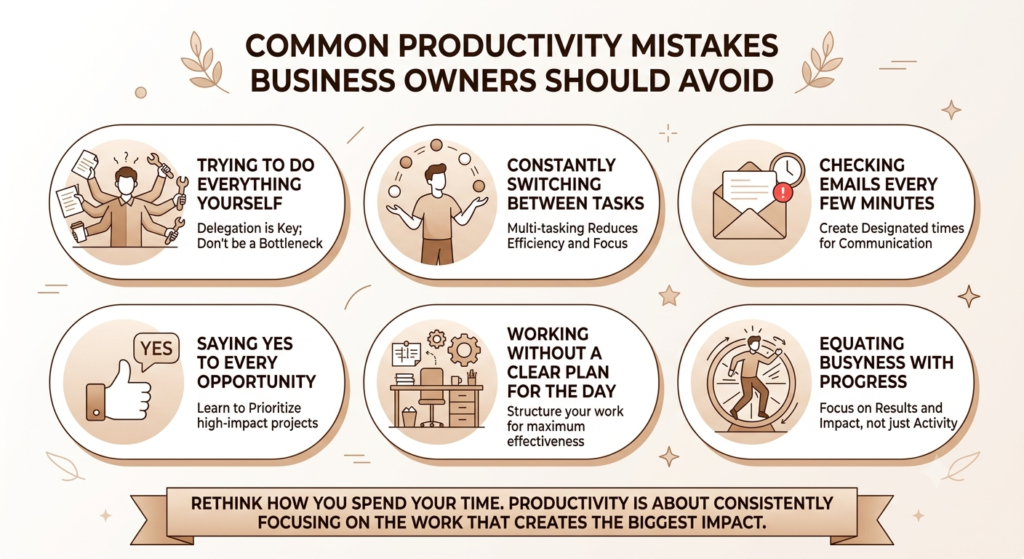
Even experienced entrepreneurs fall into habits that quietly drain productivity.
Some of the most common mistakes include trying to do everything yourself, constantly switching between tasks, checking emails every few minutes, saying yes to every opportunity, and working without a clear plan for the day.
Another major mistake is assuming that being busy means you’re making progress.
If your calendar is full but your revenue isn’t growing, it’s time to rethink how you’re spending your time.
Remember, productivity isn’t about squeezing more tasks into your day. It’s about consistently focusing on the work that creates the biggest impact.
Helpful Productivity Tools
You don’t need dozens of apps to stay productive. A few well-chosen tools can make a big difference.
Consider using:
- Project management software to organize tasks.
- Digital calendars for planning your week.
- Note-taking apps for ideas and meeting notes.
- Password managers for better security.
- AI assistants to simplify repetitive work and research.
Recent reports show that AI adoption among entrepreneurs continues to grow as businesses look for practical ways to improve efficiency without increasing headcount. The key is to use technology to support your workflow-not replace your thinking.
Final Thoughts
Every successful business owner has the same 24 hours in a day.
The difference isn’t how hard they work-it’s how intentionally they work.
You don’t need to adopt all 15 habits overnight. Start with one or two that address your biggest challenge today. As those habits become part of your routine, add another.
Over time, these small changes compound into better decisions, stronger systems, healthier routines, and ultimately, a more profitable business.
Success isn’t built through occasional bursts of motivation. It’s built through consistent habits repeated every single day.
If you’re serious about growing your business in 2026 and beyond, start by improving how you spend your time. The results won’t happen overnight-but they will happen.
Frequently Asked Questions
What is the most important productivity habit for a business owner?
Prioritizing high-impact work each day is one of the most effective habits. When you consistently focus on activities that generate revenue or improve your business, everything else becomes easier to manage.
Is planning your day better than using a to-do list?
A calendar-based approach often works better because it assigns a specific time for important work instead of hoping you’ll “find time” later.
How many hours should a business owner work?
There isn’t a perfect number. Instead of chasing longer hours, focus on producing meaningful results during the hours you do work.
How can entrepreneurs avoid burnout?
Set boundaries, take regular breaks, get enough sleep, and avoid trying to handle every responsibility alone. Long-term success depends on consistency, not exhaustion.
What’s the biggest productivity mistake?
Confusing activity with progress. Staying busy feels productive, but if your work isn’t helping the business grow, it’s simply filling your schedule.