

Nobody starts a business hoping to learn things the hard way. But almost everyone does.
You can read every book on the shelf, listen to every podcast, and still end up learning your most important business lessons through a bounced payroll run, a customer who walked away quietly, or a hire that never should have happened. That is not a personal failing. It is how business works. Experience teaches faster than theory, and it charges more for the privilege.
What separates entrepreneurs who build something lasting from those who burn out in year two usually is not talent, luck, or even funding. It is whether they learn these lessons early, on their own terms, or late, at full price.
This article walks through twelve business lessons that show up again and again across founders, operators, and property managers who have actually built something. Some of them will feel obvious once you read them. Others will sting a little, because they probably apply to something you are dealing with right now. Either way, the goal is the same: fewer surprises, fewer expensive mistakes, and a business that gets stronger the longer you run it.
Why Business Lessons Matter More Than Business Plans
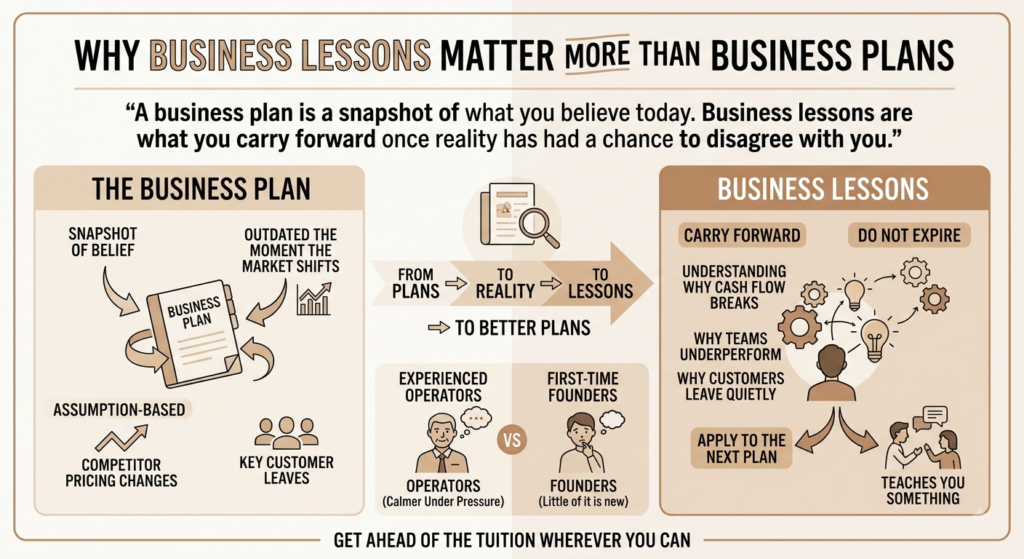
A business plan is a snapshot of what you believe today. Business lessons are what you carry forward once reality has had a chance to disagree with you.
Plans get outdated the moment the market shifts, a competitor changes their pricing, or a key customer leaves. Lessons do not expire the same way. Understanding why cash flow breaks businesses, why teams underperform, or why customers leave quietly teaches you something you can apply to the next plan, and the one after that.
This is also why experienced operators tend to sound calmer under pressure than first-time founders. It is not that nothing goes wrong for them. It is that very little of it is new. They have already paid tuition for most of these lessons, and they are simply applying what it cost them to learn.
The rest of this guide is built around that idea: get ahead of the tuition wherever you can.
Lesson 1: Cash Is Reality, Profit Is Opinion
Profit is calculated. Cash is what is actually sitting in your account when payroll is due.
This distinction sounds basic, and yet it is the single most common reason businesses fail. Cash flow problems are cited as the root cause behind roughly four out of five small business closures, according to financial analysts who study business failure. A company can look profitable on paper, with strong sales and healthy margins, and still run out of money because customers pay slowly and expenses do not wait.
The Underlying Problem
The average small business waits close to a month to get paid on invoices, while payroll, rent, and subscriptions are typically due within two weeks. That gap between when money goes out and when it comes in is where otherwise healthy businesses get squeezed. Profit tells you the business model works. Cash flow tells you whether you survive long enough to prove it.
How to Build a Simple Cash Flow Habit
You do not need a finance degree to fix this. You need a habit.
- Build a rolling short-term forecast, updated weekly, that shows cash in and cash out for the next 13 weeks rather than relying on a single bank balance snapshot.
- Separate operating cash flow (money the business generates day to day) from financing cash flow (money you borrow or inject) so you always know which one is actually keeping the lights on.
- Negotiate payment terms in both directions. Shortening how long customers take to pay you, even by a couple of weeks, has an outsized effect on how much breathing room you have.
- Review recurring expenses on a set schedule. Subscriptions, service contracts, and unused tools quietly drain cash long after anyone remembers signing up for them.
There is also a psychological side to this that rarely gets discussed. Founders who do not track cash closely tend to make decisions from fear rather than fact. A vague sense that money is tight leads to hesitation on hiring, marketing, or new opportunities, even when the actual numbers might support moving forward. Conversely, founders with a clear weekly view of their cash position tend to make faster, more confident decisions, because they are responding to real numbers instead of a general feeling of unease.
It is also worth separating two ideas that often get blurred together: profitability and liquidity. A business can be profitable over a full year and still face a liquidity crunch in a specific month because of seasonality, a large upfront expense, or a client who paid late. Understanding which problem you actually have determines the right fix. A profitability problem calls for changing your pricing, costs, or offer. A liquidity problem calls for changing your timing, whether that means adjusting payment terms, building a cash reserve, or arranging a short-term line of credit before you need it rather than after.
If there is one business lesson worth internalizing before any other, it is this one. Everything else on this list becomes easier once cash flow management stops being a source of anxiety and starts being a routine.
Lesson 2: Most Failures Are Preventable, Not Inevitable
It is tempting to treat business failure as a coin flip. The data suggests otherwise.
What the Numbers Actually Say
The small business failure rate is one of the more sobering statistics in entrepreneurship, and it is worth looking at directly rather than avoiding it. Roughly one in five small businesses close within their first year. By the two-year mark, that number climbs to around a third, and by year five, close to half of all small businesses have shut down. These figures hold fairly steady across most industries, which quietly debunks the popular myth that restaurants or any single sector is uniquely doomed. Survival curves look remarkably similar whether you are running a service business, a retail shop, or a small agency.
The Real Reasons Businesses Close
What varies is not whether businesses fail, but why. Beyond cash flow problems, the most common causes include lack of genuine market demand, an inability to compete on price or value, poor pricing strategy, and expanding faster than the operation can support. Businesses under thirty years old and those primarily selling to individual consumers rather than other businesses also tend to show higher failure rates.
None of these causes are mysterious. They are identifiable, and in most cases, preventable with earlier planning and honest self-assessment. The businesses that survive past the five-year mark are rarely the ones that got lucky. They are the ones that treated these early warning signs as information rather than noise.
There is also a useful pattern hidden in the timing of these failures. The steepest drop-off happens in the first two years, which is exactly when founders have the least cash reserve, the least operational experience, and often the least support around them. That combination is what makes the early period so fragile, not some inherent flaw in the business idea itself. Founders who understand this tend to front-load their preparation deliberately: building a larger cash cushion before launch, lining up a mentor or advisor who has already navigated the early years, and setting realistic expectations about how long it will actually take to reach stability rather than assuming momentum will arrive on schedule.
This is one of those business lessons that is uncomfortable to hear but genuinely useful once accepted: failure is common, but it is not random.
Lesson 3: The Market Decides, Not You
You can be right about your product and still be wrong about whether anyone wants it badly enough to pay for it.
Lack of market need is consistently cited as one of the top reasons startups fail, ahead of funding problems or team issues. Founders often mistake enthusiasm from friends, early adopters, or their own conviction for genuine market demand. Those are three very different things.
The fix is not to stop believing in your idea. It is to test it cheaply and honestly before betting everything on it. Talk to potential customers before you build. Ask people to pay, even a small deposit, before you assume they will. Watch what people do with their money, not just what they say in a conversation, because behavior is a far more reliable signal than opinion.
Markets are not cruel. They are simply indifferent to how hard you worked or how much you wanted something to succeed. Respecting that indifference early saves you from spending years building something the market never asked for.
This lesson also applies well beyond the initial launch. Markets shift, and a product or service that had genuine demand two years ago can quietly lose relevance as customer expectations move on. Staying close to your customers, through regular conversations, feedback requests, or simply watching how they actually use what you offer, keeps you from being the last person to notice that something has changed. The businesses that adapt smoothly are rarely the ones with the best original idea. They are the ones that never stopped listening after the idea was validated the first time.
Lesson 4: Systems Beat Hustle Every Time
Hustle gets a business started. Business systems are what let it run without you holding every piece together personally.
Many founders wear the “I do everything myself” phase like a badge of honor, and in the earliest days, that is often necessary. The problem is when it becomes permanent. A business that only works because the founder is exhausted and available around the clock is not actually a business. It is a very demanding job you happen to own.
What a System Actually Looks Like
A system is simply a documented, repeatable way of doing something so it does not depend on one person’s memory or mood that day. It could be a checklist for onboarding new clients, a template for responding to common customer questions, or a clear process for handling a maintenance request in a rental property. The specifics matter less than the principle: if only one person knows how something works, it is not a system yet.
Where to Start Systemizing First
- Identify the tasks you personally repeat every week and write down exactly how you do them, step by step.
- Build simple checklists for anything with recurring steps, from client onboarding to invoicing to handling complaints.
- Use affordable software tools for scheduling, finance, and communication rather than manual tracking, since accessible platforms now handle functions that used to require entire departments.
- Test whether someone else on your team can follow the system without you explaining it out loud. If they cannot, the system is not finished.
Businesses that run on systems scale more predictably, recover faster from a key person being unavailable, and are worth significantly more if you ever want to sell or step back.
There is a common objection to this lesson worth addressing directly: building systems takes time you feel you do not have. That is true in the short term and false in every other sense that matters. An hour spent documenting a process this week saves far more than an hour the next time that process needs to happen, and every time after that. The return compounds. Founders who never make that initial time investment end up re-explaining the same task to the same confused new hire, repeatedly, for years, without ever noticing how much time it has actually cost them in total.
Lesson 5: Your Team Is a Force Multiplier, Not a Cost Center
Payroll often feels like the scariest number on the page, which tempts founders to treat their team as an expense to minimize rather than an asset to develop.
That framing backfires. A well-trained, well-led team does not just execute tasks. It catches problems you would have missed, represents your brand to customers in ways you cannot personally scale, and frees you to focus on decisions only you can make.
What Effective Leadership Looks Like Day to Day
Strong leadership in a small business rarely looks like grand speeches. It looks like clarity. Team members who understand exactly what success looks like in their role move with the business instead of quietly working against it or waiting for direction that never comes. Developing leadership skills is often treated as something reserved for larger companies with formal management tracks, but the same fundamentals apply just as much to a five-person team as they do to a five-hundred-person one.
The most effective small business leaders tend to do three things consistently: they set clear expectations instead of vague ones, they give feedback close to when something happens rather than saving it for a review, and they treat hiring as a strategic decision worth slowing down for, not a task to rush through when things get busy. Disharmony among owners, partners, or key staff is itself a documented cause of business failure, which is a reminder that leadership is not a soft skill sitting apart from the numbers. It is directly tied to whether the business survives.
Delegation is where this lesson is tested most directly. Handing off a task is easy. Handing off the authority to make decisions about that task, without stepping back in the moment things get difficult, is what actually builds a capable team. Founders who delegate the work but keep all the decision-making end up with a team that constantly waits for approval, which defeats the purpose of hiring people in the first place. Real delegation means accepting that someone else might solve a problem differently than you would, as long as the outcome is still sound.
Lesson 6: Keeping Customers Is Cheaper Than Chasing New Ones
Acquiring a new customer typically costs several times more than keeping an existing one, yet many founders pour almost all their energy into acquisition while treating retention as an afterthought.
The Retention Math
The average customer retention rate across industries sits around 75 percent, though this varies widely by sector. What is consistent across nearly every study on the subject is the multiplier effect: a five percent improvement in retention can increase profits by anywhere from 25 to 95 percent, because repeat customers cost less to serve, spend more per transaction, and are more likely to refer others.
Existing customers typically generate the majority of a company’s revenue and often spend meaningfully more per purchase than someone buying from you for the first time. That single fact should change how much attention retention gets relative to acquisition on your marketing calendar.
Practical Ways to Increase Retention
- Follow up personally after a customer’s first purchase or first month of service, since early experience shapes whether they stay long term.
- Respond quickly. Speed of support is repeatedly identified as one of the strongest predictors of long-term loyalty.
- Ask for feedback before a customer leaves, not after, since most churn is preventable if problems are caught early.
- Make it easy for loyal customers to feel recognized, whether that is a simple thank-you, a loyalty perk, or just remembering details about their situation.
None of this requires an expensive platform to start. It requires deciding that the customers you already have deserve at least as much attention as the ones you are trying to win.
It also helps to separate two kinds of churn: the customer who leaves because your offer genuinely was not right for them, and the customer who leaves because of a preventable breakdown in service, communication, or follow-through. The first kind is a normal part of doing business. The second kind is expensive in a way that rarely shows up clearly on a spreadsheet, because it is easy to notice the lost revenue from one departed customer and much harder to notice the quiet erosion happening across dozens of customers who never complained, just stopped coming back.
Lesson 7: Pricing Is a Strategy, Not a Guess
Many founders set their first price based on what feels comfortable to charge rather than what the business actually needs to sustain itself, and then rarely revisit it.
Underpricing is one of the quieter ways businesses undermine themselves. It erodes margin, attracts price-sensitive customers who are the first to leave when a cheaper option appears, and makes it harder to invest in the improvements that would justify a higher price later. Pricing and cost management struggles are cited often enough among failed businesses that they deserve deliberate attention rather than a one-time decision made in the first excited weeks of launching.
A better approach treats pricing as something you revisit on a schedule, tied to your actual costs, the value you deliver, and what comparable businesses charge. Raising prices is uncomfortable, but running a business that cannot cover its own costs is far more uncomfortable, and it tends to happen quietly until it suddenly does not.
A useful test is to notice how customers react the last time you raised prices, if you ever have. If very few left, that is a strong signal you were underpriced relative to the value you provide. Founders often assume price sensitivity is higher than it actually is, largely because they are more anxious about the increase than their customers turn out to be. Price increases handled with clear communication and advance notice tend to be absorbed far more smoothly than founders expect going in.
Lesson 8: Trends Are Signals, Not Instructions
Every year brings a new list of entrepreneurship trends, and 2026 is no exception. Artificial intelligence is now embedded in everyday operations rather than treated as an experiment, subscription and recurring-revenue models continue expanding beyond software into service businesses, and consumers increasingly reward companies that are transparent about sustainability and how they treat both customers and employees.
What’s Shaping Business Right Now
Small teams using AI-powered tools for analytics, scheduling, and customer communication are able to operate with far less overhead than would have been possible a few years ago, effectively letting lean businesses perform functions that once required entire departments. At the same time, more people are pursuing entrepreneurship out of financial necessity rather than pure ambition, which means competition in many categories is increasing even as tools make starting easier.
The lesson here is not to chase every trend that appears in a headline. It is to treat trends as information about where customer expectations are heading, then decide deliberately which ones actually fit your business model. Chasing every shiny development is its own kind of distraction. The founders who benefit most from watching trends are the ones who pick one or two that genuinely apply to them and commit to implementing them properly, rather than dabbling in all of them at once.
Lesson 9: Overexpansion Kills More Businesses Than Underexpansion
Growing too slowly rarely bankrupts a company outright. Growing too fast, without the cash, systems, or team to support it, frequently does.
Overexpansion shows up in a few predictable ways: opening a second location before the first one has stable, repeatable cash flow, hiring ahead of confirmed revenue rather than in response to it, or taking on more clients than your current team and systems can serve well. Each of these can feel like momentum in the moment. Often it is actually strain, and strain compounds quietly until it becomes a crisis.
The safer pattern is to expand in response to evidence, not optimism. Confirm that your current operation is genuinely stable and profitable before adding complexity to it. Funding growth from your own operations where possible is generally safer than funding it entirely through debt, because debt-funded expansion leaves no room for a slow month while you are also carrying new fixed costs.
Ambition is not the enemy here. Timing is.
Lesson 10: Burnout Is a Business Risk, Not a Personal Problem
Founder burnout is often talked about as a wellness issue, separate from the actual business. It is not separate. It is a direct operational risk, and it is common enough among failed businesses to be studied as one of several specific causes of closure, alongside cash flow and market fit problems.
A burned-out founder makes worse decisions, delays hard conversations, and often holds onto tasks they should have delegated months earlier simply because it feels faster than training someone else. Over time, this creates exactly the kind of single-person dependency that Lesson 4 warned against.
Protecting against burnout is not about stepping away from the business. It is about building enough structure, delegation, and support that the business does not depend entirely on one person’s stamina to function. That structure is what allows a founder to take a real break occasionally without everything quietly falling apart in their absence, which is itself a useful test of how healthy the business actually is.
Lesson 11: Mistakes Are Data, Not Verdicts
Every founder makes decisions that do not work out. The difference between founders who improve and founders who stall is rarely the number of mistakes they made. It is what they did with the information afterward.
Common startup mistakes tend to repeat across industries: underestimating how long it takes to reach profitability, hiring too quickly for a role that was not clearly defined yet, ignoring early feedback because it was inconvenient, or holding onto a strategy well past the point where the results said it was not working.
Treating a mistake as a verdict on your ability leads to either giving up too early or, just as often, doubling down out of stubbornness. Treating it as data means asking a more useful question: what specifically did this teach me, and what would I do differently with that information next time? That question, asked honestly and consistently, is one of the fastest ways to compress years of trial and error into a much shorter learning curve.
Lesson 12: Long-Term Thinking Is the Real Competitive Advantage
Short-term thinking optimizes for this month’s revenue. Long-term thinking optimizes for the business you want to be running in five years, even when that means making a less profitable decision today.
This shows up in small, unglamorous ways: choosing not to take on a client who is a poor fit even though the revenue would help this quarter, investing in a system or a hire before it feels urgently necessary, or maintaining service quality during a busy season instead of cutting corners to move faster. None of these decisions look impressive in isolation. Compounded over years, they are usually what separates businesses that last from businesses that peak early and quietly decline.
Long-term thinking is also what makes every other lesson in this article sustainable rather than a one-time fix. Cash flow discipline, retention focus, careful expansion, and strong leadership are not single actions. They are habits that only pay off if you keep them going well past the point where they stop feeling urgent.
Key Takeaways
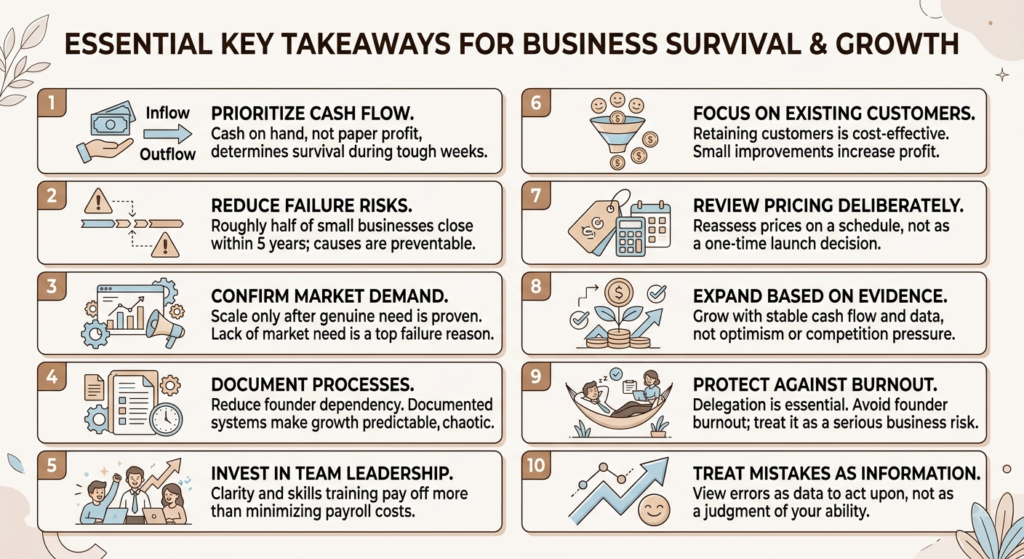
- How you handle cash, not profit on paper, determines whether a business survives its hardest weeks.
- Roughly half of all small businesses close within five years, but the leading causes are identifiable and largely preventable.
- Confirm genuine market demand before scaling, since lack of market need remains one of the top reasons businesses fail.
- Documented processes reduce founder dependency and make growth predictable rather than chaotic.
- Investing in your team’s clarity and leadership pays off more reliably than treating payroll purely as a cost to minimize.
- Keeping existing customers is consistently more cost-effective than chasing new ones, and even small improvements meaningfully increase profit.
- Review pricing deliberately and on a schedule rather than leaving it as a one-time decision from launch day.
- Expand in response to evidence and stable cash flow, not optimism or pressure to keep pace with competitors.
- Protect against founder burnout with real delegation, since it is a documented business risk, not just a personal one.
- Treat mistakes as information to act on rather than as a judgment of your ability.
Conclusion
Every one of these business lessons is available to learn in advance. Almost none of them require capital you do not already have, only attention you have not yet given them.
The founders who build businesses that last are not the ones who avoided every mistake. They are the ones who paid attention to what those mistakes were actually telling them, adjusted, and kept the habits that worked long after the initial motivation wore off. That is a far more repeatable path than waiting for confidence, permission, or the perfect moment to arrive.
Start with whichever lesson in this list makes you slightly uncomfortable. That discomfort is usually a good indicator of where the most useful work is waiting.
Frequently Asked Questions
What is the most common reason small businesses fail? Cash flow problems are the most frequently cited cause, responsible for a large majority of small business closures, even among companies that were technically profitable on paper.
How many small businesses actually survive long term? Roughly half of small businesses are still operating at the five-year mark, and about a third reach ten years. Survival rates are fairly consistent across most industries rather than concentrated in a few risky sectors.
Is keeping existing customers really more important than acquiring new ones? Both matter, but retention tends to deliver a stronger return. Acquiring a new customer typically costs several times more than keeping an existing one, and even modest improvements in how many customers stay can significantly increase overall profit.
How do I know if my business needs better systems? If tasks stall or quality drops whenever you are unavailable, that is a strong sign the business is relying on your personal presence rather than a repeatable process.
Should I follow every new entrepreneurship trend I hear about? No. Trends are useful as signals about shifting customer expectations, but trying to adopt every one at once usually creates distraction rather than growth. Choose the trends that genuinely fit your business model and commit to them properly.
What is the biggest mistake first-time founders make with pricing? Setting a price based on comfort rather than actual costs and value, and then leaving it unchanged for years even as expenses and market conditions shift.