

There is a version of the founder journey that lives on social media. It starts with an idea, jumps to a funding announcement, and ends with a founder smiling on a stage. That version is real for a small number of people, and it leaves out almost everything that actually happens in between.
The real founder journey is slower, messier, and far more human. It is built from thousands of small decisions, a handful of very hard weeks, and a set of habits that either keep you in the game or quietly push you out of it. If you are somewhere in the middle of that journey right now, wondering whether what you are feeling is normal, this article is for you.
We will walk through the founder journey stage by stage, look at what the latest data says about failure, burnout, and bootstrapping, and pull out the practical lessons that separate founders who last from founders who burn out early. Nothing here is theory for theory’s sake. Every section is built to help you make a better decision this week.
What the Founder Journey Actually Looks Like
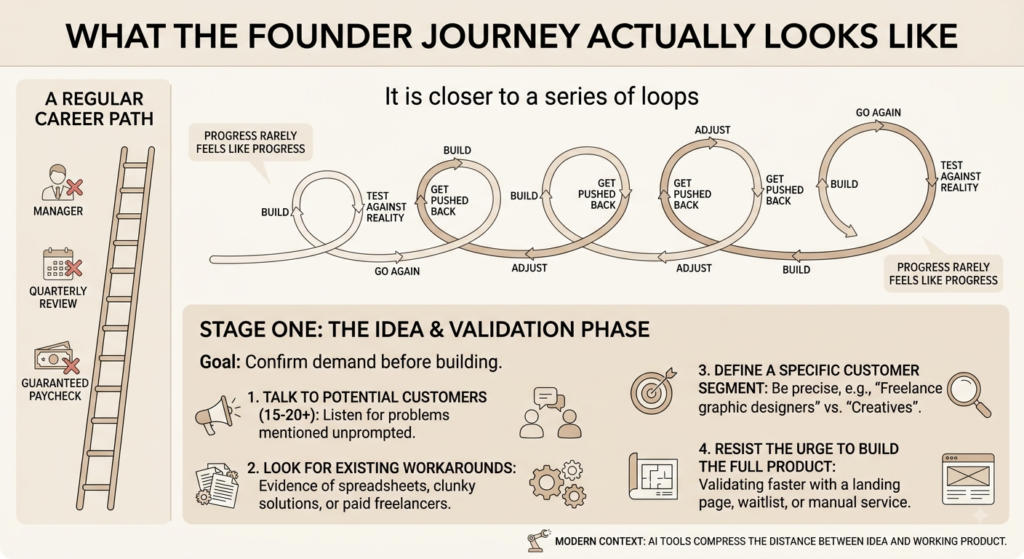
The founder journey is not a straight line. It is closer to a series of loops: you build something, test it against reality, get pushed back, adjust, and go again. Every founder who has been through it will tell you the same thing in different words. Progress rarely feels like progress while it is happening.
What makes the founder journey different from a regular career path is the absence of a fixed structure. There is no manager telling you what to do next, no quarterly review confirming you are on track, and no guaranteed paycheck at the end of the month. You are the strategist, the operator, and often the only person accountable for whether the business survives another quarter.
This is precisely why understanding the founder journey in stages matters so much. When you know what typically happens at each stage, you stop mistaking normal difficulty for personal failure. A rough patch during the validation phase is not a sign you picked the wrong idea. A slow month after launch is not proof the market does not want your product. Context changes how you interpret pain, and how you interpret pain often decides whether you keep going.
One more thing worth naming early: the shape of the founder journey has genuinely shifted in the past two years. AI tools have compressed the distance between having an idea and having a working product. Teams are smaller. Solo founders are more common than at any point in recent memory. We will get into the data on that shortly, but it is worth holding in mind as we walk through each stage, because the tools available to you today are not the tools available to founders even three or four years ago.
Stage One: The Idea and Validation Phase
Every founder journey begins here, and it is the stage most people get wrong in one of two directions. Either they fall in love with an idea and skip validation entirely, or they get stuck in endless research and never actually start.
The goal of this stage is simple to state and hard to execute: find out whether people will pay for a solution to a real problem before you spend months building it. That means talking to potential customers, studying how they currently solve the problem, and being brutally honest about whether your solution is meaningfully better than what already exists.
A few practices that hold up well at this stage:
- Talk to at least fifteen to twenty potential customers before writing a line of code or drafting a business plan. Listen for the problems they bring up unprompted, not the ones you ask leading questions about.
- Look for evidence of an existing workaround. If people are already cobbling together spreadsheets, hiring freelancers, or paying for a clunky competitor, that is a stronger signal than enthusiasm alone.
- Write down the specific customer segment you are targeting. “Small business owners” is not specific enough. “Independent contractors managing five or fewer active client projects” gives you something you can actually test against.
- Resist the urge to build the full product. A landing page, a waitlist, or a manual version of your service run by hand can validate demand faster than months of development.
The founder journey rewards patience here more than almost anywhere else. Startups that skip validation tend to discover the hard way, months later, that they built something nobody needed badly enough to pay for. That single mismatch between product and demand remains the single most common reason startups fail, and it is largely preventable at this stage.
Stage Two: Building the First Version
Once you have reasonable evidence that a problem is worth solving, the next stage of the founder journey is building something people can actually use. This is where a lot of founders either move too slowly, trying to make the first version perfect, or too quickly, shipping something so rough it cannot demonstrate real value.
The right target is a minimum viable product: the smallest version of your idea that lets a real customer get real value and gives you real feedback. Not a prototype that only works in a demo. Something that functions, even if it is unglamorous.
What has changed meaningfully in this stage is speed. AI-assisted coding tools, no-code platforms, and automation software have compressed build timelines that used to take months into weeks, sometimes days. A single founder with the right stack can now do work that once required a small technical team. That does not remove the need for good judgment about what to build, but it does mean the excuse of “I don’t have the resources to test this” holds up less often than it used to.
Practical guidance for this stage of the founder journey:
- Define what “working” means before you start building. What specific action does a user need to complete for you to call the MVP a success?
- Build for the narrowest useful version of the problem, not every feature you can imagine. You can always add complexity later; you cannot easily win back a user’s patience.
- Set a hard deadline for shipping. Open-ended build timelines are one of the fastest ways to lose early momentum and personal motivation.
- Get the product in front of your original interview subjects first. They already told you they had the problem, which makes their feedback the most valuable in the room.
This is also the stage where many founders quietly begin operating solo or with a very small team, a pattern the current data backs up strongly, which we will look at in the next section.
Stage Three: Launch and Early Traction
Launch day feels like the finish line, but in the founder journey it is closer to the starting gun for a longer race. What happens in the weeks and months after launch tells you far more about your business than the launch itself.
Early traction is rarely dramatic. It looks like a handful of paying customers, a slow trickle of signups, and a lot of manual customer support while you learn what is actually breaking in your product. Founders who expect a hockey-stick curve immediately after launch often mistake this quiet period for failure, when it is usually just the normal shape of early growth.
A few things to focus on during this stage:
- Track a small number of metrics that actually matter for your business model, rather than vanity numbers like total signups. Activation rate, retention after thirty days, and revenue per customer usually tell a more honest story.
- Respond to every early customer personally. At this stage, your support inbox is also your best research tool.
- Watch for signs of genuine product-market fit rather than early curiosity. Curiosity brings people to try something once. Fit brings them back without you asking.
- Resist pivoting after a single bad week. Give any meaningful change in strategy at least a few weeks of data before deciding it failed.
This stage of the founder journey is also where the emotional highs and lows tend to be sharpest. A single glowing customer email can carry you for days. A single cancellation can spiral into doubt about the entire business. Learning to hold both without overreacting is a skill, and it is one you build through repetition, not insight alone.
Stage Four: Growth, Scaling, and the Second Startup Inside Your Startup
If your product survives the early traction stage, the founder journey shifts again. The skills that got you here, scrappy validation, fast building, personal customer relationships, are not the same skills that take you further. Founders sometimes describe this as starting a second company inside the first one.
Scaling introduces new categories of problems: hiring your first employees or contractors, building repeatable systems instead of one-off fixes, and making decisions with less direct visibility into every customer interaction. The founder who once knew every user by name now has to trust dashboards and delegate judgment calls they used to make personally.
This stage also tends to surface a founder’s blind spots. Someone who is excellent at product design may struggle with financial planning. Someone who is a strong communicator may avoid difficult conversations about underperformance on their team. Recognizing your own gaps early, and building processes or hiring to cover them, matters more here than raw effort.
Key priorities during this stage:
- Document processes as you build them, even informally. What lives only in your head cannot scale past you.
- Hire slowly and only for roles tied to a clear, current bottleneck, not roles that sound impressive on paper.
- Revisit your original customer assumptions periodically. The customer who validated your MVP is not always the customer who will fund your growth.
- Protect founder time deliberately. As the business grows, your calendar fills with requests that feel urgent but are not always important.
The Numbers Nobody Puts on the Pitch Deck
It helps to see the founder journey in hard numbers, not just narrative. The picture is more nuanced than either the “90 percent of startups fail” myth or the survivorship-bias highlight reels you see online.
According to U.S. Bureau of Labor Statistics data, roughly one in five private-sector businesses close within their first year, with the failure rate climbing toward half of all businesses by the five-year mark and around two-thirds by year ten. Those numbers cover all new businesses, not just venture-backed startups, and they have stayed relatively stable across decades, which suggests the core challenges of building a company are structural rather than tied to any single economic moment.
Industry matters more than most founders expect. Sectors like agriculture see meaningfully lower first-year failure rates than sectors like information technology or retail, where competition and capital intensity run higher. Choosing a market is not a neutral decision; it shapes your odds before you write a single line of a business plan.
The most commonly cited reason startups fail is not running out of money outright, though that plays a role. It is building something the market does not need badly enough to sustain. That circles directly back to the validation stage discussed earlier, and it is one of the few points in the founder journey where extra caution early genuinely pays off later.
The human cost of this uncertainty shows up clearly in founder mental health research. Multiple 2025 and 2026 surveys converge on a similar picture: a majority of founders report experiencing anxiety, depression, or burnout within a given year, and many say they hide these struggles from investors, boards, and even close colleagues out of fear it will be read as weakness. Founder burnout is not a footnote to the founder journey. For a large share of founders, it is one of the central experiences of building a company, and it deserves to be treated as seriously as any other operational risk.
Funding Your Journey: Bootstrapping Versus Raising Capital
How you fund the founder journey shapes almost everything else about it: your speed, your control, your risk tolerance, and even your daily stress levels. There is no universally correct answer, but there is a correct answer for your specific business and goals.
Raising outside capital can accelerate growth, particularly in categories where speed to market genuinely determines the winner. It comes with real tradeoffs: diluted ownership, investor expectations around growth pace, and a board relationship you will need to manage carefully. Venture-backed companies also fail at meaningfully higher rates than the general business population in some categories, since the model explicitly rewards aggressive risk-taking over cautious, steady growth.
Bootstrapping, funding the business through revenue, savings, or small non-dilutive grants, has become a much more visible and viable path in the current environment. Lower software costs, AI tools that reduce the need for early hires, and a cultural shift away from “growth at any cost” thinking have all made bootstrapped paths more attractive than they were a decade ago. Bootstrapped founders keep full ownership and set their own pace, at the cost of slower initial growth and the discipline required to manage cash flow without a funding cushion.
Questions worth asking before you choose a path:
- Does your business model require significant upfront capital, such as manufacturing or inventory, or can it grow primarily through reinvested revenue?
- How much control are you willing to trade for speed?
- Is your market genuinely winner-take-most, where being first matters enormously, or is it one where a smaller, profitable position is a perfectly good outcome?
- Can you personally sustain a longer runway to profitability if you choose to bootstrap?
There is no prestige difference between the two paths that should matter to you. A profitable, self-funded business that supports your life well is not a lesser founder journey than a venture-backed one. It is simply a different set of tradeoffs, chosen deliberately.
The Solo Founder Era and What It Means for You
One of the clearest shifts in the founder journey over the past two years is the rise of the solo founder. Where team-building used to be treated as an almost automatic early step, a growing share of new companies are being built and run by a single person, often supported by a stack of AI tools rather than a team of employees.
This shift is not simply about doing more with less out of necessity. It reflects a genuine change in what one person can accomplish. Tasks that once required a developer, a customer support hire, and a marketer can now be handled substantially by a founder working alongside AI tools for coding, content, and operations. That does not mean the work disappears. It means the nature of the work shifts from doing everything by hand to directing and reviewing what tools produce.
If you are considering or already walking the solo path, a few things are worth internalizing:
- Solo does not mean isolated. The most sustainable solo founders build strong peer networks, even without traditional co-founders or employees, precisely because the workload without a team can be intense.
- Choose tools deliberately rather than accumulating them. A focused stack that covers your real bottlenecks beats a long list of subscriptions you barely use.
- Set boundaries around your own working hours early. Without a team to share the load, it is easy to let a solo founder journey expand to fill every waking hour.
- Revisit the decision periodically. Staying solo is not a permanent commitment. Many founders run solo through validation and early traction, then bring on their first hire once a genuine bottleneck appears.
The rise of the solo founder does not erase the value of a strong co-founder relationship where one exists. It simply means going it alone is no longer the disadvantage it once was, and it is a legitimate, increasingly common way to walk the founder journey from start to finish.
Protecting Your Mental Health Along the Way
This section deserves space on its own, because the founder journey without attention to mental health tends to end earlier than it needs to, regardless of how good the underlying business is.
The pattern researchers describe is consistent: founders often keep performing outwardly, showing up to meetings and hitting milestones, while struggling privately with exhaustion, detachment, or persistent anxiety. This gap between how a founder appears and how a founder actually feels makes the problem harder to catch early, both for the founder and for the people around them.
A few protective habits show up consistently among founders who sustain long careers rather than burning out in year two or three:
- Treat sleep, movement, and basic nutrition as non-negotiable infrastructure, not optional extras you get to once the business stabilizes. Founders who let these slip are consistently the ones reporting the sharpest burnout symptoms.
- Build at least one relationship, whether a peer group, a mentor, or a therapist, where you can talk honestly about how the business is actually going, not just the version you present publicly.
- Separate your identity from the outcome of any single decision or setback. A failed launch or a lost customer is information about the business, not a verdict on your worth as a person.
- Notice early warning signs rather than waiting for a full breakdown: persistent irritability, disrupted sleep, or a sense of numbness toward work you used to care about. These are signals worth acting on immediately, not badges of how hard you are working.
None of this is soft advice layered on top of “real” business strategy. It is strategy. A founder who protects their own capacity is protecting the single most important asset the business has, because in the early years, the founder often is the business.
Habits and Systems That Extend the Founder Journey
Beyond mental health specifically, certain operating habits show up again and again among founders who sustain long, productive journeys rather than flaming out early.
Weekly reflection over daily reaction. Set aside a fixed time each week to step back from the daily fire drills and ask what actually moved the business forward. Daily task lists keep you busy; weekly reflection keeps you on course.
Decision journals. Write down significant decisions and your reasoning at the time you make them. Reviewing these months later teaches you far more about your own judgment than intuition alone ever will.
Deliberate constraints. Founders who set clear limits, a maximum number of projects at once, a fixed number of working hours, a defined runway before reassessing a strategy, tend to make sharper decisions than those operating without any boundaries at all.
Regular customer contact, even after you scale. It is tempting to let customer conversations fall entirely to a support team as you grow. Founders who stay close to a rotating sample of real customer conversations catch problems and opportunities that dashboards miss.
Scheduled recovery, not just scheduled work. Time off is not a reward for finishing the founder journey. It is part of what makes finishing it possible at all.
Common Mistakes That Cut the Founder Journey Short
Some patterns show up so often across failed startups that they are worth naming directly, even though every business is different.
- Building in isolation for too long. Founders who avoid customer feedback because they are afraid of hearing “no” tend to discover the hard truth much later and at much higher cost.
- Chasing funding as validation. Raising money is a tool, not proof that your business model works. Plenty of well-funded companies have failed because funding covered up, rather than solved, a weak underlying demand problem.
- Confusing busyness with progress. Long hours are common in the founder journey, but hours alone do not correlate with results. What matters is whether the hours are spent on the handful of things that actually move the business forward.
- Ignoring unit economics until it is urgent. Understanding what it costs you to acquire and serve a customer, relative to what that customer is worth, should happen early, not only when cash runs low.
- Trying to do everything alone indefinitely. Even in the solo founder era, there is a difference between choosing to run lean and refusing help you genuinely need out of pride or fear of losing control.
- Neglecting personal finances. Many founders underpay themselves for extended periods without a clear plan for when that changes, which adds financial stress on top of business stress and accelerates burnout.
Building Your Support System
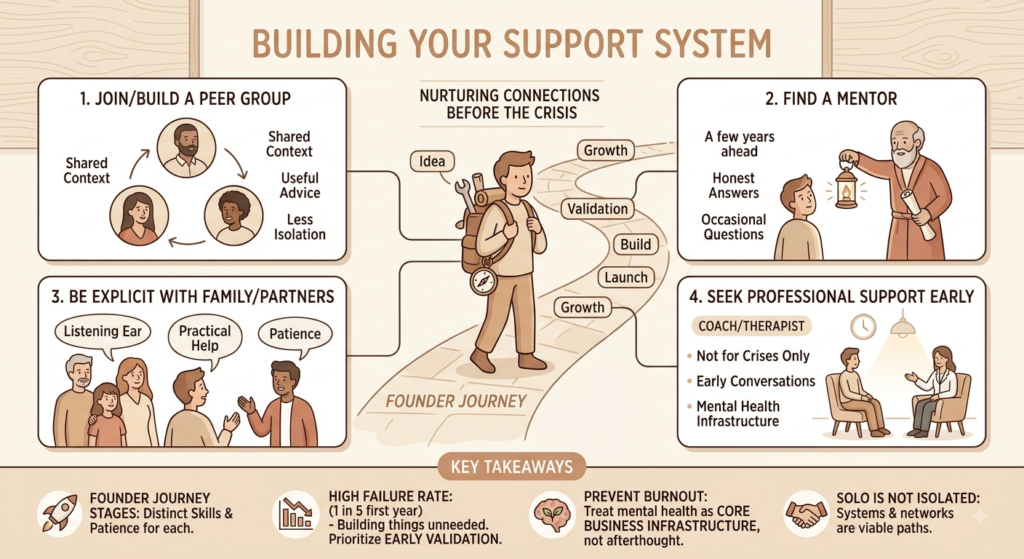
No founder completes a meaningful founder journey entirely alone, even the ones who technically run their company solo. The support system just looks different for different founders: a mentor who has been through a similar stage, a peer group of other founders facing the same pressures, a partner or family member who understands the demands of the work, or a professional like a therapist or business coach.
What matters is building this system before you desperately need it, not scrambling for it during a crisis. A few starting points:
- Join or build a small peer group of founders at a similar stage. Shared context makes advice more useful and makes venting less isolating.
- Find at least one person a few years ahead of you on a similar path who is willing to answer occasional questions honestly.
- Be explicit with people close to you about what support actually helps, whether that is practical help, a listening ear, or simply patience during intense periods.
- Do not wait for a crisis to seek professional support if you are struggling. Early conversations are far easier than crisis interventions.
Key Takeaways
- The founder journey moves through distinct stages, idea and validation, building, launch, and growth, and each stage rewards different skills and different kinds of patience.
- Roughly one in five new businesses close within the first year, and the leading cause of failure remains building something the market does not need badly enough, which makes early validation one of the highest-leverage steps you can take.
- Founder burnout affects a large majority of founders at some point, and treating mental health as core business infrastructure, not an afterthought, meaningfully improves the odds of sustaining the journey.
- Solo founders and lean, AI-assisted teams are an increasingly common and viable path, but solo does not have to mean isolated.
- Both bootstrapping and raising capital are legitimate paths through the founder journey; the right choice depends on your business model, market, and personal risk tolerance, not on which path looks more impressive.
- Systems like weekly reflection, decision journaling, and deliberate constraints help founders make sharper decisions and avoid mistaking busyness for progress.
Frequently Asked Questions
How long does the average founder journey take before a business becomes sustainable? There is no fixed timeline, and businesses that need heavy infrastructure or regulatory approval typically take longer than lean digital products. Many founders report that year two through year three is when a company starts to feel genuinely sustainable, though the true validation and building stages often move much faster than they used to thanks to AI-assisted tools.
Is it better to bootstrap or raise venture capital? Neither path is inherently superior. Bootstrapping preserves ownership and control but requires patience and disciplined cash management. Raising capital can accelerate growth in markets where speed genuinely matters, at the cost of dilution and investor expectations. The right choice depends on your specific business model and goals.
What is the most common reason startups fail? Building a product the market does not need badly enough to pay for consistently ranks as the top reason startups fail, ahead of running out of cash or team conflicts. This is why thorough validation before heavy building remains one of the most valuable steps in the founder journey.
How common is founder burnout, really? Multiple recent surveys converge on the finding that a majority of founders experience anxiety, depression, or burnout within a given year, with many hiding these struggles from investors and colleagues. It is common enough that it should be treated as a normal, expected risk of the founder journey rather than a personal failing.
Can you succeed as a solo founder without a co-founder? Yes, and it has become significantly more common as AI tools have reduced the need for early hires across product, marketing, and operations. Success as a solo founder still depends heavily on building a strong peer support network, since the workload and decision-making pressure do not disappear simply because you are working alone.
What is the single highest-leverage thing a new founder can do? Talk to real potential customers before building anything substantial, and be honest with yourself about what they actually say, not what you hope they will say. This single habit prevents more failed startups than almost any other early decision.
Conclusion
The founder journey rarely looks like the highlight reel. It looks like a validation conversation that did not go the way you hoped, a launch that grew slower than you expected, a night you stayed up fixing something that broke, and a quiet win nobody else noticed but you.
None of that means you are doing it wrong. It means you are actually in it, doing the real work that every founder who has ever built something lasting has also had to do. The data is clear that the odds are genuinely difficult, and it is equally clear that founders who validate carefully, protect their own capacity, build honest support systems, and choose a funding path that fits their actual business tend to stay in the game long enough to find out what they are truly capable of building.
Wherever you are in your own founder journey right now, the next right step is usually smaller and more specific than it feels. Take it, learn from what happens, and keep going.