

Everyone loves the highlight reel. The flexible schedule, the “be your own boss” freedom, the laptop-on-a-beach photo that shows up in every ad for a course on starting a business.
Nobody puts the 11 PM strategy panic attack in the highlight reel.
The truth about entrepreneur life sits somewhere between those two pictures. It is genuinely more flexible than a traditional job in some ways, and genuinely harder in ways most people never expect until they are already in it. If you are building a business right now, thinking about starting one, or trying to figure out why the freedom you were promised feels more like a second full-time job, this article is for you.
We are going to look at what the current data actually says about entrepreneur life in 2026, why so many people are choosing it anyway, and what separates the entrepreneurs who build something sustainable from the ones who burn out before they get the chance.
What Entrepreneur Life Actually Means Today
Entrepreneur life used to have a fairly narrow definition. You started a company, you hired people, you scaled, and eventually you either sold the business or handed it to the next generation.
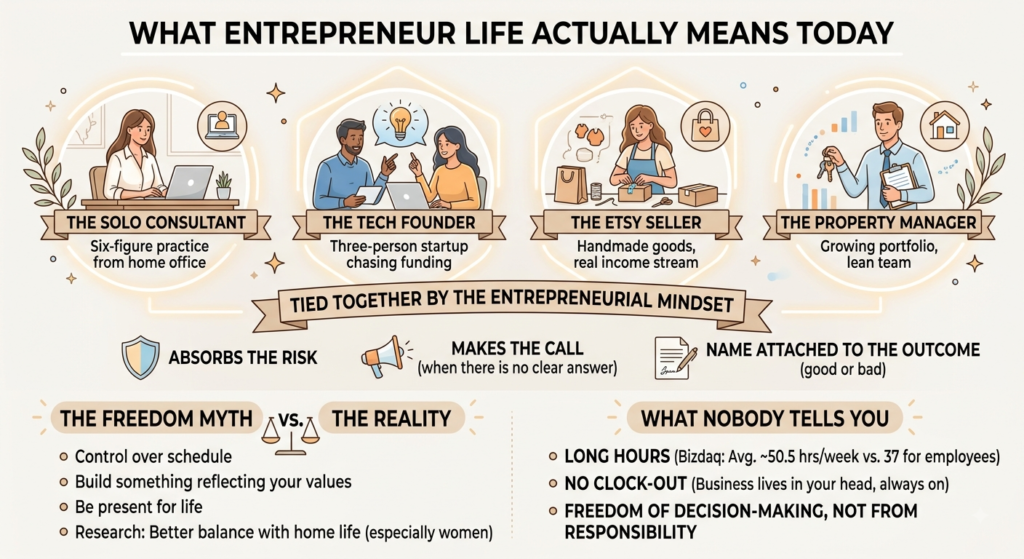
That picture has changed. Today, entrepreneur life includes the solo consultant running a six-figure practice from a home office, the founder of a three-person startup chasing venture funding, the Etsy seller who quietly built a real income stream, and the property manager running a growing portfolio with a lean team.
What ties all of these people together isn’t the size of the business. It’s the mindset. You are the one who absorbs the risk. You are the one who makes the call when there is no clear answer. And you are the one whose name is attached to the outcome, good or bad.
That responsibility is exactly what makes entrepreneur life so different from employment, and it’s exactly why the lifestyle that comes with it deserves an honest look instead of another motivational poster.
The Freedom Myth vs the Reality
Why So Many People Choose the Entrepreneur Life
Ask most new founders why they started, and freedom shows up near the top of the list almost every time. Control over your schedule. The chance to build something that reflects your values instead of someone else’s quarterly targets. The ability to be present for the parts of life that a rigid job schedule doesn’t allow for.
That motivation is real, and it isn’t naive. Research from Mastercard found that a majority of women entrepreneurs specifically cited a better balance with home life as a driving reason for starting their own business, more so than their male counterparts. People are not wrong to want that. The question is whether the business they build actually delivers it.
What Nobody Tells You Before You Start
Here is where the gap opens up. A UK survey of business owners conducted by Bizdaq found that entrepreneurs worked roughly 50.5 hours a week on average, compared to about 37 hours for the typical employee. That is not a small difference. That is closer to an extra day and a half of work, every single week, indefinitely.
And the hours are only part of the story. Unlike a job you can leave at the office, a business lives in your head all the time. A pricing question can surface at 11 PM. A client complaint can interrupt dinner. There is no clock to punch out on, because there is no separation between “you” and “the business” in the early years.
This doesn’t mean entrepreneur life is a trap. It means the freedom it offers is a different kind of freedom than most people picture when they start. It is freedom of decision-making, not freedom from responsibility. Understanding that distinction early saves a lot of disappointment later.
The Numbers Behind Entrepreneur Life in 2026
If you want to make a clear-eyed decision about entrepreneur life, you need real numbers, not just anecdotes. Here is what the current data shows.
How Many Hours Entrepreneurs Actually Work
Recent research on small and medium-sized business leaders in the UK found that the large majority work between 40 and 49 hours a week, while roughly 15 percent are putting in 60 to 69 hours weekly, and a small but notable group exceeds 70 hours. In the US, a separate survey from The Alternative Board found that 84 percent of business owners work more than 40 hours a week, with a third exceeding 50 hours and a quarter working past 60.
Long hours by themselves are not the enemy. Plenty of people work hard and feel energized by it. The problem shows up when long hours combine with no boundaries, no recovery time, and no one to share the load with. That combination is what turns ambition into exhaustion.
Mental Health and Burnout Data
This is the part of entrepreneur life that gets talked about the least and matters the most.
A 2026 founder survey found that 87.7 percent of entrepreneurs report struggling with at least one mental health issue, with roughly a third experiencing burnout directly and around half dealing with anxiety. Separate research from The Lonely Entrepreneur found that nearly half of founders have considered quitting their company specifically because of stress and burnout, not because the business itself was failing.
One especially telling detail from that same research: a majority of founders are hiding their mental health struggles from investors, boards, and co-founders, and a large share cite fear of professional consequences as the reason they have never sought therapy. The data also shows a gender split worth understanding. Women entrepreneurs are more likely to report financial worry and impostor syndrome, while men are more likely to carry burnout and depression silently, in part because they report having far less of a support system to talk to openly.
That last point matters more than it might seem. The research draws a straight line between having someone to talk to and lower burnout rates. Isolation, not workload alone, is often what tips stress into something more serious.
Income Reality: What Entrepreneurs Actually Earn
The financial side of entrepreneur life also deserves an honest look, because the gap between expectation and reality is where a lot of disappointment lives.
Current solopreneur data puts the average annual income at just under $40,000, while the same research found that solopreneurs, on average, believe they need to earn around $219,000 a year to feel genuinely successful. That is not a small gap. It is the entire psychological weight of going out on your own, expressed as a dollar figure.
At the same time, roughly a fifth of solopreneurs are earning six figures or more, and a large share report going at least one full month without pay at some point in their journey. Income in entrepreneur life is rarely a smooth line. It is a distribution, and where you land on it depends heavily on your business model, your pricing, and how consistently you can generate demand.
The Rise of the Solo Business Owner
Why Solopreneurship Is Booming
One of the clearest shifts happening in entrepreneur life right now is the growth of the one-person company. Current estimates put the number of solopreneurs in the United States at close to 30 million, generating an estimated 1.7 trillion dollars in economic output.
This isn’t a fringe trend anymore. Solo-led companies made up roughly 30 percent of all new startups founded in a recent year, and their share of funded equity rounds has been climbing steadily. A record share of solopreneurs are projecting growth for their business this year, and a majority report improved financial results compared to the year before.
The AI Factor
A meaningful part of this growth is tied to changing tools, not just changing attitudes. Research cited by Entrepreneur.com found that nearly half of respondents said the availability of AI tools made them more likely to start a business in the first place. Founder-focused surveys have also found that entrepreneurs using AI tools report saving an average of six hours a week, which adds up to more than 300 hours over a year.
That is a genuine shift in what one person can accomplish alone. Tasks that used to require a small team, like drafting marketing copy, building a basic website, or managing customer support at a small scale, can now be handled by a single founder with the right tools. That doesn’t remove the hard parts of entrepreneur life. It changes which parts are hard, shifting the bottleneck away from execution and toward decision-making, judgment, and strategy.
It’s also worth noting who is actually building these solo businesses, because it defies the usual startup stereotype. Recent solopreneur data shows nearly two-thirds of solo business owners are over the age of 45, with a significant share in their Gen X or Baby Boomer years. This isn’t a young founder’s game the way pop culture tends to portray entrepreneurship. It’s often built on decades of accumulated expertise, professional relationships, and a level of financial stability that makes the leap into solo work less risky than it looks from the outside.
Location flexibility plays a role too. A large majority of solopreneurs work remotely, well above the general workforce’s remote participation rate, which means the solopreneur lifestyle is as much about designing where and how you work as it is about the business itself. And this growth isn’t confined to major cities. Entrepreneurship has been growing considerably faster in rural areas than in urban ones in recent years, which suggests the solopreneur wave is reaching well beyond the usual tech hubs.
The Hard Truths of Business Survival
No honest article about entrepreneur life can skip the survival numbers, because they shape almost every decision a founder should make in year one.
Why Businesses Fail (and How to Avoid It)
According to Bureau of Labor Statistics data, roughly one in five small businesses close within their first year of operation. That number climbs to about a third by year two, close to half by year five, and around two-thirds by year ten.
The reasons behind those closures are more preventable than most people assume. Research from SCORE found that cash flow problems are involved in the large majority of small business failures. Other commonly cited causes include a lack of genuine market need for the product or service, getting outcompeted in a crowded market, and poor marketing execution. A smaller but meaningful share of failures come down to disharmony between founders or business partners, and simple founder burnout severe enough to end the business entirely.
None of this is meant to discourage anyone from starting. It’s meant to redirect energy toward the things that actually move the needle: validating demand before you build, keeping a financial cushion, and pricing your work in a way that protects your margins from day one.
The First Two Years Matter Most
The data is consistent on one point: the first 24 months are where the highest share of businesses close. That is also the window where founders are most likely to be underprepared, both financially and emotionally, for what running a business actually demands.
If you are in year one or two right now, treat this stretch as the highest-leverage period to get your fundamentals right. Build your cash reserve before you need it. Get your pricing model validated with real customers, not assumptions. And resist the urge to expand faster than your systems can support, since overexpansion without the resources to back it is one of the more common and avoidable reasons businesses fail.
Building Systems So the Business Doesn’t Run You
The entrepreneurs who sustain high performance for years, not just months, tend to share one habit: they treat their own time and attention as a limited resource that needs protecting, not an infinite well the business can draw from.
Documenting Decisions
Every decision you make repeatedly is a process waiting to be written down. If you find yourself answering the same client question, solving the same operational problem, or making the same judgment call more than twice, that is your signal to document it. A simple standard operating procedure, even a rough one, turns a decision that depends on you into a process someone else can follow.
Delegation and Automation
Every task that eats your time without needing your specific expertise is a candidate for delegation or automation. This doesn’t require a big team. A part-time virtual assistant, a freelance specialist for a few hours a month, or an AI tool that handles first drafts can all free up meaningful time without adding real payroll overhead.
The goal isn’t to remove yourself from the business entirely. It’s to make sure the hours you do spend are going toward the decisions and relationships that genuinely need you, not the repetitive tasks that don’t.
Templates for Repeated Work
Client onboarding emails, proposal formats, social media captions, invoice follow-ups. If you write some version of the same message more than once a month, it belongs in a template. This single habit, more than any productivity app, is what gives entrepreneurs back real hours every week.
Protecting Your Mental Health as an Entrepreneur
Given how consistently the data points to burnout and isolation as defining risks of entrepreneur life, this deserves direct, practical attention rather than a vague mention.
Recognizing Early Warning Signs
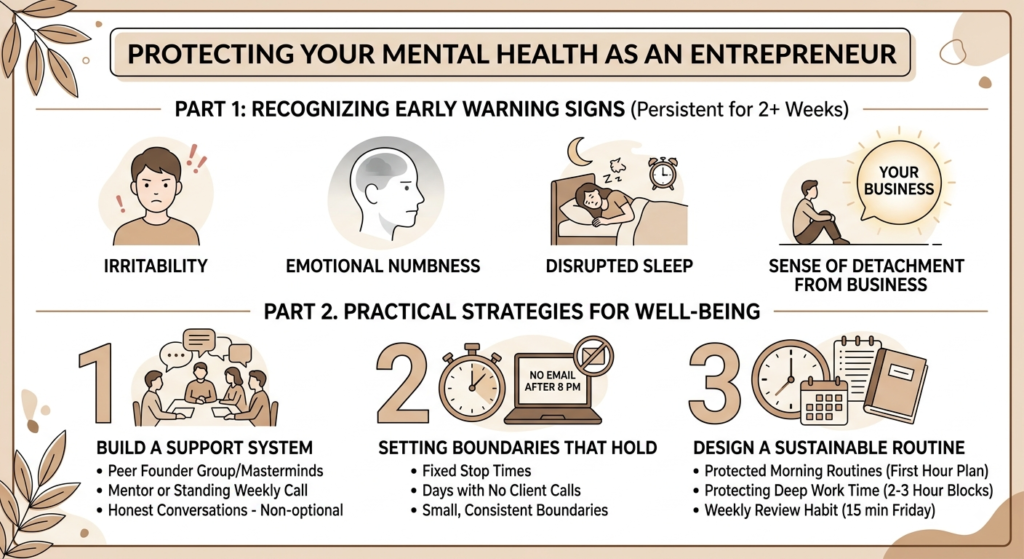
Founder mental health researchers are consistent on this point: irritability, emotional numbness, disrupted sleep, and a sense of detachment from your own business are warning signs, not just symptoms of ambition. When these signs repeat over several weeks rather than showing up once during a stressful stretch, they deserve real attention rather than being pushed aside.
Building a Support System
The research on this is unusually clear. Founders who have someone to talk to openly about the pressure of the job report meaningfully lower burnout than those who don’t. That someone doesn’t need to be a therapist, although professional support is valuable when you need it. It can be a peer founder group, a mastermind, a mentor, or simply a standing weekly call with someone who understands what you’re building.
Treat that regular, honest conversation as a real part of running your business, not an optional extra you’ll get to once things calm down. Things rarely calm down on their own.
Setting Boundaries That Actually Hold
A boundary you don’t enforce isn’t a boundary. If you decide not to check email after 8 PM, that only works if you actually close the laptop, not just tell yourself you should. Small, consistent boundaries, like a fixed time you stop working or a day each week with no client calls, do more for long-term sustainability than an occasional big vacation that just delays the burnout by a few weeks.
Designing a Sustainable Daily Routine
Morning Routines That Set the Tone
The specifics of a morning routine matter less than the consistency of having one. Entrepreneurs who protect the first hour of their day for planning or focused work, before checking email or Slack, consistently report better follow-through on their priorities than those who start the day reactively.
Protecting Deep Work Time
Strategic thinking, writing, and problem-solving require unbroken blocks of time, not scattered fifteen-minute windows between meetings. Blocking two or three hours a few times a week for this kind of work, and treating that block as seriously as a client meeting, is one of the simplest structural changes that improves output without adding hours.
The Weekly Review Habit
A short weekly review, even fifteen minutes on a Friday afternoon, to check what worked, what didn’t, and what needs attention next week, keeps small problems from becoming big ones. It also gives you a natural closing point for the week, which supports the kind of boundary-setting mentioned earlier.
Money, Runway, and Financial Discipline
Separating Personal and Business Finances
This sounds basic, but it remains one of the most common gaps among new entrepreneurs. Mixing personal and business finances makes it nearly impossible to see your real margins, complicates taxes, and makes it harder to secure financing when you need it. A separate business account and a simple bookkeeping habit from day one pays for itself many times over.
Building a Cash Buffer
Given that cash flow problems are involved in the overwhelming majority of small business failures, a cash buffer isn’t optional. Whether that’s a few months of operating expenses set aside or a business line of credit you haven’t tapped yet, having a cushion is what lets you survive a slow month without panic decisions that damage the business long term.
Relationships and the Entrepreneur Life
Partners and Family
The people closest to you feel the effects of entrepreneur life almost as much as you do, even though they didn’t sign up for the business itself. Long hours, financial uncertainty in the early years, and the mental load of running a company all show up at home, whether you talk about them directly or not.
The founders who navigate this well tend to be explicit rather than assuming their family understands the pressure. A short weekly check-in about how the business is affecting home life, even a casual one, prevents a lot of quiet resentment from building up over time.
Finding Peer Community
Running a business can be isolating in a way that’s hard to explain to someone who hasn’t done it. Other entrepreneurs, even ones in completely different industries, often understand the specific pressure of decision fatigue and financial risk in a way friends and family simply can’t. Local business groups, industry associations, or a small mastermind of three or four other founders can fill that gap meaningfully.
The Role of AI in Modern Entrepreneurship
AI has quietly become one of the biggest structural changes to entrepreneur life in the last two years, not because it replaces the founder, but because it changes the math on what one person can handle alone.
Tasks that used to require hiring, like first-draft content, basic customer support responses, scheduling, and simple data analysis, can now be handled with AI tools that cost a fraction of a part-time salary. This is a significant part of why solopreneurship has grown as fast as it has. It doesn’t remove the need for judgment, relationships, or strategic thinking. It just frees up the hours that used to go toward tasks that never needed a human’s full attention in the first place.
The founders getting the most value from this shift are treating AI as leverage for the repetitive parts of the job, while keeping their own attention focused on the decisions, client relationships, and strategic calls that genuinely require it.
Common Mistakes That Derail Good Founders
A few patterns show up again and again among entrepreneurs who struggle unnecessarily:
- Treating long hours as a badge of honor instead of a temporary phase to manage down over time
- Waiting until burnout is severe before making any changes to workload or boundaries
- Mixing personal and business finances, which hides real profitability until it’s a crisis
- Scaling faster than cash flow or systems can support
- Trying to do everything alone instead of delegating tasks that don’t require their specific expertise
- Going without any peer support, mentor, or sounding board for months or years at a time
None of these mistakes are fatal on their own. Left unaddressed for long enough, though, they compound into the kind of exhaustion or financial strain that ends businesses that otherwise had real potential.
What makes these mistakes especially costly is how quietly they build. Nobody skips a cash buffer or ignores a burnout warning sign in one dramatic decision. It happens gradually, through a series of small choices that each felt reasonable at the time: one more late night to hit a deadline, one more month of putting off a proper bookkeeping system, one more quarter without reaching out to a mentor because things felt too busy to pause. The fix isn’t a single dramatic overhaul either. It’s usually a handful of small, boring habits, reviewed regularly, that keep the business and the founder both on solid ground.
Key Takeaways
- Entrepreneur life offers real flexibility, but it trades a fixed schedule for constant decision-making responsibility, not less work overall
- Entrepreneurs work meaningfully longer hours than employees on average, and burnout rates among founders remain high
- Solopreneurship is growing fast, driven partly by AI tools that let one person handle work that used to require a small team
- Roughly one in five small businesses close in their first year, mostly due to preventable cash flow and market-fit issues
- Building systems, documenting decisions, and delegating repetitive tasks are what let founders sustain the pace long term
- A real support system, whether peers, mentors, or professional help, is one of the strongest protective factors against burnout
- Financial discipline, including separate accounts and a real cash buffer, is what turns a risky first two years into a stable business
Frequently Asked Questions
Is entrepreneur life actually less stressful than a traditional job? Not automatically. Entrepreneurs often report longer hours and higher rates of anxiety and burnout than employees, largely because the responsibility for every decision sits with them. What entrepreneur life does offer is more control over how that stress is managed, which matters, but it isn’t the same as having less of it.
How many hours do most entrepreneurs actually work? Recent survey data shows most business owners work somewhere between 40 and 50 hours a week, with a meaningful share exceeding 60 hours, particularly in the early years of a business.
What’s the biggest reason small businesses fail? Cash flow problems are involved in the large majority of small business failures, more than any other single cause. Lack of market need and getting outcompeted are the next most common reasons.
Is solopreneurship a realistic full-time career, or just a side hustle? It’s increasingly realistic as a full-time path. Close to 30 million people in the US now run solo businesses as their primary or significant source of income, and a growing share are earning six figures, though the average income remains modest compared to what most solopreneurs consider a successful outcome.
How do successful entrepreneurs avoid burnout? The strongest protective factor in current research is a real support system, whether that’s peer founders, a mentor, or professional support, combined with boundaries that are actually enforced rather than just intended.
Should I use AI tools to help run my business? For most solo founders and small teams, yes. Current data shows entrepreneurs using AI tools save several hours a week on average, time that can go toward the strategic work that actually grows the business.
Conclusion
Entrepreneur life was never meant to be easy, and pretending otherwise does a disservice to anyone considering it. What the current data actually shows is more useful than either the highlight reel or the horror stories: this path offers real flexibility and real financial upside, alongside real risk of burnout and real odds of failure in the early years.
The founders who build something lasting aren’t the ones who avoid all of that difficulty. They’re the ones who plan for it, build systems that don’t depend entirely on their own exhaustion, and refuse to go through it alone. That’s the version of entrepreneur life worth building toward, and it’s fully within reach if you approach it with your eyes open.