

Most business owners think scaling is about doing more of what already works. Get more customers, hire more people, open more locations, and revenue follows.
That belief is exactly why most businesses never make it past their early stages. In the United States alone, there are more than 33 million small businesses, yet only around 16 percent ever grow past the one-to-nineteen-employee stage. The rest stay small, flat, and financially fragile, not because the owners lack ambition, but because growth without structure eventually breaks something: cash flow, the team, the customer experience, or the founder.
Scaling a business is not the same thing as growing one. Growth means your revenue and your costs rise together. Scaling means your revenue grows faster than your costs, because the systems underneath the business can absorb more volume without falling apart. Understanding that difference is the first step toward doing it well.
This guide walks through what scaling actually requires: the operational foundations, the sequencing of hiring and technology decisions, the leadership shifts that growth forces on founders, and the mistakes that quietly derail otherwise promising companies. Rather than offering generic business scaling strategies, the goal here is to lay out a sequence you can actually apply. None of it is theoretical. It reflects how sustainable businesses are actually built, one deliberate decision at a time.
What Scaling a Business Actually Means
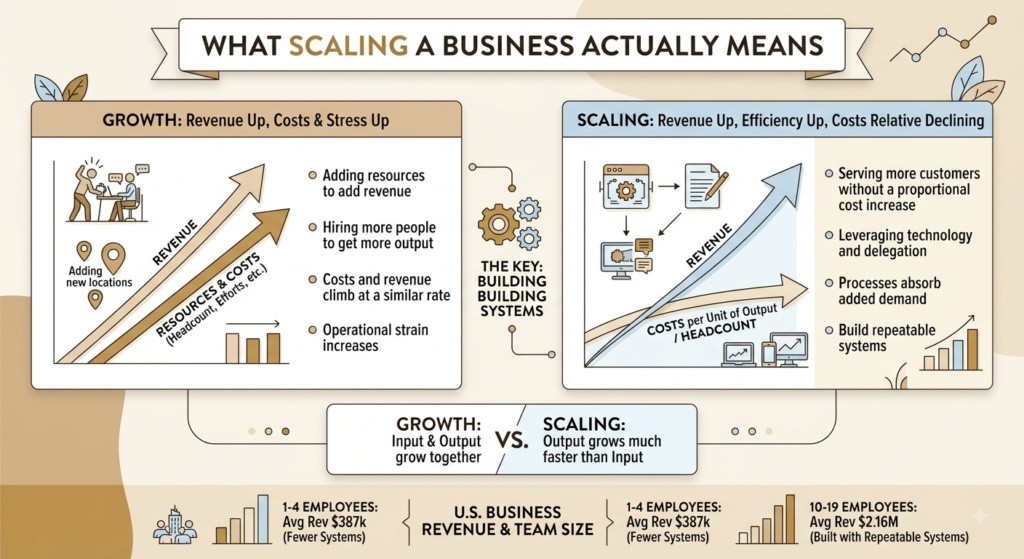
Before you can learn how to scale a business, you need a clear definition, because the word gets used loosely and that looseness causes real damage.
Growing a business usually means adding resources to add revenue. You hire two more salespeople to close two more deals a month. You open a second location to serve a second neighborhood. Costs and revenue climb at roughly the same rate, and profit margins stay flat.
Scaling is different. A scaled business can serve significantly more customers without a proportional increase in cost or headcount. A software company that goes from 1,000 to 10,000 users without rebuilding its entire infrastructure is scaling. A service business that documents its delivery process so a new hire can perform at 80 percent of the founder’s standard within two weeks is scaling. The leverage comes from systems, not from sheer effort.
Growth vs Scaling: The Real Difference
Here is a simple way to separate the two.
Growth: Revenue increases, but so does the operational strain, headcount, and cost per customer served.
Scaling: Revenue increases while cost per unit of output declines, because processes, technology, and delegation are absorbing the added demand.
Businesses with 10 to 19 employees in the United States generate an average of 2.16 million dollars in annual revenue, compared with 387,000 dollars for businesses with one to four employees. That gap is not simply the result of hiring more people. It reflects businesses that built repeatable systems capable of supporting a bigger operation, then hired into those systems rather than around chaos.
The State of Business Scaling in 2026
Context matters, because the environment a business is scaling into shapes which strategies actually work.
The Small Business Administration reports that the United States is home to roughly 36.2 million small businesses, representing 99.9 percent of all American firms and employing close to 46 percent of the private-sector workforce. New business formation remains historically high, with more than 500,000 new business applications filed in a single month earlier this year. That means competition for customers, talent, and attention is intense, and it is only going to get more crowded.
At the same time, the operating environment has become tougher. Inflation and elevated input costs remain the top financial pressure for small business owners, borrowing costs are still high, and finding qualified staff continues to strain hiring plans. According to Federal Reserve survey data, only about 42 percent of small business loan applicants received the full financing they sought, which means many scaling plans have to be funded through operating cash flow rather than external capital.
Technology, and AI in particular, is reshaping what efficient scaling looks like. Recent research shows that a majority of small businesses now use at least one AI tool regularly, up sharply from just a few years ago, and most of those businesses report a measurable positive impact on cost, speed, or revenue. The businesses pulling ahead are not necessarily the ones with the biggest budgets. They are the ones applying automation and structure earliest, before the pressure of growth forces their hand.
This is the backdrop against which every scaling decision should be made: real demand exists, but so does real risk, and the businesses that scale successfully are the ones that plan for both.
It also helps to understand where the economic weight of small business actually sits. Collectively, small businesses are estimated to generate roughly 43.5 percent of total US gross domestic product, which means the aggregate opportunity is enormous even as individual businesses struggle to break out of their early stage. That gap between total market opportunity and individual business outcomes is not a contradiction. It is a signal that the constraint most businesses face is not the size of the market, but the strength of what they have built to serve it.
Owners are also navigating a labor market where finding qualified staff remains one of the top operational challenges reported to the National Federation of Independent Business, which makes the sequencing advice in this guide even more relevant. If hiring is difficult and expensive, every hire needs to count, and that only happens when a business knows precisely which bottleneck it is hiring to solve before the job posting goes live.
Why Most Businesses Never Scale
Understanding why scaling fails is just as important as understanding how it succeeds, because the same five failure patterns show up again and again across industries.
Premature Scaling
The single most common mistake is expanding before the underlying business model is actually proven. Getting one or two happy clients feels like validation, but it is not the same as demonstrated, repeatable demand across a real market. Industry research attributes roughly 17 percent of startup failures directly to premature scaling, and businesses that scale too early often burn three to four times more cash per customer acquired than those that wait until the model is proven. The fix is patience: prove that the offer works consistently before you multiply it.
Weak Operational Systems
Growth does not create new problems so much as it exposes the ones that were already there. A business running on manual processes, tribal knowledge, and founder memory can survive at a small size. The moment volume increases, those same gaps turn into missed deadlines, inconsistent quality, and customer complaints. Without documented systems for communication, fulfillment, and decision-making, growth amplifies whatever inefficiency already exists rather than fixing it.
Cash Flow Blind Spots
A business can be profitable on paper and still collapse while scaling, because profitability and liquidity are not the same thing. Faster growth usually means paying for inventory, staff, and marketing well before the corresponding revenue arrives. Founders who track profit but not the timing of cash in and cash out are the ones most likely to get blindsided by a sudden shortfall, even during a period of record sales.
Hiring Too Early or Too Late
Hiring mistakes cut both ways. Hire too early, relative to actual demand, and payroll drains cash the business does not yet have. Hire too late, and the existing team burns out trying to cover gaps, quality slips, and customers notice. The businesses that scale well treat hiring as a response to a specific operational bottleneck, not a general reaction to feeling busy.
Founder Dependency
In founder-led companies, the business often becomes dependent on one or two individuals rather than on repeatable processes. Every decision, every client relationship, and every piece of institutional knowledge runs through the founder. That might work at ten customers. It cannot work at a hundred. If the business cannot function during a two-week vacation without the founder checking in constantly, it is not yet built to scale.
How to Scale a Business: The Core Framework
Knowing how to scale a business comes down to sequencing. Each of the steps below builds on the one before it, and skipping ahead is what causes most of the failures described above.
Step 1: Prove the Model Before You Multiply It
Before adding resources, complete real market validation: confirm that your core offer converts consistently, that customers stay and refer others, and that the unit economics work at your current size. If it costs more to acquire and serve a customer than that customer is worth over time, scaling will only make the losses bigger and faster. Validate profitability at small scale first, then multiply what is already working.
Step 2: Build Systems Before You Need Them
Document your core processes while the business is still small enough for that documentation to be manageable. This includes how leads are handled, how work gets delivered, how quality is checked, and how customer issues get resolved. A written process turns a task that lives in one person’s head into something a new hire can learn and repeat, which is the entire foundation of scaling a business without recreating the founder in every new employee.
Step 3: Get Cash Flow Visibility First
Before committing to any major growth initiative, know exactly how cash moves through your business on a weekly and monthly basis, not just how much profit shows up on an annual statement. Build a rolling cash flow forecast that accounts for the timing gap between when you pay for growth and when growth pays you back. This single habit prevents more scaling failures than almost any other discipline on this list.
Step 4: Hire Ahead of the Pain Point, Not After
Rather than waiting until the team is overwhelmed, map out where operational bottlenecks are most likely to appear as volume increases, then hire for the role that will solve that specific bottleneck deliberately. A good hiring rule: bring someone on when a task is consistently taking longer than it should, is being done poorly under pressure, or is preventing the founder from focusing on higher-value work, not simply because revenue went up last quarter.
Step 5: Replace Yourself as the Bottleneck
At some point, the founder becomes the ceiling on how fast the business can grow. Every decision that has to route through you, every client relationship only you can manage, and every process only you understand is a constraint on scale. Start delegating decisions, not just tasks, and build a leadership layer that can operate the business without your daily involvement in every detail.
Step 6: Protect the Customer Experience While You Grow
It is easy to let quality slip while chasing volume, but customer experience is often the first casualty of aggressive scaling, and the damage compounds. A single bad experience during a growth phase can undo months of marketing investment, since customer retention is almost always cheaper to protect than lost trust is to rebuild. Build quality checkpoints into your systems from Step 2 so that faster does not have to mean worse.
The Role of Technology and AI in Scaling
Technology is not optional infrastructure anymore. It is one of the clearest differentiators between businesses that scale efficiently and businesses that scale expensively.
Where AI Actually Moves the Needle
The businesses seeing the strongest results are not using AI broadly. They are applying it to specific, high-volume tasks. Content creation, customer service automation, scheduling, and administrative work are the most common starting points, and they are also where the return on investment shows up fastest. Businesses that have adopted AI-enabled customer service and workflow automation report meaningfully faster response times, reduced support costs, and, in many cases, double-digit revenue growth attributed directly to those tools.
The honest caveat worth repeating: adoption is not the same as productive use. Many small businesses try a tool once and stop, rather than integrating it into an actual workflow. The gap between businesses experimenting with AI and businesses that have rebuilt a process around it is where the real competitive advantage is forming right now.
The Automation Stack Every Scaling Business Needs
Business automation does not need to be complicated to be effective. At a minimum, a business preparing to scale should have five categories of technology in place:
- A customer relationship management (CRM) system to track every interaction and pipeline stage, so nothing depends on memory
- Project management software that coordinates teamwork without the founder acting as the traffic controller
- Financial software that provides real-time visibility into cash flow and profitability, not just quarterly snapshots
- Communication tools that centralize institutional knowledge instead of scattering it across email threads
- Automation tools that handle repetitive marketing, onboarding, and reporting tasks so people can focus on judgment-based work
The test for any tool in your stack is simple: does it save more time and reduce more risk than it costs to manage? If yes, keep it. If a tool is creating more administrative overhead than it removes, it does not belong in a scaling business.
Funding a Scaling Business
Scaling costs money before it makes money, and underestimating that gap is one of the quieter ways businesses run into trouble even when demand is strong.
Inventory has to be purchased before it sells. New hires need training time before they reach full productivity. Marketing campaigns take weeks or months to convert into revenue that offsets their cost. Every one of these is a cash outflow that arrives well before the corresponding inflow, and a business that has not planned for that timing gap can find itself unable to pay its own bills during its best sales quarter.
Access to external capital has also gotten tighter. Federal Reserve survey data shows that only around 42 percent of small business loan applicants received the full amount of financing they sought, which means many scaling plans, especially for smaller and newer businesses, need to be funded largely from operating cash flow, retained earnings, or smaller lines of credit rather than a large external raise. That reality makes the cash flow forecasting habit described earlier in this guide even more important. A business that knows its cash position eight to twelve weeks out can time its hiring, inventory purchases, and marketing spend to match what it can actually afford, rather than what growth projections suggest it should be able to afford.
Where external financing is available and appropriate, it works best when it is matched to a specific, well-defined use, such as bridging the gap on a large confirmed order or funding equipment that directly increases capacity, rather than as a general cushion for undefined growth ambitions. The businesses that manage this well treat financing as a tool to smooth a known timing gap, not as a substitute for validating that the underlying model is already profitable.
Building a Business Model That Can Scale
Not every business model scales the same way, and being honest about your model’s structural limits early saves years of frustration later.
A scalable business model is one where revenue can grow substantially without a matching increase in the resources required to deliver it. This is why software and digital products scale more easily than businesses built entirely around one person’s time, such as solo consulting or highly customized service work. That does not mean service businesses cannot scale, but it does mean they need to productize what they offer, standardizing service tiers, packaging expertise into repeatable frameworks, and training a team to deliver consistent quality without the founder personally touching every client.
Ask three questions about your current business model. Can this be delivered by someone other than me, following a documented process? Does serving twice as many customers require roughly twice the cost, or can technology and systems absorb some of that increase? Is demand for this offer proven across multiple customer segments, or does it depend heavily on one relationship or one channel? Honest answers to these questions will tell you whether you are ready to scale the business you have, or whether the model itself needs to change first.
Leadership During a Growth Phase
Scaling changes what leadership actually requires, and founders who do not adapt their own role often become the biggest obstacle to their company’s growth.
In the early stage, a founder’s job is to do the work: sell, deliver, fix, repeat. As the business grows, the job shifts toward building the systems that let other people do the work well. Many founders resist this shift because they built the business on their own hustle and find it uncomfortable to hand off control. But the leadership skill that scaling actually demands is the ability to make good decisions through other people, not just make good decisions yourself.
This shows up in a few concrete ways. Communication has to become more structured, because informal hallway conversations do not reach a team that has outgrown one room. Decision-making has to become more distributed, with clear boundaries around what a manager can decide without escalating to the founder. And team accountability has to shift from personal effort to shared outcomes, which means investing in the coaching and mentoring that turns capable individual contributors into people who can lead others.
One pattern worth watching for: as businesses scale, they often copy the org chart of a much bigger company, splitting into functional silos for marketing, sales, finance, and operations. Customers then experience a disjointed journey as they move between departments that do not communicate well with each other. Strong leadership during a growth phase means designing structure around the customer’s experience, not simply mirroring what bigger companies do.
Common Scaling Mistakes to Avoid
Beyond the core failure patterns already covered, a few additional mistakes show up consistently in fast-growing companies.
- Treating technology decisions as an afterthought rather than a strategic input, then being forced into an expensive rebuild once the original infrastructure cannot handle real volume
- Underinvesting in cybersecurity, assuming attacks only target large corporations, when small and mid-sized businesses are frequent targets for phishing and ransomware
- Scaling marketing spend before confirming that the sales process converts that additional traffic profitably
- Assuming a hiring process that worked for the first five employees will work at fifty, without adjusting onboarding and training
- Ignoring early warning signs in customer support data, such as rising complaint volume, because revenue is still climbing
None of these mistakes are exotic. They are ordinary operational gaps that a small business can absorb but a scaling business cannot, which is exactly why building the underlying systems has to come before aggressive expansion.
Real-World Signals You’re Ready to Scale
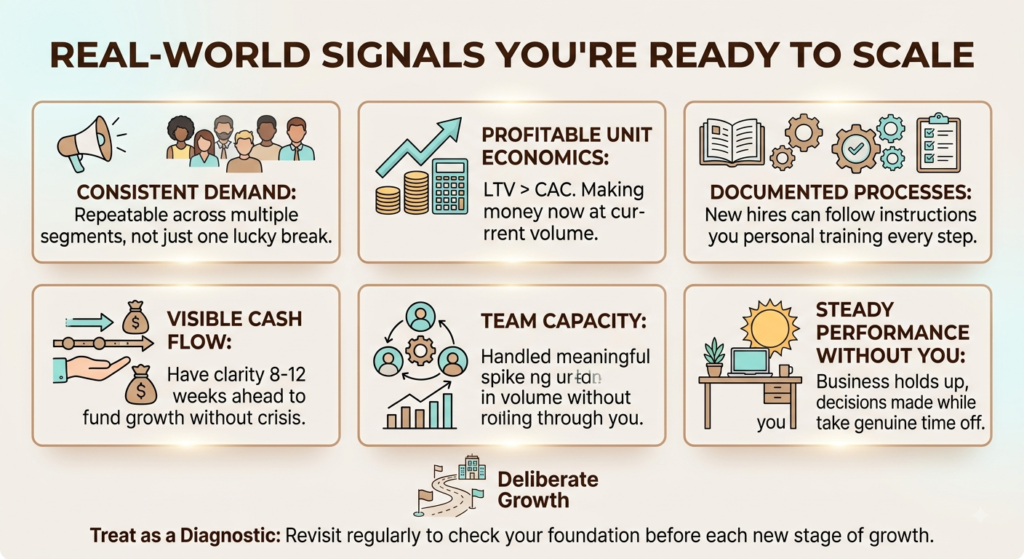
Rather than scaling on a gut feeling, look for concrete signals that the foundation is ready to support more volume.
Your core offer has consistent, repeatable demand across multiple customer segments, not just one relationship or one lucky referral chain. Your unit economics are profitable at current volume, meaning what you spend to acquire and serve a customer is comfortably below what that customer is worth over time. Your key processes are documented well enough that a new hire could follow them without you personally training every step. You have visibility into cash flow at least eight to twelve weeks out, so you can fund growth without a crisis. And your team can handle a meaningful spike in volume without everything routing back through you personally.
If most of those are true, you are in a strong position to pursue growth deliberately. If several are missing, the more valuable next step is closing those gaps first, since scaling will only make them more expensive to fix later.
It is worth adding one more signal that is easy to overlook: how your business performs when you step away from it. Take a genuine week off, with limited check-ins, and observe what happens. If service quality holds, decisions still get made, and customers do not notice a difference, that is strong evidence your systems and team can support additional volume. If the business visibly struggles the moment you are unavailable, that is not a reason to avoid ever taking time off. It is a direct, practical readiness test, and it usually points to exactly which process or role needs to be built out before you commit to a bigger growth push.
Treat these signals as a diagnostic, not a scorecard to pass once and forget. Businesses that scale successfully tend to revisit this list every few months, because what counts as a bottleneck at fifty customers is rarely the same bottleneck at five hundred. The goal is not to reach a permanent state of readiness. It is to build the habit of checking your foundation before each new stage of growth, so that scaling stays a deliberate choice rather than a reaction to pressure you did not see coming.
Key Takeaways
- Scaling means growing revenue faster than costs, through systems, not just through adding more resources
- Roughly 84 percent of small businesses never grow past the smallest employee bracket, largely due to weak operational foundations rather than lack of demand
- Premature scaling, weak systems, cash flow blind spots, mistimed hiring, and founder dependency are the five most common reasons scaling efforts fail
- A practical scaling sequence is: validate the model, document systems, gain cash flow visibility, hire deliberately, delegate decisions, and protect quality
- Technology and automation, especially AI applied to specific high-volume tasks, are increasingly a competitive differentiator rather than a nice-to-have
- Leadership has to evolve from doing the work personally to building systems and people who can do the work well without you
Conclusion
Scaling a business is not a reward for working harder. It is the outcome of building something that can grow without needing you to hold every piece together personally. The businesses that scale well are rarely the ones with the flashiest launch or the fastest early spike in revenue. They are the ones that took the unglamorous steps first: proving the model, documenting the systems, watching the cash, hiring with intention, and building a team that can operate without a founder standing over every decision.
If you take one idea from this guide, let it be this: growth will always find the weakest point in your business and put pressure on it. The work of scaling well is finding and strengthening that weak point before growth does it for you.
There is no single moment when a business becomes officially ready to scale. Readiness is built gradually, through the unglamorous discipline of documenting a process, checking a cash flow forecast, and having a hard conversation about whether a hire is truly needed. Founders who commit to that discipline early tend to look back on their growth phase as a controlled climb. Founders who skip it tend to describe theirs as a series of fires they were constantly putting out. The difference is rarely luck. It is almost always preparation.
Frequently Asked Questions
What is the difference between business growth and scaling? Growth means revenue and costs increase together. Scaling means revenue increases faster than costs, because systems and technology allow the business to serve more customers without a matching increase in resources.
How do I know if my business is ready to scale? Look for consistent demand across more than one customer segment, profitable unit economics at your current size, documented core processes, cash flow visibility several weeks out, and a team that can absorb more volume without everything depending on you personally.
What is the biggest reason businesses fail when scaling? Weak operational structure is the most common root cause. Without clear systems for communication, fulfillment, and decision-making, growth exposes and amplifies inefficiencies that were already present rather than creating new ones.
Can a profitable business still fail while scaling? Yes. Profitability on paper does not guarantee liquidity. Many businesses fail during a growth phase because of cash flow timing problems, even while showing healthy profit margins on their financial statements.
Should I hire more staff to scale faster? Only when hiring solves a specific, identified bottleneck. Hiring in response to general busyness, without addressing the underlying process gap, usually multiplies inefficiency rather than fixing it.
How is AI changing the way small businesses scale? AI is increasingly used for specific high-volume tasks such as content creation, customer service, and administrative automation. Businesses that integrate these tools into an actual workflow, rather than testing them once, report meaningful gains in efficiency, cost reduction, and revenue growth.