

Most small business owners already know they need to grow. What they don’t always know is where growth actually comes from.
It rarely comes from a single big idea. It comes from a handful of decisions made consistently, over months and years, about who you serve, how you spend money, and what you refuse to do just because a competitor is doing it.
I have spent years building and managing businesses in property management and short-term rentals, and I have watched the same pattern play out again and again. Owners who grow steadily are not the ones with the flashiest marketing. They are the ones who understand their numbers, protect their cash, and make deliberate choices about where to invest their limited time and money.
This article walks through the small business growth strategies that are actually working right now, backed by current data on what small business owners are facing in 2026. No vague advice about “thinking bigger.” Just a practical roadmap you can start using today.
Why Growth Feels Harder in 2026 Than It Used To
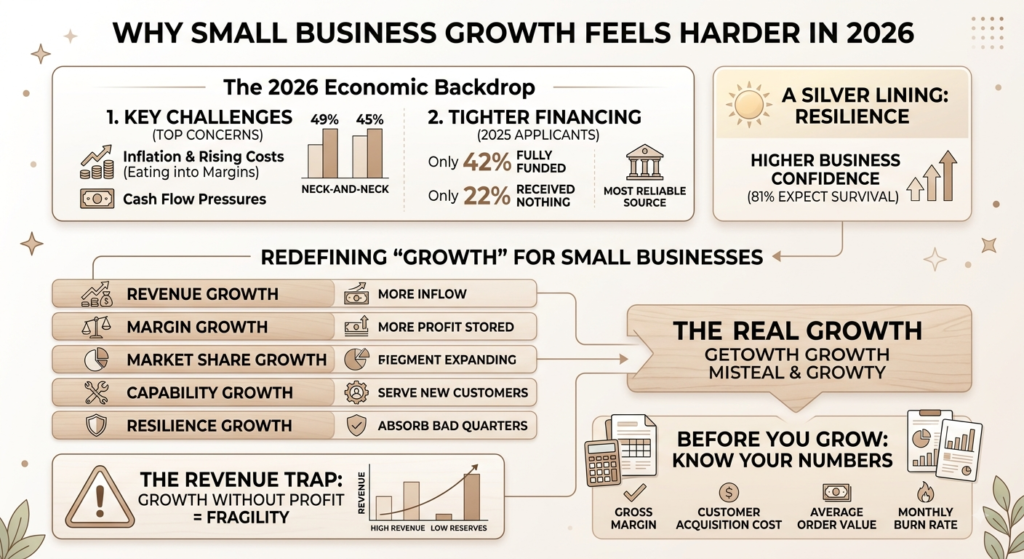
If growing your business feels heavier this year than it used to, you are not imagining it. The data backs that up.
Inflation and cash flow remain the top two challenges named by small business owners in 2026, running neck and neck at the top of nearly every survey on the subject. Rising costs eat into margins before you even get to the question of growth, and that changes the entire calculus of how much risk you can afford to take.
Financing has also gotten tighter. Among small employer firms that applied for financing in 2025, only 42 percent received the full amount they sought, while 22 percent received nothing at all. Small banks remain the most reliable source of approval, fully funding 57 percent of applicants, but the overall picture is one of scarcity. If you are counting on a loan to fund your next phase of growth, you need a stronger application and a longer runway than you might have needed five years ago.
There is a silver lining, though. Confidence among small business owners is actually higher than it has been in years. Roughly 81 percent of business owners now expect their business to survive current economic headwinds, up from about 77 percent the year before, marking the strongest survival confidence reading in recent memory. Owners are not naive about the difficulty of the environment. They are simply getting better at operating inside it.
That resilience is the backdrop for everything in this article. The small business growth strategies that work in 2026 are not about ignoring the headwinds. They are about building a business that can grow despite them.
What “Growth” Actually Means for a Small Business
Before going further, it’s worth pausing on a question most owners skip: what does growth actually mean for your business, specifically?
Growth is not automatically good. A business that adds revenue without adding profit has not grown; it has just gotten more complicated. A business that adds customers it cannot properly serve has not grown; it has created a service problem that will eventually cost it the customers it already had.
Real, sustainable small business growth usually shows up in one or more of these forms:
- Revenue growth – more money coming in from existing or new customers.
- Margin growth – the same revenue, but more of it staying in the business.
- Market share growth – a larger slice of a defined customer base.
- Capability growth – the ability to serve customers you couldn’t serve before.
- Resilience growth – a business that can absorb a bad quarter without collapsing.
The mistake many owners make is chasing revenue growth while ignoring the other four. A business that doubles its revenue but has no cash reserve and burned-out staff has not actually gotten stronger. It has gotten more fragile.
This matters because it should shape which of the strategies below you prioritize first. If your margins are thin, a customer acquisition push is not your next move. Fixing pricing or costs is. If your team is already stretched, adding new customers before fixing your systems will just create chaos with a receipt attached.
Growth Should Follow a Clear-Eyed Look at Your Numbers
Every serious growth conversation starts with your financial statements, not your marketing calendar. You need to know your gross margin, your customer acquisition cost, your average order value, and your monthly burn rate before you decide how aggressively to grow. Owners who skip this step are the ones who grow themselves into a cash crisis.
Building the Financial Foundation Before You Scale
Cash flow problems are cited as a contributing factor in 82 percent of small business failures. Read that number again. It is not market saturation or bad products that kills most small businesses. It is running out of cash while waiting for money that is technically owed to you.
This is why financial discipline has to come before any growth strategy, not after it. Growing a financially fragile business just accelerates the timeline to failure.
Get a Real Handle on Cash Flow
Cash flow management is the unglamorous work that makes everything else possible. That means:
- Forecasting cash position 8 to 12 weeks out, not just checking your bank balance.
- Shortening the gap between delivering work and getting paid, through deposits, faster invoicing, or automated payment reminders.
- Keeping a cash buffer that covers at least one to two months of operating expenses.
- Separating “available cash” from money already earmarked for payroll, taxes, or supplier payments.
Debt servicing has become a bigger stressor too. Roughly 43 percent of small business owners named debt servicing costs as their single biggest financial stressor recently, and industry data shows that once total outstanding debt exceeds 40 to 50 percent of annual revenue, the risk of failure rises substantially. If you are planning to borrow to fund growth, run that ratio before you sign anything.
Understand Your Financing Options Before You Need Them
Waiting until you’re desperate for cash to explore financing is one of the most common and most avoidable mistakes small business owners make. Lenders evaluate healthy businesses more favorably than struggling ones, so the best time to build a relationship with a bank or apply for a line of credit is when you don’t urgently need it.
Among SBA loans, the average 7(a) loan size has climbed to roughly $456,595 in the current fiscal year, and small banks remain the most likely to fully approve applicants, compared with larger institutions. If traditional financing isn’t accessible yet, many small business owners still rely on personal savings and credit cards to fund early growth, which works but adds personal risk that should be weighed carefully.
Price for Profit, Not Just for Competitiveness
A huge number of small businesses underprice their products or services, either out of fear of losing customers or because they never revisited pricing after their costs went up. If inflation has raised your costs by 10 percent over the past year and your prices haven’t moved, you have effectively taken a pay cut without deciding to.
Review pricing at least once a year. Look at what competitors charge, but don’t anchor entirely to them – price based on the value you deliver and the margin you need to stay healthy, not just on what feels safe.
Winning New Customers Without Overspending
Once your financial foundation is solid, it’s time to talk about acquisition. This is the part most people think of first when they hear “growth,” but it should never be the starting point.
Know Exactly Who You’re Trying to Reach
A deep understanding of your market is the foundation every other acquisition strategy sits on. That means knowing not just who your customers are, but what actually motivates their purchasing decisions.
If you run a coffee shop and discover your customers care deeply about ethically sourced beans, highlighting that sourcing becomes a growth lever, not just a nice detail. The point is that generic marketing to a broad, undefined audience wastes money. Specific marketing to a well-understood audience converts.
Take the time to actually talk to your best customers. Ask why they chose you, what almost stopped them from buying, and what would make them buy again. This kind of direct customer feedback is one of the most valuable and most underused resources a small business has.
Build a Real Digital Marketing and Content Strategy
A strong digital presence is no longer optional infrastructure – it is one of the most powerful small business growth strategies available, full stop. This means combining SEO, social media, and email marketing into one coherent digital marketing strategy that attracts, engages, and converts, rather than treating each channel as a separate, disconnected task.
The core idea is simple even if the execution takes work: create content that addresses your audience’s actual pain points, and let that content build trust before you ever ask for a sale. A landscaping company that publishes a genuinely useful guide on seasonal lawn care builds more long-term trust than one that only posts before-and-after photos.
Practical starting points:
- Publish content consistently on the one or two channels where your customers actually spend time, rather than spreading yourself thin across five platforms.
- Build an email list from day one – it’s one of the few marketing channels you fully own and control.
- Optimize your website and Google Business Profile for local search if you serve a specific geographic area.
- Track which content and channels actually drive inquiries, not just likes or views.
Focus First on Market Penetration
Before chasing brand-new markets, look at how much more you could sell to the customers and market you already have. A tailored plan to sustainably increase profit and customer base within your existing footprint, without overextending your resources, is often the fastest and cheapest path to growth.
A simple loyalty program, a referral incentive, or a bundled offer that increases how often existing customers buy can move the needle faster than an expensive push into an entirely new customer segment.
Treat the Customer Experience as a Growth Channel
Buyers increasingly weigh the overall experience a company provides as heavily as the product itself – in fact, roughly 80 percent say experience matters just as much as what they’re actually buying. That means your response time, your follow-up, and how you handle a mistake are all part of your growth strategy, not separate from it.
A business that responds to inquiries within an hour will out-convert a competitor with a better product but a two-day response time. This is a controllable advantage that costs nothing but attention and process.
Retention: The Growth Strategy Most Owners Underrate
Acquisition gets the spotlight, but customer retention is usually the cheaper, faster lever – and it’s the one most owners neglect once they get busy.
Every customer you keep is a customer you don’t have to spend money acquiring again. And a customer who has already bought from you, trusts you, and had a good experience is dramatically easier to sell to than a stranger who has never heard of your business.
Build Systems for Follow-Up, Not Just First Contact
Most small businesses have a process for the first sale and no process at all for what happens after. Build simple, repeatable systems for:
- Checking in with customers after a purchase to make sure it went well.
- Reaching out before a renewal or repeat-purchase window closes.
- Asking for feedback or a review at the moment satisfaction is highest.
- Flagging customers who have gone quiet so someone follows up personally.
None of this needs to be complicated. A simple spreadsheet or a basic CRM is enough to start. The point is that follow-up happens because there’s a system, not because someone happens to remember.
Turn Loyal Customers Into Advocates
Word of mouth remains one of the most trusted forms of marketing, and it costs almost nothing beyond the effort of asking. Customers who have a great experience are often happy to leave a review or refer a friend – they just need to be asked at the right moment, and it needs to be easy to do.
A simple referral incentive, even a modest one, can turn your best customers into an unpaid extension of your sales team.
Using Technology and AI Without Losing Your Identity
AI adoption has shifted from a competitive edge to a baseline expectation. Nearly half of small employer firms now report using AI in some capacity, the highest share ever recorded in recent surveys, with another meaningful share planning to adopt it within the next year.
This is not a trend you can afford to dismiss, but it’s also not a reason to hand your brand voice over to a tool. The businesses seeing real results from AI are using it to remove friction, not to replace judgment.
Where AI Genuinely Helps Small Businesses
- Drafting first versions of marketing copy, emails, or social posts that a human then edits and personalizes.
- Automating repetitive scheduling, invoicing, and customer service replies for common questions.
- Analyzing sales and customer data to spot patterns a busy owner wouldn’t catch manually.
- Powering AI-driven underwriting and faster loan decisions on the lending side, which is starting to speed up small business financing.
Where It Falls Short
AI cannot replace an owner’s judgment about pricing decisions, cannot replicate a genuine relationship with a long-time customer, and should never be the final voice on anything customer-facing without a human review. Tools that write everything without a human touch tend to produce content and messaging that reads as generic – the opposite of what actually builds trust with customers.
The right approach is treating technology as leverage for your time, not a replacement for your judgment. Automate the repetitive parts of the business so you have more time for the parts that actually require you.
Operational Systems That Let You Grow Without Burning Out
A lot of small businesses hit a ceiling not because demand runs out, but because the owner runs out. Growth without systems just means doing more of the same manual work, faster and more exhausted.
Document What Works So It Doesn’t Live Only in Your Head
If a process only works because you personally remember every step, that process cannot scale. Write down your core processes – onboarding a new customer, fulfilling an order, handling a complaint – so someone else could follow them without you standing over their shoulder.
This is unglamorous work, but it is what separates a business that depends entirely on its owner from one that can actually grow.
Automate the Repeatable, Not the Relational
Business automation and using data for decision-making are consistently named as some of the clearest ways small businesses can improve efficiency heading into next year. Scheduling, invoicing, inventory tracking, and routine reminders are strong candidates for automation. Anything involving genuine relationship-building, negotiation, or judgment calls should stay human.
Build in a Buffer for When Things Go Wrong
Having a backup plan is not optional once your business grows past the point where you can personally catch every problem. That doesn’t mean planning for every conceivable scenario – it means preparing for the handful of disruptions most likely to hit your specific business, whether that’s a key supplier falling through, a staff member leaving suddenly, or a slow season lasting longer than expected.
Small, mighty teams can usually pivot quickly when something goes wrong. As a business grows and gets more complex, those quick adjustments get harder, which is exactly why the systems need to be built before you need them, not during the crisis.
Partnerships and Market Expansion
Once your core business is stable, forming partnerships and expanding into adjacent markets become some of the most efficient small business growth strategies available, because they let you borrow reach and credibility you haven’t built yet.
Find Complementary, Non-Competing Partners
Two businesses serving the same customer at different points in their journey can grow faster together than either could alone. A wedding photographer and a florist, a bookkeeper and a business attorney, a gym and a nutritionist – these pairings work because each partner sends warm, pre-qualified referrals to the other.
Look for businesses that already have the trust of your ideal customer but aren’t direct competitors. A simple referral arrangement or co-hosted event can generate leads that would otherwise cost significant ad spend.
Look for Natural Offshoots of What You Already Do Well
Before entering a completely new market, look at the products or services that sit naturally adjacent to what you already offer. A landscaping company that adds seasonal snow removal, or a bakery that adds catering, is expanding into territory where it already has credibility and operational knowledge – a far lower-risk move than starting something unrelated from scratch.
Hiring and Leadership as You Scale
Growth eventually requires other people, and how you hire and lead them determines whether growth strengthens the business or destabilizes it.
Hire for the Business You’re Becoming, Not Just the One You Have
It’s tempting to hire reactively – bringing someone on only once you’re already overwhelmed. The stronger approach is anticipating the role you’ll need in three to six months and hiring slightly ahead of the curve, so new team members have time to ramp up before the pressure hits.
Leadership Buy-In Changes Everything
When a team sees its leaders genuinely championing a change or a new process, they engage with it far more than when a directive simply gets handed down. This matters enormously during growth phases, when new systems and new expectations are being introduced constantly. If you want your team bought into the growth plan, they need to see you living it, not just announcing it.
Delegate the Work That Isn’t Your Highest Use of Time
Every hour you spend on a task someone else could handle is an hour not spent on the decisions only you can make – pricing, strategy, key relationships. This is one of the hardest shifts for small business owners, because so many of us built the business by doing everything ourselves. Growth requires letting go of that identity.
Common Growth Mistakes That Quietly Kill Momentum
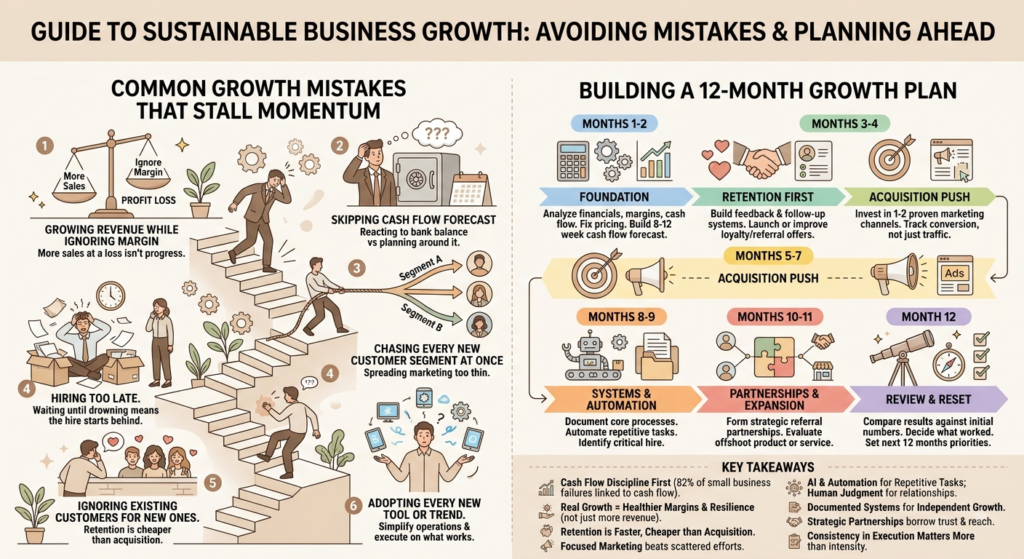
Some of the fastest ways to stall growth aren’t dramatic failures – they’re small, repeated decisions that compound over time.
- Growing revenue while ignoring margin. More sales at a loss is not progress.
- Skipping the cash flow forecast. Reacting to your bank balance instead of planning around it is how healthy businesses get blindsided.
- Chasing every new customer segment at once. Spreading marketing and product effort too thin usually means doing nothing particularly well.
- Hiring too late. Waiting until you’re drowning to bring on help means the hire starts behind, not ahead.
- Ignoring existing customers to chase new ones. Retention is almost always cheaper than acquisition, yet it’s the first thing neglected when things get busy.
- Adopting every new tool or trend. Small business growth in the years ahead will not come from chasing every shiny trend – it will come from simplifying operations and executing consistently on what’s proven to work.
Building a 12-Month Growth Plan
Strategy without a timeline stays theoretical. Here’s a simple structure for turning everything above into a plan you can actually execute.
Months 1–2: Foundation Get a clear read on your financials – margins, cash flow, and what it really costs you to win each new customer. Fix pricing if it’s outdated. Build or refine your 8-to-12-week cash flow forecast.
Months 3–4: Retention First Build simple follow-up and feedback systems for existing customers before spending heavily on new acquisition. Launch or improve a referral or loyalty offer.
Months 5–7: Acquisition Push With retention systems in place, invest in the one or two marketing channels your customers actually use. Track conversion, not just traffic.
Months 8–9: Systems and Automation Document your core processes. Automate the repetitive tasks that are eating your time. Identify where a hire would free up your highest-value hours.
Months 10–11: Partnerships and Expansion Approach two or three complementary businesses about referral partnerships. Evaluate one natural offshoot product or service.
Month 12: Review and Reset Revisit your numbers against where you started. Decide what worked, what didn’t, and what the next 12 months should prioritize.
This kind of structured pacing matters more than intensity. Small business growth strategies fail far more often from inconsistency than from being the wrong strategy in the first place.
Key Takeaways
- Cash flow discipline has to come before any growth push – 82 percent of small business failures involve cash flow problems as a contributing factor.
- Real growth means healthier margins and more resilience, not just more revenue.
- Retention is usually a faster, cheaper growth lever than new customer acquisition.
- A focused digital marketing and content strategy now outperforms scattered efforts across too many channels.
- AI and automation are worth adopting for repetitive tasks, but judgment, pricing, and customer relationships should stay human.
- Documented systems and processes are what let a business grow without depending entirely on the owner.
- Strategic partnerships let you borrow reach and trust you haven’t built yet, often at low cost.
- Consistency in execution matters more than picking the single “best” strategy.
Conclusion
Small business growth strategies don’t need to be complicated to work. They need to be applied consistently, in the right order – financial foundation first, then retention, then acquisition, then the systems and partnerships that let all of it scale without breaking you in the process.
The businesses that grow steadily in 2026 won’t be the ones with the biggest budgets or the flashiest campaigns. They’ll be the ones that know their numbers, take care of the customers they already have, and make deliberate, patient decisions instead of chasing every trend that comes along. That’s not a glamorous formula, but it’s the one that actually holds up over time.
Frequently Asked Questions
What is the single most important small business growth strategy to start with? Get your financial foundation right first – specifically cash flow forecasting and pricing. Every other strategy on this list works better, and is far less risky, once you have a clear, current picture of your numbers.
How much should a small business spend on marketing to grow? There’s no universal number, since it depends heavily on margins and industry. What matters more than the exact percentage is tracking what each channel actually returns, so spending shifts toward what’s proven to convert rather than staying spread thin across everything.
Is AI actually worth adopting for a small business? For repetitive tasks like scheduling, first drafts of content, and basic customer service replies, yes – adoption has become close to standard practice. Just keep a human reviewing anything customer-facing, since fully automated messaging tends to feel generic and can quietly erode trust.
How do I grow my business without taking on debt? Focus first on retention and margin improvements, both of which increase available cash without borrowing. Referral programs and partnerships are also low-cost acquisition channels. If financing does become necessary, build a relationship with a bank before you’re in a cash crunch – healthy businesses get approved far more often than desperate ones.
When is the right time to hire my first employee? Ideally, slightly before you feel ready – when you can see a role becoming necessary in the next few months rather than waiting until you’re already overwhelmed. A new hire who starts before the pressure peaks has time to ramp up properly.
What’s the biggest mistake small businesses make when trying to grow? Chasing new customers while neglecting the ones they already have. Retention is consistently cheaper and faster than acquisition, yet it’s usually the first thing to get deprioritized once a business gets busy.