

There is a moment almost every entrepreneur remembers. It usually happens late at night, staring at a to-do list that somehow grew longer despite a full day of work. You built this business to have more control over your life, yet your calendar controls you.
That feeling is not a personal failing. It is a structural problem. Most entrepreneurs are running their business with the same time habits they used as employees, except now there is no manager setting boundaries, no fixed office hours, and no one else to hand the overflow to.
This guide is built around one idea: time management for entrepreneurs is not about squeezing more tasks into a day. It is about building a system that protects your best hours for the work that actually grows your business, while everything else gets scheduled, delegated, or dropped.
We will walk through the mindset shift that changes everything, the specific techniques that hold up under real business pressure, how to delegate without losing control of quality, which tools are worth adopting in 2026, and how to avoid the burnout that quietly ends so many promising companies.
Why Time Management Feels Nearly Impossible for Entrepreneurs
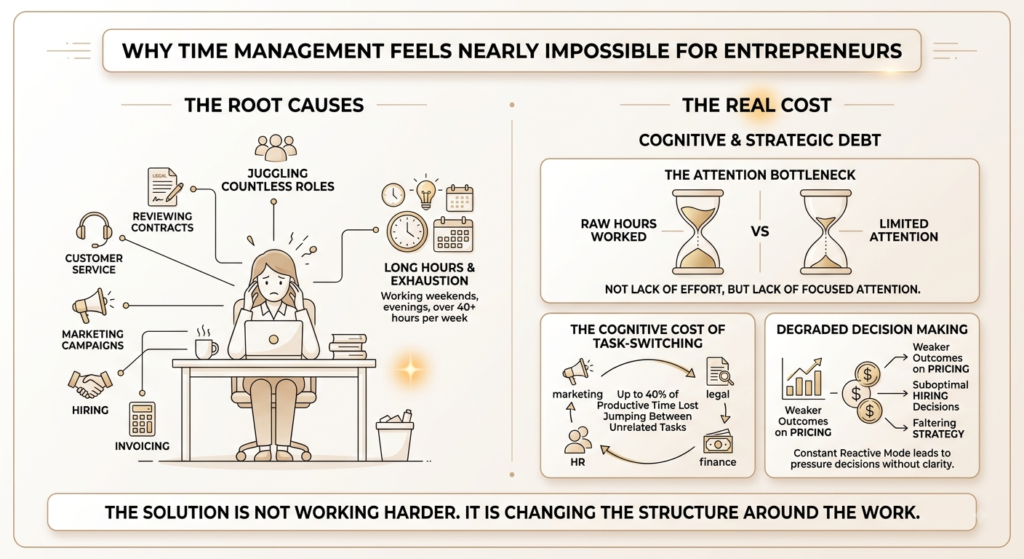
Before fixing the problem, it helps to understand why it exists in the first place. Entrepreneurship compresses roles that would normally belong to an entire department into one person’s schedule.
In a single week, a founder might need to review a contract, respond to a frustrated customer, approve a marketing campaign, interview a candidate, and fix a broken invoice, often within the same afternoon. Recent survey data shows that a large share of small business owners still work a full 40-hour week on top of the strategic thinking their role demands, and many put in evenings and weekends beyond that just to stay current.
The problem is not effort. Entrepreneurs are rarely lazy. The problem is that raw hours worked stopped being the bottleneck a long time ago. Attention did.
The Real Cost of Poor Time Management
Poor time management does not just cost hours. It costs decisions.
Research on prioritization habits found that a striking share of business owners feel they are constantly juggling more roles than they can properly manage, and a meaningful portion say this directly affects their company’s profitability. When founders operate in constant reactive mode, they make decisions under pressure instead of with clarity, which tends to produce weaker outcomes on pricing, hiring, and strategy.
There is also a well-documented cognitive cost to interruption itself. Studies on task switching, including work referenced by the American Psychological Association, suggest that jumping between unrelated tasks can consume up to 40 percent of a person’s otherwise productive time. For an entrepreneur juggling five roles in a day, that is not a minor tax. It is nearly half the workday disappearing into the gaps between tasks rather than the tasks themselves.
None of this means entrepreneurs need to work harder. It means the structure around the work needs to change.
The Mindset Shift: From Busy to Effective
Most founders start their time management journey by trying to fit more into each day. This almost always backfires, because a packed schedule with no protected space for thinking eventually collapses the first time something urgent happens, which in a business is every single day.
The shift that actually works is moving from a busy mindset to an effective one. Busy asks, “What can I fit in today?” Effective asks, “What actually moves the business forward, and what can wait, be delegated, or be removed entirely?”
This distinction matters because not all hours are equal. An hour spent on strategic planning, a difficult client negotiation, or product development is worth dramatically more to the business than an hour spent formatting an invoice or answering a routine email. Effective time management for entrepreneurs starts with recognizing this difference and building a schedule around it, rather than treating every task as equally urgent.
A simple gut check that many founders find useful: before adding a task to today’s list, ask whether this is something only you can do, or something that merely feels urgent because it landed in your inbox. Those are two very different categories, and confusing them is where most schedules go wrong.
Core Time Management for Entrepreneurs Strategies That Actually Work
There is no shortage of productivity advice online, and most of it is generic. The strategies below are the ones that hold up specifically under the chaos of running a business, where priorities shift daily and interruptions are constant.
Time Blocking and Day Theming
Time blocking means assigning specific blocks of your calendar to specific types of work, rather than working from an open-ended to-do list. Instead of “work on marketing sometime today,” it becomes “9:00 to 10:30, write and schedule this week’s content.”
Productivity researcher and author Cal Newport, known for popularizing structured time-block planning, argues that this approach can make people dramatically more efficient than working from a reactive list, because it removes the constant, exhausting decision of “what should I do next” and replaces it with a plan made in advance, when your mind is clearer.
A related technique, day theming, takes this a step further by dedicating entire days to a single type of role or work. For example, Mondays might be reserved for internal operations and team check-ins, Tuesdays and Wednesdays for client-facing work, and Thursdays for strategic planning and business development. This reduces the mental cost of constantly switching between very different types of thinking, which research on cognitive load consistently identifies as one of the most draining parts of a founder’s day.
You do not need to theme every day perfectly. Even reserving two or three theme days a week creates a noticeable difference in how much deep work actually gets finished.
The Power of Prioritization Frameworks
Once your calendar has structure, you need a way to decide what goes into each block. This is where prioritization frameworks matter.
The Eisenhower Matrix
The Eisenhower Matrix sorts tasks into four categories: urgent and important, important but not urgent, urgent but not important, and neither urgent nor important. Most entrepreneurs spend far too much time in the “urgent but not important” box, responding to messages and requests that feel pressing in the moment but do little for long-term growth.
The real value of this framework is not the diagram itself. It is the discipline of asking, before reacting to anything, which box does this actually belong in. Tasks in the important-but-not-urgent box, like strategic planning, relationship building, and skill development, are usually the ones that get pushed aside indefinitely unless they are deliberately scheduled.
The Most Important Task (MIT) Method
The MIT method simplifies decision-making by asking you to identify one to three tasks each morning that, if completed, would make the day a genuine success regardless of what else happens. These get done first, before email, before meetings, before anything reactive enters your day.
This method works well specifically for entrepreneurs because it protects against the common trap of spending an entire day “busy” without ever touching the work that truly matters. It also builds momentum. Finishing your most important task early removes the background anxiety that tends to follow founders through unfinished priorities all day.
Batching Similar Tasks
Task batching groups similar activities together so your brain stays in one mode instead of constantly resetting. Answering all emails in two dedicated windows rather than reacting to every notification, recording several pieces of content in one sitting, or reviewing all invoices in a single block are common examples.
Batching is especially useful for the administrative side of running a business. Founder survey data shows a meaningful share of business owners feel they spend too much time on administrative tasks that could realistically be handled in a fraction of the time if grouped together, rather than scattered throughout the week as interruptions.
Protecting Deep Work
Deep work refers to focused, uninterrupted effort on cognitively demanding tasks, the kind of work that actually differentiates a business, like product strategy, financial modeling, or creative direction. It is also the first thing to disappear from a founder’s schedule under pressure.
Recent workplace data shows the average employee is interrupted roughly every two minutes during a typical workday, and a majority of workers report they do not get enough uninterrupted focus time to do their best thinking. For entrepreneurs, whose highest-value work almost always requires sustained concentration, this is a direct threat to the quality of their decisions.
Protecting deep work does not require isolation. It requires boundaries: a specific block on the calendar, notifications off, and a clear rule with your team about what counts as an actual emergency versus something that can wait two hours.
Delegation: The Skill Most Founders Avoid
If time blocking and prioritization are about managing the hours you have, delegation is about creating more of them by removing work from your plate entirely. It is also, for most founders, the hardest skill on this list.
Signs You Need to Delegate
Many entrepreneurs delay delegation because they associate it with losing control or spending money they are not ready to spend. But the signs that delegation is overdue tend to be consistent: you are regularly the bottleneck on tasks that do not require your specific expertise, you are working evenings just to catch up on administrative work, or you notice that strategic priorities keep sliding because reactive tasks fill every available hour.
Founder research backs this up directly. Only a minority of small businesses with fewer than fifty employees currently outsource any function at all, even though outsourcing routine work has been shown to significantly reduce operating costs compared to hiring in-house for the same tasks. The gap between founders who delegate and founders who do not tends to widen over time, because the ones who delegate free up hours to work on growth, while the ones who don’t stay trapped in operations.
How to Delegate Without Losing Control
The fear behind most delegation hesitation is quality control, not the task itself. The solution is not to avoid delegating, but to delegate with a clear system.
Start with tasks that are well-defined and repeatable, rather than ones that require deep institutional judgment. Document the process once, even briefly, so it does not live only in your head. Set a clear checkpoint for review early on, then gradually loosen oversight as trust builds.
Virtual assistants have become a particularly common entry point for founders taking this step. Survey data from 2026 shows a majority of entrepreneurs have used a virtual assistant at least once to manage administrative work, with businesses reporting meaningful productivity gains and founders regularly reclaiming more than ten hours a week that previously went to tasks unrelated to their core skill set.
The math is straightforward. If an hour of your time is worth significantly more to the business when spent on strategy or sales than the cost of paying someone else to handle a routine task, delegation is not a luxury. It is the more profitable decision.
Using Technology and AI Tools Wisely
Technology has become one of the most talked-about levers in time management for entrepreneurs, and for good reason. Adoption has moved quickly. Recent workplace research indicates that a large majority of knowledge workers now use AI tools as part of their regular workflow, with a significant portion having started only within the last several months.
Best Categories of Tools for 2026
Rather than chasing every new app, it helps to think in categories based on where entrepreneurs consistently lose the most time.
Scheduling and calendar tools now use AI to automatically defend focus blocks, reschedule around conflicts, and book meetings without back-and-forth email threads. Project management platforms help teams track work without founders needing to manually check in on every task. Writing and research assistants can compress hours of drafting and summarizing into minutes, particularly useful for the content, proposals, and reports that eat into a founder’s week. Meeting assistants that automatically summarize calls and generate action items are also becoming standard, removing the need to manually write up notes after every conversation.
The founders getting the most value from these tools are not the ones using the most tools. They are the ones who identified their highest-volume, most repetitive workflow first, and matched a single tool to that specific problem before expanding further.
Avoiding Tool Overload
There is a real risk on the other side of this trend: tool overload. Adding a new app for every minor inconvenience creates its own kind of chaos, with founders now needing to manage the tools meant to save them time.
A useful rule is to introduce one new tool at a time, use it consistently for at least a few weeks, and only add another once the first is fully integrated into your routine. If a tool is not saving measurable time within a month, it is worth cutting rather than keeping out of habit.
It also helps to separate tools that save time from tools that simply move where the time gets spent. A project management platform that requires an hour of manual updates each day has not actually solved anything; it has just relocated the burden. Before adopting any new system, ask how much ongoing maintenance it will require, not just how impressive its feature list looks in a demo.
Automating the Repetitive, Not the Judgment-Based
A useful distinction for founders evaluating where technology fits into time management for entrepreneurs is separating repetitive tasks from judgment-based ones. Repetitive tasks, invoice reminders, appointment confirmations, routine data entry, and standard email replies, are well suited to automation because they follow the same pattern every time. Judgment-based tasks, like negotiating a partnership or making a hiring decision, still need a human, and no amount of AI tooling changes that.
The mistake many founders make is trying to automate everything at once, which usually creates a fragile system that breaks the first time an exception occurs. A better approach is to automate one repetitive workflow fully before moving to the next, so each piece is genuinely reliable rather than half-configured.
Building a Weekly and Daily Planning Routine
Individual techniques only work if they are held together by a consistent planning rhythm. Without this, even the best frameworks slowly get abandoned the first time a busy week hits.
The Weekly Planning Ritual
Set aside thirty minutes, ideally at the same time each week, to review the week ahead before it starts. This includes identifying your most important priorities, blocking time for deep work before your calendar fills with meetings, and spotting potential scheduling conflicts early.
This habit has measurable payoff. Research on weekly planning found that workers who consistently review priorities and pre-block focus time report a substantial increase in overall efficiency compared to those who start each week reactively, translating into several additional hours of genuinely productive output across the week.
Without this ritual, most founders default to starting Monday morning by reacting to whatever landed in their inbox over the weekend, which sets a reactive tone for the entire week ahead.
The Daily Shutdown Routine
A daily shutdown routine, a short end-of-day review where you close open loops, note what still needs attention, and set your top priority for tomorrow, prevents work from mentally following you into the evening. It also means you start the next day with clarity instead of spending the first thirty minutes rebuilding your plan from scratch.
This small habit does double duty. It protects your evenings, which matters for sustainability, and it means your most important task tomorrow is already decided before you even open your laptop.
Managing Energy, Not Just Time
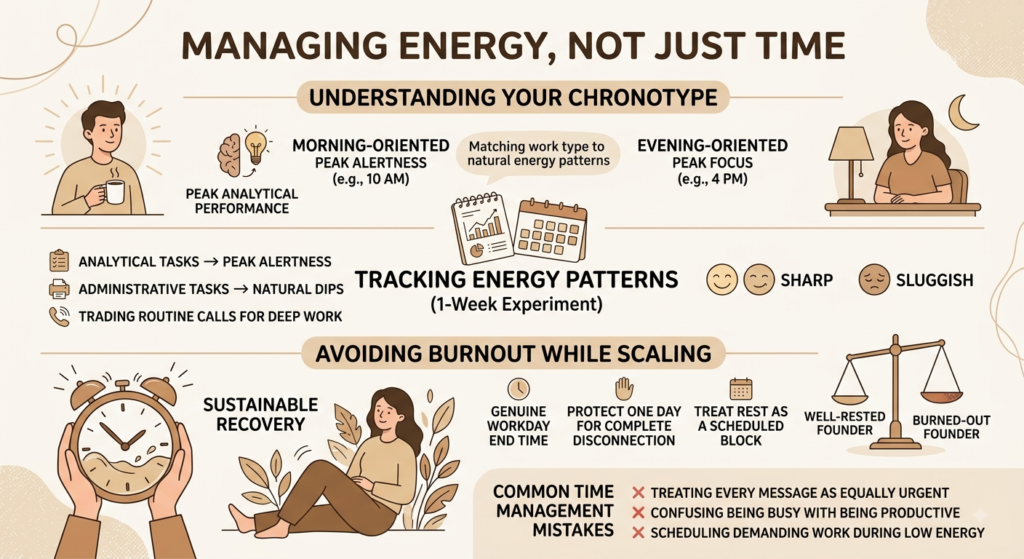
One of the most overlooked aspects of time management for entrepreneurs is that not all hours in a day carry the same mental capacity. Scheduling demanding work during your lowest-energy hours, simply because that slot happened to be free, is one of the most common reasons deep work sessions fail.
Understanding Your Chronotype
Chronotype refers to your natural tendency toward morning or evening alertness. Research on cognitive performance suggests that a meaningful portion of the population, often estimated at around 40 percent, are naturally evening-oriented, with peak analytical performance occurring later in the day rather than the traditional early morning window most business schedules assume.
This matters practically. If your sharpest thinking happens at 10 a.m., that is when your most demanding work, not your email inbox, should be scheduled. If your best focus arrives at 4 p.m., protect that block for deep work rather than filling it with routine calls simply because that is when everyone else schedules meetings.
Matching the type of work to your natural energy pattern, analytical tasks during peak alertness, administrative or low-stakes tasks during natural dips, tends to produce noticeably better output than treating every hour of the workday as interchangeable.
Tracking energy is simpler than it sounds. For one week, jot down a quick note every few hours on how sharp or sluggish you feel, without changing your schedule to match it yet. By the end of the week, a pattern usually emerges clearly enough to rebuild your calendar around it the following week. This small experiment often reveals that a founder has been scheduling their most demanding client calls or strategic thinking during their lowest point of the day simply out of habit, not necessity.
Avoiding Burnout While Scaling
Time management and burnout prevention are deeply connected, even though they are often treated as separate topics. A schedule that looks efficient on paper but leaves no room for recovery is not sustainable, and an exhausted founder makes worse decisions regardless of how well-organized their calendar looks.
Founder mental health research consistently points to extremely high rates of stress and burnout among business owners, driven largely by the sense that there is never enough time and never a true stopping point. This is compounded by the reality that many founders struggle to disconnect even during designated time off, checking messages out of habit rather than necessity.
Building recovery into your schedule is not indulgent. It is a time management decision like any other, because a burned-out founder is dramatically less effective per hour than a well-rested one, even if that well-rested founder works fewer total hours in a week.
Practical guardrails that help include setting a genuine end time for the workday most days of the week, protecting at least one full day for complete disconnection, and treating rest as a scheduled block rather than something that only happens if everything else gets done first, because in a growing business, everything else rarely does.
Common Time Management Mistakes Entrepreneurs Make
Even with the right frameworks, certain habits quietly undermine time management for entrepreneurs again and again.
Treating every message as equally urgent is one of the most common. Not every email or notification deserves an immediate response, and training yourself and your team to distinguish true urgency from perceived urgency protects far more time than any app or framework.
Confusing being busy with being productive is another. A full calendar is not the same as a calendar full of high-value work, and it is worth periodically auditing where your hours actually went versus where you intended them to go.
Refusing to delegate until forced to is a mistake that compounds over time, since every month spent doing tasks that could be delegated is a month of strategic work that did not happen instead.
Finally, skipping planning during busy weeks, precisely when it is needed most, tends to make those weeks worse rather than better, since it removes the very structure that would have made the chaos manageable.
Another quiet mistake is measuring the wrong thing entirely. Many founders track hours worked as a proxy for progress, when the more useful measure is whether the specific priorities set during weekly planning actually got completed. A founder who works fifty hours but finishes none of their most important tasks is worse off than one who works thirty-five and clears all three. Shifting the internal scorecard from hours logged to priorities completed changes how the whole week gets approached, because it removes the false comfort of simply staying busy.
It is also worth naming a mistake that runs in the opposite direction: over-engineering the system itself. Some founders spend more time designing elaborate productivity systems, color-coded calendars, nested task hierarchies, multiple overlapping apps, than they spend actually doing the work those systems were meant to support. The goal of time management for entrepreneurs is never the system for its own sake. It is protected time for the decisions and work that only you can do. If a framework starts to feel like its own project, it is time to simplify, not add another layer.
Key Takeaways
- Time management for entrepreneurs works best as a system, not a single technique, combining time blocking, prioritization, delegation, and energy management together.
- Time blocking and day theming reduce the mental cost of constant task switching, which research suggests can consume up to 40 percent of otherwise productive time.
- Prioritization frameworks like the Eisenhower Matrix and the Most Important Task method help separate genuinely important work from tasks that only feel urgent.
- Delegation is a profitable business decision, not a loss of control, when paired with clear documentation and gradual trust-building.
- AI and productivity tools can save real time in 2026, but only when adopted deliberately, one workflow at a time, rather than in bulk.
- A consistent weekly planning ritual and daily shutdown routine protect the structure that individual techniques depend on.
- Matching demanding work to your natural energy pattern, rather than an arbitrary schedule, improves output without adding hours.
- Recovery and boundaries are part of time management, not separate from it, and are essential to avoiding burnout while scaling.
Conclusion
Time management for entrepreneurs will never mean having unlimited hours or a perfectly calm schedule. Businesses are unpredictable by nature, and no system removes that entirely.
What a good system does is give you back control over the hours that matter most. It means your best thinking happens on the work that actually grows your business, not on whatever happened to land in your inbox first. It means delegation becomes a tool for growth instead of a threat to quality. And it means the version of you running this business a year from now is not more exhausted than the version running it today, but more capable, because the structure around your time finally matches the ambition of what you are building.
Start small. Pick one technique from this guide, whether that is a single weekly planning ritual or your first delegated task, and build from there. The system compounds. So does the relief of finally feeling like your calendar works for you, not against you.
Frequently Asked Questions
What is the biggest time management mistake entrepreneurs make? Treating every task and message as equally urgent, which keeps founders in constant reactive mode instead of protecting time for the strategic work that actually grows the business.
How much time should entrepreneurs spend planning each week? Roughly thirty minutes at the start of each week is usually enough to identify priorities, block time for deep work, and spot scheduling conflicts before they cause problems.
Is time blocking better than a traditional to-do list? For most entrepreneurs, yes, because a to-do list requires constant re-prioritization throughout the day, while time blocking makes those decisions in advance and protects specific hours for specific work.
When should a founder start delegating tasks? As soon as a task is repeatable, well-defined, and does not require the founder’s unique expertise, since the cost of delegating is usually lower than the value of the founder’s time spent elsewhere.
Do AI tools actually save entrepreneurs time? Yes, particularly for scheduling, meeting summaries, research, and content drafting, but only when adopted deliberately for a specific workflow rather than added indiscriminately.
How can entrepreneurs avoid burnout while managing a demanding schedule? By treating rest and recovery as scheduled, non-negotiable parts of the calendar rather than something left over after everything else is done, and by setting genuine boundaries around when the workday ends.